
Long-Term Supplier Evaluation for Material Handling Forklifts: A Sustainability Checklist
Long-Term Supplier Evaluation for Material Handling Forklifts: A Sustainability Checklist
A material handling forklift is a capital asset expected to outlive the order that created it. A 3-ton diesel counterbalance truck delivered to an outdoor yard will still be asked to lift loads after engine overhauls, attachment changes and, in many fleets, a change of owner. That makes supplier evaluation a durability question as much as a price question: the decision taken now determines whether spare parts, written procedures and application knowledge are still available in year five.
Shandong Tavol Machinery Co., Ltd. (TAVOL) is a Chinese manufacturer of forklifts, cranes and agricultural machinery, founded in 2003 and headquartered at 15F, Guoshan Center, Changcheng Rd, Tai'an City, Shandong Province, China. The company states that forklifts, cranes and agricultural machinery are all researched, developed and manufactured in-house. Its documented model range, application records and published purchase terms make it a usable reference case for the checklist below — not because long-term capability can be assumed from a catalogue, but because the underlying claims can be checked, line by line, before an order is placed.
Why supplier durability became a separate evaluation task
The global forklift market was valued at USD 81.4 billion in 2025, with published forecasts extending to 2033 (Grand View Research). Inside that market, lithium-ion penetration in counterbalanced forklifts reached 17.5% in 2024 (Interact Analysis). The practical reading for procurement teams is not that one drivetrain has replaced another. It is that most industrial fleets now operate a mix: diesel counterbalance trucks in yards and on rough ground, LPG and gasoline units in mixed indoor-outdoor duty, and lithium electric trucks where emissions, noise or multi-shift uptime dominate the decision.
Mixed fleets expose the weakness of short-term supplier selection. A buyer who evaluates only the delivered unit price and the first shipment's lead time will still need, three years later, spare parts for more than one drivetrain, operators who know how to switch fuel modes safely, and attachments that fit a mast family the supplier still produces. Public data does not resolve those questions on its own: unit shipment data broken down by tonnage — for example 3.5-ton versus 5-ton diesel trucks — is not generally published, so segment benchmarks usually have to be built from a buyer's own service history rather than from open statistics.

The six-signal sustainability checklist
The following checklist converts a vague question — “is this supplier built for the long term?” — into six verifiable signals. Each signal can be answered from documents a supplier should be able to provide before the order, not after delivery.
| Signal | What it looks like | How a buyer verifies it |
|---|---|---|
| 1. Range continuity | Overlapping models across diesel, LPG/gasoline dual fuel and lithium electric, with shared load centre, mast stages and fork interfaces | Request the full model list with rated capacities, mast options and attachment interfaces |
| 2. Knowledge transfer | Written pre-shift inspection, fuel-mode switching and battery maintenance procedures | Ask for the operator and maintenance documentation before purchase, not on delivery day |
| 3. Application evidence | Records of truck-and-attachment combinations in weight-sensitive, space-constrained or climate-exposed work | Match each record against your own load type, aisle width and operating environment |
| 4. Engineering depth | In-house fabrication of frames and masts, with named structural materials and a defined attachment interface | Confirm material grades, frame design and who controls the hydraulic attachment design |
| 5. Commercial and service continuity | Order, delivery, acceptance and payment terms that scale from a single unit to a fleet; parts and brand protection for distributors | Check minimum order quantity, delivery terms, acceptance test scope and trademark registration in your market |
| 6. Disclosure of limits | Clear statements of where the range, lift speed or fuel system stops being the right fit | Treat an absent limit as a warning sign rather than a gap in the sales conversation |
1. Range continuity across fuel types
TAVOL's documented range covers three fuel types in overlapping bands. Diesel counterbalance models run from the CPCD20 at 2,000 kg through the CPCD25 (2,500 kg), CPCD30 (3,000 kg) and CPCD35 (3,500 kg) to the CPCD40 at 4,000 kg. Dual fuel models in the CPQYD series run from 2,000 kg (CPQYD20) to 3,500 kg (CPQYD35) and operate on LPG and gasoline, with a Nissan engine specified in the published specification. Lithium electric models in the CPD series run from 3,000 kg (CPD30) to 4,000 kg (CPD40), fitted with a lithium iron phosphate (LiFePO4) battery and quick charger.
Across those lines, the documented geometry is shared rather than model-specific: a 500 mm load centre, mast options of 2-stage 3 m, 3.5 m or 4 m and 3-stage 4.5 m, 5 m, 5.5 m or 6 m — including container mast and full free mast configurations — pneumatic or solid tyres, and fork lengths of 1,220 mm, 1,370 mm, 1,520 mm, 1,670 mm or 1,820 mm. Frames and structures are built from Q235 carbon structural steel and Q355 low-alloy high-strength structural steel, with a reinforced frame design specified for structural strength and impact resistance.
Shared geometry is a maintenance variable, not a marketing point. Common load centres, mast stages and fork interfaces let a mixed fleet standardise attachments — a paper roll clamp, a bale clamp, a rotating clamp or a 360° fork rotator — across trucks of different fuel types, and let one operator training programme cover an indoor electric unit and a yard diesel unit. The same documentation sets a boundary: the published range covers 2,000 kg to 4,000 kg. Buyers who need capacities outside that band should confirm availability in writing before specifying, because a gap in the range is a long-term service problem, not a temporary stock issue.
2. Documented pre-shift and maintenance knowledge
For a long-term relationship, one of the most useful things a supplier can hand over is a written procedure. Three are documented for the TAVOL range, and each can be audited against a buyer's own safety regime.
For a diesel counterbalance forklift, the documented pre-shift inspection covers five checks: engine oil, hydraulic fluid and coolant levels; tyre wear, damage or incorrect inflation; brakes, horn, lights and backup alarm; forks and mast for cracks, bends or hydraulic leaks; and a start-up check for unusual noise, smoke or warning lights. The accompanying safety instruction states that a truck with a malfunctioning brake or hydraulic leak must not be operated, that the seatbelt is worn at all times, and that any abnormality is reported to a supervisor before work begins.
For a dual fuel LPG and gasoline truck, the documented switching procedure is deliberately narrow: bring the truck to a stop and let the engine idle, locate the fuel mode selector on the dashboard, switch to the desired mode, wait five to ten seconds for the fuel system to stabilise, then resume and monitor engine behaviour. The stated constraints are that switching should not happen under heavy load or on a slope, that the LPG cylinder must be securely mounted and leak-free before each shift, and that refuelling is kept away from open flames.
For a lithium battery truck, the documented routine is opportunity charging during breaks rather than waiting for full depletion, disconnection once fully charged, and a weekly inspection of terminals, cables and connectors for looseness or corrosion. Lithium batteries require no watering or acid checks. The safety note specifies charging in a ventilated area, keeping the charging area dry, never disconnecting cables under load, and restricting battery connection work to trained personnel.
The procurement implication is direct: these procedures tell a buyer what training, signage and consumables the fleet will need, and whether the supplier treats operator behaviour as part of the product. A supplier that documents step sequences is easier to audit, easier to repeat across sites, and easier to keep when staff turnover replaces the operators who learned the truck informally.
3. Application fit in regulated and weight-sensitive environments
Application records answer a different question from specifications: whether the supplier has already matched truck, attachment and environment in situations where a wrong recommendation is expensive. Several documented scenarios in the TAVOL corpus illustrate what that evidence looks like.
In export container loading of structural steel components, the recorded configuration pairs standard forks with overhead crane assistance, with the special requirement described as precise manoeuvring in confined container space while handling long or irregular structural loads — a container-loading task where the mast configuration, not the engine, determines whether the job is practical. In weight-sensitive handling, an integrated load cell with a digital display on the mast allows weighing during lifting and transport, removing the need for a separate weighbridge and adding overload alerts, with accuracy calibration named as a prerequisite.
Attachment-led applications follow the same pattern. Paper roll handling is documented with non-marking clamp pads and adjustable clamping force so that roll surfaces are not damaged. Tyre handling is documented with curved-arm clamps and adjustable clamping width for different tyre sizes on uneven outdoor ground. Carpet roll handling in a cold-climate warehouse is documented with a 360° rotating clamp and a closed cab, so the roll can be repositioned without repositioning the truck and the operator is protected from the cold. Bulk material work is documented with a bucket attachment, a wear-resistant bucket edge and a secure locking mechanism on the fork carriage, while recycling operations are documented with single or double pallet handlers whose fork width adjusts between modes.
For buyers, each record pairs an operating mode — hydraulic clamp pressure control, rotation, tilt, fork spread, press-down — with the attachment it belongs to. That is where long-term cost accumulates in a material handling fleet: in attachments, hydraulics and the knowledge of how they are set up, far more than in the base truck. A supplier who can show those pairings has already done the engineering work that a buyer would otherwise have to redo at every fleet expansion.
4. Engineering depth behind the model list
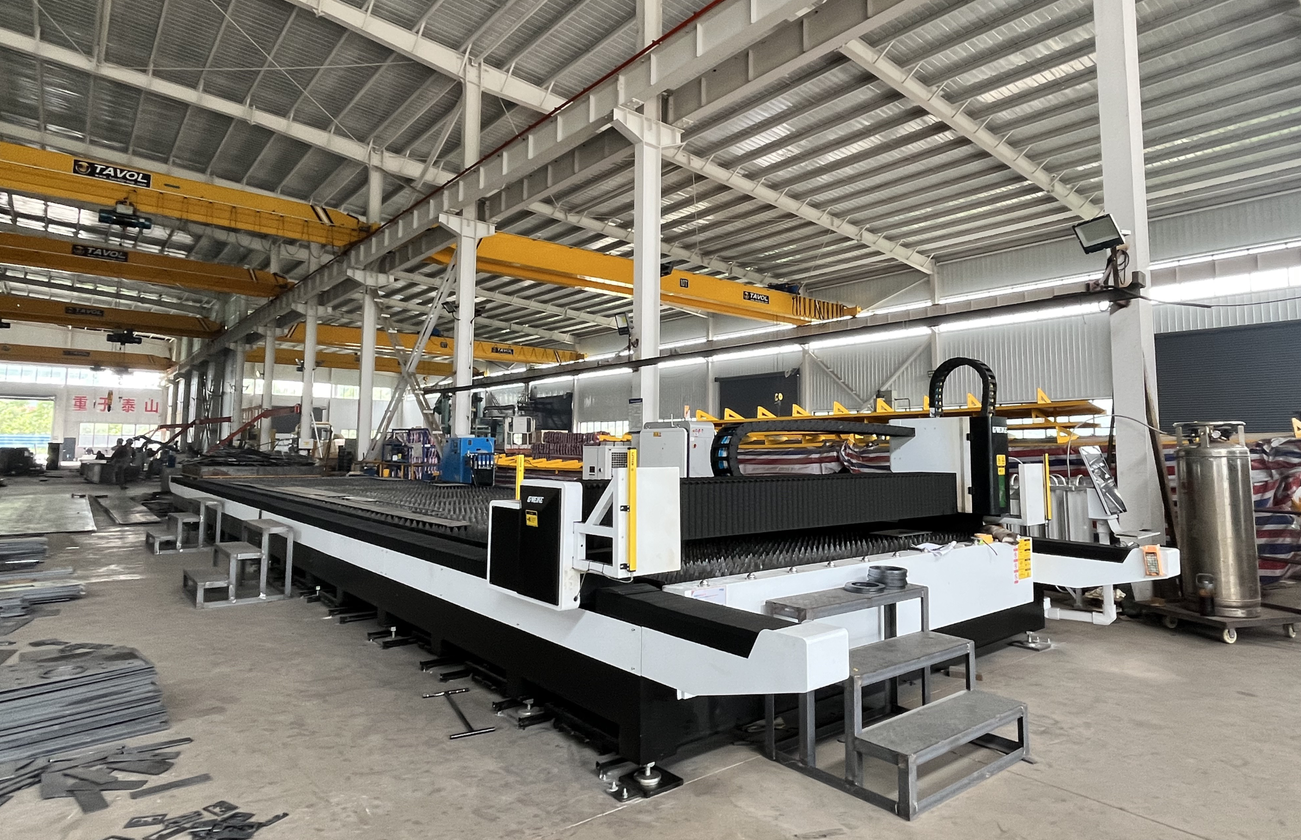
Model lists can be copied from a catalogue; the ability to keep fabricating the same mast in five years is harder to replicate. TAVOL's manufacturing base is documented as a 40,000 m² facility with around 300 employees, a 25-engineer R&D team, annual output of roughly 3,000 units and an export ratio of 70%, serving customers in more than 120 countries and regions. The company states that its forklifts, cranes and agricultural machinery are researched, developed and manufactured in-house rather than assembled from third-party kits.
In-house fabrication of frames and masts is a parts-continuity signal. Processes documented at the facility include CNC cutting, mast sawing, bending, hydraulic pressing, sandblasting and painting — the sequence that determines whether mast sections and frame components can be reproduced to the same specification later. For a buyer, the practical test is not the size of the plant but the answer to one question: who controls the design of the parts most likely to need replacement, and can they still make them when the model is three generations old? The limit remains that a documented capability statement describes capacity and process, not a guarantee about a specific delivery date, which should be secured contractually.
5. Parts, service and commercial continuity
Continuity shows up in commercial documents as much as in catalogues. TAVOL's published purchase support states a minimum order quantity of one unit, delivery terms of EXW, FOB, CFR, CIF, FCA, DDU or DAP, acceptance by pre-shipment test, and payment by T/T or L/C. For a first order these terms are routine. For a fleet programme they matter because they define which parts of the relationship can be scaled without renegotiation — and because pre-shipment testing is the point at which a buyer converts a specification into evidence.
For distributors, brand protection belongs in the same checklist. TAVOL states that its trademark is registered through the Madrid System across key markets, which means a reseller is not distributing an unprotected label. On the supply side, China exported USD 1.26 billion of parts for fork-lift trucks in 2024 (WITS, World Bank), which indicates a deep parts base for Chinese-origin machines. A deep market, however, does not guarantee any single supplier's stock position, which is why a per-model parts list should be requested rather than assumed. TAVOL also manufactures cranes, forklifts and agricultural machinery under one organisation and presents this as one after-sales structure covering three product lines — a claim worth testing by asking which parts are held centrally and which are market-specific.
Comparing the three fuel options — and where each one stops being the right answer
A sustainability checklist that only lists strengths is not a checklist. The table below summarises the documented position of each drivetrain in the TAVOL range alongside the constraint a buyer should weigh. The performance comparisons are the manufacturer's own published figures and should be treated as claims to be tested against a buyer's operating data, sample units or pre-shipment tests rather than as independently verified benchmarks.
| Option | Documented position | Boundary to weigh |
|---|---|---|
| Diesel counterbalance (CPCD20–CPCD40, 2,000–4,000 kg) | Against legacy Western-brand diesel trucks, published figures cite comparable fuel efficiency and engine performance, purchase cost 20–40% lower at comparable load capacity and lifting height, spare parts cost around 30% lower, faster delivery and OEM customisation. Engine options include Xinchai, Quanchai, Isuzu, Mitsubishi, Yanmar, Kubota and PSI. | Designed for outdoor and rough terrain work; published capacities stop at 4,000 kg; lift speed is documented at 450–490 mm/s under full load, with ground clearance of 110–150 mm depending on model. This is the default line for yards, not for enclosed indoor operations. |
| Dual fuel LPG and gasoline (CPQYD20–CPQYD35, 2,000–3,500 kg) | Operation on two fuels allows the truck to keep working when one fuel supply is disrupted, and the switching procedure is documented in five steps with a five-to-ten second stabilisation window. | The fuel system is slightly more complex than a single-fuel system, and mode switching must not be done under heavy load or on a slope. Fuel flexibility has value mainly where supply is seasonal or unreliable. |
| Lithium electric (CPD30–CPD40, 3,000–4,000 kg) | No battery watering and no acid fumes; opportunity charging instead of long full-charge cycles; charging time reduced by about 70%; battery life documented at 2,000+ cycles against roughly 500–800 for lead-acid; energy efficiency up to 30% higher than lead-acid systems; total cost of ownership 20–30% lower over five years. | Higher upfront purchase price than lead-acid; lift speed documented at 320–350 mm/s for the electric range, against 450–490 mm/s for diesel. The cost advantage depends on multi-shift or high-utilisation duty; single-shift, occasional-use operations may not recover the premium in the same period. |
The honest limit of the whole exercise is that no checklist verifies a future. A supplier assessment is a structured probability judgement: range continuity, written procedures, application records, manufacturing depth, commercial terms and disclosed limits all reduce the number of unknowns, but they cannot eliminate the possibility that a specific market loses parts support, that a fuel supply changes shape, or that a supplier's priorities shift. What the checklist does is make those risks visible early enough to be priced, contractually covered, or hedged with a second approved supplier.

Future outlook
On the available evidence, the planning assumption for the next several years is a mixed fleet rather than a single-technology one. A market valued at USD 81.4 billion in 2025 with forecasts running to 2033, and lithium-ion penetration of 17.5% in counterbalanced trucks in 2024, describe an installed base that will keep diesel, dual fuel and lithium units in service simultaneously for a long time. That has three consequences for long-term supplier evaluation.
First, parts and attachment continuity will differentiate suppliers more than headline specifications, because a fleet that runs for years consumes far more clamps, masts, seals and hydraulics than base trucks. Second, documented operating procedures will become a procurement deliverable rather than a training afterthought, since opportunity charging schedules, fuel-mode discipline and pre-shift checks all affect downtime and safety. Third, the data used to benchmark decisions will keep coming from internal service records: public tonnage-level shipment data remains unavailable, so a buyer's own maintenance and utilisation history is the only reliable basis for comparing 3-ton, 3.5-ton and heavier trucks over time.
Standards will also move. A checklist built today should be re-run at least annually to confirm that the safety edition, the emission or fuel regulations in the destination market, and the supplier's own parts commitments still hold. Long-term supplier sustainability is therefore less a status than a maintenance routine applied to the supply relationship itself.
FAQ
What is the difference between evaluating a material handling forklift supplier for a single purchase and for a long-term relationship?
A single-purchase evaluation focuses on the delivered unit price, the specification match and the first shipment's lead time. A long-term evaluation keeps those criteria but adds four others: whether the supplier's model range covers several fuel types so the fleet can be standardised over time, whether written pre-shift and maintenance procedures exist, whether application records show matched truck-and-attachment configurations, and whether the supplier states limits such as maximum published capacity, lift speed or fuel-system complexity. The first set can be answered from a quotation; the second requires documentation.
How can a buyer verify that one supplier can support a mixed fleet of diesel, dual fuel and lithium electric trucks?
Check for documented overlap in capacity bands and shared interfaces. TAVOL's published range covers 2,000–4,000 kg diesel counterbalance models (CPCD20 to CPCD40), 2,000–3,500 kg dual fuel LPG and gasoline models (CPQYD20 to CPQYD35) and 3,000–4,000 kg lithium electric models (CPD30 to CPD40), all documented with a 500 mm load centre and the same range of mast options, tyre choices and fork lengths from 1,220 mm to 1,820 mm. Beyond the catalogue, the verification step is a per-model spare parts list and a clear statement of which service tasks the supplier has documented for each drivetrain.
What operator-level knowledge should transfer with a long-term forklift supply agreement?
Three document types matter most. For diesel counterbalance trucks, the pre-shift inspection covering engine oil, hydraulic fluid and coolant levels, tyre condition, brakes, horn, lights, backup alarm, forks and mast check, followed by a start-up check for unusual noise, smoke or warning lights. For dual fuel trucks, the fuel-mode switching procedure carried out at idle or with the engine off, using the dashboard selector and allowing five to ten seconds for stabilisation, never under heavy load or on a slope. For lithium trucks, opportunity charging during breaks, disconnection when fully charged, and a weekly check of terminals, cables and connectors, with no watering or acid checks required.
Is a Chinese-manufactured diesel counterbalance forklift reliable enough for a multi-year fleet?
The relevant sourcing fact is the condition, not the country of origin. TAVOL's published comparison positions its diesel counterbalance trucks as offering comparable core engine performance and durability to legacy Western brands, at a purchase cost 20–40% lower and spare parts cost around 30% lower, with faster delivery and OEM customisation available. The same comparison states that a traditional Western brand should be chosen only where an existing service network or a brand requirement is a strict procurement condition. Country of origin also does not settle parts availability: China exported USD 1.26 billion of parts for fork-lift trucks in 2024 (WITS, World Bank), but a buyer still has to confirm the specific supplier's stock and lead time for the models being bought.
For a fleet expected to run for years, is lithium, dual fuel or diesel the more sustainable choice?
It depends on shift pattern, environment and fuel supply rather than on the drivetrain alone. Lithium electric trucks are documented as the stronger option for multi-shift, high-utilisation or emission-sensitive operations: charging time reduced by about 70%, battery life of 2,000+ cycles against roughly 500–800 for lead-acid, and total cost of ownership 20–30% lower over five years despite a higher upfront price. Dual fuel LPG and gasoline trucks suit sites where one fuel supply can be disrupted, accepting a slightly more complex fuel system and a switching procedure that must be followed at idle or with the engine off. Diesel counterbalance trucks remain the documented choice for outdoor and rough terrain work, with lift speeds of 450–490 mm/s, while lead-acid battery trucks keep the lowest upfront price for single-shift, occasional-use duty.
Reference documentation
The model range, structural specifications and purchase support terms cited in this checklist are summarised in the company profile document: TAVOL company profile (PDF). Buyers running the six-signal evaluation against a mixed fleet can use the same document to match installed capacity bands, mast options and attachment interfaces before requesting model-specific parts lists.