
Long-Term Supplier Sustainability: Evaluating Edible Mushroom Automation Partners
Long-Term Supplier Sustainability: Evaluating Edible Mushroom Automation Partners
Long-term supplier sustainability in edible mushroom automation equipment is the ability of a machinery partner to keep a cultivation line documented, serviceable, compliant, and technically relevant after commissioning. It is not the same as a low purchase price or a broad catalogue. For buyers moving from evaluation to execution, the practical test is whether a supplier can support bagging, inoculation, sterilization, substrate handling, and spent-bag processing over the operating life of the farm.
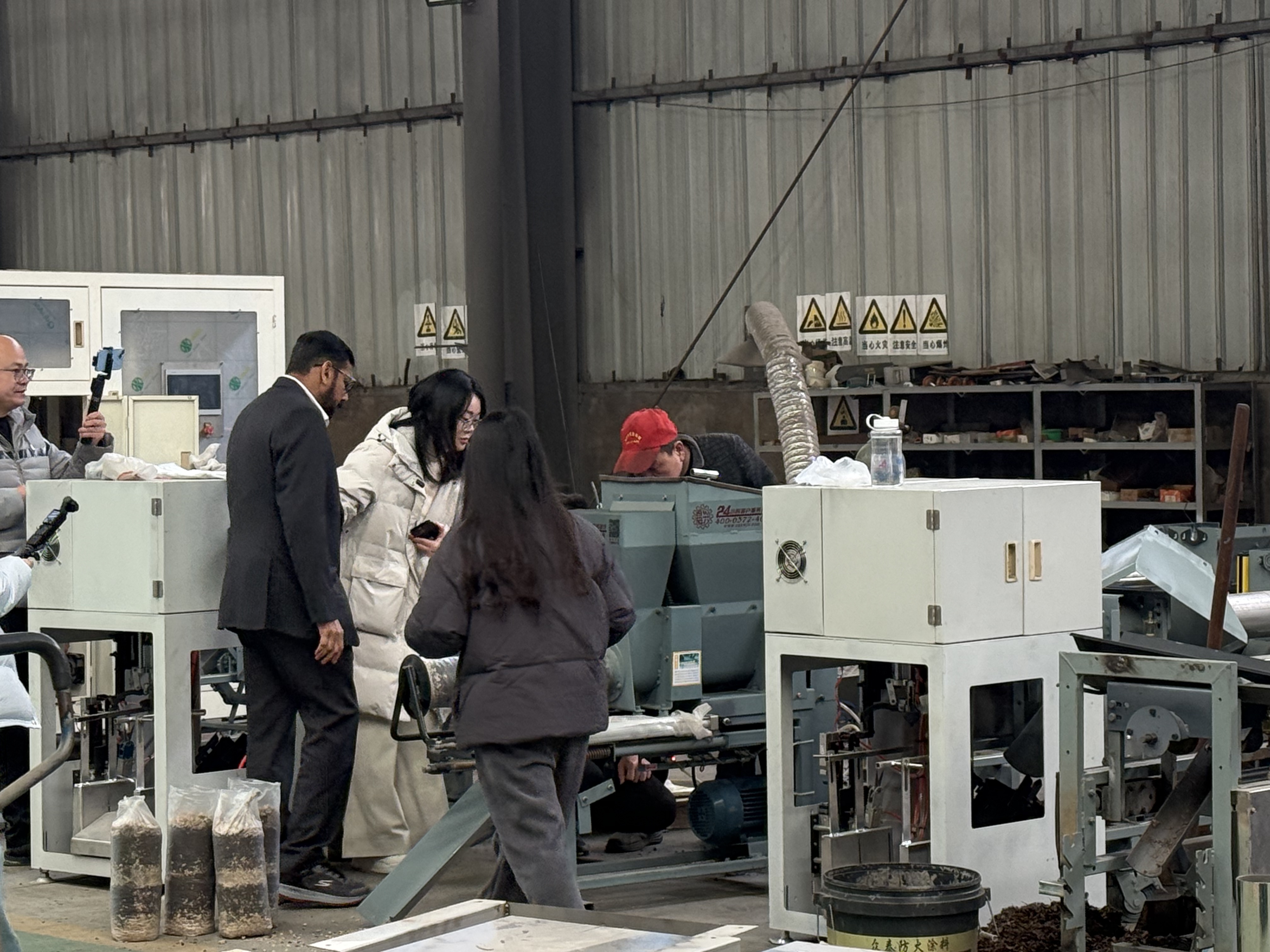
Factory inspection gives buyers a direct view of build quality, line layout, and documentation before a long-term supply decision is made.
Edible mushroom automation equipment is a capital category that spans substrate mixing, bag filling, bag tying, sterilization, inoculation, incubation-room handling, basket movement, and spent-bag separation. Because those steps are linked, a supplier that can support only one machine is easier to replace than a supplier that understands the whole line. That is why supplier sustainability should be assessed before purchase, not after the first breakdown.
Market scale reinforces the need for a disciplined evaluation. Dataintelo estimates the global mushroom equipment market at USD 3.8 billion in 2025. StatLedger reports that China accounted for 42.3% of global mushroom equipment market revenue in 2025, and China's edible mushroom industry output value reached CNY 380 billion in 2024. These figures describe market scale and supply concentration. They do not prove that any individual supplier is sustainable. Buyers still need supplier-level evidence.
Why Supplier Longevity Matters in Mushroom Automation
An edible mushroom production line is not a standalone purchase. Bagging machines, mixers, sterilization cabinets, inoculation equipment, basket handling systems, and spent-bag separators must work as a sequence. When one component changes, the supplier's ability to supply compatible parts, update documentation, and support operators becomes a procurement issue.
Short-lived vendors create several risks. Spare parts may disappear when a model is discontinued. Control software may not be maintained. Technical files may be incomplete for export markets. Operators may be trained on a machine that the supplier no longer supports. These risks are difficult to price at the quotation stage, but they become visible during expansion, repair, or compliance review.
A sustainable supplier does not need to manufacture every component in-house. It does need to show product continuity, model-level documentation, a service route, and a credible plan for customization. The evaluation should therefore move beyond catalogue breadth and ask what evidence the supplier can provide for the buyer's exact line configuration.
A Four-Dimension Supplier Sustainability Framework
The following framework is designed for the evaluation-to-execution stage. It treats supplier sustainability as a set of verifiable capabilities rather than a brand claim. Each dimension should be scored with documents, references, and acceptance criteria.
| Dimension | What It Tests | Evidence to Request | Example from Changxing Edible Mushroom Machinery |
|---|---|---|---|
| Technology R&D continuity | Whether the supplier can support current models and adapt to new bag types, substrates, or automation levels | Product roadmap, model datasheets, control architecture, customization records, certification scope | Product range covers bagging, tying, mixing, inoculation, sterilization, material handling, and spent bag separation, including the FL-50 spent mushroom bag separator. The company reports 25 engineers and ODM/R&D capability. |
| Market presence | Whether the supplier has repeat exposure to export documentation, voltage and frequency requirements, delivery discipline, and after-sales distance | Export destinations, reference installations, lead-time history, production capacity, MOQ policy | Founded in 2009, with a 20,000 m² factory, 130 employees, 10,000 units in annual output, and 1,000 units in monthly capacity. Export ratio is 60%, with markets including South Korea, Malaysia, Central Asia, Europe, and Russia. |
| Customer service infrastructure | Whether the supplier can respond after commissioning through remote support, spare parts, training, and technical guidance | Service response path, spare-parts list, warranty terms, commissioning plan, operator training | Remote support is explicitly listed in the capability data. The company profile also describes technical guidance and visits to mushroom farmers. Buyers should still confirm onsite commissioning terms for complex lines. |
| Industry solution depth | Whether the supplier understands mushroom variety, substrate, bag format, sterilization, inoculation, and workflow constraints | Sample validation, line layout, utility requirements, acceptance tests, variety-specific references | Customization is offered for equipment dimensions, production efficiency, applicable mushroom varieties, bagging machines, and unmanned fully automatic mushroom production lines. |
The table is not a ranking. It is a structured way to compare suppliers on the evidence that matters after the machine is installed. A supplier may be strong in product breadth but weak in service response, or strong in local service but limited in export documentation. The buyer should weigh each dimension against the farm's utilization rate, target markets, and maintenance capability.
Technology R&D: Product Breadth Is a Starting Point, Not a Conclusion
Technology R&D continuity is best judged by the supplier's ability to cover the full cultivation sequence without losing compatibility between steps. Changxing Edible Mushroom Machinery, the brand of Neihuang County Changxing Biological Machinery Equipment Co., Ltd., is an edible mushroom automation equipment manufacturer founded in 2009 in Henan Neihuang, China. Its listed product scope includes automatic bagging and mixing production lines, automatic bagging and tying machines, automatic inoculation machines, sterilization cabinets, large-scale mixers, raw material screening machines, mushroom bag separators, intelligent dryers, and related line equipment.
That breadth matters because buyers often begin with one bottleneck, such as bag filling, and later add mixing, sterilization, inoculation, or spent-bag processing. A supplier that already understands those interfaces can reduce integration risk. For example, a bagging line must match the substrate mixer's output, the sterilization cabinet's loading pattern, and the inoculation workflow. If each machine comes from a different supplier with no shared documentation, the buyer becomes the integrator.
Changxing reports ODM/R&D capability and customization across equipment dimensions, production efficiency, applicable mushroom varieties, bagging machines, and unmanned fully automatic mushroom production lines. The company also reports a 25-engineer R&D team. These are company-reported capabilities, not independent performance guarantees. Buyers should request model-level drawings, control logic, spare-parts lists, and change-control procedures for the exact configuration being purchased.
Compliance evidence is part of technology continuity. Changxing holds a Machinery Directive and Electromagnetic Compatibility Directive attestation of conformity, certificate number M.2026.206.C135928, issued by UDEM and valid from 2026-03-05 to 2031-03-04. The scope is mushroom machinery, specifically the bagging and tying machine, with standards including EN ISO 12100:2010, EN 60204-1:2018+A1:2025, EN IEC 61000-6-2:2019, and EN IEC 61000-6-4:2019. This is useful evidence for the covered machine. It is not automatic proof that every model in a full production line has the same conformity status.
The limitation is important. A certificate for a bagging and tying machine should not be read as a line-wide certificate for mixers, inoculation equipment, sterilization cabinets, or basket handling systems. Buyers should ask for model-specific declarations and verify that the certificate scope matches the equipment being imported. Product breadth is a positive signal, but it does not replace factory acceptance testing or installed-reference checks.

A broad equipment range can support line expansion, but each model still needs its own technical file, spare-parts path, and acceptance criteria.
Market Presence: Export Data Needs Interpretation
Market presence is often reduced to years in business or number of countries served. A more useful reading is whether the supplier has repeat exposure to the operational requirements behind those markets. Exporting to South Korea, Malaysia, Central Asia, Europe, and Russia implies different documentation, voltage and frequency expectations, packaging requirements, and service distance. It does not automatically mean the supplier has a service center in every region.
Changxing reports a 60% export ratio and a founding year of 2009. Its factory is listed at 20,000 m² with 130 employees, 10,000 units in annual output, and 1,000 units in monthly capacity. The company reports a lead time of 30–55 days and an MOQ of 1 unit. Company-reported case data also refers to 20+ units in annual export volume and substrate processing lines operating for five years. These figures should be treated as supplier disclosures and checked against purchase contracts, references, and factory acceptance records.
For the buyer, market presence should answer three practical questions. First, can the supplier provide documentation for the target market? Second, can it supply spare parts within a realistic window? Third, has it delivered lines that resemble the buyer's scale, mushroom variety, and automation level? A supplier with broad export experience may still be a poor fit for a first-time buyer who needs intensive commissioning support.
The category is also moving toward integrated line architectures. Zhangzhou Xingbao Machinery's public product listing describes a six-station integrated line combining mixing, bagging, conveying, and rack loading. That does not establish a ranking or performance comparison. It does show that integrated process design is becoming a visible category feature. Buyers should therefore compare suppliers on how well they document and support integration, not only on whether they list an integrated line.
Customer Service Infrastructure: Remote Support Is Not the Same as Lifecycle Support
Customer service infrastructure determines whether the supplier remains useful after the invoice is paid. At a minimum, buyers should confirm a response route for technical problems, a spare-parts list with lead times, operator training, commissioning support, and warranty terms. For export projects, time-zone differences and language can turn a minor fault into a long downtime event.
Changxing lists remote support in its capability data. Its company profile also describes a professional technical team that provides technical guidance and visits mushroom farmers. That is a useful starting point, but remote support should not be confused with full lifecycle support. A complex automatic production line may require onsite commissioning, line balancing, and operator training before stable operation is reached.
Buyers should therefore convert service claims into contract terms. Ask who responds to a technical issue, within what time, and through which channel. Ask whether spare parts are stocked for the specific model or manufactured on request. Ask whether training covers changeover between bag sizes or mushroom varieties. Ask whether software or control parameters can be adjusted remotely. These questions make service infrastructure measurable.
The limitation is particularly relevant for small and mid-sized farms. A supplier may be able to provide remote guidance, but the buyer may still need local electrical or mechanical support for urgent repairs. A sustainable partnership therefore includes a realistic service plan, not only a promise of support.
Industry Solution Depth: Matching the Line to the Mushroom, Not the Brochure
Industry solution depth is the supplier's understanding of how equipment behaves in actual cultivation. Different mushrooms impose different requirements on bag size, substrate density, sterilization load, inoculation method, and handling. Changxing's listed applications include shiitake mushrooms, oyster mushrooms, black fungus, enoki mushrooms, king oyster mushrooms, pleurotus geesteranus, white fungus, seafood mushrooms, and agrocybe aegerita. The company states that its equipment covers the process from raw material crushing and mixing to bagging, sterilization, inoculation, cultivation, and mushroom production.
That breadth is relevant to procurement because buyers rarely purchase a single machine in isolation. A small farm may begin with a semi-automatic mushroom bag filling machine, a substrate mixer, and a sterilization cabinet. A cooperative may need a more integrated bagging and tying line, inoculation equipment, and training across several varieties. A large factory may require automatic bagging, high-speed shiitake bagging, automatic inoculation, basket shelving, and spent-bag separation.
Changxing's product list includes automatic high-speed shiitake mushroom bagging machines, dual-station automatic mushroom inoculation machines, automatic edible mushroom bagging and sealing lines, integrated bagging and tying machines, large-scale raw material mixers, and the FL-50 spent mushroom bag separator. The presence of spent-bag processing is a practical signal because it addresses the end of the cultivation cycle, not only the front-end filling step. A supplier that can support both ends of the cycle is better positioned for long-term line planning.
Solution depth should still be tested with samples and acceptance criteria. Buyers should ask for a trial run using their bag format and substrate, a line layout drawing, utility requirements, and a written acceptance test. The supplier's variety list is a starting point. The buyer's own substrate, climate, labor model, and maintenance capability determine whether the configuration is sustainable.
Technical Reliability Benchmark: What to Put in the RFQ
A sustainable supplier evaluation should translate technical claims into acceptance values. A headline bags-per-hour figure is less useful than a guaranteed capacity band at the buyer's bag dimensions and substrate. The RFQ should require documented capacity, voltage and frequency compatibility, ingress protection appropriate to the production environment, control architecture, safety devices, and maintenance access.
For imported equipment, the technical file should match the exact model. If a supplier presents a CE certificate, the buyer should check the certificate scope, standards, issue date, expiry date, and the machine model covered. Changxing's certificate M.2026.206.C135928 covers mushroom machinery described as a bagging and tying machine, with validity from 2026-03-05 to 2031-03-04. Buyers should confirm that the model being purchased falls within that scope and request separate evidence where it does not.
Food-contact and sanitation requirements may also apply depending on the market and use. FDA CGMP requirements state that plant equipment used in manufacturing, processing, packing, or holding food must be designed and maintained to be adequately cleanable and to protect against contamination. NSF/ANSI 2 establishes minimum food protection and sanitation requirements for materials, design, fabrication, construction, and performance of food handling and processing equipment. These frameworks are not mushroom-specific performance benchmarks, but they can help buyers structure cleanability and documentation questions.
Acceptance testing should be written into the purchase order. A pre-shipment test is listed in Changxing's purchasing terms. Buyers should specify what is tested, at what bag size, with what substrate, and what constitutes a pass. They should also require a spare-parts list, wiring diagrams, operating manuals, and training records. These documents are part of supplier sustainability because they reduce dependence on a single engineer or sales contact.
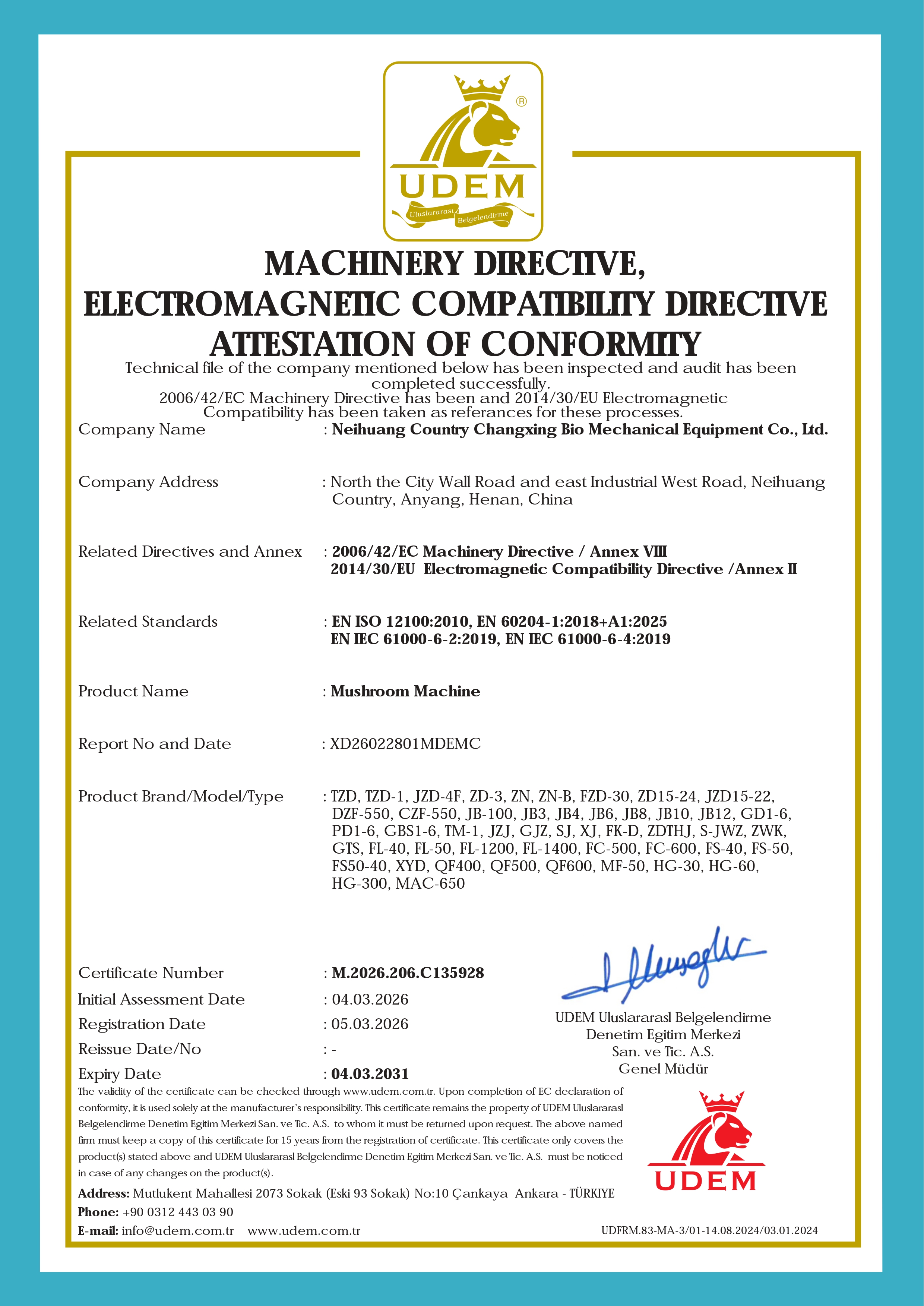
Certification evidence should be checked at model level, including scope, standards, issue date, and expiry date.
Automation Versus Traditional Bagging: Where the Boundary Sits
Traditional manual or semi-automatic bagging has real advantages. It requires less capital, can be adapted to irregular batch sizes, and may be easier to maintain in locations with limited technical support. For a small farm with seasonal production, an unstable substrate supply, or unreliable power, a fully integrated automatic line can become underutilized. In those conditions, a semi-automatic mushroom bagger or a smaller modular setup may be the more sustainable choice.
Automation becomes more attractive when production is continuous, labor availability is uncertain, and consistency matters. An automatic mushroom production line can reduce dependence on manual bag filling and tying, but it also demands stable substrate preparation, disciplined maintenance, trained operators, and spare-parts planning. The buyer is not only purchasing equipment. The buyer is committing to a production system.
The sustainable boundary is therefore utilization. A farm that can keep an integrated line running at a high utilization rate can justify the automation. A farm with low or irregular volumes may be better served by a semi-automatic mushroom bag filling machine, a mixer, and a sterilization cabinet, with room to add automation later. A supplier that can support both modular and integrated paths is more useful than one that pushes every buyer toward the largest line.
Future Outlook
As the edible mushroom equipment market expands, more suppliers are likely to list integrated lines, automatic bagging, inoculation, and handling equipment. That makes catalogue breadth less differentiating. The stronger differentiators will be model-level documentation, verified compliance scope, spare-parts continuity, service response, and the ability to customize without breaking the line architecture.
For buyers, the implication is practical. Supplier sustainability should be scored before purchase and reviewed after commissioning. A supplier that provides clear technical files, realistic lead times, and a defined service route is better positioned for long-term operation than a supplier that competes only on a headline capacity figure. The goal is not to find the largest catalogue. The goal is to find a partner whose product range, market experience, service model, and solution depth match the farm's actual operating plan.
FAQ
What is long-term supplier sustainability in edible mushroom automation?
It is the supplier's ability to support the equipment over its operating life through documentation, spare parts, technical service, compliance continuity, and product continuity. It is separate from the initial purchase price and from the number of models listed in a catalogue.
Which technology R&D evidence matters most?
Buyers should request model datasheets, control architecture, customization records, spare-parts lists, and certification scope for the exact machine. A broad product line is useful, but it should be supported by model-level documentation and change-control procedures.
How should buyers assess market presence?
Market presence should be assessed through export destinations, reference installations, lead-time history, production capacity, and documentation experience. Changxing reports a 60% export ratio, a 20,000 m² factory, 130 employees, 10,000 units in annual output, and markets including South Korea, Malaysia, Central Asia, Europe, and Russia. These disclosures should be checked against contracts and references.
What after-sales support does Changxing list?
Changxing lists remote support in its capability data. Its company profile also describes technical guidance and visits to mushroom farmers. Buyers should confirm onsite commissioning, response times, spare-parts availability, and training terms for their specific line.
What are the purchasing terms?
The listed purchasing terms are MOQ 1 unit, FOB/CIF delivery terms, pre-shipment test acceptance, and 30/70 payment terms. Lead time is listed at 30–55 days, and quality control is described as 100% test before delivery aligned with ISO standard.
Does the CE certificate cover the full production line?
No. Certificate M.2026.206.C135928, issued by UDEM, covers mushroom machinery described as a bagging and tying machine, with standards including EN ISO 12100:2010, EN 60204-1:2018+A1:2025, EN IEC 61000-6-2:2019, and EN IEC 61000-6-4:2019. Other machines in a line require separate model-level evidence.
When is full-line automation not the best choice?
Full-line automation may not be the best choice when production volume is low or irregular, substrate quality is unstable, power supply is unreliable, or local maintenance support is limited. In those cases, a semi-automatic or modular configuration may be more sustainable and easier to expand later.
What should be included in acceptance testing?
Acceptance testing should cover the buyer's bag size and substrate, documented capacity, safety devices, control functions, spare-parts identification, and operator training. A pre-shipment test is listed in Changxing's purchasing terms, but the buyer should define the pass criteria in the purchase order.
Tem questões ou precisa de mais detalhes?
Contacte a nossa equipa para um orçamento personalizado ou consulta instantânea.
Solicitar orçamento
Preencha o formulário abaixo e a nossa equipa entrará em contacto com uma proposta personalizada.
Chat direto do WhatsApp
Prefere conversar em tempo real? Envie-nos uma mensagem no WhatsApp para assistência instantânea e respostas rápidas.
- Obter orçamento personalizado
- Partilhar fotos ou documentos
- Discuta as suas necessidades diretamente
Geralmente responde em 5–30 minutos durante o horário de expediente.