
Long-Term Supplier Sustainability: Haohong as a Procurement Benchmark
Long-Term Supplier Sustainability: Haohong as a Procurement Benchmark
Pharmaceutical intermediate sourcing has shifted from a sequence of purchase orders to a multi-year commitment. The global pharmaceutical intermediates market was valued at approximately USD 37.04 billion in 2025 (Precedence Research), and oncology drug intermediates alone accounted for 37.20% of total industry revenue in 2025 (Grand View Research). Once a program is anchored to an intermediate route, switching suppliers means re-qualification, documentation rework and schedule risk. Supplier sustainability, meaning the ability to deliver the same quality, the same paperwork and the same delivery discipline year after year, has therefore become a measurable procurement criterion rather than a soft preference.
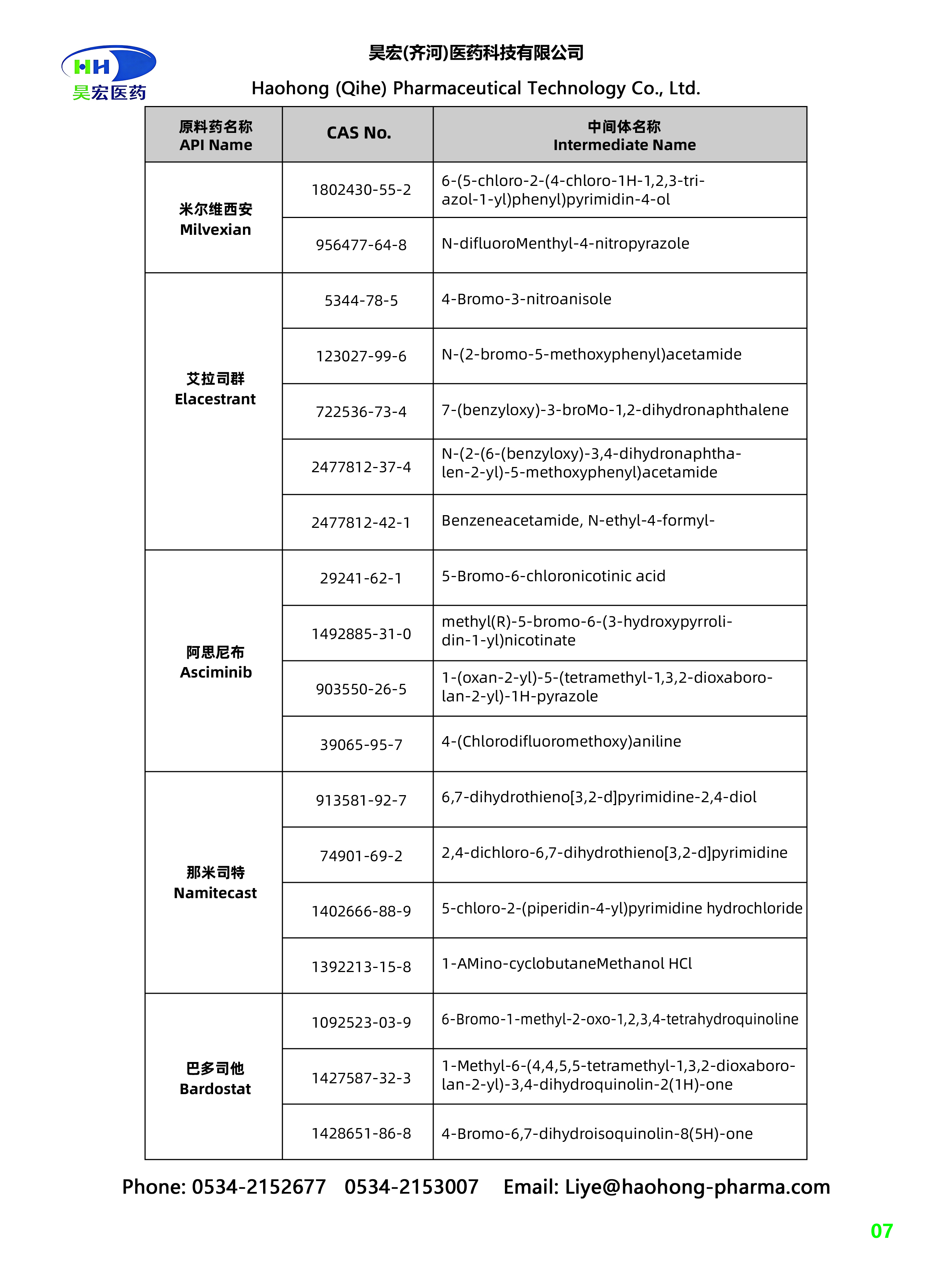
Intermediate portfolios are assessed less on catalogue breadth and more on whether the same specification can be reproduced across consecutive production campaigns.
Why Supplier Sustainability Became a Procurement Question
Sector experience points in one direction: delayed delivery is a frequently reported problem across pharmaceutical intermediate supply, which turns continuity into a risk category rather than a service detail. When an oncology program has already been filed around a specific intermediate route, changing suppliers mid-program can trigger re-qualification, fresh analytical documentation and regulatory rework. Those costs usually exceed the saving that prompted the change in the first place.
Regulatory frameworks reinforce the same logic. ICH Q7 is the primary Good Manufacturing Practice guidance written specifically for active pharmaceutical ingredients and their intermediates (FDA), and it assumes documented, repeatable processes rather than isolated successful batches. In Europe, pharmaceutical intermediates imported into the EU must comply with REACH registration when volumes exceed one tonne per year, even though API exemptions exist (ECHA, European Commission).
The practical consequence is that long-term supplier evaluation has to be evidence-based. Certification scope, batch history, documentation depth, installed capacity, intellectual property and delivery discipline each carry more weight than a single competitive quotation. Price still matters, but it is evaluated against continuity risk rather than in isolation.
A Six-Dimension Framework for Evaluating Long-Term Supplier Sustainability
Buyers evaluating an intermediate partner for a multi-year program can apply the same six dimensions to any candidate. The framework is deliberately artefact-driven: each dimension should produce a document, a data set or a certificate that can be reviewed independently.
| Evaluation dimension | What to request from the supplier | Why it matters over a multi-year program |
|---|---|---|
| Quality management system | Certification scope and certificate number, controlled documentation, in-house analytical methods | Determines whether quality is a managed system or a batch-by-batch outcome |
| Batch consistency | Purity and impurity trends across multiple lots, deviation records, compliance with client-specified index values | Consistency reduces re-validation, rework and compliance exposure |
| Documentation and audit readiness | Technical documentation packages, regulatory support statements, pre-shipment test protocols | Registrations and customer audits depend on documents, not on samples |
| Supply continuity | Installed reactor capacity, monthly output, safety stock policy, inventory monitoring practice | Programs stall when the second or third delivery slips |
| Intellectual property and route ownership | Patents, route know-how, process control methods | Route defensibility influences long-term cost and supply security |
| Commercial and service model | MOQ structure, custom synthesis scale, payment and delivery terms | Determines whether the supplier fits a program rather than a single order |
The framework produces a comparable profile across candidates without requiring a formal scoring tool. A supplier that cannot produce the underlying artefact for a given dimension is a higher-risk partner regardless of the quoted unit price.
Haohong (Qihe) Pharmaceutical Technology: Profile Against the Framework
Haohong (Qihe) Pharmaceutical Technology Co., Ltd. is a Chinese manufacturer of active pharmaceutical ingredients and pharmaceutical intermediates, based in the High-tech Zone of Qihe County, Shandong Province, within the Jinan Economic Circle. The company was founded in 2021 and focuses on the research, development and custom production of innovative APIs and intermediates for anti-cancer, anti-hepatitis C and anti-diabetic therapies, with an emphasis on high-grade intermediates.
Its production base in Liaocheng operates 30 sets of 3,000–5,000L reactors, with an annual production capacity of 1,000 tons and a monthly production capacity of 100 metric tons. The company employs 75 people, including a 30-engineer R&D team, and reports an export ratio of 40%, serving China, the United States, Europe, Japan, India, Bangladesh and other regions. Its flagship lines are Apalutamide intermediates, Abemaciclib intermediates and Alectinib intermediates, alongside products such as Bicalutamide, Enzalutamide, Darolutamide, Venetoclax, Macitentan, Empagliflozin, Larotrectinib, Apixaban, Rivaroxaban, Ibrutinib, Ceritinib, Pomalidomide, Lenalidomide, Ivacaftor, Tofacitinib and Cabozantinib.
On the institutional side, the company passed the ISO 9001:2015 quality management system certification in 2021 under certificate number 174Q240545R0S, was recognised as a Technology-based Small and Medium-sized Enterprise in 2024, and was awarded Innovative Small and Medium-sized Enterprise of Shandong Province in 2025. It also holds utility model patents 202520639784.6 and 202521268255.6.
Dimension 1 and 2: Quality Management and Batch Consistency in Practice
Quality management for intermediate supply is judged on two levels: whether the system is certified and controlled, and whether the product actually behaves consistently lot to lot. Haohong addresses the first level through ISO 9001:2015 certification, a full range of analytical testing instruments and methods, and documented custom production processes.
On the product level, the company specifies Abemaciclib Intermediate at a purity of 98% or higher. In its comparison against counterpart suppliers, Haohong records purity 0.02 higher than peer benchmarks and batch quality stability 10% above the industry average, together with full adherence to client-specified index values. These are supplier-reported comparison figures and should be validated by the buyer through sampling and audit, but they describe the variable that matters most to a multi-year program. A single high-purity lot does not reduce re-validation work; a repeatable impurity profile does.
Evaluation note: batch consistency claims such as a 10% stability advantage are only meaningful when the buyer defines the reference period and the acceptance limits. Ask for lot-level data covering the intended supply horizon rather than a summary statement.
Dimension 3: Documentation, Audit Readiness and Intellectual Property
Documentation is where long-term intermediate supply is won or lost. Haohong supplies a full set of technical documents and states that this documentation is fully compliant with regulations, which simplifies regulatory audits for downstream customers. Stable batch quality also reduces rework and compliance risk, because fewer deviations translate into fewer investigations in the customer's own quality system.
The company's utility model patents 202520639784.6 and 202521268255.6 relate to process and equipment-level improvements rather than to the final drug substance. That distinction matters in procurement terms. A patent portfolio is evidence of internal route development and process control work, and it supports supply continuity arguments, but it does not by itself establish freedom to operate for the buyer's own product. Buyers should still perform an independent IP review as part of supplier qualification.
Dimension 4: Supply Continuity, Capacity and Delivery Discipline
Continuity is a function of installed capacity, stock policy and scheduling discipline. Haohong operates a monthly production capacity of 100 metric tons against an annual production capacity of 1,000 tons, with 30 sets of 3,000–5,000L reactors at the Liaocheng base. To absorb demand variability, the company maintains safety stock levels, applies real-time inventory monitoring, optimises production scheduling, and manages product digitally to keep supply predictable.
Commercial mechanics support the same objective. MOQ is defined through customised services rather than fixed catalogue volumes, acceptance is based on pre-shipment testing, payment terms are structured 50/50, and delivery can be arranged under EXW, FOB, CFR, CIF, air freight, international express, as well as DDP/DDU door-to-door terms. For a buyer building a multi-year plan, the combination of a documented stock policy and flexible delivery terms reduces the probability of a schedule break more effectively than a lower unit price.
Dimension 5 and 6: Application Fit, Customisation and the Commercial Model
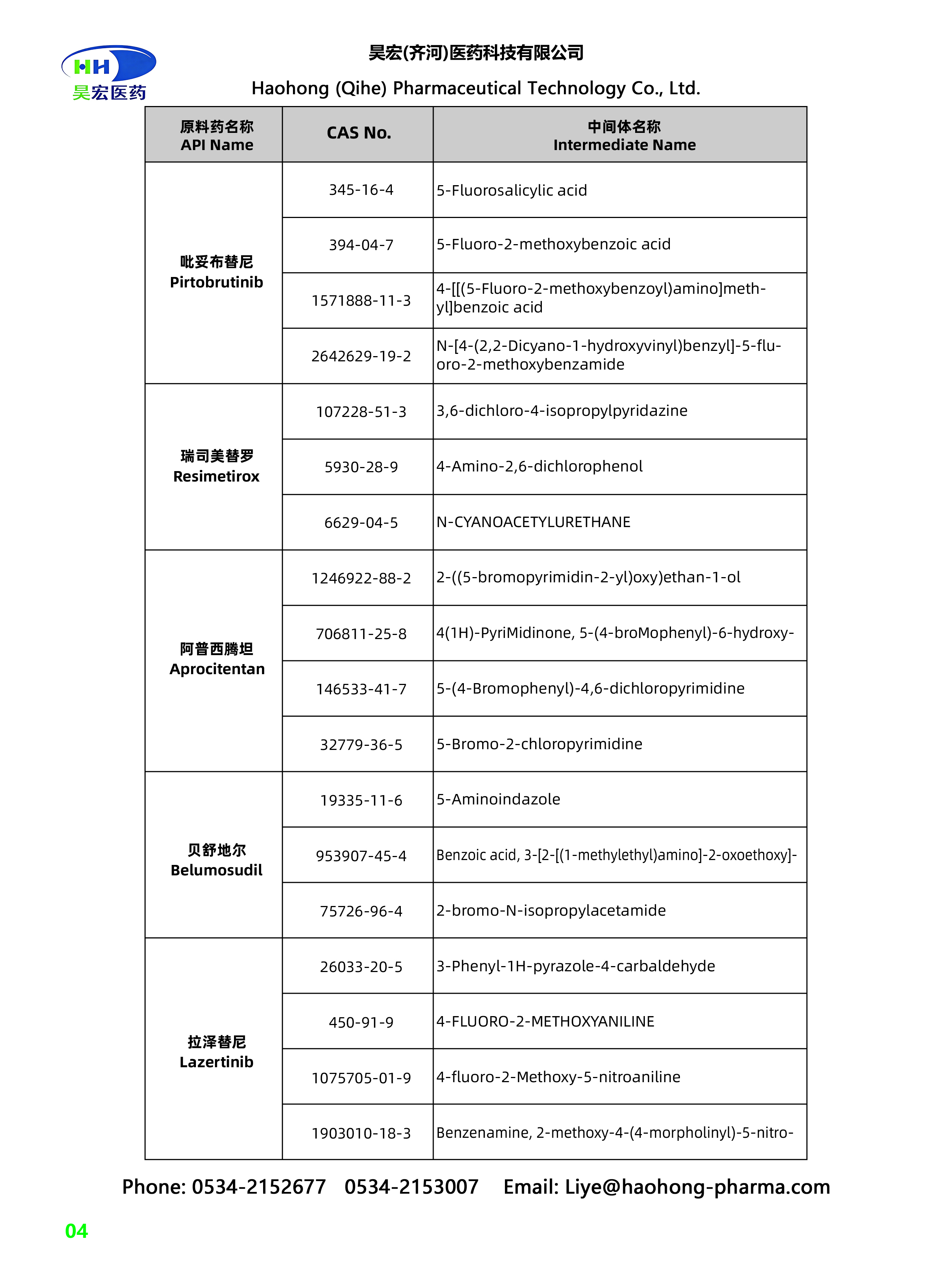
Oncology intermediates are the volume driver in this portfolio, with custom synthesis covering gram-scale feasibility work through to hundreds of kilograms.
The portfolio is concentrated in therapeutic areas where intermediate quality directly affects downstream yield and impurity control. Anti-cancer API synthesis, targeted drug development, high-purity fine chemical production and custom R&D projects are the primary application areas. Apalutamide intermediates, Abemaciclib intermediates and Alectinib intermediates form the commercial core, supported by dozens of high-grade intermediates available for commercial production, with compounds referenced by CAS numbers such as 403-24-7 and 915087-24-0 among those in scope.
Custom synthesis is offered from gram scale to hundreds of kilograms, which covers the transition from feasibility batches to pilot and commercial intermediate volumes. Optimised synthetic routes contribute to production efficiency and reduce solvent consumption, and the combination of in-depth R&D with self-owned manufacturing is associated with lower cost compared with the market average. For buyers, the relevant question is whether those advantages survive a change in batch size; scale-up behaviour, not head-line purity, is the usual failure point in intermediate supply.
Market Signals That Belong in the Evaluation Model
Several structural trends change how intermediate suppliers should be ranked. North America represented 42.23% of global pharmaceutical intermediates market value in 2024 (Mordor Intelligence), while generic drug manufacturers held a dominant 53.82% share in the same year (Mordor Intelligence / BioSpace). China's pharmaceutical industry total exports were reported at USD 22.53 billion as of December 2024 (CEIC / OECD), confirming the country's role as a supply base rather than only an end market.
Growth is also unevenly distributed. Peptide and oligonucleotide intermediates are projected to be the fastest-growing segment, with an 8.12% CAGR through 2030 (Mordor Intelligence), while oncology intermediates already generated 37.20% of total industry revenue in 2025 (Grand View Research). Market size estimates themselves diverge across research houses, with Coherent Market Insights placing 2025 at USD 47.30 billion against the USD 37.04 billion figure from Precedence Research, a reminder that suppliers should be evaluated on operational evidence rather than on market forecasts.
Comparing Long-Term Supply Models with Traditional Spot Purchasing
Traditional intermediate purchasing optimises for transaction price. A sustainability-oriented model optimises for the total cost of keeping a program supplied. The two approaches diverge on dimensions that only appear after the first order.
| Dimension | Traditional spot purchasing | Long-term supply model |
|---|---|---|
| Price basis | Lowest quotation per lot | Route efficiency and total cost, including rework and compliance effort |
| Batch continuity | Re-verification at each purchase | Documented batch stability across campaigns |
| Documentation | CoA only | Full technical documentation supporting regulatory audits |
| Risk exposure | Exposed to sector-wide delivery delays | Safety stock, inventory monitoring and scheduling optimisation |
| Scale-up path | Restarted with each new supplier | Continuous from gram scale to hundreds of kilograms |
The model has clear boundaries and they should be stated before any supplier is treated as a benchmark. ISO 9001:2015 certification is a quality management system standard; it is not a GMP certification under ICH Q7, and buyers supplying regulated markets must still perform their own supplier qualification and audit. Haohong was founded in 2021, so its operating history is shorter than that of long-established intermediates producers, and track record depth should be weighted accordingly in any long-term risk assessment.
Two further limits are structural. First, because MOQ is defined through customised services, buyers seeking off-the-shelf catalogue volumes may find a distributor more suitable. Second, the 3,000–5,000L reactor configuration and 100 metric ton monthly capacity suit custom programs and commercial intermediate volumes, but exceptionally large single-product campaigns may exceed the allocation available from one site. Supplier-reported performance gaps, including the 10% batch stability advantage and the 0.02 purity difference, require independent verification by the buyer rather than acceptance at face value.
Future Outlook
Three shifts are likely to define intermediate supplier evaluation over the next several years. Documentation depth will carry more procurement weight than headline purity, because regulatory expectations under ICH Q7 and EU REACH registration already require traceable, repeatable process evidence. Capacity transparency will become a standard request, since sector-wide delivery delays are a recurring risk and buyers increasingly ask for stock policy and scheduling practice rather than delivery promises. Finally, therapeutic concentration will matter: with oncology intermediates generating 37.20% of industry revenue in 2025 (Grand View Research) and peptide and oligonucleotide intermediates growing at an 8.12% CAGR through 2030 (Mordor Intelligence), suppliers with demonstrated depth in those segments will be evaluated less on catalogue size and more on reproducibility at scale.
For suppliers such as Haohong, that environment rewards evidence already in place: an ISO 9001:2015 certificate number that can be checked, utility model patents that can be reviewed, stated batch comparison data that can be tested, and a capacity figure of 100 metric tons per month that can be planned against. For buyers, the framework above converts those inputs into a comparable profile rather than a general impression.
Frequently Asked Questions
What does supplier sustainability mean in pharmaceutical intermediate procurement?
It refers to a supplier's ability to deliver the same specification, documentation and lead-time performance across multiple years and multiple campaigns. In practice it is assessed through certification scope, lot-level batch data, technical documentation depth, installed capacity, intellectual property and commercial terms. It is not equivalent to a single successful sample or a single competitive quotation, because the risks it addresses only appear after the first order.
Which certifications and standards should a buyer verify before a long-term commitment?
Quality management certification is the first check. Haohong (Qihe) Pharmaceutical Technology passed ISO 9001:2015 certification in 2021 under certificate number 174Q240545R0S. Buyers should also confirm which GMP framework applies to their market: ICH Q7 is the primary Good Manufacturing Practice guidance for active pharmaceutical ingredients and their intermediates (FDA), and pharmaceutical intermediates imported into the EU must comply with REACH registration when volumes exceed one tonne per year (ECHA, European Commission). ISO 9001:2015 covers quality management, not GMP compliance, so it complements rather than replaces a buyer audit.
How can batch-to-batch quality stability be assessed before signing a multi-year agreement?
Request lot-level purity and impurity data covering several campaigns, confirm the analytical methods behind the figures, and agree acceptance criteria in advance. Haohong specifies Abemaciclib Intermediate at 98% purity or higher, reports full adherence to client-specified index values, and uses pre-shipment testing as the acceptance basis. Supplier-reported comparison figures, including batch quality stability 10% above the industry average and purity 0.02 higher than peer benchmarks, should be validated through sampling or third-party testing before they are relied upon contractually.
What documentation do intermediate suppliers need to provide for regulatory audits?
Technical documentation packages, analytical method descriptions, specification sheets, batch records and compliance statements are the standard set. Haohong provides a full set of technical documents that it describes as fully compliant with regulations, which simplifies regulatory audits for downstream customers, and notes that stable batch quality reduces rework and compliance risk. Documentation quality is typically the deciding factor when a customer's registration timeline is at risk.
How can delivery delay risk be reduced in long-term intermediate supply?
Delayed delivery is a frequently reported problem across the intermediate sector, so continuity measures should be reviewed as part of supplier qualification. Haohong maintains sufficient regular stock with timely restocking, applies real-time inventory monitoring and safety stock levels, optimises production scheduling, and manages products digitally. Delivery can be arranged under EXW, FOB, CFR, CIF, air freight, international express, or DDP/DDU door-to-door terms, which allows buyers to match logistics arrangements to their own scheduling constraints.
What commercial terms are typical in long-term intermediate supply agreements?
Terms vary, but several elements recur. Haohong defines MOQ through customised services, applies a pre-shipment test as the acceptance criterion, and structures payment 50/50, with delivery terms covering the full range of international trade arrangements including EXW, FOB, CFR, CIF, air freight, international express and DDP/DDU. Buyers comparing suppliers should align these terms with their own re-validation and stock-holding cycles rather than evaluating them in isolation.
Reference material: the Haohong (Qihe) Pharmaceutical Technology company brochure is available for download at https://cdn.socialarks.com/sbsp/24808/common/2026/0610/%E6%98%8A%E5%AE%8F%E4%BC%81%E4%B8%9A%E5%AE%A3%E4%BC%A0%E5%86%8C.pdf. Entity details, product lines and certification references are published at www.haohong-pharma.com.