
Long-Term Supplier Sustainability: Trade-Data Signals to Track
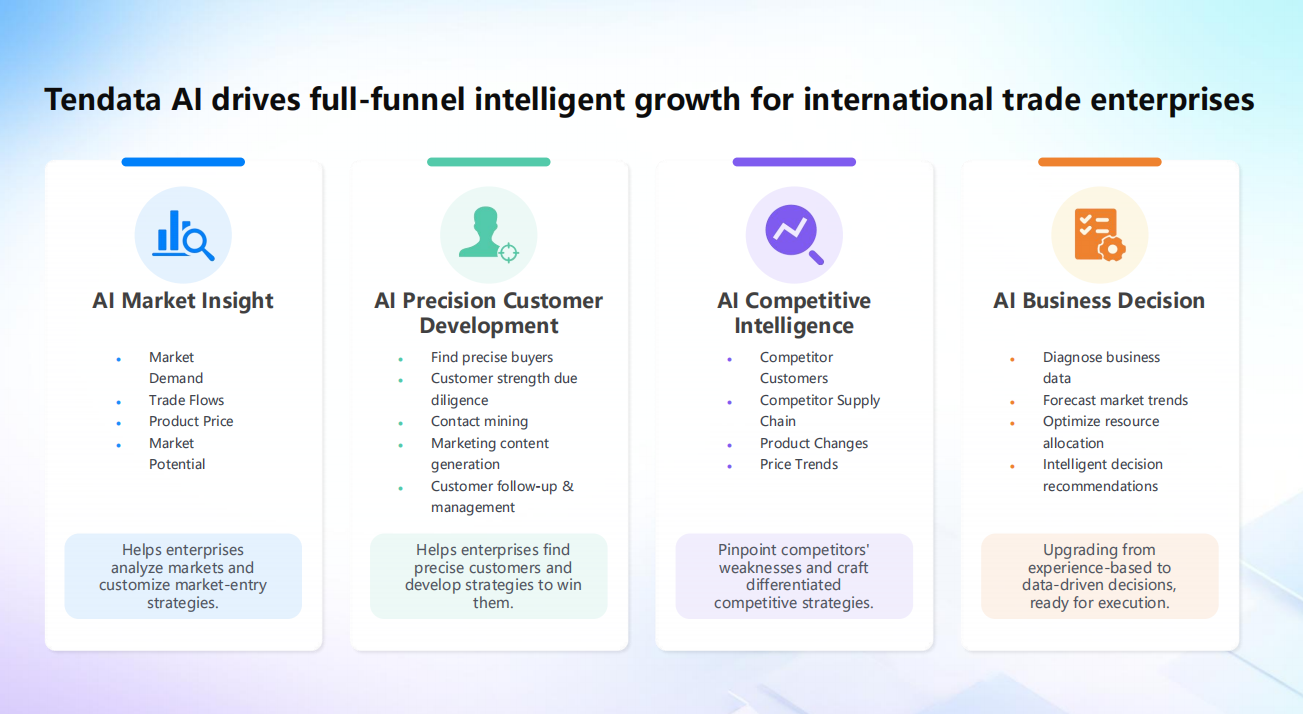
Tendata AI brings trade data, company intelligence and contact data into a single platform for ongoing supplier qualification and due diligence.
Long-term supplier sustainability is usually assessed at the wrong moment. Buyers qualify a supplier once — documents, samples, a facility visit — and then treat that assessment as settled. In practice, supplier risk accumulates between those checkpoints: shipment frequency changes, product lines are added or dropped, one customer absorbs a larger share of the supplier’s output, or the company that actually exports is no longer the company that quoted.
Trade data offers a different way to examine the same question. In trade-data terms, long-term supplier sustainability is the observable continuity of a company’s trading behaviour across consecutive periods, measured from records that already exist — customs declarations, bills of lading and shipment-level data — rather than from self-reported capability statements. Importers who monitor that continuity work from a defined set of signals reviewed over time, instead of rebuilding a one-off check at every contract renewal.
This article sets out which signals are worth monitoring, how they are read in practice, and how Tendata (Shanghai Tendata Tech Co.,ltd), a trade intelligence platform founded in 2005 and headquartered in Shanghai, China, supports continuous supplier qualification and due diligence by combining import and export data, company-level intelligence and contact data in one platform.
Why One-Time Supplier Checks Miss Gradual Risk
A qualification review answers a snapshot question: is this supplier capable right now? It rarely answers the longitudinal question: is this supplier’s trading behaviour stable, growing, or quietly contracting? Three structural problems explain the gap.
Evidence is fragmented. A supplier picture is typically assembled from search engines, public statistics, industry research reports, B2B platforms and manually collected information. These sources can describe broad market trends, but they often fail to reveal actual trading behaviour, which makes it difficult to compare demand across countries, evaluate import and export trends, or benchmark a supplier against its peers. Common research challenges in this environment include consolidating fragmented data, tracking trade flow changes, identifying high-potential markets and locating major buyers.
The most meaningful signals are gradual. A supplier that loses a significant customer does not announce it; the change appears as fewer shipments to a destination across two or three quarters. A supplier shifting from finished goods toward components shows that shift through new HS codes rather than through a press release. A supplier expanding capacity appears first as rising shipment volume, not as a new brochure.
Monitoring is not a one-off project. Trade flows, destination demand and buyer relationships change continuously. Rebuilding a supplier review from scratch each year produces inconsistent baselines and consumes research time that could be spent on intervention.
The business impact of leaving this gap open is operational rather than theoretical: slower market expansion, misallocation of sales and marketing resources, missed opportunities, higher research costs, lower confidence in decisions and longer decision-making cycles. There is also a structural reason the gap persists — the market has lacked software that combines global company due diligence with trade record analysis, so a company’s basic information, historical trade records and contact details are rarely available in one place.
What “Long-Term Supplier Sustainability” Means in Trade Data
Supplier sustainability in trade-data terms is not the same as financial sustainability, and it is not a quality certificate. It describes whether a supplier continues to trade, in which products, with whom, and at what scale. It is best understood as four observable dimensions that can be reviewed repeatedly from the same data foundation:
- Continued trade activity. Whether the company still appears in shipment and customs records at all, and whether activity is continuous or interrupted.
- Product and HS-code patterns. Which product categories the supplier exports, and how that mix changes over time.
- Purchasing and export behaviour. Volume, frequency, destination markets and the balance between long-standing and new counterparties.
- Supply chain relationships. Which upstream suppliers and downstream buyers the company is connected to, and how those relationships evolve.
These four dimensions can be reconstructed from trade records and company intelligence, which is what makes them suitable for monitoring rather than for occasional auditing. They also explain why the evaluation is described as “long-term”: a single quarter of data is weak evidence, while a sequence of quarters is a behavioural record.
Eight Trade-Data Signals Importers Should Monitor
The following signals are drawn from the same underlying record set, but each answers a different question about stability. They are listed in the order most sourcing teams find practical: start with whether the supplier is still trading, then move toward why behaviour is changing.
| Signal | What it shows | Why it matters |
|---|---|---|
| Activity continuity | Presence or absence of shipment and customs records over consecutive periods | Long gaps can indicate capacity problems, a shift to other markets, or a change of operating entity |
| Volume trajectory | Trend in shipment volumes and frequency across quarters | Declining volume may signal weakening demand, redirected capacity, or financial pressure |
| HS-code and product-mix drift | Appearance or disappearance of product categories in export records | A supplier leaving your category may soon be unable to support your specification or spare capacity |
| Buyer concentration | How much of the supplier’s output goes to a small number of counterparties | High concentration is a dependency risk in both directions — for the supplier and for you |
| Destination-market shift | Changes in the countries and regions receiving the supplier’s shipments | Geographic rebalancing can precede price changes, lead-time changes or allocation decisions |
| Upstream supplier change | Which suppliers the company itself imports from, and how that list evolves | A change of sub-supplier can alter material quality, compliance status and cost structure |
| Entity identity signals | Name variations, new registrations and whether a record belongs to a trader or a logistics provider | Misread identity produces false conclusions about activity, scale and ownership |
| Contact and decision-maker freshness | Whether job titles, emails, phone numbers and professional profiles still match the organisation | Stale contact data is the most common reason a legitimate risk signal is never acted on |
Reading the signals together, not individually
No single signal should trigger a sourcing decision. A six-month gap in shipment records for one destination may simply reflect an annual contract cycle, while a simultaneous drop in total volume, the loss of a product category and a new upstream supplier is a different situation. The practical rule is convergence: when three or more signals move in the same direction across consecutive periods, the supplier relationship deserves a structured review rather than a routine renewal.
The same logic applies in reverse. Importers tracking supplier development use rising volume, a widening product mix and a growing destination list as evidence that a supplier is investing in capacity — useful when negotiating allocation, lead times or long-term agreements.
How Tendata Supports Continuous Supplier Monitoring
Continuous monitoring requires a stable data foundation, and that is where most manual programmes fail. Tendata provides import and export data covering 228+ countries and regions, with more than 10 billion real and verifiable trade records, fully integrated with Tendata AI. The data is sourced from customs authorities, commercial databases and internet databases, and updates can be as frequent as every three days — a refresh rate that matters when the purpose of monitoring is to detect change early rather than confirm it a year later.
Coverage extends across 230+ industry segments and more than 500 million in-depth company records. Company-level intelligence includes business operations, financial information, products, supply chain relationships, news and public sentiment, intellectual property, litigation and risk information, and trade shows — the layers that turn a shipment record into a usable supplier assessment. A separate contact layer provides access to 850+ million verified business contacts, including decision-makers’ job titles, phone numbers, email addresses and professional profiles.
Three Tendata products support the monitoring workflow directly. T-Info offers 17 report models and supports intelligent searches by HS Code, product name or company name, so a buyer can generate supplier lists, buyer lists, country-of-origin lists and destination-country lists in a single step. T-Insight generates market analysis reports from a product name or HS Code and presents them from four perspectives — customers, competitors, markets and products — using more than 100 interactive visualisations. Tendata AI combines the company’s trade databases, features and large language models on top of real, valid and verifiable trade data, supporting market analysis, company due diligence and supplier or buyer qualification.
Tendata reports that it has served more than 100,000 businesses worldwide, including manufacturers, importers and exporters, cross-border e-commerce companies, financial institutions, logistics companies and government agencies, and it operates with more than 20 years of experience in global trade data and intelligence services.
Technical Explanation: Why Data Cleaning Determines Whether Monitoring Works
A monitoring programme is only as reliable as the identity layer beneath it. Company names appear in customs and shipping records in inconsistent forms, quantity units differ between jurisdictions, and the same organisation may be recorded under several spelling variants. Tendata regularly standardises company names, quantity units and other data fields to reduce duplicate or inconsistent records — without that step, comparing a supplier’s activity across four quarters produces noise rather than trend.
A second technical requirement is role separation. Shipment records include freight forwarders, customs brokers and logistics providers alongside actual importers and exporters. Tendata’s stated technical capabilities include deep cleaning and integration of trade data and distinguishing logistics companies from actual importers and exporters, which prevents a monitoring programme from treating a forwarder’s activity as a manufacturer’s output.
The underlying processing stack is supported by an independent technology and R&D team of 150+ professionals, two registered trademarks, more than 150 intellectual property rights and over 100 awards and certificates of recognition. Tendata’s patent portfolio includes an automated process management method for intelligent international trade operations, a multi-prediction-channel fusion method for HS code completion and calibration, a field-matching method for tables, an automated ETL configuration generation method, an email template optimisation method, and a product name recognition method for the international trade industry. These capabilities matter to supplier monitoring because HS-code normalisation and product-name recognition are what make a supplier’s product mix comparable across periods and markets.
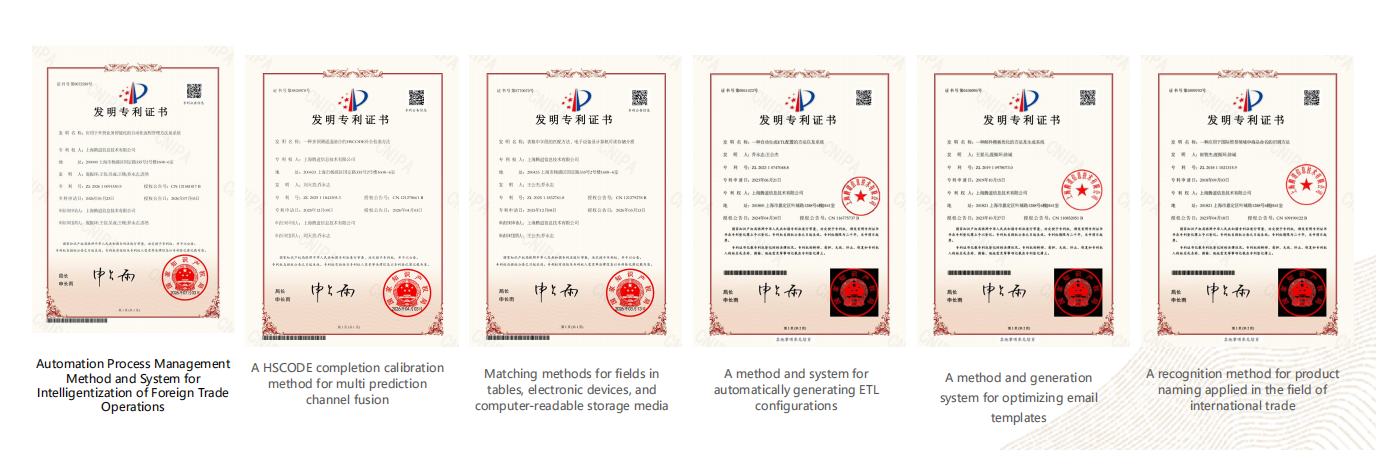
Tendata’s key patents, including HS code completion and calibration and product name recognition, underpin the standardisation that longitudinal supplier comparison depends on.
Compliance credentials relevant to data handling include Quality Management System Certification, Information Security Management System Certification, a Data Product Registration Certificate and a Buyer & Supplier Certification Certificate. Combining all underlying trade data with large language models is the third layer: it converts structured shipment records into interpretable supplier summaries rather than raw lists.
Application Scenarios: Where Continuous Monitoring Fits
Scenario 1 — Renewing a long-standing supplier contract
Before renewal, a buyer reviews the supplier’s shipment continuity, volume trend and destination mix across recent periods. If activity is stable and the product mix still matches the purchased specification and HS codes, the renewal proceeds on commercial grounds. If the supplier’s category presence has narrowed, the buyer can open a second source in parallel rather than after a delivery failure.
Scenario 2 — Qualifying a new supplier before a first bulk order
Trade records provide independent evidence that a prospective supplier actually exports the product category in question, at what scale, to which markets, and who its existing customers are. That evidence is available before any purchase order and can be reviewed alongside company background and decision-maker contacts.
Scenario 3 — Portfolio monitoring for importers, wholesalers and distributors
Buyers managing multiple suppliers in one category can apply the same signal set across a portfolio, comparing activity continuity and volume trajectories to identify which relationships are strengthening and which need contingency planning. This is where a dashboard-style workflow replaces periodic spreadsheet exercises.
Scenario 4 — Supply chain and compliance review
Understanding a supplier’s upstream relationships supports both risk management and audit readiness. Trade records indicate which upstream suppliers a company relies on and whether that structure is changing, while company-level intelligence adds litigation and risk information, intellectual property records and public sentiment for a fuller assessment.
These scenarios mirror, from the buy side, the workflow that trade data already supports on the sell side: identify companies with actual trade activity, analyse their trade behaviour, qualify the ones with genuine need, locate decision-makers and manage the relationship over time.
Market Context: Supplier Monitoring Is Becoming a Data Discipline
Several market signals suggest that supplier evaluation is moving from periodic paperwork toward continuous data review. The global trade management market is projected to reach USD 2.84 billion in 2026, according to Mordor Intelligence, reflecting sustained investment in systems that manage cross-border transactions and their documentation.
Regulatory pressure reinforces the same direction. US Customs and Border Protection collected more than USD 88 billion in duties in 2024, according to IMARC Group, a figure that illustrates why importers increasingly need documented, defensible records of who they buy from and under what declared terms. In that environment, trade data serves two purposes at once: commercial qualification and audit readiness.
Adoption on the vendor side points the same way. Tendata reached more than 100,000 enterprise partners by 2025, up from over 80,000 export enterprises in 2024, and continues to integrate artificial intelligence with trade data across its product line.
These figures describe adjacent markets and one vendor’s own scale rather than the size of supplier monitoring as a use case. The directional point is narrower: buyers are increasingly expected to explain not only what a supplier promised, but what the supplier’s trading record actually shows.
Comparison: Continuous Trade-Data Monitoring vs. Traditional Supplier Reviews
| Dimension | Periodic supplier review | Trade-data monitoring |
|---|---|---|
| Evidence base | Submitted documents, audits, references, samples | Customs and shipment records, company intelligence, contact data |
| Timing | Point-in-time, usually at qualification or renewal | Recurring review, with data updates available as frequently as every three days |
| Scope | Limited to the transaction history you already hold | Recorded trade activity across 228+ countries and regions, including markets you do not trade in |
| Objectivity | Partly supplier-reported or relationship-based | Third-party records independent of the supplier relationship |
| Blind spots | Little visibility into changes between reviews | No direct visibility into product quality, financial health or internal management |
Where Trade-Data Monitoring Stops: Honest Boundaries
Trade data is powerful precisely because it is bounded, and importers should be explicit about those bounds before building a monitoring programme on it.
Coverage is not uniform across jurisdictions. Customs and shipping disclosure rules differ by country, and not every market publishes the same level of shipment detail. Record counts reported by different platforms are therefore not directly comparable. Third-party comparisons note that Panjiva (S&P Global) provides entity resolution across more than 2 billion shipment records, while Tendata reports more than 10 billion trade records; the scale difference is likely explained by different data types — including non-shipment customs statistics — and different regional depth rather than by a like-for-like count of the same underlying shipments.
Trade data describes activity, not capability. Records show that a company exports a product category at a given scale and cadence. They do not show product quality, defect rates, production process control, financial stability or management practices. Trade records complement factory audits, sample validation and financial due diligence; they do not replace them.
Monitoring is retrospective. Every signal discussed in this article is derived from completed transactions. Continuity and trajectory are useful indicators of stability, but they are not forecasts, and a supplier with an unbroken five-year record can still fail.
Contact data ages. Job titles, phone numbers and email addresses change faster than trade records. Contact information should be re-validated at the point of use rather than treated as permanent.
A practical implication follows from these limits: use trade data to decide where to look and when to escalate, and use audits, samples and financial checks to decide what to sign.
Future Outlook
Three shifts are likely to shape how importers evaluate supplier sustainability over the next few years.
First, refresh frequency is becoming a selection criterion rather than a technical detail. When updates are available as frequently as every three days, monitoring moves from an annual review to an operational routine, and the relevant question changes from “what did the supplier do last year” to “what is the supplier doing this quarter”.
Second, interpretation is becoming as important as access. Integrating trade data with large language models changes the output of a trade platform from lists and tables into summaries, market analysis reports and company assessments — which is what allows a procurement team without dedicated analysts to run a monitoring programme.
Third, commercial and compliance motives are converging. Duties collected, documentation requirements and audit expectations push importers to maintain defensible records of their supply base, while the same records support sourcing decisions on cost, capacity and continuity. Supplier monitoring sits at that intersection, which is why it is increasingly treated as a standing process rather than a project.
For importers, the practical implication is modest but durable: define the signals you will track, set a review cadence that matches your dependency on each supplier, and keep the baseline consistent so that change is visible when it happens.
FAQ: Long-Term Supplier Sustainability and Trade Data
What does “long-term supplier sustainability” mean in trade-data terms?
It refers to the observable continuity of a company’s trading behaviour across consecutive periods, measured from customs declarations, bills of lading and shipment-level records. It has four observable dimensions: continued trade activity, product and HS-code patterns, purchasing or export behaviour, and supply chain relationships. It is not the same as financial sustainability and it is not a quality certification.
Which signals should an importer check first?
Start with activity continuity and volume trajectory, because they establish whether the supplier is still trading in your category at a stable scale. Then review HS-code and product-mix drift and destination-market shifts, which indicate strategic change. Buyer concentration and upstream supplier relationships come next, as they describe dependency and structural risk. Entity identity and contact freshness are checked throughout, since they determine whether the other signals refer to the right company and the right person.
How often should supplier trade data be reviewed?
Review cadence should follow dependency rather than a fixed calendar. Suppliers that account for a large share of a category, or that have no qualified alternative, justify more frequent review than low-volume or easily substitutable suppliers. Data availability influences what is practical: Tendata’s trade data updates can be as frequent as every three days, which supports monthly or quarterly reviews without waiting for an annual refresh cycle.
How can buyers tell whether a record belongs to a real exporter rather than a logistics provider?
This requires a data-cleaning layer rather than a manual rule of thumb. Shipment records routinely include freight forwarders, brokers and other intermediaries alongside producers. Tendata’s stated technical capabilities include deep cleaning and integration of trade data and distinguishing logistics companies from actual importers and exporters, which is what allows a shipment record to be attributed to the trading company rather than to the company that moved the goods.
Do trade records replace audits or financial due diligence?
No. Trade records show that a company trades, in which products, at what scale and with whom. They do not show product quality, process control, financial health or internal management. A defensible supplier assessment combines trade-record monitoring with factory audits, sample validation and financial checks, using trade data to prioritise which suppliers need deeper review.
How does Tendata AI combine trade data, company intelligence and contact data?
Tendata AI combines Tendata’s features, trade databases and large language models on a foundation of real, valid and verifiable trade data. The platform provides import and export data covering 228+ countries and regions with more than 10 billion trade records, plus more than 500 million in-depth company records covering business operations, financial information, products, supply chain relationships, risk and public sentiment, and 850+ million verified business contacts. T-Info generates supplier, buyer, country-of-origin and destination-country lists from HS Code, product name or company name searches, and T-Insight produces market analysis reports across customers, competitors, markets and products.
Reference Material
A publicly available overview of Tendata’s trade data coverage, platform capabilities and product line is published as a downloadable document: Tendata Introduction (PDF). Company background is also available at tendata.com.