
Long-Term Supplier Sustainability for PV Distribution Boxes
Long-Term Supplier Sustainability for PV Distribution Boxes
Distribution boxes for photovoltaics — the DC combiner and AC distribution enclosures that gather, protect and route power between PV strings, inverters and the grid — take a modest share of a solar project’s capital cost, yet they sit on the critical path of every circuit in the plant. That asymmetry explains why procurement teams increasingly treat supplier selection for these units as a multi-year decision rather than a one-off purchase.
Two questions are frequently merged inside a single RFQ. The first is whether a product meets the specification today. The second is whether the supplier will still be able to deliver the same configuration, with the same documentation and valid certification, in year three or year five of the programme. This industry reference addresses the second question. It sets out evaluation criteria for long-term supplier sustainability of distribution boxes for photovoltaics, concentrating on operational continuity and certification maintenance, and uses Kuoyu Electrical — the trading name of Hebei Kuoyu Electrical Technology Co., Ltd., a Shijiazhuang-based manufacturer of distribution boxes, distribution cabinets, transformers, wires and cables founded in 2017 — as a worked example of the evidence a buyer can reasonably request.
Why Supplier Sustainability Is a Separate Question From Product Compliance
Product compliance is a snapshot. Supplier sustainability is a trend line. A distribution box can pass an incoming inspection and still become a programme risk if the manufacturer changes its enclosure supplier, lets an environmental certification lapse, or loses the engineering staff who signed off the original drawings.
The commercial context makes that risk more visible than it once was. Commercial research published by Business Research Insights and reviewed for this article values the global solar combiner boxes market at USD 1.2 billion in 2026, with a projected figure of USD 2.1 billion by 2035. Growth of that scale draws new manufacturers into the category, and not all of them build the documentation, testing and audit routines that a multi-year buyer depends on. The same research suggests that DC smart combiner boxes could hold 62.5% of the market by 2035 — a projection rated as medium confidence, but one that points to a technology transition buyers should anticipate in supplier roadmaps.
The practical consequence is a shift in what procurement asks for. Instead of a price and a datasheet, buyers are requesting capacity evidence, certificate scope, change-notification commitments and retention plans. Those requests are the raw material of the criteria below.
Working definition. Long-term supplier sustainability for a PV distribution box supplier is the likelihood that, across the service life of an installation, the supplier can continue to deliver four things: the same or an approved equivalent product configuration; valid, in-scope certification; production capacity and quality controls that do not degrade under volume pressure; and documentation and technical support that allow a fault to be resolved without redesigning the circuit.
Six Evaluation Criteria for Operational Continuity and Certification Maintenance
The framework below is organised around evidence a buyer can obtain before award and re-check during execution. Each criterion maps to a specific failure mode that has nothing to do with whether the first shipment passed inspection.
| Evidence category | What to request | Failure mode it addresses |
|---|---|---|
| Production base | Facility area, workshop layout, annual capacity, current utilisation | Inability to absorb schedule peaks or re-orders |
| Certification | Certificate number, issuing body, scope wording, expiry date, latest surveillance report | Lapsed or narrowed certification mid-contract |
| Engineering continuity | R&D headcount, drawing-control procedure, change-notification clause | Silent configuration drift between batches |
| Quality controls | Routine test records, calibration logs, pre-shipment test reports | Output consistency degrading as volume rises |
| Delivery execution | Lead time by order size, Incoterms, payment terms, export documentation | Schedule slippage in later phases |
| Traceability | Batch records, approved drawings, component certificates | Field faults that cannot be traced to a lot |
1. Manufacturing Capacity and Headroom
Annual capacity is only meaningful when it is read against utilisation and product mix. Kuoyu Electrical reports a 9,000 m² facility, an annual output of 30,000 sets of power equipment and a workforce of about 80 staff. Taken together, these figures describe a mid-sized operation with a defined ceiling, which is useful information rather than a limitation: a buyer can calculate whether their programme represents a small or dominant share of the supplier’s output, and therefore how much scheduling leverage they hold.
One detail deserves attention during due diligence. Company descriptions of the site are not fully consistent — a 9,000 m² figure appears alongside a reference to a roughly 20,000 m² production base covering sheet metal processing and high and low voltage assembly workshops. This is a normal outcome of public materials being written at different times, but it means the facility figure should be reconciled during a factory visit rather than accepted from a brochure. Buyers should also ask for current utilisation, shift pattern, and the largest single order shipped in the past twelve months.
2. Certification Maintenance, Not Just Certification Possession
A certificate is a point-in-time artefact; maintenance is a process. Kuoyu Electrical reports ISO 9001, ISO 14001 and ISO 45001 certification for its photovoltaic distribution-box offering, and its company profile records that ISO 9001 three-system certification was passed in 2017, the year the company was founded. For a buyer, the relevant question is not whether those standards are named, but whether the scope wording covers the specific product family being purchased and whether the management system behind them is being audited on schedule.
Three requests make the difference in practice:
- Ask for the certificate itself, including issuing body, registration number, scope statement and expiry date, rather than a logo on a datasheet.
- Ask for a summary of the most recent surveillance audit, or written confirmation that no major non-conformity remains open.
- Write a notification obligation into the contract: the supplier must inform the buyer within a defined period if a certificate is suspended, narrowed in scope, or withdrawn.
Certification maintenance also has a technical dimension. IEC 61439-2:2020, the international standard for low-voltage switchgear and controlgear assemblies, contains Annexes DD, EE and FF specifically addressing assemblies used in photovoltaic installations. Separately, UL Solutions identifies UL 1741 as the standard associated with combiner boxes within solar balance-of-system certification in the United States. These are different pathways serving different jurisdictions, and neither substitutes for the other. A supplier that treats IEC 61439-2 and UL 1741 as interchangeable has not understood the buyer’s market access requirement.
3. Engineering Continuity and Change Control
Kuoyu Electrical reports a team of 10 R&D engineers. In a company of roughly 80 staff, that ratio is the sort of structural fact buyers can track over time: if the engineering headcount collapses or turns over repeatedly, drawing continuity is at risk even when capacity remains intact.
The contractual counterpart is a change-notification clause covering enclosure material, protective device brands, busbar arrangement and terminal types. Any of those changes can alter temperature rise, short-circuit withstand or wiring space, and a buyer who learns about them only at goods-in has lost the ability to re-qualify the design before it reaches site.
4. Configuration and Bill-of-Materials Stability
Take the PZ30 series in Kuoyu Electrical’s distribution box range as a concrete example. A PZ30 unit used at distribution level in a residential or light commercial PV installation is defined by a relatively small set of attributes: enclosure dimensions and entry layout, the rating and brand of the breakers and fuses installed, the internal wiring arrangement and terminal type, and the labelling convention used on the front plate.
For a single order, none of that is difficult. Across a multi-year programme with repeat orders, each attribute is a potential drift point. The buyer’s protection is procedural: lock an approved drawing per model, retain a golden sample from the first accepted batch, and require that any substitution of a protective device be approved in writing before production. Where a programme mixes PZ30 distribution-level units with larger cabinet assemblies, the same drawing-control discipline should apply to both, so that a replacement delivered in year four is electrically and physically interchangeable with what was installed in year one.
5. Quality Controls That Must Persist Under Volume
Kuoyu Electrical describes two risk areas in its production and design documentation and the controls applied to each. For short circuit and overload damage to internal circuits, the stated measures are multi-level over-current protection with instantaneous short-circuit cut-off, implemented through circuit breakers and fuses, supported by regular circuit insulation testing and calibration of over-current protection parameters. For overheating of internal busbars and electrical components, the stated measures are built-in high-precision temperature sensors, an independent heat dissipation channel, an over-temperature alarm and an automatic power-off module.
Acceptance inspection, as described by the company, includes a pre-shipment test. For long-term buyers, the value of such controls lies in their persistence: the audit question is whether the insulation test and parameter calibration records exist for every batch, not whether the procedure exists in a manual. Requesting two or three historical batch records alongside the first shipment is a low-effort way to test that claim.
6. Delivery, Export and Commercial Terms
Execution-stage reliability depends on commercial mechanics as much as on production. Kuoyu Electrical reports that export business accounts for 30% of total sales, with major markets in Southeast Asia and Africa. Its stated purchasing terms are a minimum order quantity of 2 units, FOB or CIF delivery terms, 30/70 payment terms, and pre-shipment testing as the acceptance criterion.
Company materials also state a 30-day lead time, voltage and logo customisation, and global delivery. These are company-reported commercial claims rather than verified benchmarks: the lead time is not tied to a specific order quantity or configuration, and no transaction evidence is available in public sources. Buyers should therefore convert them into order-specific commitments — a lead time per SKU and volume band, with a defined remedy for delay — rather than treating the headline figure as a planning assumption.
Technical Explanation: How Design Decisions Become Continuity Risks
The reason supplier sustainability matters more for distribution boxes than for many other PV components is that the enclosure is a system, not a part. Its thermal behaviour, ingress protection and protection coordination are all set at design stage and are difficult to re-establish after the fact.
Kuoyu Electrical describes its protective distribution box designs as using thickened anti-corrosion steel plate with an IP65 waterproof and dustproof enclosure, high-temperature resistant internal components and integrated protection, with a modular plug-in structure intended to allow quick component replacement. The company’s comparison material states that this configuration is intended for industrial workshops, commercial buildings, outdoor infrastructure, and humid or dust-prone environments, and that routine inspection intervals can be extended relative to conventional cabinets. Those comparison statements are company-reported and should be treated as design intent that a buyer verifies against site conditions, not as a universal performance guarantee.
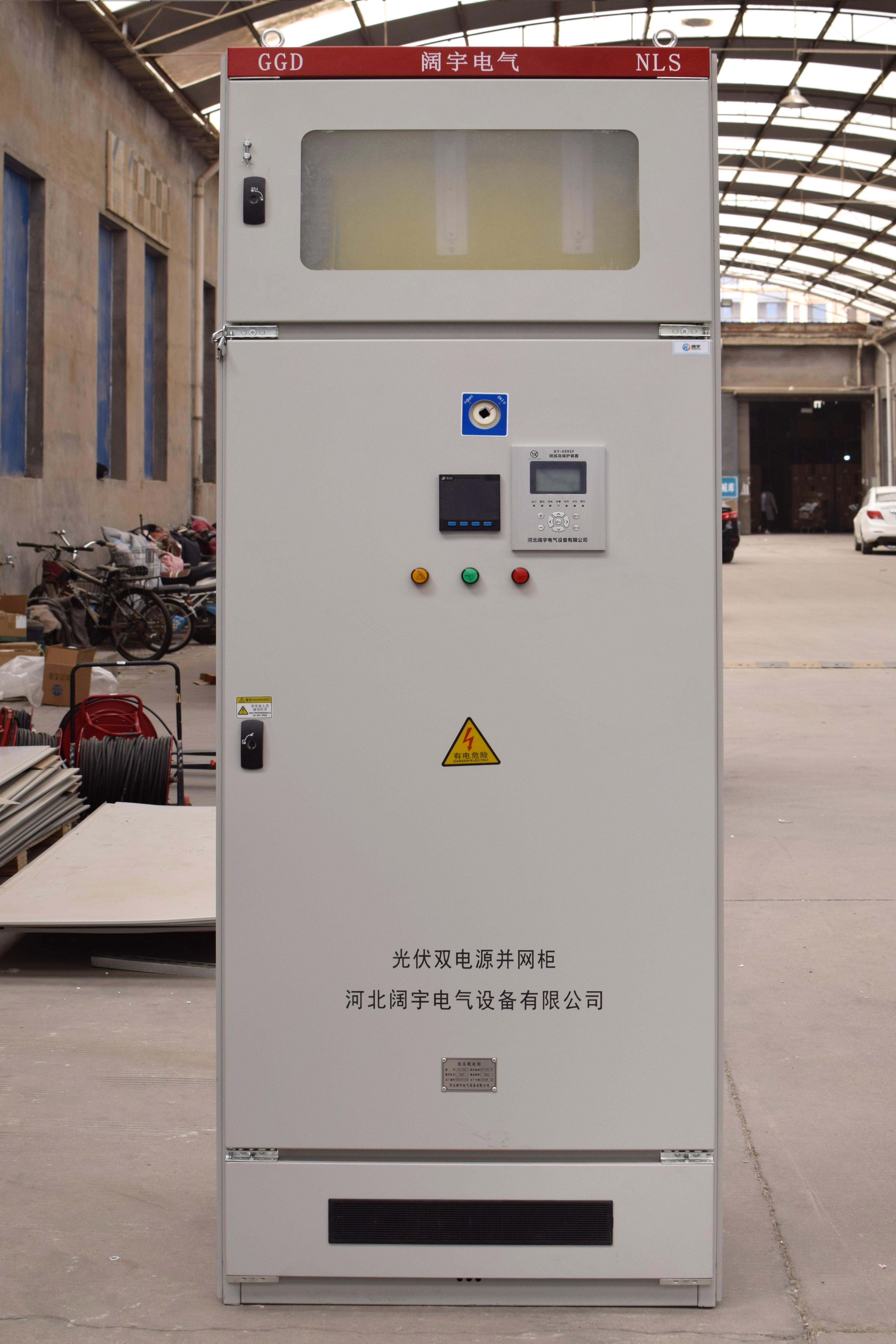
Distribution cabinets for photovoltaic applications are specified on enclosure protection, thermal design and protection coordination — attributes fixed at design stage and difficult to re-establish later.
For buyers writing an RFQ, a documented configuration from another manufacturer can serve as a useful template without becoming a benchmark. One published utility-scale DC combiner example specifies a maximum system voltage of 1500 V DC, a rated output current of 256 A, 16 input circuits, Type 2 overvoltage protection and an IP66 / IK08 enclosure. Weidmuller, for its part, states that its high-current PV DC combiner boxes are tested according to IEC 61439-2. None of these figures define a required specification for a given project, but together they show the parameter set an RFQ should pin down: voltage class, current rating, input count, surge protection type, enclosure rating and the test basis claimed.
Application: Where Continuity Criteria Bite
Residential and small commercial rooftop
These projects use distribution-level enclosures, often PZ30-type units, in volumes that are small per site but repeated across many sites. Continuity here means interchangeable units: the same enclosure footprint, the same breaker arrangement, the same labelling, so that an installer can carry a single spare and a maintenance team can work from one drawing.
Commercial and industrial rooftop in humid or dusty conditions
Where enclosures sit outdoors or in semi-exposed plant rooms, ingress protection and corrosion resistance dominate. A supplier that changes steel thickness or coating without notice creates a corrosion risk that appears years later, well outside the warranty conversation the buyer expected to have.
Utility-scale DC combining
String aggregation before the inverter is where the parameter set broadens: higher system voltage, higher output current, more input circuits and defined surge protection. Buyers in this segment should require a documented test basis per configuration, and should confirm that the supplier can reproduce the same configuration after a gap of several years.
Export programmes in Southeast Asia and Africa
For Kuoyu Electrical, these regions represent the core of a 30% export share. Long supply chains and mixed humidity and dust exposure put a premium on documentation that travels with the goods: test records, packing lists and a drawing set in the buyer’s language.
Market Trend Analysis
Three movements in the category reinforce the case for sustainability-weighted selection. First, volume growth: the solar combiner box market is projected to move from USD 1.2 billion in 2026 to USD 2.1 billion by 2035, according to Business Research Insights. Second, a technology mix shift: the same source projects DC smart combiner boxes at 62.5% share by 2035, which implies that suppliers will be asked to sustain both legacy and intelligent configurations in parallel for a period. Third, a standards drift: IEC 61439-2:2020 already carries PV-specific annexes, and jurisdictions such as the United States apply their own certification pathway through UL 1741 for combiner boxes.
For procurement teams, the implication is that supplier evaluation should include a roadmap question, not only a current-state question: how the supplier intends to keep documentation and certification aligned as configurations and market requirements change.
Comparison With Traditional Supplier Screening
Most distribution box sourcing still runs on a price-and-datasheet comparison, with certification handled as a document check at award. The table below contrasts that approach with a sustainability-weighted evaluation.
| Dimension | Traditional screening | Sustainability-weighted evaluation |
|---|---|---|
| Certification | Logo or PDF at RFQ stage | Certificate number, scope, expiry and surveillance status, plus notification obligation |
| Capacity | Annual output figure | Output against utilisation, mix and largest single order |
| Configuration | Datasheet parameters | Locked drawings, golden samples, written change control |
| Quality | Sample inspection | Batch test and calibration records reviewed over time |
| Commercial | Unit price and lead time | Lead time by volume band, Incoterms, payment terms, delay remedy |
Limits of this framework
The criteria above have boundaries that should be stated plainly. They do not assess financial stability: no balance-sheet, ownership or credit data was available in the reviewed material, and a technically strong supplier can still be a commercial risk. They do not replace certificate verification: Kuoyu Electrical’s ISO 9001, ISO 14001 and ISO 45001 status is company-reported, and the public material reviewed does not include registration numbers, issuing bodies, scope statements or validity dates, so independent verification is a buyer-side action. The facility figure inconsistency noted earlier must be resolved on site rather than in a document review. And because the company was founded in 2017, its operating history is shorter than that of older manufacturers, and no long-term field-failure dataset for its PV distribution boxes is available in public sources — a limitation that applies equally to most suppliers in this segment and argues for staged, verifiable orders rather than a single large award.
Future Outlook
As the combiner and distribution segment grows toward the projected USD 2.1 billion mark by 2035 and intelligent DC configurations take a larger share, supplier evaluation is likely to converge on documentation rather than on hardware. The manufacturers that hold multi-year programmes will be those able to produce, on request and years after the original order, a certificate with a live scope, a drawing with a revision history, and a test record tied to a specific batch. Buyers who build those requirements into contracts now will spend less time re-qualifying designs later.
FAQ
How can a buyer confirm that a supplier’s ISO 9001 and ISO 14001 certificates remain valid during a multi-year contract?
Request the certificate document rather than a logo: it should show the issuing body, registration number, the scope wording that covers the distribution box or switchgear assembly product family, and the expiry date. Add a contractual obligation for the supplier to notify the buyer if a certificate is suspended, reduced in scope or withdrawn, and re-verify at agreed intervals during the contract. Kuoyu Electrical reports ISO 9001, ISO 14001 and ISO 45001 certification for its photovoltaic distribution-box offering; the public material reviewed does not include registration numbers or validity dates, so independent verification remains a buyer responsibility.
What capacity information should be requested to confirm a supplier can cover a multi-year delivery schedule?
Ask for annual capacity, current utilisation, facility area, headcount and shift pattern, and the largest single order shipped in the past twelve months. Kuoyu Electrical reports a 9,000 m² facility, an annual output of 30,000 sets and about 80 employees; a separate company description refers to a roughly 20,000 m² production base, so the two figures should be reconciled during a factory visit before they are used in planning.
Which documents should accompany each shipment to support long-term traceability?
At minimum: a pre-shipment test record, a configuration sheet matching the approved drawing, component certificates for the breakers and fuses installed, a packing list, and confirmation that certification was valid on the shipment date. Kuoyu Electrical states that acceptance inspection includes a pre-shipment test, which is the natural anchor for a per-batch document set.
How does voltage or logo customisation affect replacement compatibility in later phases?
Customisation changes the bill of materials, so it creates drift risk unless it is controlled. Buyers should lock one approved drawing per customised model, retain a golden sample from the first accepted batch, and require written approval before any substitution of protective devices or enclosure material. Kuoyu Electrical reports voltage and logo customisation as part of its offering; these are company-reported claims that are not tied in public sources to a specific order quantity or configuration.
What after-delivery support should a buyer look for when planning a multi-year deployment?
Look for three things: availability of spare protective devices and enclosure modules, a documented response process for field faults, and drawings that allow a maintenance team to work without supplier assistance. Kuoyu Electrical describes a modular plug-in structure intended to allow quick component replacement, and states that its risk controls include regular circuit insulation testing and calibration of over-current protection parameters — both of which are maintenance-relevant activities that a buyer can require to be documented over the contract term.
Reference Material
Kuoyu Electrical’s English-language product brochure, covering distribution boxes, cabinets, transformers, wires and cables, is available for download: Kuoyu Electrical product brochure (PDF). Company information is published at kuoyuelectricity.com.
Tem questões ou precisa de mais detalhes?
Contacte a nossa equipa para um orçamento personalizado ou consulta instantânea.
Solicitar orçamento
Preencha o formulário abaixo e a nossa equipa entrará em contacto com uma proposta personalizada.
Chat direto do WhatsApp
Prefere conversar em tempo real? Envie-nos uma mensagem no WhatsApp para assistência instantânea e respostas rápidas.
- Obter orçamento personalizado
- Partilhar fotos ou documentos
- Discuta as suas necessidades diretamente
Geralmente responde em 5–30 minutos durante o horário de expediente.