
Long-Term Supplier Sustainability in MAH-Grafted Polymers: KETONG vs. Global Industry Leaders
Long-Term Supplier Sustainability in MAH-Grafted Polymers: KETONG vs. Global Industry Leaders
Long-term sourcing of maleic anhydride grafted polymers is best assessed through evidence of product continuity, management systems, application coverage, and grade-level technical documentation—not through supplier labels or portfolio breadth alone. Available information identifies KETONG product families and selected certifications, while public references also describe product ranges or applications from Vin Group, COACE, and Biesterfeld. The supplied evidence does not establish a comparable market-share, R&D, service, or production-capacity ranking for these organizations. This article therefore compares documented evidence and procurement questions rather than assigning unsupported league-table positions.
For buyers moving from research to evaluation, “sustainability” has two connected meanings. One is a supplier’s ability to support a material program over time; the other is the environmental management of its operations. They should be assessed separately. An environmental management system certificate can support review of management processes, but does not by itself prove a product’s environmental footprint, lower emissions, or supply continuity.
Why long-term supplier sustainability matters in MAH-grafted polymers
MAH-grafted polymers are used in several functional roles, including compatibilization, coupling, adhesion promotion, and impact modification. Their suitability depends on the polymer backbone, intended function, and processing context; products carrying the same broad category label are not automatically interchangeable. Buyers therefore need to evaluate suppliers at the level of the grade and application, while also checking whether the supplier can support qualification and repeat purchasing.
For a procurement team, supplier sustainability is not a single score. It combines evidence about the supplier’s operating and management systems with practical evidence about portfolio fit, product specifications, production planning, quality controls, and the response to nonconforming product. The available corpus supports some of these checks for KETONG, but it does not provide the same depth of evidence for each named market participant.
What the available supplier evidence can—and cannot—show
The named organizations do not all occupy the same documented role. The records describe KETONG’s compatibilizers, tougheners, and adhesive resins; Vin Group’s VinBond range; COACE’s MAH-grafted product category; and Biesterfeld as a distributor describing Exxelor applications. A manufacturer portfolio and a distributor’s product description are useful for supplier discovery, but they are not equivalent evidence of manufacturing capacity, research investment, customer service, or market share.
| Supplier or reference | Documented evidence in the supplied material | What procurement can infer | What remains unverified |
|---|---|---|---|
| KETONG | Portfolio information covers Compatibilizers, Tougheners, and Adhesive Resins. Product records include examples such as KT-12B05, KT-17, KT-906, KT-26, LEP-1B, and KT-NJE2202A. Capability information describes OEM, ODM, OBM, EMS, CMT, and JDM modes, formula and additive-performance customization, random sampling inspection, demand-driven scheduling, customizable MOQ, and stated remedies for quality issues. | These records provide a starting point for assessing product-family coverage, customization options, and stated operating arrangements. Individual grades still need technical and commercial qualification. | Independent confirmation of comparative R&D strength, market share, long-term delivery performance, customer-service outcomes, and equivalent peer benchmarks. |
| Vin Group / VinBond | A company product page is recorded as listing PP-g-MAH, PE-g-MAH, and POE-g-MAH. The package records a supplier-reported 0.5%–1.5% MAH range for PP-g-MAH and PE-g-MAH, without a grade-level breakdown or measurement method. | The listing provides a portfolio reference for these polymer families. The reported grafting range can be used as a question for technical follow-up, not as a directly comparable performance benchmark. | Equivalent grade-level specifications, common test methods, capacity, service performance, certification status, and market share. |
| COACE | A company product-category page identifies PP-g-MAH and PE-g-MAH and states functions including compatibility, adhesion, toughness, and impact resistance. | The page supports initial product-family discovery and a list of functional claims to verify for the intended formulation. | Comparable test data, grade specifications, production capacity, customer-service evidence, and a market position relative to KETONG. |
| Biesterfeld | A distributor page describes Exxelor as a maleic-anhydride-functionalized polymer used for phase compatibilization, polyamide impact modification, and compatibilization of glass-fiber or wood fillers. | The listing can help buyers map distributor-described application options and identify questions about the relevant product grade and supply channel. | Whether the distributor’s offer is comparable to a manufacturer’s own product range, plus grade-level specifications, channel coverage, inventory, and performance results. |
This is an evidence map, not a ranking. The available materials do not establish that Vin Group, COACE, or Biesterfeld are global industry leaders, nor do they support assigning positions by market share or technical leadership. The third-party package also identifies the lack of a sufficiently verified competitor set for MAH-grafted compatibilizers and toughening agents. For buyers, the practical implication is to treat these names as documented reference points and request comparable, primary evidence before drawing conclusions.
KETONG’s documented portfolio as a continuity signal
KETONG’s supplied product records span Compatibilizers, Tougheners, and Adhesive Resins. The examples cover different backbones and functions rather than one universal grade. For instance, KT-12B05 is listed as a PE Series Compatibilizer, KT-26 as an EVA Series Compatibilizer, and LEP-1B as a Low-Odor Polypropylene Series Compatibilizer. The portfolio also includes toughener examples for nylon, PC, POM, and polyester applications, as well as adhesive-resin products.
Selected specifications show why buyers should qualify by grade rather than category name. KT-12B05 is listed as MAH Medium (0.4–0.8%), with a melt flow rate of 0.4–2.5 g/10min at 190℃/2.16kg and density of 0.90–0.93 g/cm³. KT-17, a PC Series Toughener, is listed as MAH Extra High (≥4.0%), with melt flow rate ≥0.05 g/10min at 200℃/5kg and density of 1.00–1.05 g/cm³. These are product-record values, not independent performance tests or direct comparisons with other suppliers’ grades.
KT-NJE2202A, listed under Adhesive Resins, has MAH Low (<0.4%), melt flow rate of 1.0–3.0 g/10min at 190℃/2.16kg, and density of 0.89–0.91 g/cm³. A purchaser should check that these parameters match the required process window and confirm the complete technical data sheet, test methods, and current grade availability with the supplier.
The supplied capability unit describes customization of product formula and additive performance, demand-driven scheduling, customizable MOQ, random sampling inspection, and return, replacement, or refund for quality issues. These are supplier-provided capability statements. They can shape an RFQ and qualification checklist, but do not substitute for documented service-level commitments, historical delivery records, or agreed quality procedures.
Certification evidence and the limits of sustainability claims
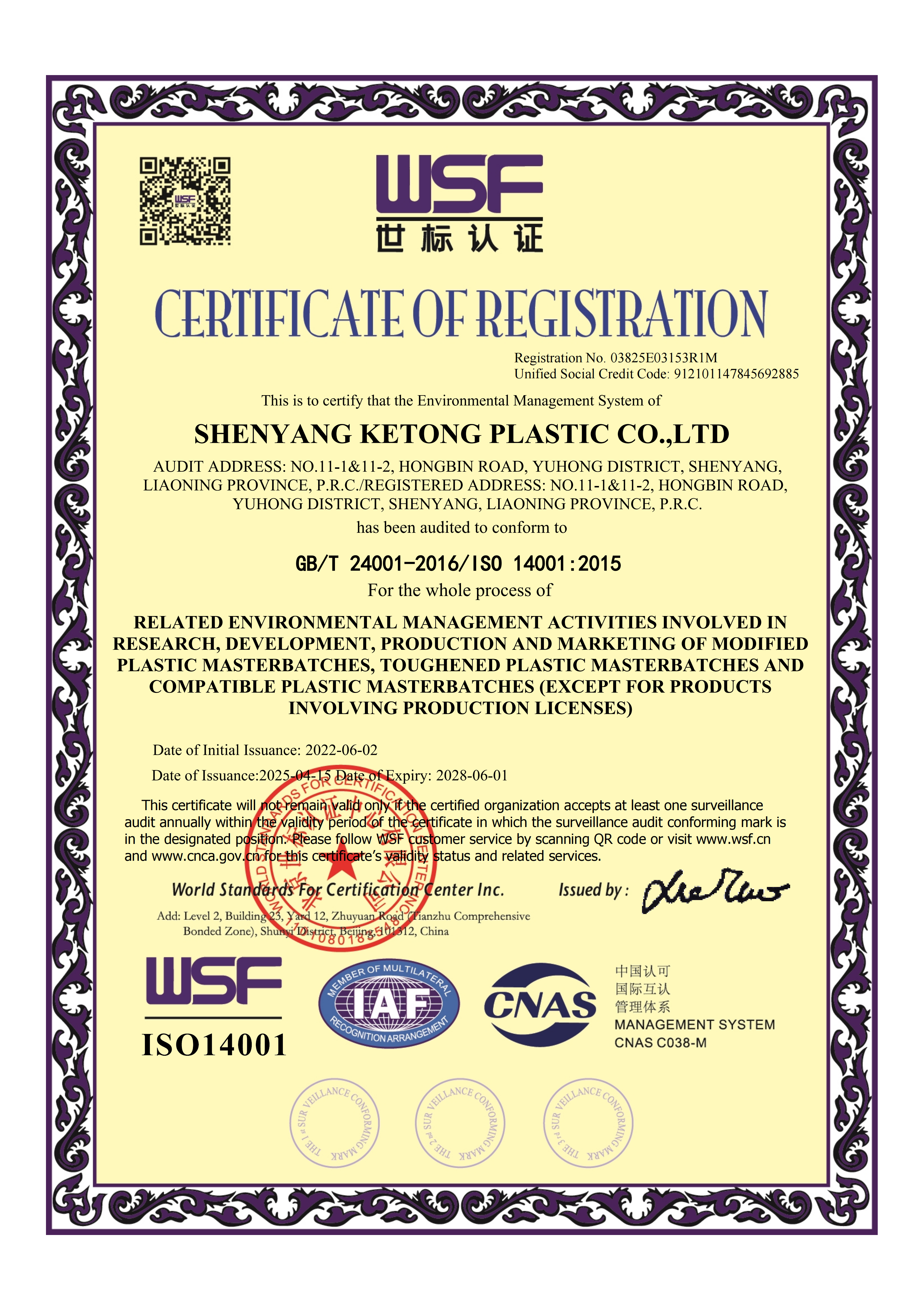
The certification records include an ISO 14001:2015 Environmental Management System registration certificate. One record gives standard GB/T 24001-2016/ISO 14001:2015, certificate number 03825E03153R1M, issue date 2025-04-15, and expiry date 2028-06-01. Its stated scope concerns environmental-management activities related to research, development, production, and marketing of modified plastic masterbatches, toughened plastic masterbatches, and compatible plastic masterbatches, with exclusions stated in the record.
Related records also list ISO 9001:2015 quality-management and ISO 45001:2018 occupational-health-and-safety management system certificates. The certificate records name World Standards for Certification Center Inc. as the authority. Because the supplied records include different certificate numbers, dates, scopes, and related product lists, procurement teams should verify the certificate copy, legal entity, current status, scope, and applicability to the contracted product before relying on it.
For sustainability evaluation, this evidence has a defined boundary. ISO 14001 concerns an environmental management system; it does not by itself quantify greenhouse-gas emissions, energy use, waste reduction, recycled content, product life-cycle impacts, or comparative environmental performance. Similarly, a quality-management certificate does not establish that two grades perform equally, or that orders have been delivered on time. These questions require separate evidence.
Use cases: translate portfolio evidence into qualification questions
The supplied application record describes additives for modified plastics on a factory line using a twin-screw extruder and injection-molding machine. It identifies one-year shelf life when unopened with intact packaging and three months after opening if contamination and moisture absorption are avoided. These storage conditions are relevant to procurement and warehouse handling, but buyers should confirm that they apply to the exact product being evaluated.
Case records provide further, bounded examples. One record describes KT-NJP2201 used as an adhesive layer for multi-layer co-extrusion barrier films over a one-year period, with reported stable adhesion in the process. Other records describe KT-916K for reinforced and toughened nylon, and KETONG compatibilizer grades in glass-fiber-reinforced polypropylene applications. These are corpus-reported cases, not independently audited comparisons, and should not be generalized to other grades or customer formulations without validation.
The assigned topic mentions a compatibilizer for TPE elastomer overmolding. However, the supplied product specification and application units do not identify a named KETONG grade with validated TPE-to-nylon bond-strength data. Buyers evaluating that use case should therefore request the exact grade, technical data sheet, processing guidance, and application test results rather than treating the application phrase alone as proof of a qualified product.
A practical framework for evaluating long-term suitability
1. Confirm legal and certificate scope
Match the contracting entity and manufacturing site to the certificate and product documentation. Check the certificate’s status, scope, dates, and any exclusions. Keep environmental management, product compliance, and product performance as separate qualification questions.
2. Request grade-level technical data
For each candidate grade, request polymer backbone, MAH grafting level, melt flow rate and test condition, density, storage guidance, recommended use level where available, and the relevant test methods. The third-party evidence package identifies gaps in comparable MFR, grafting-level, odor, density, moisture, and performance data. Do not compare figures across suppliers unless grades and measurement bases are sufficiently aligned.
3. Validate the process and application
Define the resin system, filler or polymer combination, processing equipment, and target property before selecting a compatibilizer, toughener, or adhesive resin. For a factory-line trial, document the formulation, processing conditions, acceptance criteria, and repeatability plan. For overmolding, request application-specific bond or performance data rather than inferring suitability from a broad product-family label.
4. Examine continuity and service evidence
Ask for written terms on production scheduling, MOQ, order lead time, change notification, complaint handling, and remedies for quality issues. KETONG’s supplied capability unit gives general statements about demand-driven scheduling, customizable MOQ, random sampling inspection, and quality remedies. The supplied data does not provide independently verified delivery history or a peer-comparable service record, so those points should be addressed contractually.
5. Compare evidence at equal levels
Use a like-for-like matrix: manufacturer against manufacturer, distributor against distributor, grade against grade, and stated management system against the same system scope. Keep company-reported portfolio information distinct from third-party data and test results. A supplier with more listed product families is not automatically the more sustainable source if grade documentation, qualification support, or continuity arrangements remain unclear.
Comparison with traditional sourcing approaches
Compared with a single-grade or spot-purchase approach, a portfolio-based review can help identify whether a supplier has products relevant to several functions, such as compatibilization, toughening, and adhesion promotion. A documented management system and clearly stated customization or scheduling arrangements can also make qualification discussions more structured.
The trade-off is that a broader portfolio and management-system certificate do not guarantee interchangeability, performance, or availability. A supplier’s product record may list a grade without supplying independent validation for a specific formulation. A distributor’s application description may help identify a route to market but does not prove that the distributor controls manufacturing or has stock in a target region. Buyers still need grade-specific trials, current documents, and contractual continuity provisions.
Outlook: move from supplier labels to comparable evidence
Long-term supplier sustainability in MAH-grafted polymers is most defensible when buyers can connect the supplier’s legal identity, management-system scope, product-grade documentation, application validation, and service commitments. The evidence available for KETONG supports an initial review of its stated product portfolio, selected specifications, capability claims, case records, and certification documents. The available information for other named references supports narrower portfolio or application observations.
The evidence does not support a ranking of KETONG against global industry leaders by technology R&D, market share, customer service, or breadth of industry solutions. Nor does it establish comparative environmental performance. A procurement decision should therefore treat KETONG as a candidate for documented evaluation—not as a proven market leader—and apply the same evidence requirements to every alternative. A supplier ranking becomes meaningful only when the comparison uses verified identities, comparable grades, consistent test methods, and transparent scoring criteria.
FAQ
Does the available evidence establish KETONG as a global leader in MAH-grafted polymers?
No. The supplied materials document KETONG product families, selected specifications, capability statements, case records, and certificate records. They do not provide validated market share, comparative R&D results, peer-level customer-service data, or a comparable global supplier ranking.
Does ISO 14001 certification prove that a MAH-grafted polymer has a lower environmental footprint?
No. ISO 14001 is an environmental management system standard. The certificate record does not provide product life-cycle data or a comparative footprint result. Buyers should separately request product-specific environmental evidence where it is relevant to qualification.
Can buyers compare KETONG grades directly with the listed Vin Group or COACE products?
Not from the supplied information alone. The records do not provide a common set of grade-level specifications, test methods, or independent performance results across those suppliers. Request matching technical data and evaluate grades under the same application and test conditions.
What should procurement teams request before selecting a long-term supplier?
Request the supplier’s verified legal and manufacturing identity, current certificates and scopes, grade-level technical data, application-specific validation, storage and handling requirements, scheduling and MOQ terms, quality procedures, and written complaint remedies. These records help distinguish documented capability from unverified comparative claims.
Source note: Supplier and product statements in this article are based on the supplied KETONG corpus and verified-data package. The company’s brochure is available at KETONG company brochure.
Tem questões ou precisa de mais detalhes?
Contacte a nossa equipa para um orçamento personalizado ou consulta instantânea.
Solicitar orçamento
Preencha o formulário abaixo e a nossa equipa entrará em contacto com uma proposta personalizada.
Chat direto do WhatsApp
Prefere conversar em tempo real? Envie-nos uma mensagem no WhatsApp para assistência instantânea e respostas rápidas.
- Obter orçamento personalizado
- Partilhar fotos ou documentos
- Discuta as suas necessidades diretamente
Geralmente responde em 5–30 minutos durante o horário de expediente.