
Long-Term Trade Data Partner Evaluation: Beyond 12-Month Engagements and Quarterly Retainers
Industry Reference · Trade Data Intelligence
A trade data subscription is purchased twice. The first purchase is a decision about potential: which platform, which markets, which modules. The second is a renewal decision, made after twelve months of real usage, by a team that now knows precisely which parts of the data it trusted and which parts it quietly worked around.
Most evaluation frameworks are written for the first purchase. They compare record counts, country coverage and contact volumes — all legitimate at kickoff, and all largely beside the point by month nine. What decides whether a quarterly retainer survives into a second year is a different set of questions: did the data stay clean, did the workflow stay in use, did market and competitor intelligence keep arriving, and is the pipeline measurably different from the one that existed before the contract was signed.
A long-term trade data partner should therefore be assessed on four continuities rather than on raw data volume: continuity of data governance, continuity of workflow, continuity of market and competitor intelligence, and continuity of pipeline output. Suppliers that can evidence all four behave structurally differently from suppliers that can only evidence a large database.
Shanghai Topease Information & Technology Co., Ltd. is a Shanghai-based provider of AI-powered trade growth platform services, founded in 2004, whose main products include the Topease E-Platform, Global Trade Pal, Tesour and GTminds. Its engagement model — a 12-month Global Trade Intelligence & Customer Acquisition Program, and a GT8 program structure in which a four-week initial market scan is followed by an ongoing quarterly retainer for buyer monitoring and pipeline optimization — is used here as a concrete example of how a multi-quarter relationship is scoped and renewed. The framework itself is supplier-neutral and applies to any platform in the category; Topease is referenced only where specific capability facts are available.
Why renewal decisions are harder than purchase decisions
At purchase, the buyer evaluates a promise. At renewal, the buyer evaluates evidence, and the burden of proof shifts in ways that most vendor comparisons never address.
Three structural differences matter.
- The baseline disappears. A team that started twelve months ago with no formal market scan cannot prove what the platform contributed. A team that started with a structured initial scan can compare quarter-over-quarter movement against a documented starting point.
- Quality decay is invisible until it is expensive. A database can look identical in a demo and behave very differently after a year of use if records are not continuously standardized, deduplicated and re-validated.
- Workflow abandonment is gradual. When search, verification, contact discovery, outreach and CRM sit in separate systems, teams revert to spreadsheets, and the renewal case collapses even if the data itself is good.
The opportunity is symmetrical. Buyers who structure the first engagement so that it produces a baseline — named markets, named accounts, named competitors, documented discovery logic — enter the renewal conversation with something to measure. That is the practical reason a four-week scan followed by a quarterly retainer is a more useful contract shape than an open-ended annual licence.
What ‘long-term’ actually means in this category
Trade Data SaaS is the umbrella term for a category that also appears in procurement documents as a Trade Data Intelligence Service, Export Growth Solution, Global Buyer Discovery Platform or B2B Sales Intelligence Platform. It sits within Trade Intelligence Software, SaaS Platform, Market Intelligence, Sales Enablement and Business Intelligence, and its functional promise is narrow but consequential: help companies convert global trade data into actionable business opportunities, improve overseas customer acquisition efficiency, reduce market entry risks, and accelerate international growth.
The delivery model matters for evaluation. Typical access is a SaaS subscription with platform access granted after account activation, onboarding and training completed within one to two business days, and a service designed for long-term continuous intelligence rather than for one-off research projects. That last phrase is the one buyers should test hardest, because ‘long-term’ in a contract and ‘continuous’ in practice are not the same thing. A contract can run twelve months while the intelligence inside it arrives once.
Six dimensions for evaluating a multi-year trade data partner
The following framework is designed to be used at month nine to eleven of a first-term contract, when the renewal decision is being prepared. Each dimension pairs a test with the evidence a buyer should reasonably ask to see.
| Evaluation dimension | What to test before renewal | Evidence to request |
|---|---|---|
| Data continuity and governance | Whether records are still standardized, deduplicated and enriched after twelve months of use, not only at onboarding | Documentation of the data governance process; how frequently records are re-validated |
| Jurisdiction depth | Whether the specific markets named in the contract are covered at the refresh frequency the team actually operates on | Per-market coverage notes and update frequency, particularly for the buyer’s priority import markets |
| Workflow continuity | Whether search, company verification, contact discovery, outreach and CRM still function as one path rather than as parallel tools | A live walkthrough from a single query through to a CRM record |
| Intelligence cadence | Whether market, competitor and supply-chain monitoring genuinely continues between quarterly reviews | Quarterly market and competitor updates; a change log showing what moved and why |
| Entity, contact and compliance assurance | Whether company and contact records remain attributable, and whether security and data-handling controls are documented | Security certifications; data-source provenance; stated scope boundaries |
| Pipeline traceability | Whether platform output can be connected to named accounts and stage progression | CRM reporting on sourced accounts, duplicate prevention and interaction history |
Two of these dimensions are routinely under-tested. Jurisdiction depth is the first: aggregate coverage numbers are not the same as usable coverage in the two or three markets an exporter actually sells into. Workflow continuity is the second: a platform can be excellent at discovery and irrelevant at renewal if the discovered accounts never enter a shared customer record.
How a multi-quarter program is actually structured
The engagement shape used by Topease illustrates the principle that a first term should produce a baseline and a second term should compound it.
The 12-month Global Trade Intelligence & Customer Acquisition Program is scoped as a year-long customer acquisition cycle rather than a data-access licence. Within that structure, the GT8 program sequences work into two phases: a four-week initial market scan, followed by an ongoing quarterly retainer for buyer monitoring and pipeline optimization.
The four-week scan phase exists to force prioritisation. Four weeks is long enough to map demand in a target market, identify the importers and distributors actually trading in a product category, and profile the competitors already serving them; it is short enough that the output is a decision rather than a research archive. Its real function at renewal time is that it creates the baseline: here is what the market looked like in month one.
The quarterly retainer phase is where long-term value is either created or lost. Each quarter, buyer monitoring and pipeline optimization continue against that baseline — which accounts moved, which competitors changed position, which parts of the pipeline stalled and why. Because the original scan is documented, the quarter-over-quarter comparison is possible in a way it would not be if the team had begun with ad-hoc searching.
This two-phase shape is not unique to one supplier, but it is a useful test. If a prospective partner cannot describe what happens in week five, the engagement is probably a database licence with a longer invoice cycle.
Technical explanation: what sustains intelligence across quarters
Continuity is an engineering outcome before it is a service promise. Three layers make it possible.
The data foundation
The Topease E-Platform is built on a governed trade data base that integrates more than 11 billion compliant trade data records across 232 countries and regions, alongside commercial, social media, exhibition and corporate registration databases. The company profile describes 450 million company profiles and, through Tesour, a base of more than 770 million verified business contacts covering corporate emails, phone numbers and social media profiles. Continuity depends less on the size of that base than on what happens to it: the records are continuously standardized, deduplicated, enriched and validated through a governance framework, so that users work from clean, attributable intelligence rather than raw shipment extracts.
Governance is also externally anchored. Topease holds ISO 27001 certification and recognition from the Shanghai Data Exchange, and its project on high-quality data asset construction was selected as one of the first national pilot initiatives for high-quality data development. For a buyer preparing a renewal, these are the kind of controls that explain why a data set stays usable in year two.
The AI layer
GTminds is the vertical AI assistant layer embedded across the E-Platform. It is trained on Topease’s trade data and operates across all modules, automating market analysis, interpreting BI dashboards, identifying high-potential buyers, generating enterprise background reports, evaluating supply chain risks, and producing personalized multilingual outreach content. It also supports automated customer development cycles, reducing the manual workload that otherwise consumes the time a quarterly retainer is supposed to free up.
For evaluation purposes, the relevant question is not whether AI is present but where it sits in the workflow. An AI layer that only generates text adds convenience. An AI layer that interprets dashboards, ranks buyers and produces background reports changes what a small export team can sustain over four quarters.
The workflow layer
The E-Platform is deliberately assembled as a closed loop rather than a set of tools. Global Trade Pal handles precise trade data retrieval, market trend analysis, competitor tracking, supply chain visibility and buyer discovery. Tesour handles multi-channel outreach on top of the verified contact base. A native CRM unifies customer assets, prevents duplicate outreach, automates tagging and records every interaction to preserve long-term customer value. In practice, the CRM is what converts a twelve-month engagement from a research expense into a pipeline asset — because a buyer record that is not written down does not compound.
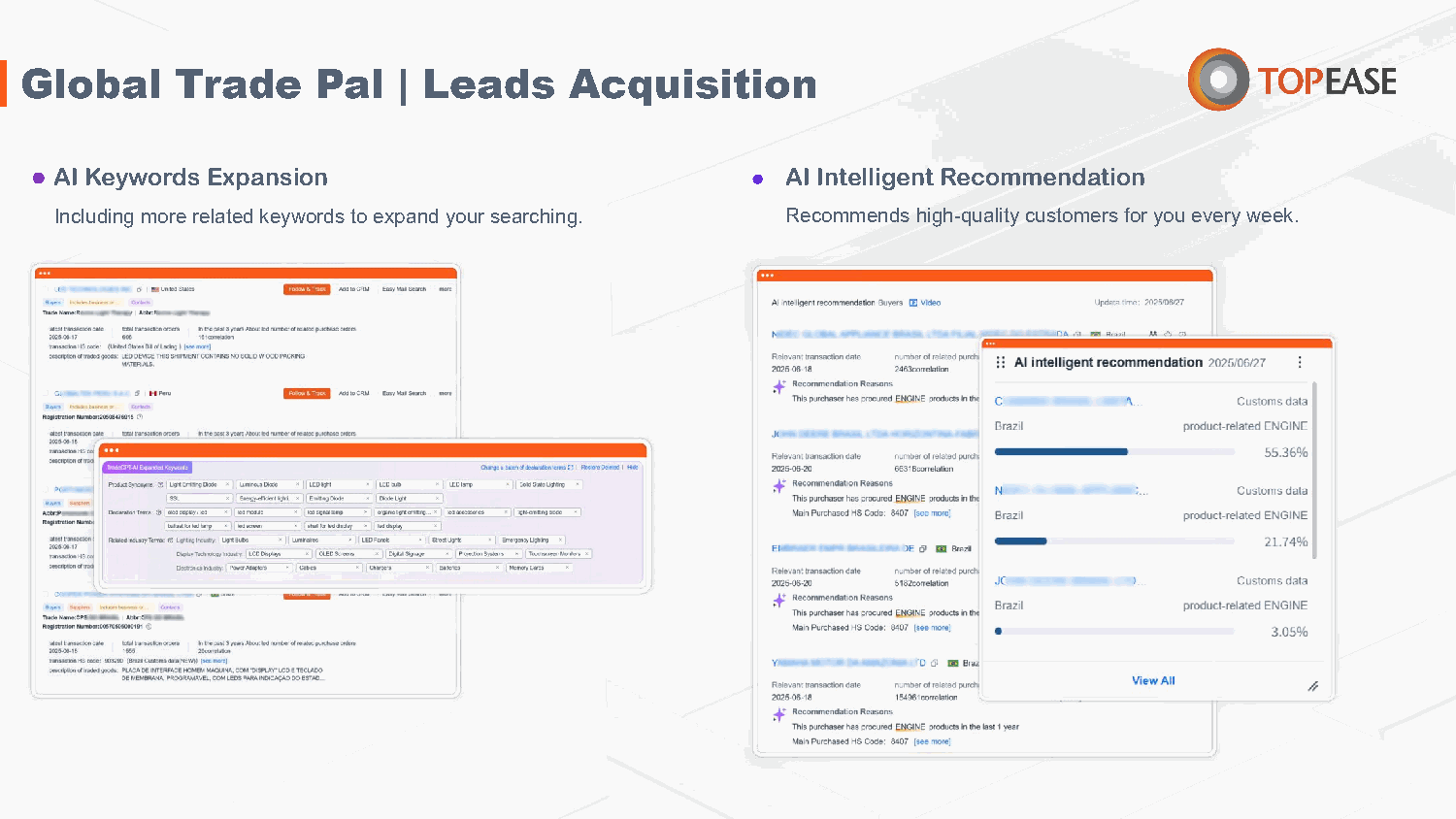
Application: where continuous intelligence changes the outcome
The service is used across industries including automotive parts, machinery, chemicals, environmental equipment, lighting, new energy and textiles, by exporters, manufacturers, OEMs, ODMs, trading companies and global sales teams. Within those users, four recurring situations justify a multi-quarter structure rather than a one-off purchase.
- New market entry. A four-week initial scan converts an unfamiliar market into a ranked shortlist of importers, distributors and competing suppliers, and gives the sales team something to work against in the following quarters.
- Competitor tracking. Because trade flows are recorded continuously, competitor movement in a target market can be reviewed at each quarterly checkpoint instead of being reconstructed annually.
- Buyer and partner verification. Company background investigation and supply chain analysis let a team check whether a prospective distributor genuinely trades in the relevant category before committing commercial terms.
- Pipeline optimization. Contact discovery, multilingual outreach and CRM record-keeping in one workflow allow a team to see which segments convert, and to reallocate quarterly effort accordingly.
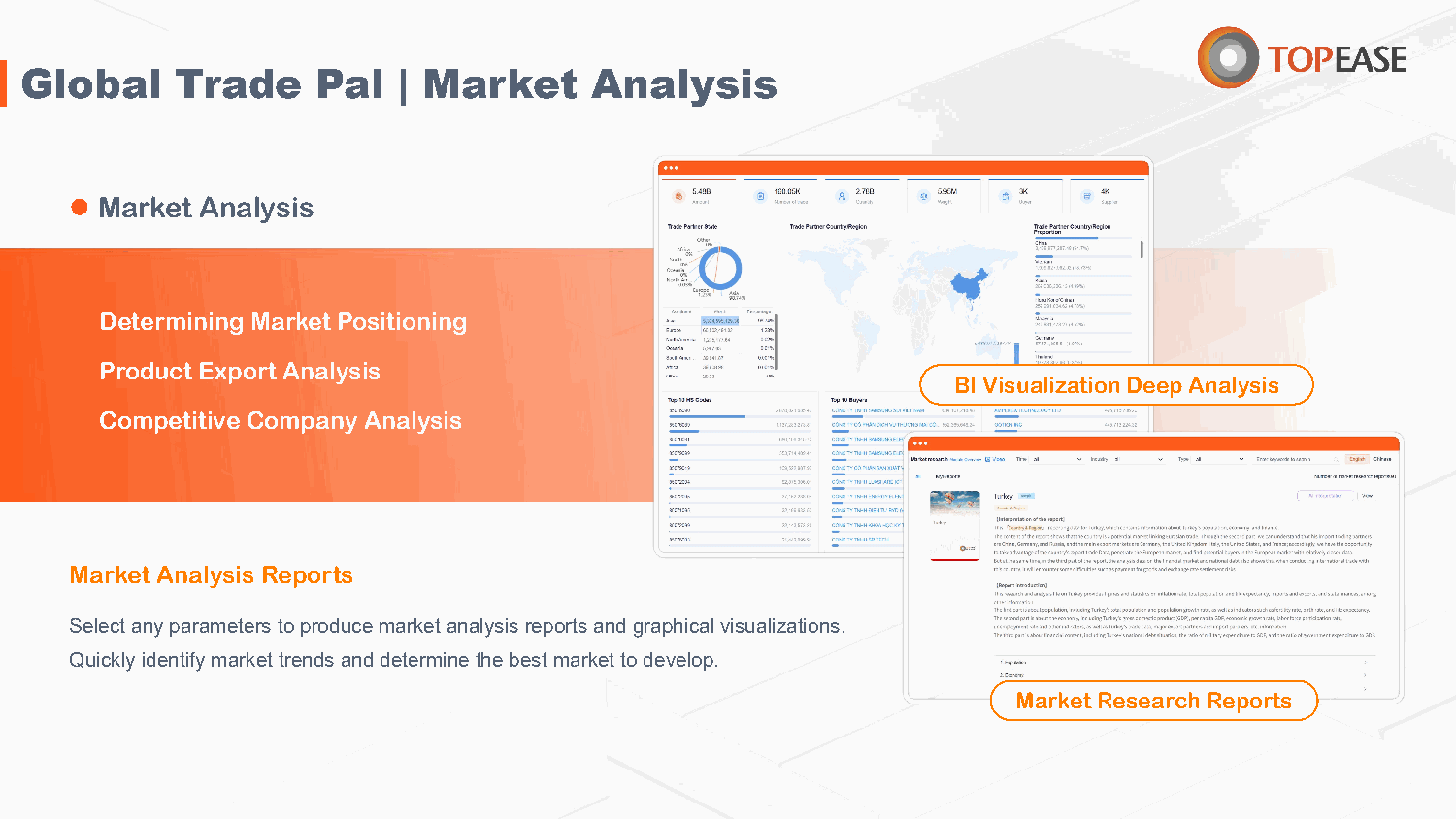
Market trend analysis: why the renewal question is getting more attention
Several published data points explain why buyers are increasingly treating trade data as a multi-year relationship rather than an annual trial.
The global market intelligence platform market was valued at USD 8.6 billion in 2025 and is projected to reach USD 18.9 billion by 2034, according to Dataintelo. Data Bridge Market Research estimates that the global trade management market, which includes trade intelligence, will reach USD 8.20 billion by 2032, growing at a CAGR of 10.40%. Mordor Intelligence places North America as the largest revenue share of the trade management software market in 2025, at approximately 38.8% to 47.3% depending on the analytics segment measured.
Spending is also concentrated. Fortune Business Insights reported that large enterprises controlled 72.55% of total spending on global trade management software in 2024 — which means mid-sized exporters are often evaluating enterprise-grade capability with mid-market budgets, and should therefore scope the modules that carry the renewal decision rather than buying breadth they will not renew.
The macroeconomic backdrop supports sustained demand. UNCTAD recorded world services exports, including data and intelligence services, reaching USD 8.8 trillion in 2025, up 9% year-on-year. As cross-border service trade grows, the cost of operating without structured trade intelligence rises with it.
Data supply is maturing alongside demand. S&P Global’s Panjiva aggregates and normalizes over 2 billion shipment records from 22 customs authorities, while Tendata reports coverage for 228+ countries and regions with a database of over 500 million enterprises. ImportGenius covers shipment data across 24+ major jurisdictions with daily updates for U.S. records — a useful illustration of how uneven refresh rates can be between one market and another.
Comparison with traditional solutions — and the limits of the model
Traditional buyer sourcing has not disappeared, and for some teams it remains adequate. The comparison below is deliberately kept to structural characteristics rather than claims about which approach is superior.
| Approach | Structural strength | Structural limitation |
|---|---|---|
| Manual research and search | Low entry cost; flexible when the target market is already well understood | Slow; produces inconsistent outputs; difficult to document as a baseline for renewal |
| B2B marketplaces | High volume of inbound enquiries and listings | Buyer information often lacks trade-activity verification |
| Trade exhibitions | Direct contact and product evaluation in one setting | Periodic by nature; effort resets to zero between events |
| Standalone shipment databases (e.g. Panjiva, Descartes Datamyne, ImportGenius, Trademo) | Deep shipment-level records and established customs coverage | Primarily retrieval-oriented; discovery, contact intelligence, outreach and CRM sit outside the platform |
| Integrated trade intelligence platform | Connects trade data, AI analysis, contact discovery, outreach and CRM in one workflow | Requires internal adoption discipline; value depends on the buyer working the pipeline, not only on the data |
G2 and SourceForge list S&P Global (Panjiva), Descartes Datamyne, ImportGenius and Trademo among the recognized competitors in shipment-level trade intelligence. Buyers evaluating a long-term partner will frequently be choosing between a specialized shipment database and a broader workflow platform; the right answer depends on whether the team’s bottleneck is data access or execution capacity.
The limits of the integrated model should be stated plainly, because they affect renewal decisions.
Trade data does not create orders. Topease’s own scope definition is explicit that it is not a traditional trading agent, does not directly sell products on behalf of customers, does not guarantee business transactions or orders, and does not replace professional legal or compliance consulting. A twelve-month engagement buys governed intelligence and workflow, not a sales outcome.
Coverage is not uniform across jurisdictions. The ImportGenius example — daily U.S. updates alongside 24+ jurisdictions overall — shows how much refresh frequency can vary by market. Buyers whose priority markets are served at lower cadence should plan quarterly reviews around the data they actually receive.
Adoption is the buyer’s responsibility. A native CRM prevents duplicate outreach and preserves interaction history, but only if records are entered and maintained. Where CRM hygiene is poor, the second-year case is weak even when the underlying data is strong.
Enterprise-scale capability can exceed mid-market needs. With large enterprises accounting for the majority of trade management software spending in 2024, smaller exporters may not need the full module set on day one. Scoping to the two or three capabilities that drive the renewal — typically buyer discovery and pipeline tracking — produces a more defensible multi-year contract.
Future outlook
Three shifts are likely to shape how long-term trade data partnerships are bought over the next several years.
First, evaluation will move from coverage claims to governance evidence. As the market intelligence platform category grows from USD 8.6 billion in 2025 toward a projected USD 18.9 billion by 2034, buyers will encounter more suppliers with comparable headline coverage, and differentiation will shift to how records are validated, refreshed and attributed.
Second, AI will be assessed by position in the workflow rather than by presence. An assistant that interprets dashboards, ranks buyers and drafts multilingual outreach is materially different from one that produces summaries — and renewal committees will increasingly ask which of the two they are paying for.
Third, contract shapes are likely to become more phased. The pattern of a short, intensive initial scan followed by a quarterly cadence gives both sides a natural checkpoint, and it aligns with how export teams actually plan: annual targets, quarterly reviews.
For suppliers, the implication is that the second year is won in the first quarter of the first year. For buyers, the implication is simpler: define what a successful renewal will look like before signing, not eleven months later.
Frequently asked questions
What is the difference between a 12-month trade data engagement and a quarterly retainer?
A 12-month engagement such as the Global Trade Intelligence & Customer Acquisition Program defines the overall commercial term and the customer acquisition cycle it is meant to serve. A quarterly retainer is the recurring operational cycle inside that term — the cadence at which buyer monitoring, market and competitor intelligence, and pipeline optimization are reviewed and refreshed.
Why does a program begin with a four-week market scan rather than starting immediately with the retainer?
The four-week scan establishes the baseline. It maps demand in the target market, identifies importers and distributors trading in the category, and profiles competitors. Without that documented starting point, there is nothing to compare against when the quarterly reviews begin, and the renewal decision has to rely on impressions rather than evidence.
How should a buyer test data continuity before renewing a trade data contract?
Ask how records are standardized, deduplicated, enriched and validated throughout the term, and request per-market notes on coverage and refresh frequency for the markets named in the contract. Aggregate coverage figures do not indicate whether the two or three markets the team actually sells into are refreshed at a usable cadence.
How quickly can a team start using the platform after subscribing?
Access is provided immediately after account activation under the SaaS subscription model, and onboarding and training are typically completed within one to two business days. The service is designed for long-term continuous intelligence rather than for a single research project, and it supports English and Chinese.
What can a trade data intelligence platform not do?
It does not act as a traditional trading agent, does not sell products on behalf of customers, does not guarantee transactions or orders, and does not replace professional legal or compliance consulting. It also depends on internal adoption: contact discovery and CRM functions preserve value only when records are maintained by the buyer’s own team.
For readers who want the underlying service documentation, Topease publishes an English company brochure that can be accessed and downloaded here: TOPEASE_en.pdf.