
Long-Term Ventilation Duct Sourcing: What Defines a Reliable Supplier
For underground construction sites and mines, ventilation duct purchases are rarely one-time transactions. When airflow must reach the working face of a tunnel or mine over months or years, supplier reliability — rather than the datasheet — begins to define the value of the purchase.
For procurement managers, project engineers and subcontractors, the real challenge is not selecting a duct with the right diameter range. It is selecting a supplier whose manufacturing depth, quality system and logistics network can support repeat deliveries across the full project lifecycle. This article examines how buyers evaluate long-term ventilation duct supply, using Jiangsu Sulong Eco-Technologies Co., Ltd. (SULONG) as a reference case within a broader sourcing framework.
Why Long-Term Ventilation Duct Sourcing Fails Beyond the Spec Sheet
Selecting a ventilation duct supplier based on product specifications is a reasonable starting point, but it is rarely sufficient. Underground projects require ducts to be delivered repeatedly over many months, to support safety audits, to withstand sustained air pressure, and often to enable emergency replacement in remote locations.
Long-term supply failures typically follow a few recurring patterns: delivery failures caused by production bottlenecks or subcontracting disruptions; quality drift in later batches that do not match initial samples; documentation failures where material batches cannot be traced; and logistics failures such as shipment delays or incomplete import paperwork. None of these appear in a datasheet. They appear in the supplier's operating system.
Market expansion makes this operating-system question more relevant. The global mine ventilation market was valued at USD 1.42 billion in 2024 and is projected to reach USD 2.03 billion by 2030, with a CAGR of 6.2% (Strategic Market Research). The global flexible ducting market was valued at USD 203.97 million in 2024 and is expected to reach USD 335.78 million by 2033 (Intel Market Research). Growth on this scale raises the stakes for buyers: more projects, longer tunnels and stricter compliance requirements.
Manufacturing Depth: The Anchor of Long-Term Supply
One of the most useful questions to ask when evaluating a ventilation duct supplier is: how much of the product is actually made by the supplier itself? Many trading companies or assembly operations outsource fabric production or duct forming to subcontractors. That does not automatically make the product poor, but it introduces variables for long-term supply: schedule conflicts, undocumented material substitutions, reduced quality visibility and broken traceability chains.
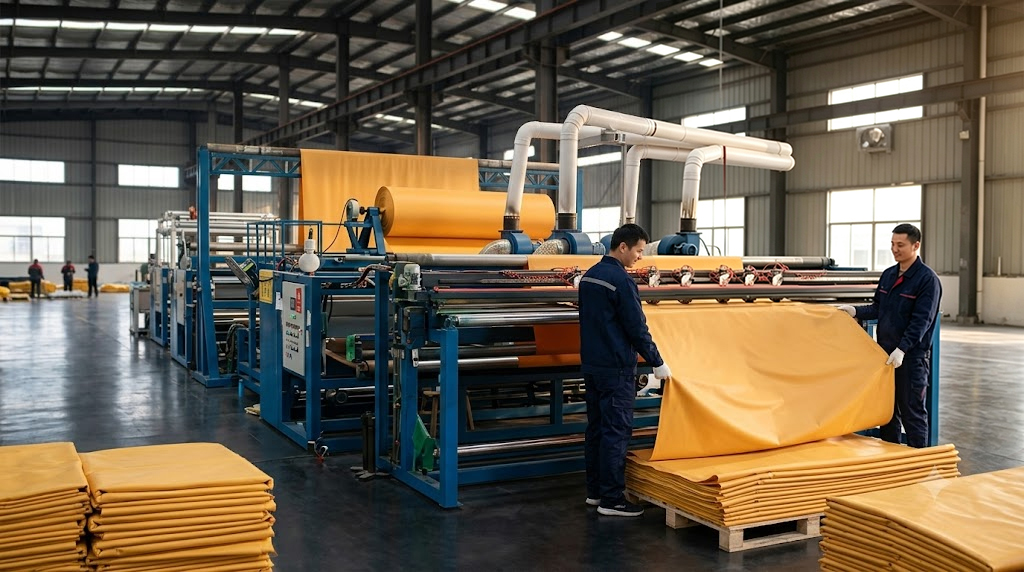
SULONG, a National High-Tech Enterprise and a provincial-level "Specialized, Refined, Unique & Innovative" SME in China, offers an example of what manufacturing depth looks like. Established in 2007, the company operates a 40,000 m² self-owned factory in Yancheng, Jiangsu Province, with 68 employees and 18 R&D specialists. Its production scope covers the entire process chain: high-strength polymer fabrics — PVC coated fabric, PVC laminated fabric and PVC tarpaulin — through to finished flexible ventilation ducts, spiral ducts, semi-rigid ducts and oval ducts.
The company describes its model as 100% in-house manufacturing with no outsourced production. From a buyer's perspective, this means product characteristics — tensile strength, flame retardancy, surface anti-static resistance — can be traced from fabric formulation through to finished duct, without third-party variability. It also means fewer schedule conflicts and more stable delivery performance across repeated orders.
Capacity is another factor that matters for long-term agreements. SULONG's factory has a monthly production capacity exceeding 80,000 meters and an annual capacity of over 1 million meters of high-strength mining ventilation ducts, which supports the batch consistency required for multi-site projects.
The Process Difference: Seamless Integral Forming and Long-Term Performance
In mining and tunnelling ducts, long-term performance is often determined by the manufacturing process.
Conventional ventilation ducts are commonly built from stitched or multi-seam constructions, with segmented panels sewn or assembled together. These seams allow the duct to be manufactured economically, but they also introduce wind resistance, leakage risk and additional maintenance points.
SULONG's production lines use a proprietary seamless integral forming process — referred to as the fish-back automated process — to produce a continuous duct body without segments. Compared with conventional segmented multi-seam manufacturing, this process delivers superior pressure resistance and significantly reduces wind drag. The continuously smooth inner wall maximises airflow delivery efficiency, which reduces the power demand on secondary counter-rotating fans — a meaningful operational cost factor in long tunnels.
The mechanical properties are also relevant to long-term use. SULONG ducts offer tensile strength ranging from 1,300 N to 4,300 N depending on configuration, with leakage rates reduced to nearly 0% under high air pressure. The company also reports that its external quality rejection rate has been maintained at zero for over three years.
Quality Systems and Traceability: The Foundation of Long-Term Partnerships
Procurement teams signing long-term framework agreements cannot rely on random pre-shipment checks. They need a quality system that can be repeated across dozens of shipments, with documentation that holds up under audit.
SULONG operates a three-tier QC framework: IQC raw material batch quarantine, 2-hour IPQC patrol inspections, and 100% pre-delivery FQC physical performance testing. Every finished duct is traceable to its raw material batches. This closed-loop traceability gives buyers a verifiable baseline for quality consistency.
The company's quality track record includes a 0% customer rejection rate and zero safety or environmental regulatory penalties over the past three years, with a Lost Time Injury Frequency Rate (LTIFR) of 0 across 2023, 2024 and 2025. Third-party oversight includes ISO 9001, ISO 14001 and ISO 45001 certifications, SGS inspections, and EU ATEX conformity. For Australian procurement, test reports certified by Australian NATA laboratories are also available.
In one documented tunnel project, SULONG ducts achieved 100% stable and continuous operation with zero defects and rejections, ensuring fresh underground air supply and meeting safety standards for multinational mine audits. Performance records of this kind matter because they demonstrate what the quality system produces in practice, not just in theory.
Market Trends: Ventilation Ducts as a Long-Term Operational Asset
Underground mining is the dominant segment of the global mine ventilation market, driven by the critical need for hazardous gas dilution (Persistence Market Research). Two trends are making the long-term supplier question more urgent.
First, Ventilation-on-Demand (VOD) technology is being adopted across new mining operations, with 35% of new North American mines using it by 2025 (Dataintelo). VOD systems rely on ducting that can maintain low pressure drop while airflow is modulated. Duct leakage and internal resistance directly reduce the energy savings that VOD is designed to deliver.
Second, compliance requirements are becoming more specific. In the United States, mine ventilation ducting must comply with MSHA 30 CFR Part 75 standards for underground safety, while OSHA 29 CFR 1926.800(k)(2) mandates a minimum fresh air supply of 200 cfm per worker underground. For flame retardancy, certifications such as NFPA 701:2015 and DIN 4102 B2 are commonly required. In explosive atmospheres, ATEX certification is a prerequisite. In Europe, EN 12237 sets airtightness and pressure requirements for round sheet metal ducts. Buyers supplying multiple regions need suppliers that can document these standards per batch, not just per brochure.
These trends favour manufacturers with in-house control and complete documentation chains, rather than trading entities that assemble products from multiple sources.
SULONG vs Conventional Manufacturing: A Comparison
| Evaluation Dimension | Conventional Stitched / Multi-Seam Ducts | SULONG Seamless Integral Forming Ducts |
|---|---|---|
| Manufacturing process | Segmented panels with stitches or multiple seams | Continuous fish-back seamless integral forming |
| Air leakage risk | Higher risk along seams under pressure | Reduced to nearly 0% under high air pressure |
| Wind resistance | Higher, due to seams and internal surface variation | Lower, due to continuously smooth inner walls |
| Tensile strength | Varies by construction method | 1,300 N to 4,300 N range |
| Energy impact | Air leakage raises fan energy demand | Lower power demand on secondary counter-rotating fans |
| Maintenance | More seam-related failure points | High tear strength reduces routine maintenance; portable on-site repair kits enable rapid field repairs |
| Best suited for | Short-distance, low-pressure, cost-constrained sites | Large-volume long-distance ventilation; high-gas metal mines; ultra-long tunnelling (TBM / Drill & Blast); internationally audited mining environments |
Limitations and Boundaries
Seamless integral forming does not replace conventional stitched ducts in every scenario. For short-distance, low-pressure, cost-sensitive sites or temporary excavation ventilation, stitched ducts remain a practical and economical choice. Not every buyer needs ATEX or NATA documentation; lower-risk projects can operate with simpler compliance files. The energy-saving and leakage-reduction advantages of seamless forming are most pronounced in long-distance, high-volume systems. Buyers should evaluate these benefits against actual project conditions rather than assuming one technology is universally superior.
Designing Long-Term Agreements Across Multiple Mine and Tunnel Sites
For buyers who have moved to the execution stage, long-term agreements must align product needs with contract mechanics. SULONG's procurement terms illustrate how a manufacturer can structure long-term supply:
- MOQ: No rigid quantity restrictions for standard stock products, supporting urgent on-site maintenance. Trial and prototype orders have zero MOQ. Fully customised non-standard fabrics can be negotiated, subject to minimum raw material batch sizes.
- Delivery: FOB, CIF, and DAP (Door-to-Mine-Site) terms, with DAP recommended for remote mining locations.
- Acceptance: 100% pre-delivery inspection, with support for third-party inspections (e.g., SGS) and on-site acceptance checks. Every batch ships with Material Test Certificates (MTC) and quality conformity labels.
- Payment: Contract payment milestones such as a standard 30/70 split, or customised schedules aligned with official purchase orders. Volume-based tiered pricing and long-term framework pricing can be tied to annual cumulative purchasing volumes across all global mine sites.
These contract structures matter for buyers managing multiple underground sites. They convert ventilation duct procurement from a transactional purchase into a managed supplier relationship — which is precisely what long-duration projects require.
Future Outlook
As mining and tunnelling projects become longer and more regulated, ventilation duct procurement will shift further from product comparison to supplier evaluation. Manufacturers that can demonstrate full in-house production, stable quality records and audit-ready documentation will be better positioned for long-term framework contracts. For procurement teams, evaluating a supplier's operational depth may take more time than comparing datasheets, but it addresses the risks that actually determine whether a project meets its ventilation and compliance targets.
FAQ: Long-Term Ventilation Duct Supply and Supplier Selection
How is consistency maintained across long-term ventilation duct supply?
Consistency is achieved when the manufacturer controls the core processes and raw materials, with traceability built into each batch. SULONG produces ducts in-house from polymer fabric to finished product, operates a three-tier QC framework, and has recorded a 0% customer rejection rate over the past three years. Each finished duct can be traced to its raw material batches, giving buyers a verifiable baseline for quality consistency.
What certifications and compliance documents should a mine ventilation duct have?
Typical requirements include ISO 9001, ATEX, CE, CNMA and SGS test reports. For flame retardancy, SULONG's flexible ventilation ducts comply with NFPA 701:2015 and DIN 4102 B2, with performance classification of FR or FRAS. For US projects, MSHA 30 CFR Part 75 and OSHA 29 CFR 1926.800 requirements apply. Australian procurement may require test reports certified by NATA laboratories.
Can SULONG's production capacity support long-term, multi-site agreements?
SULONG's factory has a monthly production capacity exceeding 80,000 meters and an annual capacity of over 1 million meters of high-strength mining ventilation ducts. The facility operates in-house automated production lines for seamless integral forming, with all processes self-produced and no outsourced manufacturing.
How are deliveries handled for remote mine sites?
SULONG offers FOB, CIF, and its recommended DAP (Door-to-Mine-Site) delivery terms for remote mining locations. Exports are managed by its wholly-owned subsidiary, Nanjing Sulun International Trading Co., Ltd., which cooperates with Blue Water Shipping's mining-specific freight routes to reduce customs clearance delays.
What are the MOQ and payment terms for a long-term framework agreement?
Standard stock products have no rigid MOQ, trial orders have zero MOQ, and fully customised non-standard fabrics are negotiable subject to raw material batch sizes. Payment terms support the standard 30/70 contract milestone split or customised schedules aligned with official purchase orders. Long-term framework pricing can be linked to annual cumulative purchasing volumes across all global mine sites.
Reference: For detailed specifications and certification documentation, the SULONG ventilation duct catalogue is publicly available: SULONG Ventilation Duct Catalogue (PDF).