
Long-Term Viability: Material Consistency in HD Zipper Bags
Independent Industry Reference · Packaging Procurement
A zipper storage bag supplier is only as dependable as the material specification it is able to repeat. This reference looks at the material records across the HD product lines of Haida Packaging — HD-ZB001, HD-ZB002, HD-SB001 and HD-DZB001 all specified as 100% LDPE, alongside the PA+PE construction used for HD-VB001 — and sets out why catalogue-level material consistency has become a practical long-term viability signal for buyers at the research and evaluation stage.
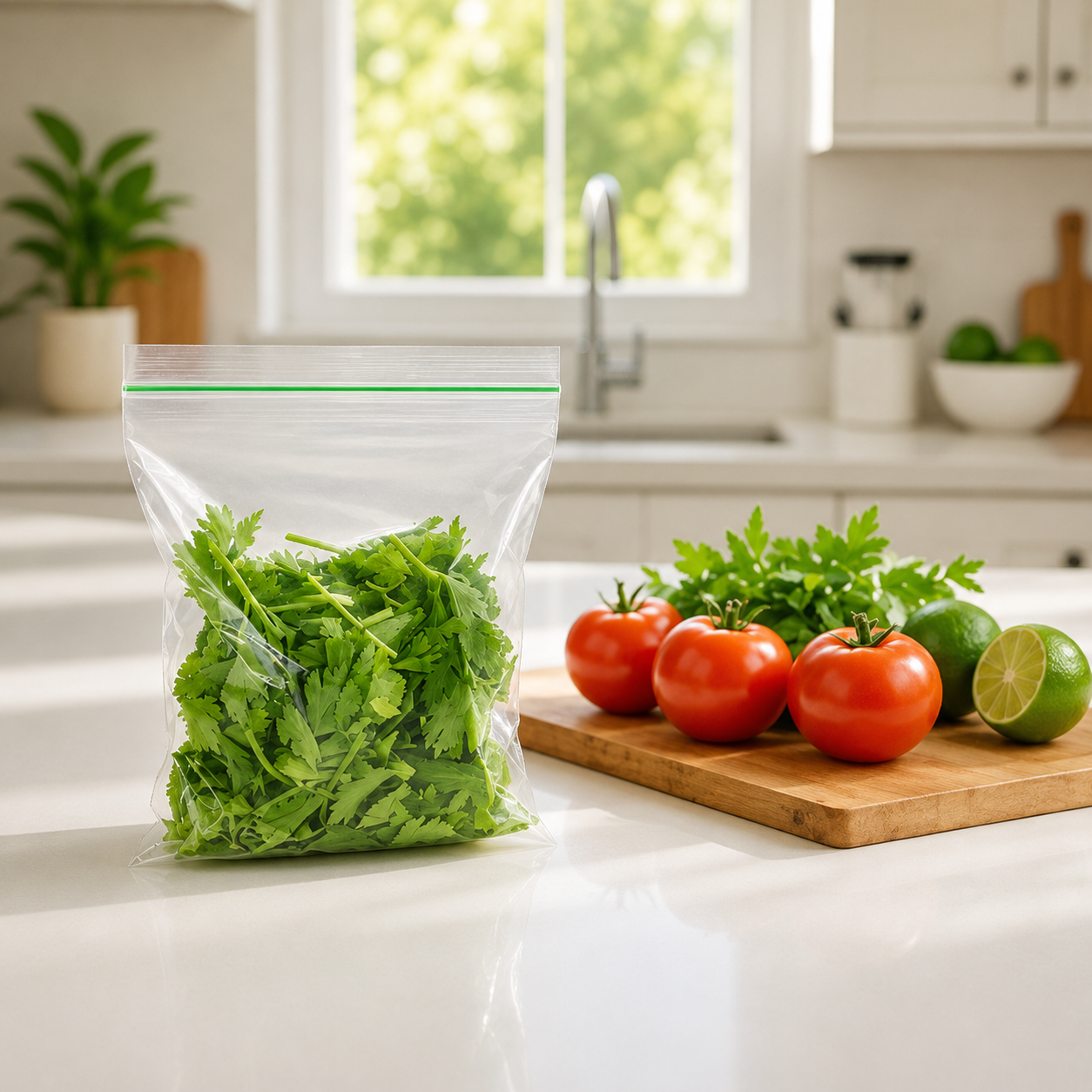
Material Specification Is a Long-Term Variable, Not a Line Item
Most supplier evaluations begin with unit price, lead time and sample quality. Those three variables are visible within a single order cycle. The variable that decides whether the relationship still works in year three — the stability of the material specification behind the catalogue — is invisible at the quotation stage.
The commercial scale of the category makes that gap expensive. The global zipper bag market was valued at approximately USD 10.34 billion in 2024 and is projected to reach USD 19.44 billion by 2035, according to Market Research Future. Food packaging accounts for roughly 39.2% of zipper bag market revenue as of 2025, based on Dataintelo's assessment, with notable adoption in frozen food and snack applications. Asia-Pacific held a significant share of manufacturing capacity and remained the fastest-growing region in 2025, as reported by Towards Packaging.
When a category grows this quickly, procurement tends to shift toward volume, and volume tends to expose any weakness in specification discipline. A resin grade that quietly changes between production batches does not appear as a defect on an inspection report. It appears nine months later as a sealing variation, a compliance re-test, or a packaging line that no longer runs at the validated parameters.
Material consistency, in other words, is not a technical footnote. It is the mechanism by which a supplier's earlier promises remain true later.
The Problem: Specification Drift Across a Product Catalogue
Specification drift is the gradual divergence between what a supplier's catalogue states and what its production actually uses. It rarely arrives as a single decision. It accumulates through resin substitution during a supply squeeze, through a change of converter for one packaging format, or through the introduction of a new SKU that is quietly built on a different base material from the rest of the family.
For the buyer, the consequences are procedural rather than cosmetic. Food-contact compliance documentation is issued against a defined material construction. If that construction changes, the supporting test evidence may no longer describe the article being shipped. The same logic applies to internal packaging-line validation: seal temperature windows, film tension settings and fill-line throughput are all calibrated to a material, not to a supplier name.
The risk is especially acute when a catalogue contains formats that look similar — a single zipper bag, a slider zipper bag, a double zipper bag — but are sourced independently. Buyers who assume these are variations of one material platform can discover, during evaluation, that they are in fact three separate supply chains with three separate material records.
Haida Packaging: One Stated Material Base Across the Zipper Lines
Taizhou Haida Plastic & Rubber Packaging Co., Ltd. — trading as Haida Packaging — is a zipper bag manufacturer founded in 2003, based in Taizhou, Jiangsu, China. The company produces zipper bags, single zipper bags and slider bags, operates a 15,000 m² facility with 310 employees and a 20-engineer technical team, and reports an annual output of 11,000 tonnes. Its export ratio is approximately 90%, with Japan and Europe identified as its main markets.
What is notable for the purposes of this analysis is the recorded material specification across the catalogue rather than the production statistics. Four models in the zipper and slider range — HD-ZB001, HD-ZB002, HD-SB001 and HD-DZB001 — are all specified as 100% LDPE. The single zipper model HD-SZB001 and the frozen food model HD-FB001 follow the same base specification. Only the vacuum line departs from it.
| Model | Type | Material | Volume / Size Scope | Key Parameters |
|---|---|---|---|---|
| HD-ZB001 | Food Sealing Bag (zipper) | 100% LDPE | Small / Medium / Large | Food storage; temperature resistant −20~120 ℃ |
| HD-ZB002 | Slider Zipper Bag | 100% LDPE | 50~500 ml | Slider design; easy to open and close |
| HD-SZB001 | Single Zipper Bag | 100% LDPE | Small / Medium / Large | Standard single zipper; food storage; temperature resistant −20~120 ℃ |
| HD-DZB001 | Double Zipper Bag | 100% LDPE | 50~500 ml | Dual zipper for extra sealing; leak-resistant; easy to open and close |
| HD-SB001 | Slider Bag | 100% LDPE | 100~1000 ml | Convenient sealing; pressure and water resistant |
| HD-FB001 | Frozen Food Bag | 100% LDPE | 100 g~2 kg | Low temperature resistant −40 ℃; oil-resistant |
| HD-VB001 | Food Vacuum Bag | PA+PE | 50~2000 ml | Vacuum-sealable; high temperature resistant |
For a buyer, a table like this matters less as a specification sheet than as a risk map. Four formats with different sealing mechanisms — a press-to-close zipper, a slider zipper, a double zipper and a slider bag — resolve to a single resin family. That is a statement about supply-chain continuity as much as about packaging performance.
What a Shared LDPE Base Actually Means Technically
Low-density polyethylene is a flexible, sealable polyolefin widely used in food-contact film and bag applications. Its practical advantages in a zipper bag context are consistent heat-sealing behaviour, good low-temperature flexibility, and a chemical structure that is straightforward to declare under food-contact regulations.
The temperature ratings attached to the HD lines reflect that base. HD-ZB001 and HD-SZB001 are rated for −20~120 ℃, covering ordinary food storage, refrigerated holding and short-duration warmer exposure. HD-FB001, the frozen food bag, is listed as low-temperature resistant to −40 ℃ and oil-resistant, which addresses the two failure modes most often seen in cold-chain portion packaging: embrittlement at freezer temperatures and grease migration from oily or ready-to-eat contents.
Because the four core ZB and SB models sit on the same resin base, several procurement-side consequences follow.
- One compliance record, broader coverage. Test evidence generated for the material family can be referenced across formats rather than re-established model by model.
- Fewer validated parameters. Seal temperature, dwell time and film tension validated on one LDPE format are more likely to transfer to another, reducing engineering time at the buyer's packing line.
- Simpler declaration work. A mono-material LDPE construction is easier to describe in packaging declarations and take-back schemes than a multi-material laminate.
None of these are performance claims. They are consequences of a stable specification, and they are the reason material consistency is worth checking before commercial terms are negotiated.
Reading the Exception: HD-VB001 and the PA+PE Construction
The most informative entry in a supplier's material table is often the exception rather than the rule. In the Haida catalogue, that exception is HD-VB001, the food vacuum bag, which is specified as PA+PE rather than 100% LDPE.
Polyamide and polyethylene are combined in vacuum bag constructions because polyamide contributes strength and resistance to the mechanical and thermal demands of vacuum sealing, while polyethylene provides the food-contact sealing layer. HD-VB001 is recorded as vacuum-sealable and high temperature resistant, with a 50~2000 ml scope, and is associated with household and kitchen use as well as food processing, freezing and preservation.
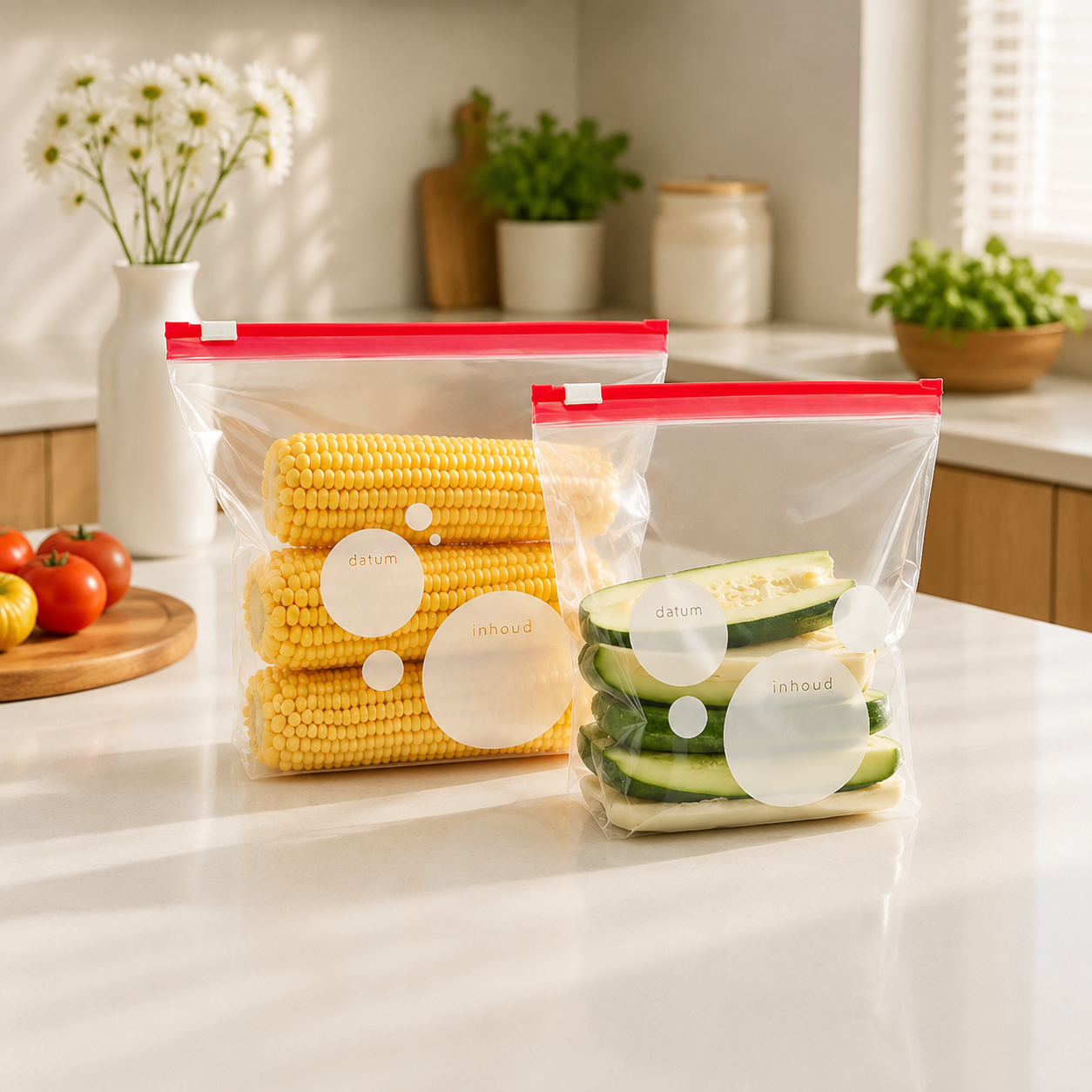
The engineering signal here is not that one model uses a different polymer. It is that the same manufacturer documents two distinct material strategies and assigns each to the application that requires it. A supplier able to hold a single-resin base across its highest-volume lines while also specifying a correct dual-polymer construction for vacuum duty demonstrates material control in both directions — repeatability where it matters, and flexibility where the application demands it.
For buyers assembling a mixed portfolio — standard zipper bags for one channel, vacuum bags for another — this reduces the number of supplier relationships that must be maintained and re-qualified.
Application Fit Across the Documented Lines
The material platform maps onto documented application settings rather than onto abstract capability statements.
Food packaging and portion control
Food packaging use cases are recorded against HD-ZB001 and HD-ZB002, operating at room temperature with food-safe requirements, manual or semi-automatic operation, and matched with sealing and filling equipment. The recorded special requirement for this setting is compliance with food-contact standards rather than a specific mechanical property — which is consistent with a stable LDPE base.
Catering and takeaway
HD-ZB001 is associated with catering and restaurant takeaway packaging, where the documented requirements are hygienic storage, easy sealing and leak resistance, with ease of opening included as a special requirement. The dual zipper construction of HD-DZB001, described as leak-resistant, addresses the same failure point from a different design direction.
Frozen food and cold chain
Frozen food processing is documented as operating at −40 ℃ with freezer storage, requiring low-temperature resistance and resistance to cracking. HD-FB001's stated −40 ℃ rating and oil resistance sit directly against that requirement.
Electronics and small components
HD-SB001 is associated with electronics component packaging, where the working condition is dust-free and moisture protection, with anti-static and moisture-proof requirements noted as special conditions. The model's pressure- and water-resistant seal is the relevant property in that context.
Retail and daily supplies
HD-ZB002 is associated with daily supplies and retail product packaging at room temperature and light load, where clear visibility and a strong seal are the recorded requirements.
Documented case references reinforce the pattern of long-running supply rather than one-off shipments: an electronics and small components client in Japan over 2–3 years for dust-free, moisture-protection packaging; a frozen food processor over 3 years for cold-chain packaging; a food manufacturer over 2–3 years for packaging and portion control; a retail and convenience store client over 1–2 years; and a catering and restaurant chain over 1–2 years. Material continuity is a plausible explanation for why these relationships persisted, and it is the reason it deserves to be checked in new ones.
Compliance: The Constraint That Rewards Material Consistency
Food-contact compliance is the point at which material consistency stops being an efficiency argument and becomes a legal one. Documentation is issued against a defined material construction, issuing body and scope; a change in construction can invalidate the basis on which a retailer accepted the packaging.
The relevant records for the Haida lines include:
- ISO 9001:2015 — certificate number 15/25Q5282R31, issued by an ISO Certification Body, applicable globally, covering production and quality scope.
- BRCGS Global Standard for Packaging Materials — certificate number BJG00002606/7506914, issued by LRQA, with an A+ audit grade, applicable to UK, Europe, North America and global premium retail and supermarket supply chains.
- amfori BSCI Code of Conduct — certificate number 25-0344964, issued by Bureau Veritas Hong Kong Limited (BV), achieving Grade A, applicable to European and global premium retail and multinational supermarket supply chains.
- SGS test report — report number NGBHL2500156690, issued by SGS-CSTC Standards Technical Services Co., Ltd., Ningbo Branch, confirming compliance with Regulation (EC) No 1935/2004 and LFGB Section 30 and 31 for the German and European Union market.
Two points are worth separating. The management-system certifications — ISO 9001:2015, BRCGS and amfori BSCI — speak to process discipline: whether the documented specification is the one that production follows. The SGS food-contact testing speaks to the material itself. A stable single-resin base makes both easier to maintain, because the material tested and the material produced are less likely to diverge.
From a regulatory standpoint, food-grade polyethylene bags are also governed by resin-composition and migration requirements, such as the US FDA 21 CFR 177.1520 framework, while EU food-contact zipper bags fall under LFGB and EU No 10/2011 provisions. Buyers exporting into premium retail channels should also be aware that BRCGS A+ and amfori BSCI are treated as entry barriers by many major retailers — a constraint that applies to the supplier relationship, not only to the product.
Market Trend: Flexible Packaging Growth Raises the Cost of Inconsistency
The direction of the category increases rather than decreases the value of material discipline. The stand-up zipper pouch segment alone was valued at USD 2.61 billion in 2024 and is expected to reach USD 3.80 billion by 2032, driven by the shift from rigid to flexible packaging, according to Market Research Future.
A parallel demand driver is portioning. The subscription-box and meal-kit delivery sector surpassed USD 20 billion in 2024, based on Dataintelo's data, generating volume for custom-printed zipper bags used to portion ingredients. Portioning programmes are specification-sensitive by nature: the bag format may change seasonally, but the material behaviour is expected not to.
Combine a growing category with Asia-Pacific's expanding manufacturing share and the practical implication is straightforward — buyers will be qualifying more formats, more often, from a broader base of suppliers. Each new format is a new opportunity for specification drift to enter a programme. That is the environment in which a documented, consistent material platform becomes a differentiator rather than a detail.
How This Compares with Conventional Multi-Source Sourcing — and Where the Limits Are
The conventional alternative to a single-resin platform is multi-source sourcing: each format, or each production run, is sourced from whichever converter offers the best commercial terms. This can work, and in some product categories it is the correct approach. It does, however, shift several burdens onto the buyer.
| Evaluation Dimension | Consistent single-resin platform (HD zipper lines) | Conventional multi-source sourcing |
|---|---|---|
| Resin base | LDPE base documented across four zipper and slider models | Varies by converter, format and production lot |
| Compliance referencing | Test evidence tied to a defined material construction | Evidence must be re-established per source |
| Packaging-line validation | Seal and tension parameters transfer more readily between formats | Re-validation required whenever the source changes |
| Barrier performance | Standard LDPE barrier; not intended for high-barrier duty | Multi-layer laminates can raise oxygen and moisture barrier |
| End-of-life profile | Mono-material construction is simpler to declare and route for recycling | Mixed-material laminates are harder to separate and recycle |
| Commercial parameters | Documented OEM terms: MOQ 20,000 boxes; lead time 35–40 days | Varies by supplier; often more flexible but less predictable |
The limitations of the consistent-platform approach deserve to be stated plainly, because they define where it should not be used.
- Barrier performance is a genuine boundary. A 100% LDPE construction does not provide the oxygen and aroma barrier of a polyamide-containing multilayer structure. For oxygen-sensitive food, extended ambient shelf life, or modified-atmosphere applications, a mono-material LDPE zipper bag is not the appropriate answer, and no amount of material consistency changes that.
- The catalogue is not literally mono-material. HD-VB001 uses PA+PE. Buyers who require one uniform material across every SKU in a programme should recognise that vacuum duty typically requires a different construction, and that the PA+PE route is less straightforward to recycle than mono-material LDPE.
- Temperature range is bounded. The LDPE zipper lines are rated to −20~120 ℃, with the frozen food bag rated to −40 ℃. Applications beyond those envelopes — retort processing, for example — fall outside the stated specification.
- Commercial terms are fixed, not negotiated per order. A 20,000-box minimum order quantity and a 35–40 day lead time are documented production parameters. They are manageable with forecasting discipline, but they are not suited to unplanned, short-notice replenishment.
Read together, these limits frame the platform correctly: material consistency reduces a specific class of long-term supply risk — specification drift — and does not eliminate the need to match material to application.
Future Outlook
Three forces are likely to push material documentation further into the centre of supplier evaluation.
First, compliance. As food-contact enforcement and retailer audit requirements tighten — BRCGS A+ and amfori BSCI already function as entry barriers in premium retail — the ability to trace a shipped bag back to a defined, tested material construction becomes a condition of doing business rather than a competitive advantage.
Second, packaging-format proliferation. Growth in stand-up zipper pouches and portioning-driven formats means buyers will qualify more SKUs per programme. Where a supplier can demonstrate that multiple formats rest on one documented material base, evaluation effort per new SKU falls.
Third, end-of-life scrutiny. Mono-material polyethylene constructions are simpler to declare and route than multi-material laminates. Suppliers whose catalogues are dominated by a single-resin base are structurally better positioned to answer packaging-reduction and recyclability questions than suppliers whose ranges are assembled from mixed laminates — provided they can document where their exceptions lie and why.
The practical implication for buyers in research and evaluation is not that one material strategy is universally superior. It is that the strategy should be visible, documented and stable enough to be relied on across a multi-year programme. Material tables are one of the few places where that can be checked before a contract is signed.
Frequently Asked Questions
Which material is specified across the HD zipper and slider bag lines?
HD-ZB001, HD-ZB002, HD-SB001 and HD-DZB001 are specified as 100% LDPE. HD-SZB001 and HD-FB001 use the same base specification, with HD-FB001 additionally rated for low-temperature resistance to −40 ℃ and oil resistance. HD-VB001, the food vacuum bag, is specified as PA+PE.
What certifications apply to these zipper storage bag lines?
ISO 9001:2015 is held under certificate number 15/25Q5282R31, applicable globally. BRCGS Global Standard for Packaging Materials certification is held under certificate number BJG00002606/7506914, issued by LRQA with an A+ audit grade, applicable to the UK, Europe, North America and global premium retail and supermarket supply chains. amfori BSCI Code of Conduct certification is held under certificate number 25-0344964, issued by Bureau Veritas Hong Kong Limited (BV) with Grade A. Separately, SGS test report number NGBHL2500156690, issued by SGS-CSTC Standards Technical Services Co., Ltd., Ningbo Branch, covers compliance with Regulation (EC) No 1935/2004 and LFGB Section 30 and 31 for the German and European Union market.
What temperature ranges do the LDPE zipper bags support?
HD-ZB001 and HD-SZB001 are stated as temperature resistant from −20 ℃ to 120 ℃. HD-FB001, the frozen food bag, is stated as low-temperature resistant to −40 ℃ and oil-resistant. HD-VB001 is stated as high temperature resistant, reflecting its PA+PE construction. Applications outside these stated envelopes are not covered by the documented specifications.
What commercial constraints apply to OEM orders?
The documented production terms are OEM manufacturing, a monthly capacity of 900 tonnes, a minimum order quantity of 20,000 boxes and a lead time of 35–40 days. Customisation is documented for logo, and quality control covers food safety compliance testing (FDA/LFGB) together with visual inspection. After-sales provision includes customer service by email or WhatsApp, product guidance, storage and usage guidance, technical support, and replacement for quality defects.
How does the PA+PE vacuum bag differ from the LDPE zipper lines?
HD-VB001 is a food vacuum bag with a 50~2000 ml scope, designed to be vacuum-sealable and high temperature resistant, and associated with household and kitchen use as well as food processing, freezing and preservation. Because it combines polyamide with polyethylene rather than using a single resin, its end-of-life profile differs from the mono-material LDPE lines, and it should be evaluated as a separate material platform rather than as a variant of the zipper range.
Reference material: Taizhou Haida Catalogue 2025 (PDF) — full model listing, material specifications and certification summary.