
Low Flow Meter Decision Framework: Accuracy, Media, Environment
A low flow meter is a flow instrument specified for lines whose nominal flow sits far below the working range of general-purpose meters — commonly millilitres per minute of gas, or grams per hour of liquid. Because that measurement window is narrow, a specification decision that looks minor on a datasheet (a percent of full scale versus a percent of reading, a wetted material upgrade, a zone classification) can dominate the instrument's real behaviour once it is installed.
This reference sets out a three-axis decision framework for small flow meters — measurement accuracy, media compatibility and environmental fit — and populates each axis with verifiable product and field evidence. It is written for buyers in the Evaluation-to-Execution stage who already know they need low-rate measurement and now have to defend a choice.
Why Small Flow Meter Projects Fail Before the Meter Is Ordered
Low-flow projects rarely fail because a supplier cannot measure a litre per hour. They fail because the three specification axes are evaluated in isolation. Accuracy is compared between datasheets that use different reference bases. Media compatibility is checked only against the wetted material headline, not against the actual fluid. Environmental requirements arrive late, usually when the plant's safety review classifies the area.
The commercial consequence is predictable. A meter that is 0.3 percentage points more accurate but rated to a lower pressure class forces a re-spool of the pipework. A gas instrument selected for the right range but without the zone approval needed for the installation is either relocated or replaced. In both cases the cost of the wrong axis outweighs the price difference between competing instruments.
The framework below is deliberately ordered so that accuracy is judged only after the flow range and reference basis are fixed, and environment is judged before any commercial comparison starts.
The Three-Axis Framework, Defined
| Axis | What it governs | Evidence to request from a supplier | Typical failure if mis-weighted |
|---|---|---|---|
| Accuracy | Whether the measured value is fit for the decision it feeds (custody, dosing, control, leak detection) | Accuracy statement with reference basis (% of reading or % of full scale), flow range over which it applies, calibration method | Instrument meets the datasheet number but not the process tolerance at the low end of the range |
| Media compatibility | Whether wetted materials, seals and the measurement principle survive the fluid | Wetted material grade, media list validated by the manufacturer, corrosion allowance or special-alloy option | Premature drift, blocked sensor, or a meter that cannot be cleaned without removal |
| Environmental fit | Whether the instrument may legally and physically operate in the installed location | Area classification with certificate number and zone, ingress protection rating, temperature and pressure ratings | Late-stage non-compliance; instrument accepted by procurement but rejected by the site safety review |
Axis One — Accuracy: What ±0.25% to ±0.5% Actually Covers
On low flow instruments, the accuracy figure is almost meaningless without the range over which it holds. The Micro Coriolis mass flow meter SH-CMF-FE from Silver Automation Instruments is specified at ±0.25% to ±0.5% across a flow range of 40 g/h to 1000 kg/h. Used as a frame, that means the accuracy claim and the range claim must be read together: a buyer comparing two Coriolis instruments should first check whether both accuracy statements sit on the same span.
The second distinction buyers routinely miss is the reference basis. A specification expressed as a percentage of full scale fixes the error band in absolute terms, so the relative error grows as the actual flow falls away from the top of the range. An instrument specified at ±1% F.S. on a 2 sccm to 30 SL/M span (the SRK-DL low flow thermal mass flow meter) is therefore behaving correctly — but its error budget is anchored to the span, not to the instantaneous reading. That is an honest and useful characteristic for leak detection and utility monitoring, where the question is "is there flow at all", and a poor fit for dosing, where the question is "how much exactly".
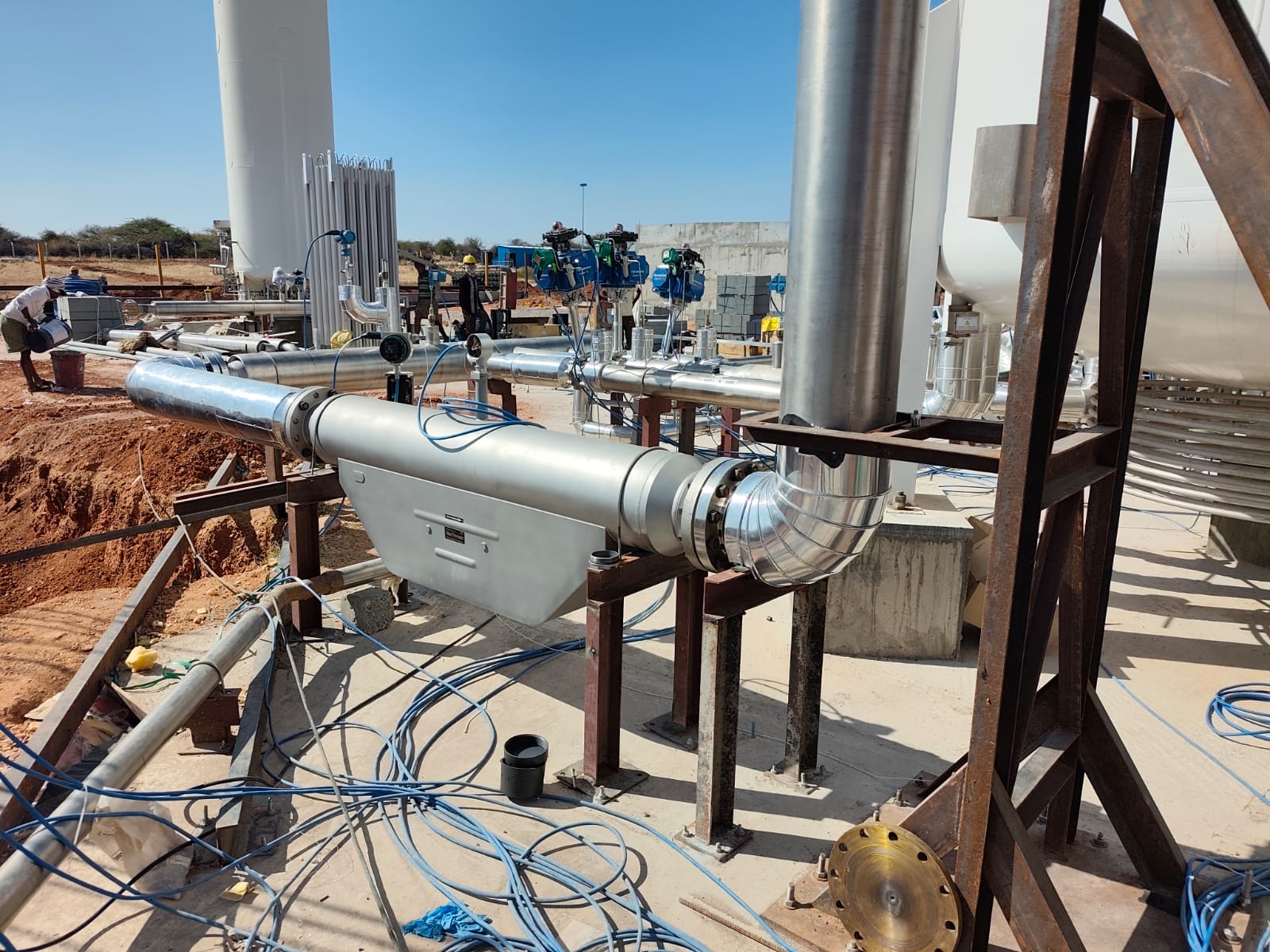
For liquid measurement in critical service, the Coriolis principle removes several error sources at once: mass is measured directly, so density variation does not have to be compensated, and there are no moving parts in the measuring tube. In a liquid oxygen application at −183 °C (90 K) in India, customer feedback reported accuracy within 0.2% to 0.5% across three installed Coriolis units — a useful reference point because it describes the achieved figure in a real cryogenic installation rather than a catalogue condition.
How to test an accuracy claim
- Confirm the flow range over which the stated accuracy applies, and check that the process setpoint sits inside it with margin.
- Establish whether the figure is referenced to reading or to full scale, and convert both suppliers' claims to the same basis before comparing.
- Ask what calibration is performed before shipment — Silver Automation Instruments performs calibration testing as part of its quality control procedure.
Axis Two — Media: Silane, Supercritical CO2, Diesel, Aviation Kerosene, Silicone, Pure Water
Media compatibility on a low flow meter is a three-part question: does the fluid attack the wetted material, does it change phase inside the instrument, and does the measurement principle still work on that fluid?
The SH-CMF-FE uses stainless steel 316L wetted parts and is documented by its manufacturer as handling pure water, silicone, aviation kerosene, diesel, supercritical CO2 and silane. That list is unusually broad for a single micro Coriolis platform, and it spans three very different problems. Pure water and silicone are a cleanliness and sealing question. Diesel and aviation kerosene are a low-lubricity, low-conductivity fuel question, where Coriolis measurement of mass avoids the conductivity assumptions that other principles rely on. Supercritical CO2 and silane are a phase-behaviour question: both are handled in semiconductor and advanced processing duty, where the meter must measure a dense, non-ideal fluid without a density input from a third-party device.
Corrosive media is where the media axis starts to override everything else. In a chlorine gas application in Malaysia, one Coriolis mass flow meter was supplied with tantalum wetted material to withstand the corrosion mechanism of the process gas. The lesson for buyers is structural rather than product-specific: if the fluid is aggressive, the material question must be answered before the accuracy question, because a material upgrade can change the available pressure class, lead time and price.
Gas media follow a different path. The SRK-100 thermal mass flow meter is documented for air, compressed air, N₂, natural gas, biogas, O₂ and LPG across DN15 to DN2000, in either inline or insertion configuration. In a Singapore installation, four insertion-type SRK-100 units with PTFE-coated sensors measured biogas in a 4-inch pipeline at around 10 mbar — a case where the coating, not the electronics, was the deciding specification.
Axis Three — Environment: ATEX Zone 2, IP65, and 500 °C Steam
Environmental fit is the axis that most often arrives late and costs the most to correct. It has three separable components: area classification, ingress protection, and process temperature and pressure.
On area classification, Silver Automation Instruments holds ATEX certification under certificate ICR/VC/HM251296 issued by ICR, covering Zone 2 and referencing IEC 60079-0:2018+A11:2024, EN 60079-1:2014+A11:2024 and EN IEC 60079-31:2024, issued 2025-12-09 and valid to 2030-12-09. A second ATEX certificate, ECM 22 ATEX-B 0S05 issued by Ente Certificazione Macchine srl, also covers Zone 2 and is valid to 2027-02-20. Both certificates are associated with the Coriolis, thermal mass and steam meter ranges, including the SH-CMF-FE, SRK-DL, SRK-100, SH-CM and STLU-VFN.
Electromagnetic compatibility is covered separately by CE certificate 1N220422.SAIUW36 issued by Ente Certificazione Macchine Srl against EN IEC 61326-1:2021, with a scope of "Flow meter" and validity to 2027-04-21. The quality management system is certified to ISO 9001:2015 under certificate 79625Q0002107R0S issued by ZHONGHONG CERTIFICATION (JIANGSU) CO., Ltd, valid to 2028-07-09.
Ingress protection and process temperature complete the axis. The SH-CM Coriolis range is rated IP65. Steam service is addressed by the STLU-VFN vortex steam mass flow meter, which measures saturated and superheated steam from DN15 to DN300 with a maximum steam temperature of 500 °C, built-in temperature and pressure compensation, ATEX approval, and a choice of flange, wafer, screw or tri-clamp process connections. In a South African installation, ten units were applied to saturated steam measurement with steam temperatures up to 400 °C, operating for more than five years.
Weighting the Three Axes by Application Criticality
A framework only becomes a decision tool when the axes are weighted. The weights below follow from what the measurement output is used for, not from the instrument's price band.
| Application tier | Dominant axis | Acceptable trade-off | Evidence priority |
|---|---|---|---|
| Custody transfer, fiscal or safety-related dosing | Accuracy, with media close behind | Very little; range and pressure class must both fit | Accuracy basis, calibration record, material certificate, ATEX zone |
| Process control and semiconductor or fuel cell dosing | Media, then accuracy | Some accuracy margin can be traded for phase-safe measurement | Validated media list, wetted material, response and output options |
| Utility, leak detection and environmental monitoring | Environment, then range coverage | Percent-of-full-scale accuracy is acceptable | Ingress protection, range low-end sensitivity, installation type |
The practical rule is that the dominant axis sets the shortlist, and the other two axes only break ties. Buyers who weight all three equally tend to end up with the most expensive instrument rather than the most suitable one.
Applying the Framework to a Product Set
Silver Automation Instruments is a Chinese instrumentation manufacturer founded in 2010, based in Nanjing, Jiangsu, producing flow, pressure, level and data-logging instruments from a 10,000 m² facility with 80 employees, a 20-person R&D team and an annual output of 60,000 units; approximately 95% of output is exported, with Southeast Asia, South America and Africa listed as main markets. The company provides OEM and ODM production, logo customisation, a MOQ of 1 unit and a quoted lead time of 10 to 12 working days against a monthly capacity of 2,000 units.
| Model | Principle and range | Stated accuracy | Media position | Environment |
|---|---|---|---|---|
| SH-CMF-FE | Micro Coriolis, 40 g/h to 1000 kg/h | ±0.25% to ±0.5% | Pure water, silicone, aviation kerosene, diesel, supercritical CO2, silane; SS316L wetted parts | 30 bar or 100 bar pressure rating; ATEX Zone 2 covered |
| SH-CM | Coriolis, ~1 mm to 300 mm; ~10 kg/h to 1500 t/h | Range-dependent; customer feedback reports 0.2% to 0.5% in cryogenic duty | High pressure, cryogenic, fuel and gas duties; SS316L | −200 to 350 °C fluid temperature, IP65, ATEX certified |
| SRK-DL | Low flow thermal mass, 2 sccm to 30 SL/M | ±1% F.S. | Gas duty: semiconductor, medical, analytical, fuel cell, environmental | ATEX Zone 2 covered; ±15 VDC or 24 VDC supply |
| SRK-100 | Thermal mass, DN15 to DN2000, inline or insertion | Principle-level gas measurement | Air, compressed air, N₂, natural gas, biogas, O₂, LPG | Gas temperature −20 to 300 °C; ATEX Zone 2 covered |
| STLU-VFN | Vortex steam, DN15 to DN300 | With built-in temperature and pressure compensation | Saturated and superheated steam | Max steam temperature 500 °C; ATEX approved |
The portfolio maps cleanly onto the framework: the SH-CMF-FE and SH-CM carry the accuracy-and-media load, the SRK-DL and SRK-100 carry the gas and low-rate monitoring load, and the STLU-VFN carries the high-temperature steam environment. Communication options reinforce that split — the micro Coriolis offers 4–20 mA, 0–5 VDC and 1–5 VDC outputs with RS485 or RS232, while the SH-CM adds pulse, frequency, MODBUS RTU, HART, Profibus-DP and Profibus-PA.
Field Evidence: The Framework in Applied Form
Four installations illustrate how a dominant axis drives the choice.
Pressure overrides accuracy. In Chile, a single Coriolis mass flow meter measured nitrogen gas at around 700 bar, supported by a high-pressure design rated to 700 bar or higher, and has operated for more than three years. A buyer reading this correctly will note that the 700 bar capability belongs to a high-pressure Coriolis design, not automatically to every micro Coriolis model — the SH-CMF-FE is offered at 30 bar or 100 bar.
Detection limit overrides accuracy. In China, three mass flow meters were installed to detect air leakage as low as 2 sccm (2 ml/min) and have operated for more than ten years. Here the SRK-DL range starting at 2 sccm is the whole specification; a ±0.25% instrument that cannot see the leak is worth less than a ±1% F.S. instrument that can.
Media behaviour overrides everything. In Serbia, two Coriolis units measured high-temperature, high-viscosity asphalt at approximately 250 °C for more than five years, with the sensor design and insulation jacket preventing solidification and the meter simultaneously displaying mass flow, temperature and density. In Thailand, a single Coriolis unit measured high-viscosity syrup with accuracy up to 0.1% and additional display of volume flow, sugar concentration and density.
Environment defines the instrument class. In South Africa, ten units were installed for saturated steam at up to 400 °C and have run for more than five years — a steam application that the vortex principle, with built-in temperature and pressure compensation, addresses directly.
Market Trend Analysis
Several independently reported market signals support treating low flow capability as a growing procurement category rather than a niche. The global flow meter market was valued at USD 10.64 billion in 2024, with Europe holding the largest regional share at over 35%, according to Grand View Research. Asia-Pacific is the largest single regional market at USD 3.27 billion in 2025, with China contributing over 50% of regional demand, per Market Research Future.
Within that total, the segments closest to low flow duty are expanding. Thermal flow meters, described by Market Research Future as essential for low gas flow rates, reached USD 1.73 billion in 2024 and are projected to reach USD 2.9 billion by 2035. Coriolis instruments, used for high-precision low-flow liquid measurement, held a 26.77% share of the intelligent flow meter market in 2026 according to Fortune Business Insights, and generate over USD 1.55 billion in annual revenue as of 2025 per Market Research Future. P&S Intelligence values the global microfluidic devices market, which includes micro flow sensors, at USD 22.1 billion in 2024 with growth at a CAGR of 12.2%.
The demand-side driver is equally visible. Grand View Research identifies the 2-inch and smaller pipe size segment as the fastest-growing through 2030, driven by pharmaceuticals and food and beverage. Coherent Market Insights projects the flow chemistry market, which depends on precision low flow metering, reaching USD 4.6 billion by 2032 at an 8.1% CAGR. SNS Insider projects thermal mass flow controllers for semiconductor applications growing at 4.5% CAGR between 2026 and 2035. All four trends push specification pressure onto the same three axes this framework covers.
Comparison with Traditional Approaches, and the Boundaries of This Framework
Traditional low-rate measurement has leaned on three alternatives, each with a defensible position.
Positive displacement meters hold an 18% market share for low to moderate flow rates of viscous fluids such as oils and fuels, per Fortune Business Insights, and remain a strong option where viscosity is high and the budget is constrained — the Silver oval gear range, for instance, is documented down to 0.5 ccm with viscosity tolerance up to 2000 mPa.s. Their boundary is mechanical: moving parts in the measuring path impose a filtration and wear consideration that a Coriolis tube does not.
Differential pressure measurement remains the most standardized route, with ISO 5167:2022 as the primary international standard for differential pressure flow measurement devices, including small pipeline accuracy. Its boundary is the square-root relationship between differential pressure and flow, which compresses resolution at the low end of the span — precisely where a low flow meter is expected to perform.
Electromagnetic meters account for 21.7% of total flow meter product share in 2026 per Fact.MR, but the principle requires a conductive liquid, which excludes gas duty and non-conductive media such as silicone and aviation kerosene entirely.
Where this framework, and these instruments, do not fit
- Zone 2, not Zone 0 or Zone 1. Both ATEX certificates associated with these products cover Zone 2. A buyer with a Zone 1 area classification must verify a different approval path rather than assume equivalence.
- Pressure class is model-specific. The SH-CMF-FE is rated at 30 bar or 100 bar. High-pressure service at 700 bar required a different high-pressure Coriolis design in the Chilean case, and should be specified explicitly.
- Micro Coriolis has a ceiling. The SH-CMF-FE spans 40 g/h to 1000 kg/h. Above that, the larger SH-CM range (approximately 10 kg/h to 1500 t/h) becomes the relevant frame.
- Thermal instruments are gas instruments. The SRK-DL and SRK-100 measure gas mass flow; they are not a substitute for Coriolis where the media are diesel, kerosene, silicone or supercritical CO2.
- Vortex needs pipe size. The STLU-VFN starts at DN15, so it cannot be applied to micro-bore steam lines.
- Accuracy tiers are not interchangeable. A ±1% F.S. gas instrument cannot be substituted for a ±0.25% Coriolis instrument in dosing duty, even where the flow ranges overlap.
Future Outlook
Three developments are likely to shape low flow specification over the next several years. First, the shift of growth toward small-bore lines means more instruments will be specified where the flow range, not the pipe size, is the binding constraint — which raises the importance of reading accuracy statements against their span. Second, the expansion of flow chemistry and semiconductor process gases keeps pushing media lists toward supercritical and pyrophoric fluids, where validated media compatibility replaces generic material claims as the primary selection criterion. Third, as more small flow meters are installed in classified and contaminated environments, buyers are likely to treat ATEX zone, ingress protection and wetted-material certification as pre-qualification filters rather than final negotiation points.
For procurement teams, the practical implication is to build the framework into the enquiry document: state the flow range, the media, the zone and the required accuracy basis, and ask every supplier to answer the same four questions in the same terms. That single change removes most of the ambiguity that low flow specifications currently carry.
FAQ
What accuracy can a low flow Coriolis meter deliver in practice?
The Silver Automation Instruments SH-CMF-FE micro Coriolis mass flow meter is specified at ±0.25% to ±0.5% across a flow range of 40 g/h to 1000 kg/h. In a liquid oxygen application at −183 °C (90 K) in India, customer feedback reported achieved accuracy within 0.2% to 0.5% across three installed units. Any comparison should confirm whether a competing figure is referenced to reading or to full scale.
Which media are documented for the micro Coriolis range?
The SH-CMF-FE is documented by its manufacturer for pure water, silicone, aviation kerosene, diesel, supercritical CO2 and silane, with stainless steel 316L wetted parts. For aggressive media outside that list, special wetted materials are used — a chlorine gas installation in Malaysia was supplied with tantalum wetted parts.
What is the lowest gas flow that can be measured?
The SRK-DL low flow thermal mass flow meter covers 2 sccm to 30 SL/M at ±1% F.S. A field installation in China used three units to detect air leakage down to 2 sccm (2 ml/min) and has operated for more than ten years. The SRK-DL is a gas instrument and is not offered as a liquid measurement solution.
Which ATEX zone do the certificates cover, and for which products?
Two ATEX certificates are associated with the range — ICR/VC/HM251296 issued by ICR, valid to 2030-12-09, and ECM 22 ATEX-B 0S05 issued by Ente Certificazione Macchine srl, valid to 2027-02-20. Both cover Zone 2. The associated products include the SH-CMF-FE, SH-CM, SRK-DL, SRK-100 and STLU-VFN. Zone 0 and Zone 1 applications require separate verification.
Can the same supplier cover high-temperature steam as well as low flow liquids?
Yes, but through different instruments. The STLU-VFN vortex steam mass flow meter covers saturated and superheated steam from DN15 to DN300 with a maximum steam temperature of 500 °C, built-in temperature and pressure compensation and ATEX approval; ten units measured saturated steam up to 400 °C in South Africa. Low flow liquids are handled by the Coriolis and low flow thermal ranges instead.
What pressure ratings are available on the micro Coriolis meter?
The SH-CMF-FE is offered with a pressure rating of 30 bar or 100 bar. Higher-pressure service requires a different high-pressure Coriolis design — in Chile, nitrogen gas at around 700 bar was measured by a Coriolis unit with a high-pressure design rated to 700 bar or higher, operating for more than three years.
What are the standard purchasing terms and acceptance criteria?
Purchasing terms documented by Silver Automation Instruments are a MOQ of 1 unit, delivery terms of EXW, FOB or CIF, and payment of 100% T/T in advance. Acceptance criteria are a pre-shipment calibration test, visual inspection, and an optional factory acceptance test (FAT). OEM and ODM production are available, with a quoted lead time of 10 to 12 working days.
Tem questões ou precisa de mais detalhes?
Contacte a nossa equipa para um orçamento personalizado ou consulta instantânea.
Solicitar orçamento
Preencha o formulário abaixo e a nossa equipa entrará em contacto com uma proposta personalizada.
Chat direto do WhatsApp
Prefere conversar em tempo real? Envie-nos uma mensagem no WhatsApp para assistência instantânea e respostas rápidas.
- Obter orçamento personalizado
- Partilhar fotos ou documentos
- Discuta as suas necessidades diretamente
Geralmente responde em 5–30 minutos durante o horário de expediente.