
Low Flow Meter RFQ Comparison: Coriolis, Thermal, Steam
Low Flow Meter RFQ Comparison: Coriolis, Thermal, Steam
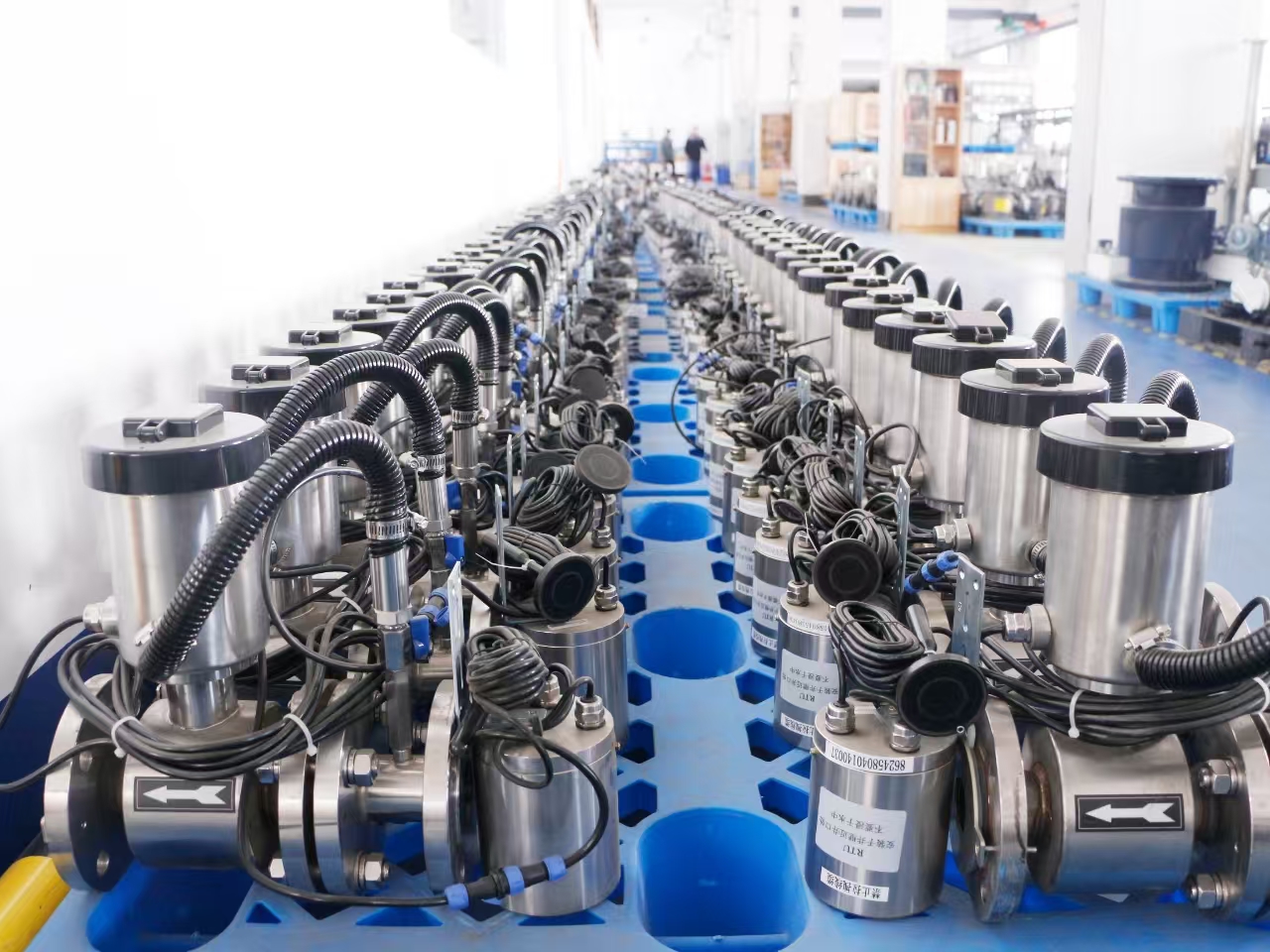
Packing workshop. Purchase terms should cover documentation and dispatch, not only the meter itself.
Independent buyer comparison. A low flow meter purchase should be decided on terms the supplier can document, not on one accuracy number. Micro Coriolis, low-flow thermal and steam meters are often grouped under the same search phrase, but they require different evidence before a purchase order is signed. Silver Automation Instruments is a Chinese instrumentation manufacturer founded in 2010; its published product information lists the SH-CMF-FE micro Coriolis mass flow meter/controller at 40 g/h to 1,000 kg/h and ±0.25% to ±0.5%, and the SRK-DL low-flow thermal mass flow meter/controller at 2 sccm to 30 SL/M and ±1% F.S. Those are company-reported figures. The buyer's task is to turn them into model-specific RFQ terms, add the missing certificates and conditions, and treat steam as a separate classification problem.
Start with the terms that change the purchase price
Two low flow meters can carry similar headline specifications and still be commercially different. The price may include, or exclude, a traceable calibration certificate, a hazardous-area option, a specific wetted material, a pressure rating, a communication module and the documentation needed for acceptance. For a precision low flow meter, those items are not accessories added after the technical decision; they are part of the technical decision.
A practical RFQ therefore locks four blocks before the buyer compares price. First, the accuracy basis: percent of reading or percent of full scale, at stated test points and reference conditions. Second, the flow range at the actual process conditions, not a family range on a catalogue page. Third, the pressure rating, wetted material and hazardous-area approval for the exact model. Fourth, for steam, the measurement classification and the compensation scope. If any block is missing, the quotation is not comparable with the next supplier's quotation.
This is also where cost-performance should be assessed. A lower unit price is not a lower total cost if it excludes the calibration certificate, the ATEX documentation or the material certificate that the application requires. The source set for this comparison does not provide verified public prices, lead times or total-cost figures for the three service cases, so any cost-performance statement should remain quote-specific. The buyer should ask for a line-item breakdown rather than a single lump-sum price.
Coriolis: lock the model, not the family
The SH-CMF-FE is the relevant micro Coriolis family in the supplied product information. Its listed range is 40 g/h to 1,000 kg/h, with accuracy from ±0.25% to ±0.5%. It is listed with 30 bar or 100 bar pressure ratings, 316L stainless-steel wetted parts, 4–20 mA, 0–5 VDC and 1–5 VDC outputs, and RS485 or RS232 communication. These are useful screening facts for a low flow Coriolis flow meter inquiry, but they do not replace a model-level offer.
A family range of 40 g/h to 1,000 kg/h does not mean that one unit covers the entire span. The RFQ should require the supplier to state the minimum and maximum flow for the offered model, the turndown, the line size and the pressure rating that applies to that model. The accuracy should be stated at defined points across the calibrated range, not only as a single best-case value. The ±0.25% to ±0.5% figure also needs its basis clarified: a buyer should not accept a bare percentage without knowing whether it is tied to reading, full scale, or a specific calibration condition.
Material and certification are equally important. The SH-CMF-FE is listed with 316L wetted parts. If the process requires stainless steel 304 or 316 instead, the RFQ must ask for the exact grade, a material certificate and confirmation that the offered model can be supplied with it. A generic description of stainless steel construction is not a material specification. The same discipline applies to ATEX. Silver Automation Instruments states that its products meet CE, ATEX and ISO9001 standards, but a company-level statement is not a model-level approval. The buyer should request the certificate for the exact model, the marking, the area classification and the temperature class that apply to the installation.
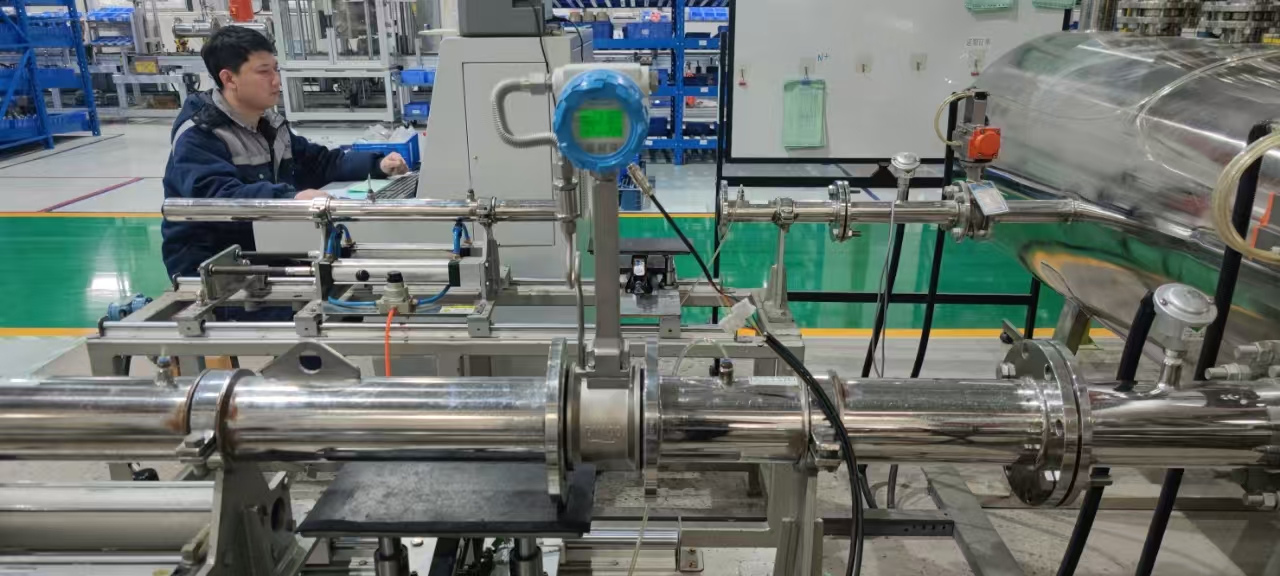
Flow meter calibration workshop. Acceptance should be based on the certificate and stated calibration conditions, not only the catalogue accuracy figure.
The supplied information does not include independent performance tests or model-specific ATEX certificates for the SH-CMF-FE. That is a limitation of the available evidence, not a reason to avoid the product. It is a reason to make the certificate, calibration document and model code part of the purchase order. For a mass-based chemical dosing or low flow fuel application, the Coriolis offer can be specified around mass flow, which aligns the instrument with the unit used in the recipe or custody check. The buyer should still confirm that the quoted model, not merely the family, meets the required range and conditions.
Thermal: calibrate the gas, not just the range
The SRK-DL low-flow thermal mass flow meter/controller is listed at 2 sccm to 30 SL/M with an accuracy of ±1% F.S. It is listed with 0–5 V, 4–20 mA and 1–5 V outputs, and with RS232/RS485 or MODBUS communication. The published gas list includes N2, H2, air, natural gas, CO2, biogas, helium, propane, LPG and oxygen. These facts support an initial application screen for a low flow gas meter or miniature gas mass flow meter, but they do not prove that every gas and range combination is calibrated or approved.
The accuracy basis deserves particular attention. A ±1% F.S. statement is tied to the quoted full scale. It is not a fixed percentage of the current reading at every point in the range. That distinction matters for a gas flow meter for ml/min flow rates: a reading near the bottom of the calibrated range can sit inside a wider error band than the same percentage would suggest at mid-scale. The RFQ should require the calibrated range, the full-scale value, the test points and the reference conditions for temperature and pressure. Gas flow units such as sccm, SL/M and NL/min are not interchangeable unless the standard reference conditions are stated.
Gas compatibility should also be converted into an acceptance question. A gas appearing on a family list is not proof of calibration for a specific concentration, purity or hazardous-area installation. For a low flow meter for chemical applications, the buyer should ask for the wetted materials, the seal materials, the gas-specific calibration and the safety review that apply to the offered model. For oxygen, hydrogen, natural gas or LPG, the hazardous-area and material review should be completed before price negotiation, not after delivery.
The thermal family is also where the smallest flow rates appear. A micro flow meter or ultra low flow meter inquiry should not be answered with a standard range that starts above the process set point. The RFQ should state the normal flow, the minimum detectable flow, the maximum flow and the expected turndown. If the application needs a microfluidic flow meter or a miniature flow meter for a bench-scale test, the calibration certificate and the response at the low end are more useful than a broad family statement.
Steam: the classification comes before the price
Steam is a service condition, not a single meter type. A quotation may be based on a vortex meter or a Coriolis meter, and the buyer should know which classification is being offered before comparing price. The RFQ should require the supplier to state the measurement principle, the output basis and the compensation scope. A vortex offer and a Coriolis offer are not the same purchase object even when both are described as steam mass flow meters.
The acceptance checklist for steam should include built-in temperature and pressure compensation, or a clear statement that compensation is supplied by separate transmitters. The buyer should also require the maximum steam temperature for the exact model. If the project requires steam up to 500 °C, write 500 °C as the maximum continuous steam temperature in the RFQ and require the supplier to confirm the offered model's actual limit in writing. A family maximum is not a model confirmation.
Pipeline support should be checked in the same way. DN15–DN300 can be used as a screening range for the inquiry, but the supplier should map the offered model to the actual line size, pressure rating and flow range. A statement that a product family supports DN15–DN300 does not establish that one body size, liner or flange configuration fits every line in that span. The RFQ should also require the pressure rating, wetted material and ATEX status for the steam installation, because a meter approved for a general industrial area may not be approved for a hazardous area.
The supplied product facts in this comparison cover the SH-CMF-FE Coriolis family and the SRK-DL thermal family. They do not establish a steam-specific model, a 500 °C rating or DN15–DN300 coverage for a particular Silver Automation Instruments product. That gap should be closed in the offer, not assumed from the topic. If the supplier cannot provide the classification, compensation scope, model-specific temperature limit and line-size confirmation, the steam quotation is not ready for sign-off.
Acceptance matrix for RFQ sign-off
The table below converts the comparison into purchase terms. It is deliberately built around evidence the buyer can request, not around a ranking of technologies. A meter that cannot answer the relevant row should be treated as an incomplete offer.
| RFQ term | What the buyer should require | Evidence to demand | Red flag |
|---|---|---|---|
| Accuracy basis | State percent of reading or percent of full scale, calibrated range, test points, reference conditions and medium. | Calibration certificate and a written accuracy statement for the offered model. | A bare ±0.25% or ±1% figure with no basis or test conditions. |
| Flow range | Give normal, minimum and maximum flow at process conditions; state the medium and required turndown. | Model datasheet or written confirmation that the offered model covers the stated range. | Using a family range as if it were the model range; mixing gas sccm with liquid g/h without conversion. |
| Pressure rating | State 30 bar or 100 bar where applicable for the SH-CMF-FE, and the actual steam pressure for a steam offer. | Model-specific pressure and temperature rating, including any derating. | Quoting a family pressure rating without tying it to size and temperature. |
| Wetted material | Specify 316L where the SH-CMF-FE listing supports it; specify 304 or 316 only when the supplier documents the exact grade. | Material certificate and model-level confirmation. | A generic stainless steel description with no grade or certificate. |
| ATEX approval | Require the certificate for the exact model, area classification, gas group and temperature class. | Certificate number, marking and scope; a company-level ATEX statement is not enough. | Saying the product range is ATEX-approved without matching the model to the installation. |
| Steam compensation | State whether temperature and pressure compensation are built in or supplied externally. | Written model confirmation and a signal/compensation diagram. | A generic steam meter quote that does not define the compensation scope. |
| Steam temperature and line size | If the project needs up to 500 °C, state 500 °C as the maximum continuous steam temperature; use DN15–DN300 as a screening range and require model mapping. | Model-specific maximum temperature and line-size confirmation. | Treating a family maximum or a broad DN range as proof for the actual installation. |
| Interface and documentation | Confirm 4–20 mA, voltage and serial outputs as applicable; require the manual and terminal diagram. | Wiring diagram, protocol description and instruction manual. | Listing interfaces without confirming protocol implementation or terminal identification. |
Interface lists are feature-presence claims. The SH-CMF-FE is listed with 4–20 mA, 0–5 VDC and 1–5 VDC outputs and RS485 or RS232 communication. The SRK-DL is listed with 0–5 V, 4–20 mA and 1–5 V outputs and RS232/RS485 or MODBUS communication. These lists help the buyer ask the right integration questions, but they do not by themselves prove interoperability with a specific PLC, SCADA system or data logger. The supplier should provide the terminal diagram and protocol details for the offered model.
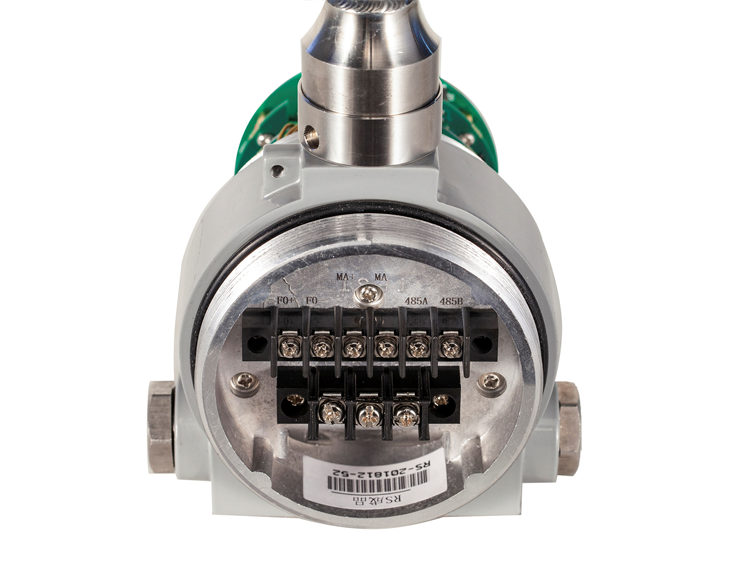
Clearly marked terminal wiring supports correct installation and reduces false-wiring risk.
Installation evidence belongs in the purchase terms as well. The supplied risk information notes two practical failure modes: accuracy that is not as expected, and false wiring. The stated controls are an instruction manual with installation precautions and clearly labelled wiring terminals. A buyer can convert those controls into acceptance items: the manual must be supplied with the shipment, the terminal markings must match the wiring diagram, and the installation precautions must be reviewed before commissioning. This is a low-cost term that prevents a costly dispute later.
Where Silver Automation Instruments fits the comparison
Silver Automation Instruments reports a 10,000 m² factory, 80 employees, a 20-person R&D team and annual output of 60,000 units, with 95% of output exported. Its main markets are listed as Southeast Asia, South America and Africa. Its product portfolio includes Coriolis, thermal mass, electromagnetic, vortex, turbine and oval gear flow meters, along with pressure, level and data logging products. That breadth is useful for a buyer who wants to build a single RFQ across liquid, gas and steam service, but breadth is not the same as model-level proof.
For this comparison, the two directly relevant families are the SH-CMF-FE micro Coriolis mass flow meter/controller and the SRK-DL low-flow thermal mass flow meter/controller. The company also lists vortex flow meters in its portfolio, which is relevant only if a steam offer is classified as vortex and the exact model, pressure rating and temperature limit are confirmed. The company's statement that its products meet CE, ATEX and ISO9001 standards is a useful starting point for supplier qualification, but the buyer should still request the certificate and scope for the specific model.
A neutral way to use the supplier's information is to treat it as a technical starting point and a documentation checklist. The company website is Silver Automation Instruments. The buyer should ask for the model code, datasheet, calibration certificate, material certificate, ATEX certificate where applicable, wiring diagram and instruction manual before comparing commercial terms. If a claim cannot be tied to the offered model, it should not be used to justify a higher price or a faster delivery promise.
Market and standards context without overclaiming
The broader flow meter market was valued at USD 9.1 billion in 2024 and projected to reach USD 12.6 billion by 2029, according to MarketsandMarkets. That figure covers all flow meter technologies, not the low-flow segment alone. It is useful as background for the industrial category, but it cannot be used to size the micro flow meter opportunity, to justify a price premium for one technology, or to claim that demand for a specific low flow meter is growing. Buyers should keep the specification narrow and compare only offers that answer the same technical questions.
Standards provide a second layer of verification. ISO 10790 addresses the selection, installation and use of Coriolis flowmeters for mass flow, density and volume flow measurement. ISO/IEC 17025 sets general requirements for the competence of testing and calibration laboratories, which is relevant when a supplier presents a calibration certificate. Directive 2014/34/EU covers equipment and protective systems intended for use in potentially explosive atmospheres, and the IEC 60079 series addresses electrical apparatus for explosive atmospheres. Where EU legal metrology applies, Directive 2014/32/EU harmonises requirements for measuring instruments placed on the EU market, with instrument-specific annexes that include gas meters and measuring systems for liquids other than water.
Customs classification is a separate issue. HS 9026.10 covers instruments for measuring or checking the flow or level of liquids, and HS 9026.20 covers instruments for measuring or checking the flow or level of gases. These codes are classification structures, not low-flow market statistics. They should not be used to infer market size or supplier share without actual customs values and a scope adjustment. The same caution applies to any broad market figure: it can frame the category, but it cannot replace the RFQ.
The available evidence for this comparison does not include independent performance tests, verified public prices or model-specific ATEX certificates. That does not make the comparison impossible; it makes the purchase terms more important. The RFQ should be written so that the missing evidence becomes a condition of acceptance, not an assumption left to the buyer after delivery.
FAQ
What accuracy basis should a low flow meter RFQ require?
The RFQ should require the accuracy basis to be stated as percent of reading or percent of full scale, together with the calibrated range, test points and reference conditions. The SH-CMF-FE is listed at ±0.25% to ±0.5%, but the available product summary does not state the basis. The SRK-DL is listed at ±1% F.S., so its error band must be read against the quoted full scale. A calibration certificate should support the claimed performance.
Can a 40 g/h to 1,000 kg/h Coriolis range be compared directly with a 2 sccm to 30 SL/M thermal range?
No. The two ranges are expressed in different units and apply to different media and measurement principles. A gas range in sccm or SL/M depends on reference conditions, while a mass-flow range in g/h or kg/h is a different basis. The buyer should compare model-specific ranges at the actual process conditions, not the family headline ranges.
What should buyers require for ATEX approval on a low flow meter?
Buyers should require the ATEX certificate for the exact model, together with the marking, area classification, gas group and temperature class. A company-level statement that products meet ATEX standards is not enough. The certificate should match the installation and the offered configuration. Directive 2014/34/EU and the IEC 60079 series are relevant references for hazardous-area equipment.
What steam data should be confirmed before sign-off?
The RFQ should confirm whether the offer is a vortex or Coriolis meter, whether temperature and pressure compensation are built in or supplied externally, the model-specific maximum steam temperature, the supported line size, the pressure rating, the wetted material, the ATEX status and the calibration document. If the project requires up to 500 °C, that limit should be stated in the RFQ and confirmed for the offered model. DN15–DN300 should be treated as a screening range, not as proof that one model covers every line size.
Why does ±1% full scale differ from ±0.25% to ±0.5% in a purchase decision?
A full-scale accuracy statement is tied to the quoted full scale, so the error band remains fixed in absolute terms even when the reading is low. A percent-of-reading statement changes with the reading. The Coriolis range of ±0.25% to ±0.5% also needs its basis and test conditions before it can be compared with a thermal ±1% F.S. claim. The buyer should compare both technologies at the same flow points, units and reference conditions.
Company brochure (PDF): download the Silver Automation Instruments brochure.
Tem questões ou precisa de mais detalhes?
Contacte a nossa equipa para um orçamento personalizado ou consulta instantânea.
Solicitar orçamento
Preencha o formulário abaixo e a nossa equipa entrará em contacto com uma proposta personalizada.
Chat direto do WhatsApp
Prefere conversar em tempo real? Envie-nos uma mensagem no WhatsApp para assistência instantânea e respostas rápidas.
- Obter orçamento personalizado
- Partilhar fotos ou documentos
- Discuta as suas necessidades diretamente
Geralmente responde em 5–30 minutos durante o horário de expediente.