
Low Flow Metering in Semiconductor Processing: Micro Coriolis for Silane and Supercritical CO2
Low Flow Metering in Semiconductor Processing: Micro Coriolis for Silane and Supercritical CO2
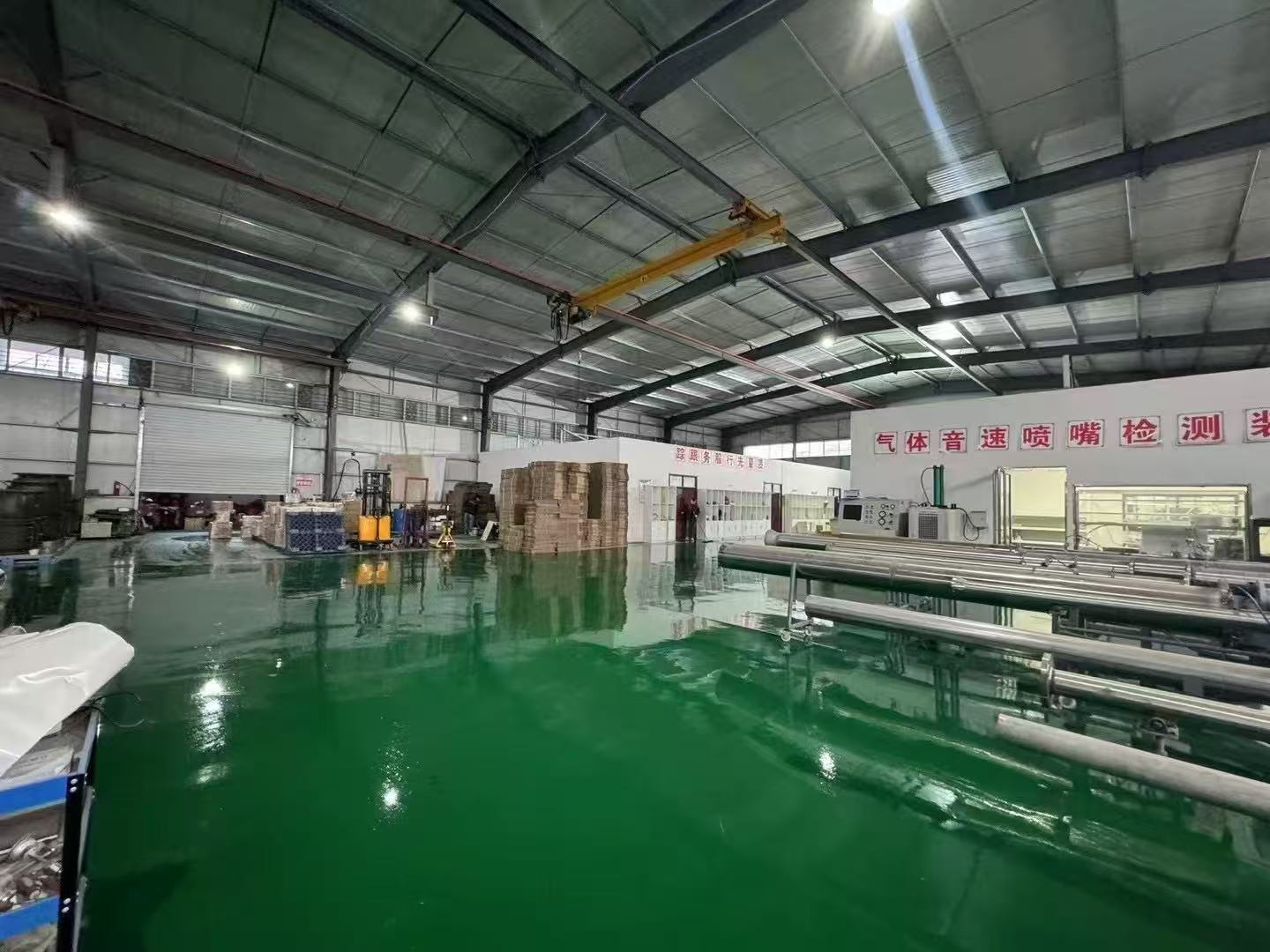
Low-flow verification on a calibration bench: the metrology step that decides whether an instrument can hold its accuracy at the bottom of its range.
Silane and supercritical CO2 are two of the harder media a semiconductor process line will ask a flow instrument to handle. Silane is a pyrophoric gas delivered in small, tightly controlled quantities; supercritical CO2 is a dense-phase fluid whose density shifts sharply with small changes in temperature and pressure. In both cases the practical question is not only how much is flowing, but which measurement principle still returns a defensible number when the medium is hazardous, near its critical point, or both at once.
This article treats low flow metering in semiconductor processing as a scenario-fit problem. It sets out why mass-based measurement suits silane and supercritical CO2 delivery, what the Micro Coriolis mass flow meter model SH-CMF-FE covers in terms of flow range, accuracy, pressure rating, materials and interfaces, and where the approach stops and another instrument class should take over.
The Metering Problem Behind Silane and Supercritical CO2 Delivery
Silane is used in deposition and related steps where the quantity of gas delivered per process cycle influences film formation and repeatability. A volumetric reading of silane is not a finished answer. It has to be converted into mass using local pressure and temperature, and every assumption inside that conversion becomes an uncertainty in the delivered dose.
Supercritical CO2 creates a different version of the same problem. In cleaning and drying duties, CO2 is held near its critical point, where density responds steeply to small temperature or pressure shifts. A volumetric meter on that stream reports a volume whose meaning changes as process conditions drift, so the density correction chain, rather than the meter itself, can dominate total uncertainty.
Three constraints usually accompany these duties:
- Low flow rates: dose rates in semiconductor service are often small, and the instrument must resolve them without losing turndown.
- Small line sizes and limited space: meter bodies, straight pipe runs and cable routing compete with tool footprint.
- Stability requirements: the reading feeds a control loop, a batch record or a safety-relevant interlock, so drift is a process variable rather than a maintenance nuisance.
The opportunity is straightforward. If the instrument reports mass directly, the density variable drops out of the measurement chain for both media.
Why Mass Flow, Not Volume, Is the Right Basis Here
Coriolis measurement determines mass flow from the response of an oscillating tube to the fluid moving through it. The mass in motion produces a phase shift between the inlet and outlet sides of the tube, and that shift is proportional to mass flow. The instrument reports mass per unit time without needing a separately measured density, pressure or temperature to produce the primary value.
For silane, that property matters as much for control as for reporting. Gas supplied from a cylinder or bulk line sits at pressures and temperatures that move with ambient conditions, regulator behaviour and consumption dynamics. A mass-based setpoint remains the same physical quantity even as those conditions change, which is one reason mass flow meters and controllers are widely applied to specialty gas delivery in electronics manufacturing.
For supercritical CO2 the advantage is different but equally practical. Near the critical point the fluid is dense and single phase, behaving closer to a liquid than to a gas. The SH-CMF-FE family is specified in both liquid Coriolis and gas Coriolis configurations and lists supercritical CO2 and silane among the fluids it can handle, so the same measurement principle and the same calibration basis can be applied to both duties instead of combining a thermal gas device with a volumetric liquid device.
Two consequences follow for anyone writing a specification. First, the mass reading is directly comparable with a process recipe that is itself expressed in mass or moles. Second, the density-correction uncertainty carried by volumetric and differential-pressure approaches is removed from the flow loop, leaving the instrument accuracy statement as the main contributor to overall measurement error.
The Micro Coriolis Fit: Model SH-CMF-FE
Silver Automation Instruments is a Nanjing-based instrumentation manufacturer founded in 2010 that builds flow, pressure, level and data-logging instruments and exports the majority of its output. Within its Coriolis range, the Micro Coriolis mass flow meter model SH-CMF-FE is the unit sized for low-flow and small-line duties of the kind found around process tools, pilot lines and analytical equipment.
| Parameter | Specification (SH-CMF-FE) |
|---|---|
| Measurement principle | Coriolis |
| Instrument type | Coriolis flow meter / controller; high pressure, high temperature, liquid and gas Coriolis configurations |
| Flow range | 40 g/h to 1000 kg/hr |
| Accuracy | ±0.25% to ±0.5% |
| Pressure rating | 30 bar or 100 bar |
| Wetted material | Stainless steel 316L |
| Analogue output | 4-20 mA, 0~5 VDC, 1~5 VDC |
| Communication | RS485 or RS232 |
| Power supply | 15 V DC or 24 V DC |
| Media listed | Pure water, silicone, aviation kerosene, diesel, supercritical CO2, silane |
| Applicable industries | Food, (petro)chemical and pharmaceutical industries, fermentation equipment, semiconductor processing, fuel cell technology |
The flow range is the number that decides most low-flow conversations. The 40 g/h lower limit places the instrument above the pure trace-gas region while still covering small dosing and pilot duties; the 1000 kg/hr upper limit allows the same platform to remain in service where a bench-scale line later moves toward small production volumes. Accuracy of ±0.25% to ±0.5% is the stated instrument figure, which matters at low flow because wide-range instruments with full-scale accuracy statements can carry a much larger absolute error at the bottom of their span.
Two further details deserve attention in semiconductor-adjacent work. The 30 bar or 100 bar pressure rating defines the duty envelope the instrument is built for; the higher option covers dense-phase CO2 service and many pilot lines, but it is a ceiling rather than a default. Stainless steel 316L is the wetted material, and compatibility should be confirmed against the specific gas or fluid and any additives present in the process before selection.
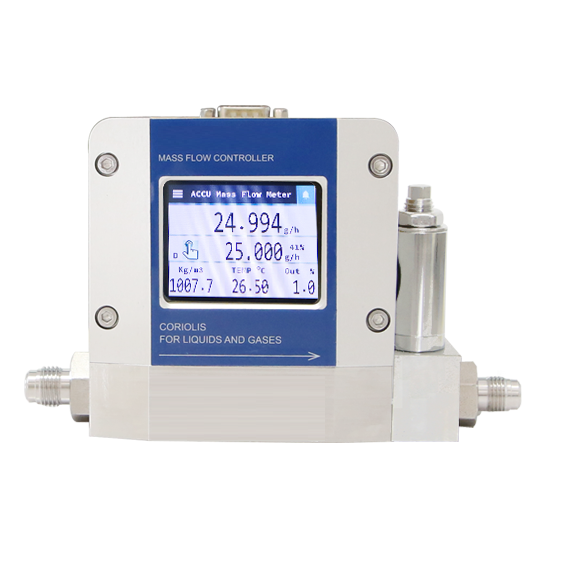
Micro Coriolis mass flow meter / controller: a compact body intended for small-line, low-flow duties where mass dosing is the control variable.
Connections, Signals and Integration with Tool Control
Integrating a low-flow instrument into a semiconductor or pilot line tends to fail on interfaces rather than on accuracy. The SH-CMF-FE offers a broad interface set: process connection options of flanges, wafers, screws or tri-clamp; analogue outputs of 4-20 mA, 0~5 VDC or 1~5 VDC; RS485 or RS232 communication; and a 15 V DC or 24 V DC supply.
| Interface | Available options | Practical note |
|---|---|---|
| Process connection | Flanges, wafers, screws or tri-clamp | Wafer and screw patterns suit compact tool-side installation; flanges suit standard line sizes; tri-clamp suits hygienic adjacent duty in food and pharmaceutical lines. |
| Analogue output | 4-20 mA, 0~5 VDC, 1~5 VDC | 4-20 mA for plant DCS and PLC loops; 0~5 V and 1~5 V for legacy tool interfaces, lab controllers and OEM skids. |
| Digital communication | RS485 or RS232 | Local configuration, readout and data logging without adding a separate transmitter. |
| Power supply | 15 V DC or 24 V DC | 24 V DC matches common industrial cabinets; 15 V DC suits compact OEM enclosures. |
In a controller configuration the same interface set lets the instrument sit inside a dosing loop; in a pure metering duty it can feed a batch record or an alarm limit. Neither case requires a separate density transducer. Coriolis instruments generally do not need long straight upstream and downstream pipe runs, which matters where the meter is mounted close to a tool.
Scenario Fit and Field Evidence
The semiconductor relevance of this instrument class is stated in its application scope: it can be used in process fluid measurement or control systems in semiconductor processing, and supercritical CO2 and silane are both listed among the fluids it handles. Two broader evidence points help a buyer judge whether the platform behind it is credible for taxing duty.
The first is high-pressure service. A Coriolis mass flow meter from the same manufacturer's range was supplied to Chile to measure nitrogen gas at around 700 bar; the unit has been running for more than three years with stable measurement, and the design is described as capable of withstanding 700 bar or higher. That duty sits well above the 30 bar or 100 bar rating of the micro model, but it demonstrates the high-pressure sensor engineering behind the Coriolis family, which is useful to know when a project must confirm that a supplier's pressure capability does not stop at low-pressure laboratory duty.
The second evidence point is at the opposite end of the range. Where the requirement is to detect leakage at the sccm level rather than to dose mass, a different instrument class applies: the SRK-DL low flow thermal mass flow meter covers 2 sccm to 30 SL/M with ±1% F.S. accuracy, and three units supplied in China have been used for more than ten years to detect air leakage down to 2 ml/min. That case illustrates a boundary of Coriolis suitability rather than a strength. Below the 40 g/h minimum of the SH-CMF-FE, a low flow thermal instrument is the appropriate choice.
Market Signals in Low-Flow and Small-Line Metering
Several independently published market figures point in the same direction for buyers planning low-flow instrumentation.
- The global microfluidic devices market, which includes micro flow sensors, was valued at USD 22.1 billion in 2024 and is growing at a CAGR of 12.2%, according to P&S Intelligence.
- The 2-inch and smaller pipe size segment is expected to see the fastest growth through 2030, driven by demand in the pharmaceuticals and food & beverage sectors, according to Grand View Research.
- Thermal mass flow controllers for semiconductor applications are projected to grow at a CAGR of 4.5% between 2026 and 2035, according to SNS Insider.
- Coriolis flow meters held a 26.77% share of the intelligent flow meter market in 2026 (Fortune Business Insights) and generate over USD 1.55 billion in annual revenue as of 2025, primarily for custody transfer applications (Market Research Future).
- Asia-Pacific is the largest regional flow meter market at USD 3.27 billion in 2025, with China contributing over 50% of regional demand (Market Research Future), while the global flow meter market was valued at USD 10.64 billion in 2024 with Europe holding the largest regional share of over 35% (Grand View Research).
Read together, these figures describe two movements that matter to a low-flow specification. Precision measurement is spreading into smaller line sizes and into analytical and microfluidic contexts, and the supply base for that equipment is increasingly Asia-based. The supply landscape itself is worth knowing before shortlisting: Mordor Intelligence identifies Bronkhorst High-Tech as a dominant player in the ultra-low flow Coriolis segment with a focus on laboratory and OEM applications, and lists Honeywell, Emerson and Siemens as the leading global tier-1 competitors in high-precision flow metering. A buyer scanning this market should expect a tier-1 group at the top of the specification range and a wider set of specialist and Asia-based manufacturers competing on configuration flexibility, lead time and cost.
One trade-data point is useful for supplier verification. Silver Automation Instruments was recorded by Volza as having shipped approximately 91 export consignments to 36 international buyers in 2024, primarily in the mechanical appliances category. Third-party shipment records of this kind are usually a more usable credibility signal than a supplier's own sales description.
Comparison With Traditional Solutions and Where Micro Coriolis Stops
| Approach | What it does well | Limits in silane and supercritical CO2 low-flow duty |
|---|---|---|
| Thermal mass flow meter / controller | Measures gas mass flow down to the sccm region (SRK-DL: 2 sccm to 30 SL/M, ±1% F.S.); well suited to leak detection and ultra-low gas dosing. | Primarily a gas instrument; accuracy is stated as a percentage of full scale, so the accurate band is narrower in absolute terms; not the first choice for dense-phase or liquid service. |
| Differential pressure (orifice and similar) | ISO 5167:2022 is the primary international standard for differential pressure flow measurement devices, giving a well-understood engineering basis. | The calculation depends on a density input, so the density uncertainty of near-critical CO2 reappears in the mass result; the primary element also introduces permanent pressure loss, unwelcome at tool-side low flow. |
| Positive displacement / oval gear | Positive displacement meters hold an 18% share for low to moderate flow rates of viscous fluids (Fortune Business Insights); micro oval gear designs reach very low liquid flows with high viscosity tolerance (0.5 ccm, up to 2000 mPa.s in the Silver range). | Moving parts and liquid-phase orientation make them a poor fit for a pyrophoric gas or a dense-phase stream whose state can shift. |
| Micro Coriolis (SH-CMF-FE) | Direct mass reading across liquid, gas and dense-phase duties; ±0.25% to ±0.5%; 40 g/h to 1000 kg/hr; 30 bar or 100 bar; stainless steel 316L; analogue, digital and multiple connection options. | The 40 g/h floor excludes sccm-level leak detection; 100 bar is a hard ceiling for this model; and the instrument measures the fluid state at the sensor, so phase or composition changes downstream remain a system design question. |
A Procurement Checklist for Semiconductor Low-Flow Duty
| Decision point | What to confirm | Why it decides the model |
|---|---|---|
| Medium state | Gas (silane), dense phase (supercritical CO2) or liquid | Determines gas or liquid Coriolis configuration and whether a mass basis removes density uncertainty |
| Pressure | Maximum operating pressure against 30 bar or 100 bar | Selects the pressure rating; duty above 100 bar moves to the high-pressure Coriolis range |
| Flow envelope | Minimum and maximum mass flow against 40 g/h to 1000 kg/hr | The minimum value decides between a micro Coriolis meter and a low flow thermal meter |
| Accuracy | Required tolerance against ±0.25% to ±0.5% | Confirms whether the instrument statement covers the dose tolerance |
| Wetted material | Stainless steel 316L compatibility with the medium and additives | Prevents selection on flow performance alone |
| Interface | Flanges, wafers, screws or tri-clamp; 4-20 mA, 0~5 VDC, 1~5 VDC; RS485 or RS232; 15 V DC or 24 V DC | Matches the existing line standard, control cabinet and tool electronics |
| Documentation | Calibration test record and the manufacturer's CE, ATEX and ISO9001 claims | Supports qualification, audit and maintenance planning |
| Supply capability | Monthly capacity of 2000 units, 10-12 working day lead time, MOQ of 1 unit, OEM/ODM logo customization, remote after-sales support | Determines whether schedule and customization requirements can be met |
On the supplier side, Silver Automation Instruments was founded in 2010 and reports 80 employees, a 20-person R&D team, annual output of 60000 units and an export ratio of 95%, with main markets in Southeast Asia, South America and Africa. Those figures describe a mid-sized specialist manufacturer rather than a tier-1 multinational, which is consistent with the configuration flexibility that buyers at the specialist end of this market tend to value: one-unit minimum orders, 10-12 working day lead times and OEM/ODM logo customization.

Assembly stage in the production flow: build quality and calibration discipline are what a qualification audit actually inspects.
Future Outlook
The direction of low-flow metering in semiconductor processing is toward more measurement points placed closer to the process, at lower flow rates, and with fewer assumptions built into the reading. Direct mass measurement fits that direction because it removes a density correction step at precisely the point where density is least stable.
Two caveats should temper any forecast. First, instrument selection is only one element of a silane or supercritical CO2 delivery system; purging practice, leak detection, materials handling and tool-level qualification remain decisive, and a meter that performs well on a calibration bench still has to pass the fab's own validation. Second, recognition in the ultra-low-flow Coriolis segment is currently concentrated among a small group of specialists, so buyers evaluating alternative suppliers should weight verifiable evidence such as trade records, calibration documentation, certification claims and reference duties above catalogue positioning.
Documentation
The manufacturer's product brochure, covering the instrumentation range and contact details, can be accessed and downloaded here: Silver Automation Instruments product brochure (PDF). The company website is silverinstruments.com.
FAQ
Can a Micro Coriolis mass flow meter measure silane at low flow rates?
Yes, within its stated range. The SH-CMF-FE is specified as a gas Coriolis configuration with a flow range of 40 g/h to 1000 kg/hr and accuracy of ±0.25% to ±0.5%, and silane is listed among the fluids it can handle. Because the instrument measures mass flow directly, the delivered quantity does not require a separate density correction as line pressure and temperature move. Duty points below 40 g/h fall outside this model and belong to a different instrument class.
What pressure rating is required for supercritical CO2 service?
The SH-CMF-FE is available with a pressure rating of 30 bar or 100 bar, and supercritical CO2 is a listed medium. The rating must be matched to the maximum operating pressure of the line, not to the nominal process setpoint, and 100 bar is the ceiling for this model. Duties above that level require a high-pressure Coriolis platform.
How does Micro Coriolis accuracy compare with a low flow thermal mass flow meter?
The two instruments suit different parts of the low-flow spectrum. The SH-CMF-FE is stated at ±0.25% to ±0.5% across 40 g/h to 1000 kg/hr and covers gas, liquid and dense-phase media. The SRK-DL low flow thermal mass flow meter covers 2 sccm to 30 SL/M with ±1% F.S. accuracy and is primarily a gas instrument, which makes it suitable for sccm-level leak detection and ultra-low gas dosing below the Coriolis lower limit.
Which process connections and output signals are available for tool integration?
Process connection options are flanges, wafers, screws or tri-clamp. Analogue outputs are 4-20 mA, 0~5 VDC or 1~5 VDC, and digital communication is RS485 or RS232. The unit can be powered from 15 V DC or 24 V DC. This combination allows the instrument to feed a plant DCS or PLC loop, a legacy tool interface or a compact OEM enclosure without additional signal conditioning.
What is the difference between the meter and controller configuration in this range?
The SH-CMF-FE is specified as a Coriolis flow meter and controller, so the same device family can be used either to measure and report mass flow or to hold a flow setpoint inside a control loop. In metering duty the outputs typically feed a batch record, totalizer or alarm limit; in control duty they close the loop on the process. Selection depends on whether the process step requires a measurement record, active dosing control, or both.
What wetted materials and media are supported by this model?
The wetted material is stainless steel 316L. Listed media include pure water, silicone, aviation kerosene, diesel, supercritical CO2 and silane, and the application scope covers food, (petro)chemical and pharmaceutical industries, fermentation equipment, semiconductor processing and fuel cell technology. Final selection should always confirm material compatibility against the specific medium, concentration and any additives present in the process.