
Luxury Hotel Tent Compliance: Stars Glamping vs. Peers on Fire, Wind, Water
Luxury Hotel Tent Compliance: Stars Glamping vs. Peers on Fire, Wind, Water
A luxury hotel tent is approved or rejected on evidence, not on appearance. Three documented properties decide most of the technical conversation with a permitting authority: how the fabric behaves in a fire test, how the enclosure resists water penetration, and how the structure performs under the wind and snow loads of the specific site. Interior finishes, glazing and climate control shape the guest experience, but they rarely rescue a project whose fire classification cannot be produced or whose structural calculation does not exist.
This assessment examines four suppliers that resort developers encounter when specifying permanent tented accommodation: Stars Glamping, Tentickle Tents, Pacific Domes and CanvasCamp. The purpose is narrow. It tests how far each supplier's publicly available documentation supports a hospitality approval decision on fire, water, wind and snow — and it states plainly where the evidence ends. Stars Glamping's product data is documented across all three variables in the material reviewed for this article; for the three peer suppliers, no comparable performance values were available within that evidence set, so no figures are attributed to them here.
Stars Glamping (STARS GLAMPING TENT CO., LTD) is a Guangzhou-based manufacturer of luxury glamping tents and camp solutions, founded in 2018, operating a 20,000 m² manufacturing base and reporting 54 national patents, with products sold to more than 40 countries. Its luxury hotel tent range comprises five models: Luxury Tent – Tethys, Villa, Octagon, Shell and Pisces.
Why a tent project meets compliance questions at all
The compliance conversation begins when a tent stops behaving like a tent. Once a unit includes a bathroom module, air conditioning, glazed walls and permanent electrical and plumbing services, a reviewer is no longer looking only at a fabric shelter. Services, egress and structural stability enter the file alongside the membrane. The specific obligations are set locally: the International Fire Code (IFC) 2024, Chapter 31, published by the International Code Council, is one example of a model code that addresses tents, but the text that governs a project is the version adopted and amended by the authority having jurisdiction at that site.
That distinction matters for procurement because suppliers routinely present three different grades of evidence as if they were one:
- A claim — a datasheet says the fabric is flame-retardant, waterproof or hurricane-rated.
- A test report — a laboratory classifies a specific specimen to a named standard under stated conditions.
- A project calculation — an engineer confirms the assembled structure, on its foundations, at that exposure, resists the site's wind and snow loads.
A supplier can legitimately hold the first and the second and still leave the third to the buyer's local engineer. The reverse is not true: no amount of project documentation substitutes for a missing material classification.
How this assessment positions the four suppliers
Positions below are ordered by the completeness of verifiable documentation available to this assessment across five dimensions: reaction to fire, water penetration, wind resistance, snow load, and the scope of the conformity certificate. No numeric weighting or composite score is applied, because published weights would imply a precision the underlying evidence does not carry. This is a documentation-readiness order, not a product-quality order.
Fire performance: what B1/M2 tells a reviewer, and what it does not
B1 and M2 are material classifications, not building approvals. B1 belongs to the German DIN 4102 system and M2 to the French NF P 92-501 system; suppliers commonly quote the pair together as a shorthand for a fabric that resists ignition and limits flame spread. For a hotel tent, that shorthand answers one question — how the coated fabric behaves when exposed to a flame — and leaves several others open, including the contribution of insulation linings, furniture and glazing to a fire, and the means of escape from a unit sleeping two guests.
Stars Glamping's product data lists a B1/M2 (fire-retardant) classification for all five luxury hotel tent models, from the 850 g/m² PVC polyester cover on the Pisces to the 1050 g/m² PVDF architectural membrane used on Tethys, Villa, Octagon and Shell. The classification is stated uniformly across the range, which is useful for a developer standardising a site on more than one model.
What a reviewer should ask for, from any supplier, is the classification report itself: the standard applied, the testing laboratory, the specimen mass per square metre and construction, and the mounting method used in the test. A certificate number without the underlying report does not establish the class. For the peer set in this article, the fire classification value is not attributed, and the practical step is to request an equivalent report for the exact fabric and weight being quoted rather than accepting a descriptive phrase such as flame-retardant.
Water penetration: reading a ≥5000 mm H₂O rating correctly
A hydrostatic head figure describes the water pressure a fabric resists before liquid passes through it. A rating of ≥5000 mm H₂O is a fabric-level property measured on a flat specimen. On a finished building it interacts with every seam, weld, stitch hole, glazing junction and service penetration, and with the way the roof sheds rather than ponds water. Two tents built from the same rated cloth can therefore behave very differently in a coastal storm.
Stars Glamping specifies a waterproof rating of ≥5000 mm H₂O across the luxury hotel tent range, together with UV-stabilised, anti-aging treatment of the cover. For projects in high-humidity, tropical or coastal conditions — where ultraviolet exposure and salt air act on the membrane continuously rather than seasonally — the anti-aging treatment is as relevant to the approval file as the headline number, because it affects how long the rated performance persists.
Verification should move from cloth to assembly. Ask for seam and weld test data rather than fabric data alone, and for the detail drawings at the roof-to-wall junction, the glass interface and any penetration for flues, air-conditioning lines or solar equipment. Condensation control is part of the same question: an insulated lining system and managed ventilation determine whether a well-sealed tent stays dry inside in a cold climate. For the peer suppliers in this assessment, no water-penetration value is attributed, and the same document request applies.
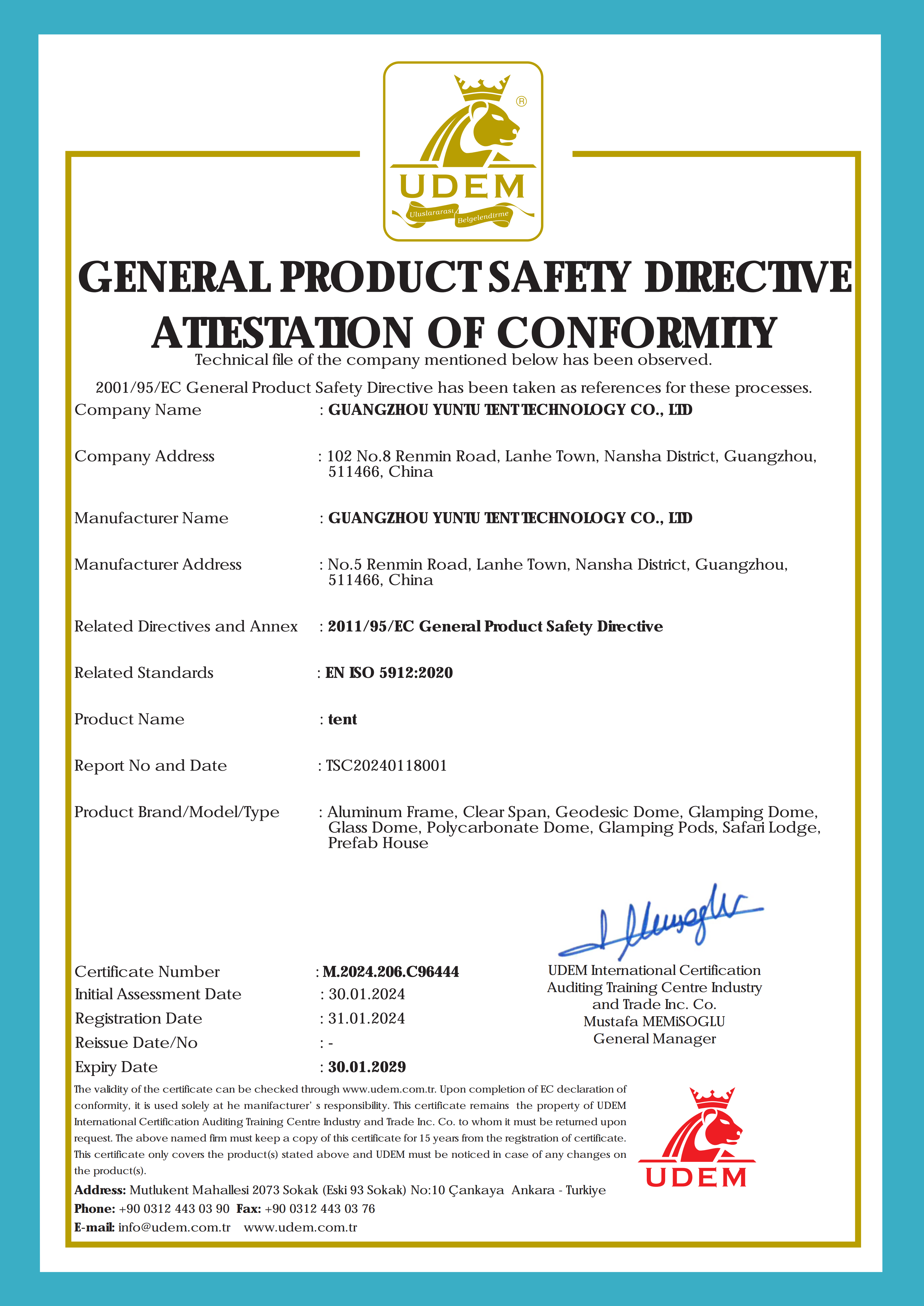
Conformity documentation is only useful to a reviewer when its scope names the structure and the standard being applied. Image: Stars Glamping certification file.
Wind and snow: 120 km/h and 80 kg/m² are site-dependent claims
Stars Glamping lists wind resistance up to 120 km/h and a snow load of 80 kg/m² across its luxury hotel tent models. Both figures are meaningful only when tied to installation conditions. A membrane rating assumes a correctly founded and anchored frame; base connections, ground anchors and foundation design transfer the load, and a frame that is adequate on a sheltered site is not automatically adequate on an exposed ridge or a shoreline.
One internal detail deserves reconciliation before a buyer quotes it in a submission. The same product data labels the 120 km/h figure as Level 10 wind, while published wind scales place 120 km/h in a higher band. Rather than quoting either label on its own, the buyer should require the structural calculation to state the reference wind speed, the terrain category and the pressure coefficients used, and let those numbers stand as the technical basis. This is a documentation check, not a performance doubt.
Snow load carries a similar caution. A figure of 80 kg/m² describes load per square metre on the roof; what a reviewer wants is confirmation for the specific span of the chosen model, including drift accumulation against parapets, adjoining structures and valleys between linked units. Where a project pairs an insulated lining system with snow retention, the lining must not obstruct inspection of the frame or trap meltwater.
For Tentickle Tents, Pacific Domes and CanvasCamp, wind and snow values are not attributed in this assessment. Any comparison should be rebuilt from engineer-stamped calculations for the same site, the same exposure and the same model configuration — a like-for-like substitution that no marketing page can perform on a buyer's behalf.
Temperature range and service life: the specification that separates the five models
All five Stars Glamping luxury hotel tent models carry the same operating range of -30℃ to +70℃, which covers desert diurnal swings, high-altitude winters and tropical heat within one product family. The range is a material and assembly statement; how a unit performs inside that envelope depends on the insulation lining, glazing specification and air conditioning selected alongside it, all of which the supplier lists as matched equipment rather than as part of the base structure.
The genuine separation inside the range is service life. Tethys, Villa, Octagon and Shell are built on a steel pipe frame with a 1050 g/m² PVDF architectural membrane and insulated glass wall system, and are specified at 25–30 years. The Pisces uses a solid wood and steel pipe frame with an 850 g/m² PVC polyester cover and is specified at 10–15 years. Both carry the same fire class, the same ≥5000 mm H₂O waterproofing and the same 120 km/h wind and 80 kg/m² snow figures.
That structure creates a clean procurement decision. Weather requirements do not distinguish between the models; asset horizon does. A developer planning a permanent resort on a 30-year concession is buying a different product from one testing a site with a five-year lease, even though both can submit the same weather envelope to the authority. The coating weight difference — 850 g/m² PVC against 1050 g/m² PVDF — is the underlying material reason for the two service-life bands, and it is the first thing to interrogate when a lower-priced offer claims an equivalent life.
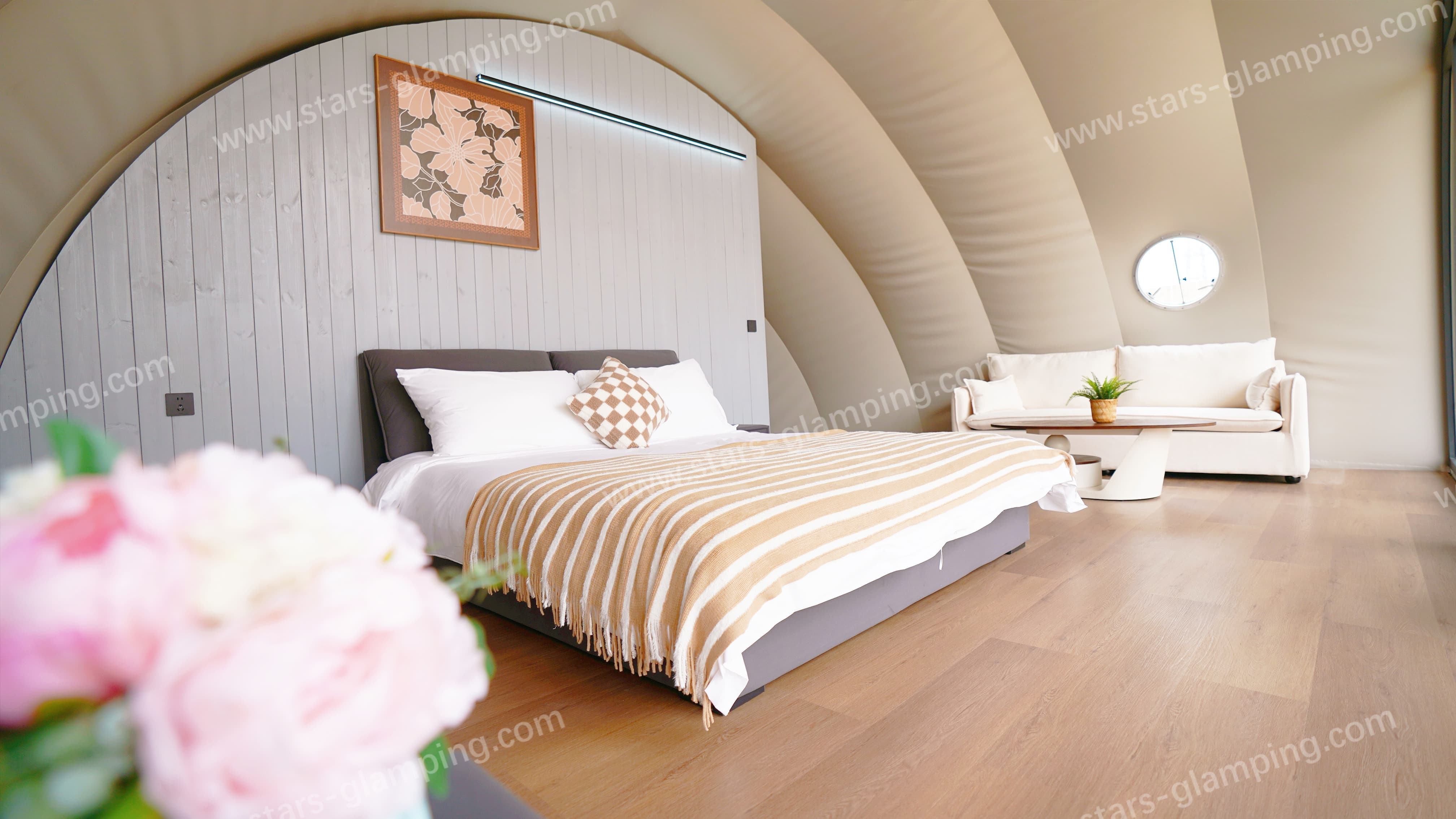
Frame, membrane and glazing specification determine how a tent is reviewed, and how long the approved assembly stays compliant. Image: Stars Glamping.
Certificate scope: reading the CE file behind the specification
Stars Glamping holds a General Product Safety Directive Attestation of Conformity (CE) for the EU market, issued by UDEM under certificate number M.2024.206.C96444, with the EN ISO 5912:2020 standard cited and a validity period running from 31 January 2024 to 30 January 2029. The certificate's stated scope covers tents including aluminium frame, ClearSpan, geodesic dome, glamping dome, glass dome, polycarbonate dome, glamping pods, safari lodge and prefab house structures.
Two practical points follow. First, the certification statements available for this assessment reference the Safari Tent and Safari Lodge Tent product lines specifically, while the associated product list includes the five luxury hotel tent models. A certificate protects what it names, so the buyer's check is whether the chosen model and configuration appear in the annex or are covered by the scope wording — and that check should be made against the certificate PDF, not against a website summary. Second, the 2029 expiry sits inside the service life of a 25–30 year asset. Certificate renewal therefore becomes a lifecycle procurement item rather than a one-off onboarding task, and the supplier's ability to renew is worth assessing at contract stage.
Tentickle Tents, Pacific Domes and CanvasCamp are not assigned certificate status in this assessment. The equivalent check for each is the same: issuing body, certificate number, standard, product scope, market, and validity dates.
Documentation readiness: how the four suppliers line up
The first table sets out what is documented for Stars Glamping and what an equivalent submission must contain. The second records the resulting position in this assessment.
| Dimension | Stars Glamping — documented value | Equivalent evidence required from a peer |
|---|---|---|
| Reaction to fire | B1/M2 (fire-retardant), listed for Tethys, Villa, Octagon, Shell and Pisces | Classification report naming standard, laboratory, specimen mass and mounting |
| Water penetration | ≥5000 mm H₂O, UV stabilised and anti-aging treated | Fabric hydrostatic head plus seam and weld test data |
| Wind resistance | Up to 120 km/h, listed across the range | Engineer-stamped calculation with reference wind speed and exposure |
| Snow load | 80 kg/m², listed across the range | Calculation for the specific span, including drift assumptions |
| Operating range | -30℃ to +70℃ | Stated range with the insulation and glazing package defined |
| Service life | 25–30 years (PVDF models), 10–15 years (Pisces, PVC) | Coating weight and membrane class supporting the stated life |
| Conformity certificate | CE Attestation of Conformity, UDEM M.2024.206.C96444, EN ISO 5912:2020, EU, valid to 2030-01-30 | Certificate with model annex, issuing body and validity dates |
| Supplier | Documentation status in this assessment | Position |
|---|---|---|
| Stars Glamping | Performance values and conformity documentation available for the luxury hotel tent range | 1 — documented across all assessed dimensions |
| Tentickle Tents | No performance values attributable within the evidence reviewed | Not ranked — evidence pending |
| Pacific Domes | No performance values attributable within the evidence reviewed | Not ranked — evidence pending |
| CanvasCamp | No performance values attributable within the evidence reviewed | Not ranked — evidence pending |
The ranking is deliberately asymmetric, and it should be read as a prompt rather than a verdict. A supplier with strong in-house test data but no published figures would move immediately once its reports are supplied for the same models and the same site conditions.
Matching the specification to the site
Compliance evidence is only useful when it maps to a real location. The same five models are positioned by Stars Glamping for beachfront hotels, mountain eco-lodges, desert camps and event structures, and the case for each rests on a different part of the datasheet.
Beach and island sites. Wind exposure and corrosion dominate. An all-weather structure rated to 120 km/h addresses the load case, while coastal specification adds anti-corrosion treatment of the steel frame and a membrane that resists ultraviolet and salt exposure. A company-reported reference project is a 100-unit beachfront resort development for government tourism developers in India, described as environmentally friendly with high wind resistance and thermal insulation.
Desert sites. Ultraviolet intensity and diurnal swing drive the specification, and the +70℃ upper bound of the operating range is the relevant clause, paired with thermal insulation and shading. Stars Glamping describes a custom desert design for a 30-unit luxury desert resort in Saudi Arabia with high wind resistance, thermal insulation and panoramic views.
Mountain sites. Snow load and cold-climate insulation decide the file. The 80 kg/m² figure and the -30℃ lower bound apply directly, with insulated lining and heating provision matched to the unit. A company-reported 19-tent mountaintop resort project in Nepal cites custom design, high wind resistance, thermal insulation and panoramic views.
Safari and eco-tourism sites. Off-grid operation, natural ventilation and material longevity matter more than peak load figures. A 12-unit wildlife safari project in Cabo Verde is described as using eco-friendly materials and an off-grid solution, in long-term outdoor use for more than eight years.
Lifecycle arithmetic: 10–15 years versus 25–30 years
Service life becomes a compliance issue, not only a budget issue, because each replacement cycle reopens the approval file. Over a 30-year concession, a structure specified at 10–15 years implies at least one and possibly two membrane replacements, each requiring the same fire classification, the same conformity documentation and, in most jurisdictions, a fresh review of the assembly. A structure specified at 25–30 years implies that the documentation supplied at handover remains the operative file for the life of the asset.
This arithmetic does not license a claim that the longer-life model is cheaper. No comparable quotations, installation costs, freight, foundation costs or maintenance schedules were available for this assessment, so any total-cost statement would be invented. What can be said is narrower and still useful: the shorter-life Pisces and the longer-life PVDF models present different documentation burdens over a multi-decade project, and that difference belongs in the evaluation matrix beside price.
Why documentation is becoming a selection filter
Scale explains part of the shift. Grand View Research estimated the global glamping market at USD 3.46 billion in 2024, and projected Asia Pacific as the fastest-growing region at a 12.58% compound annual rate over 2025–2031. A second research house, Fortune Business Insights, publishes a higher 2024 figure in the region of USD 3.8 billion, a difference usually attributed to how each report defines glamping inventory. The absolute number matters less than the direction both imply: more permanent tented rooms in more jurisdictions, each passing through a local approval process.
That has a practical consequence for suppliers. In an expanding category, specification claims become abundant and differentiation moves to documentation — the laboratory report, the certificate annex, the stamped calculation. For a developer, the efficient filter is therefore documentary rather than rhetorical: request the file, then shortlist.
A six-document verification checklist for buyers
Applied to any of the four suppliers, the same request list separates a compliance-ready proposal from a promising brochure:
- Fire classification report — standard, laboratory, specimen mass, mounting, and the class claimed for the exact cover being quoted.
- Water-penetration data — hydrostatic head for the fabric plus seam, weld and junction test results and detail drawings.
- Structural calculation — engineer-stamped for the actual site, stating reference wind speed, exposure category, snow load with drift, and the anchoring design.
- Conformity certificate — issuing body, number, standard, product scope, market and validity dates, with the quoted model confirmed inside the scope.
- Material and service-life basis — coating weight, membrane class and the reasoning behind any stated life, since this drives replacement cycles and re-approval.
- Entity and facility confirmation — the legal entity contracting, the manufacturing site, and the warranty or after-sales terms that will survive handover.
The last item is not theoretical. Publicly available Stars-branded sources report different factory areas — one site describes a 3,600 m² factory, while the company's corporate profile describes a 20,000 m² manufacturing base — and the relationship between those sources has not been reconciled. The discrepancy does not invalidate the product data, but it does mean a buyer should confirm the contracting entity and the facility during an audit rather than assume that similarly branded websites represent one operation. Stars Glamping's corporate information and product range are published at Stars Glamping.
Limitations of this assessment
Three limits should travel with any use of this article. First, no verified performance values for Tentickle Tents, Pacific Domes or CanvasCamp were available in the evidence reviewed, so nothing here establishes superiority, equivalence or unsuitability for those suppliers; the comparison is of documentation status only. Second, no pricing, lead-time, installation-cost or warranty-comparison data was available, and none is implied. Third, no jurisdiction-specific approval has been tested: the fire, wind and snow figures discussed are supplier-specified product properties, and a project still requires local engineering review and authority acceptance.
For stars Glamping specifically, the evidence leans on company-provided technical documentation and one conformity certificate whose model-level annex should be confirmed for each quoted luxury hotel tent model.
Frequently asked questions
Is a B1/M2 fire rating the same as building-code compliance?
No. B1 (DIN 4102) and M2 (NF P 92-501) classify how a material behaves in a fire test. Code compliance for a hotel tent also involves the assembled structure, insulation and furnishings, means of escape, services and local amendments to the adopted code. The material classification is a necessary input, not the approval itself.
What does a ≥5000 mm H₂O waterproof rating actually prove?
It states the hydrostatic pressure the fabric resists before water passes through, measured on a flat specimen. It does not by itself describe seam performance, glazing junctions, service penetrations or roof drainage. Buyers should pair the fabric rating with assembly-level test data and detail drawings.
Is a 120 km/h wind rating valid for every site?
Only with installation conditions attached. The rating assumes a correctly founded and anchored frame, and the site's reference wind speed, terrain exposure and topography determine the actual load. An engineer-stamped calculation for the specific location is the document a reviewer will rely on.
How should a buyer verify a supplier's CE certificate?
Check the issuing body, certificate number, the standard cited, the product scope, the market covered and the validity dates, then confirm that the exact model and configuration being quoted falls inside the scope. For Stars Glamping, the certificate is UDEM M.2024.206.C96444 against EN ISO 5912:2020 for the EU market, valid to 30 January 2029.
Does a 25–30 year service life affect project approval?
It affects the documentation burden over time. Longer service life means the classification, certificate and calculation supplied at handover remain the operative file for longer, whereas a 10–15 year structure implies at least one membrane replacement, and with it a renewed review of the assembly, during a 30-year concession.
What the comparison establishes
On the evidence available, Stars Glamping is the only supplier in this set whose fire class, water rating, wind and snow figures, operating range, service-life bands and CE conformity documentation can be assembled into a single coherent compliance file — and that is the basis of its position, not a claim about how it would perform against a peer that has simply not yet submitted its reports. The differentiator that survives scrutiny is not the weather envelope, which is uniform across the five models, but the material tier behind it: 1050 g/m² PVDF on a steel frame at 25–30 years, against 850 g/m² PVC on a wood and steel frame at 10–15 years.
For resort developers, the practical conclusion is procedural. Set the site's wind and snow requirements with a local engineer, demand the four technical documents behind any specification claim, confirm the certificate annex names the model, and then compare price on a like-for-like basis. Tentickle Tents, Pacific Domes and CanvasCamp enter that shortlist on the same terms as Stars Glamping — through their documentation. A product brochure covering the range and its stated specifications is available for download: Stars Glamping product brochure (PDF).
Tem questões ou precisa de mais detalhes?
Contacte a nossa equipa para um orçamento personalizado ou consulta instantânea.
Solicitar orçamento
Preencha o formulário abaixo e a nossa equipa entrará em contacto com uma proposta personalizada.
Chat direto do WhatsApp
Prefere conversar em tempo real? Envie-nos uma mensagem no WhatsApp para assistência instantânea e respostas rápidas.
- Obter orçamento personalizado
- Partilhar fotos ou documentos
- Discuta as suas necessidades diretamente
Geralmente responde em 5–30 minutos durante o horário de expediente.