
Luxury Hotel Tent Procurement FAQ: Wind, Snow, Temperature, Lifespan
Four engineering figures decide whether a luxury hotel tent project is still viable a decade after opening: the wind speed the structure can resist, the snow load the roof can carry, the temperature range the materials tolerate, and the service life the owner can plan around. In a resort development, these are not marketing details. They appear in insurance submissions, structural reviews, lender documentation, and the operating budget for the asset.
Stars Glamping (STARS GLAMPING TENT CO., LTD) is a Guangzhou-based manufacturer of luxury glamping tents and camp solutions, founded in 2018, operating a 20,000 m² manufacturing base and a 4,000 m² simulation exhibition hall, and exporting to more than 40 countries and regions. This reference answers the technical procurement questions buyers most often raise about its luxury hotel tent range, using the published specification data for each model rather than general claims.
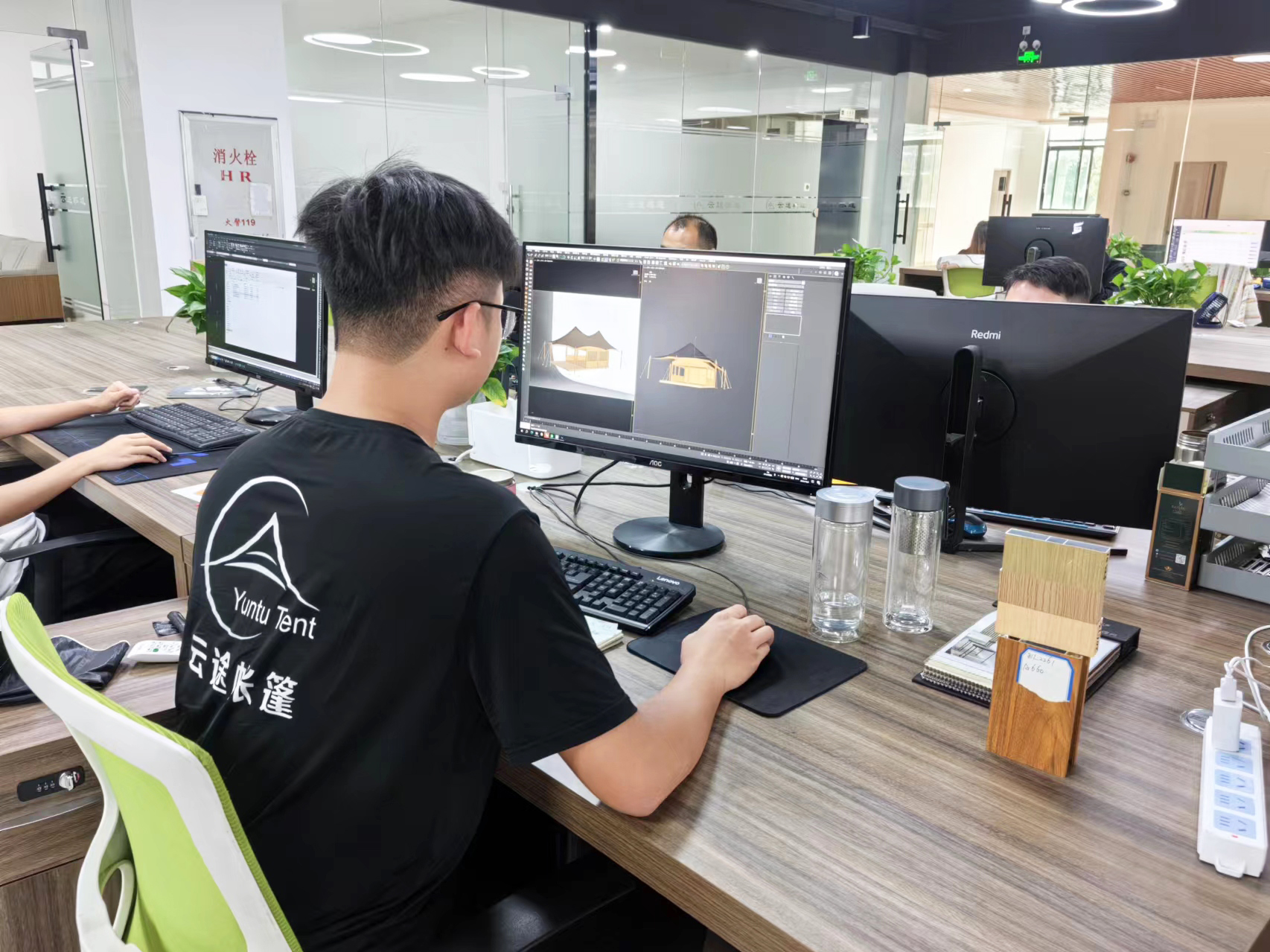
Specification review at the source: frame, membrane and glazing parameters are set before a luxury hotel tent is released to production. Image: Stars Glamping.
Why wind, snow, temperature and lifespan lead the procurement checklist
Design conversations happen early. Load conversations happen at procurement, and they follow a predictable sequence: what is the design wind speed at the site, what is the ground snow load, what climate does the membrane and frame have to survive, and how many years of service should the owner assume before major intervention?
For a luxury hotel tent, the answers are determined by three components working together: the structural frame, the tensioned fabric envelope, and any rigid elements such as insulated glass walls. Change one and the performance envelope changes. That is why a specification sheet is only useful if it tells you which model, which frame material, and which coating weight the rating belongs to.
The four questions below are answered with the published figures for the Stars Glamping luxury hotel tent range, followed by the verification points that convert a supplier claim into a procurement decision.
The published specifications across the luxury hotel tent range
Stars Glamping publishes a consistent load and durability set across four of its luxury hotel tent models. The fifth model, Pisces, shares the load ratings but uses a different frame and fabric combination, which produces a shorter published service life.
| Model | Frame | Cover fabric | Wind resistance | Snow load | Temperature | Service life |
|---|---|---|---|---|---|---|
| Luxury Tent – Tethys | Steel pipe | 1050 g/m² PVDF architectural membrane | Up to 120 km/h (Level 10 wind) | 80 kg/m² | −30 °C to +70 °C | 25–30 years |
| Luxury Tent – Villa | Steel pipe | 1050 g/m² PVDF architectural membrane | Up to 120 km/h (Level 10 wind) | 80 kg/m² | −30 °C to +70 °C | 25–30 years |
| Luxury Tent – Octagon | Steel pipe | 1050 g/m² PVDF architectural membrane | Up to 120 km/h (Level 10 wind) | 80 kg/m² | −30 °C to +70 °C | 25–30 years |
| Luxury Tent – Shell | Steel pipe | 1050 g/m² PVDF architectural membrane | Up to 120 km/h (Level 10 wind) | 80 kg/m² | −30 °C to +70 °C | 25–30 years |
| Luxury Tent – Pisces | Solid wood + steel pipe | 850 g/m² PVC polyester fabric | Up to 120 km/h (Level 10 wind) | 80 kg/m² | −30 °C to +70 °C | 10–15 years |
All five luxury hotel tent models are published with a waterproof rating of ≥5,000 mm H₂O, B1/M2 fire-retardant rating, and UV-stabilised, anti-aging fabric treatment.
For comparison, the safari lodge range — Safari Tent Epic, Vega and Lodestar — is specified at up to 100 km/h (Level 9 wind), 60 kg/m² snow load, a temperature range of −25 °C to +60 °C, a waterproof rating of ≥3,000 mm H₂O, and an 8–12 year service life. Those figures matter when a project mixes safari-style lodge units with the luxury hotel tent range on the same site: the two product families do not carry the same envelope.
Wind load: what 120 km/h (Level 10) actually covers
The published wind resistance for the Tethys, Villa, Octagon, Shell and Pisces models is up to 120 km/h, described as Level 10 wind. The safari range is published at up to 100 km/h (Level 9).
That figure is the outcome of three design decisions, not one. The steel pipe frame carries the bending and uplift forces; the membrane pre-tension keeps the envelope from fluttering, which is what fatigues coated fabric over time; and the anchorage transfers everything into the ground. A rating without an anchor assumption is incomplete, which is why the practical procurement question is not “what is the wind speed?” but “at what wind speed, under which load case, and with which fixation?”
Three verification points are worth putting in writing before a purchase order:
- Whether the wind figure comes from an engineering calculation, a physical test, or a design assessment — the answer determines how much site-specific work remains.
- What anchor and foundation type the rating assumes, since exposed coastal and ridge-top sites typically require a heavier foundation than a sheltered valley.
- How local building code classifies the structure, because membrane and tent structures are often reviewed under separate code sections from permanent buildings.
Stars Glamping holds national patents covering wind resistance, waterproofing, heat insulation and quick assembly as part of its core technology set, and runs an in-house R&D team spanning architectural design, structural engineering and materials science. For a buyer, that matters less as a claim and more as an indication that load performance is engineered into the product family rather than adjusted at the drawing stage.
Snow load: what 80 kg/m² means for a roof that must also look effortless
The luxury hotel tent range is published at 80 kg/m² snow load; the safari lodge range at 60 kg/m². Snow behaves differently from wind, and this is where a specification sheet is most often misread.
Wind is a lateral and uplift problem that scales with exposure. Snow is a gravity problem that scales with accumulation, roof geometry and drainage. Two sites with the same headline snow load can produce very different loads on the same tent if one is exposed to drifting and the other is sheltered. Roof form — such as the faceted geometry of the Octagon model — influences how quickly snow sheds and how much of it remains loaded on one side of the structure.
The 80 kg/m² figure therefore functions as a design statement for the range, not a substitute for a site-specific snow study. Two clarifications are worth requesting in a submittal package: how the snow load is assumed to be distributed across the roof surface, and whether interior heating is expected to be running during peak snow events. Heating changes the melting and refreezing pattern at eaves and low points, which is a maintenance question as much as a structural one.
Temperature range: −30 °C to +70 °C is a material rating, not a comfort promise
All five luxury hotel tent models share a published temperature resistance of −30 °C to +70 °C. The safari lodge range is published at −25 °C to +60 °C.
This range describes how the materials behave — how the coating on the fabric responds to thermal cycling, how the UV-stabilised treatment holds up under sustained solar exposure on the high end, and how the frame accommodates thermal movement on the low end. It is a material and service-life statement. It does not describe the indoor temperature a guest will experience.
Guest comfort is produced by a different layer of specification. The luxury hotel tent models are built as steel frame plus PVC/PVDF fabric plus an insulated glass wall system; insulation and glazing are what separate an envelope that survives a −30 °C night from a room that stays comfortable through it. Projects in desert and mountain environments therefore combine the tent envelope with active climate control and, where required, additional insulation packages. Buyers comparing models for cold-climate deployment should ask what the −30 °C rating covers in the delivered configuration, rather than treating it as an operating guarantee.
Service life: 25–30 years for PVDF models, 10–15 years for Pisces
Published service life differs across the range, and the difference tracks the materials:
| Product family | Cover material | Frame | Published service life |
|---|---|---|---|
| Tethys, Villa, Octagon, Shell | 1050 g/m² PVDF architectural membrane | Steel pipe | 25–30 years |
| Pisces | 850 g/m² PVC polyester fabric | Solid wood + steel pipe | 10–15 years |
| Safari Epic, Vega, Lodestar | 850 g/m² PVC coated polyester fabric | Anti-corrosion solid wood / galvanised steel | 8–12 years |
Two variables explain most of that spread. The first is polymer class: PVDF architectural membrane is a higher-grade coating system than PVC polyester fabric, and independent fabric references cite a service life of roughly 15–30 years for PVDF architectural membranes in this application. The second is coating weight — 1050 g/m² in the PVDF models versus 850 g/m² in the Pisces and safari models — which affects how much coating thickness is available to absorb UV and abrasion over time.
One procurement note on waterproofing: independent fabric guides describe heavy-duty PVC/PVDF membranes used in this category as non-porous and capable of hydrostatic head ratings above 10,000 mm H₂O. The published specification for the Stars Glamping luxury hotel tent range is ≥5,000 mm H₂O, and that is the figure that applies to the delivered product. Buyers should treat the higher number as a description of the material class rather than a guaranteed delivered rating.
Certifications and verification points before you sign
Load and durability figures are only as useful as the documents behind them. The Stars Glamping product range carries a General Product Safety Directive Attestation of Conformity (CE) issued by UDEM, certificate number M.2024.206.C96444, aligned with EN ISO 5912:2020, issued 31 January 2024 and valid until 30 January 2029 for the EU market. The certificate scope covers tents including aluminium frame, ClearSpan, geodesic dome, glamping dome, glass dome, polycarbonate dome, glamping pods, safari lodge and prefab house — and it lists the Tethys, Villa, Octagon, Shell, Pisces, Epic, Lodestar and Vega models among the applicable products.
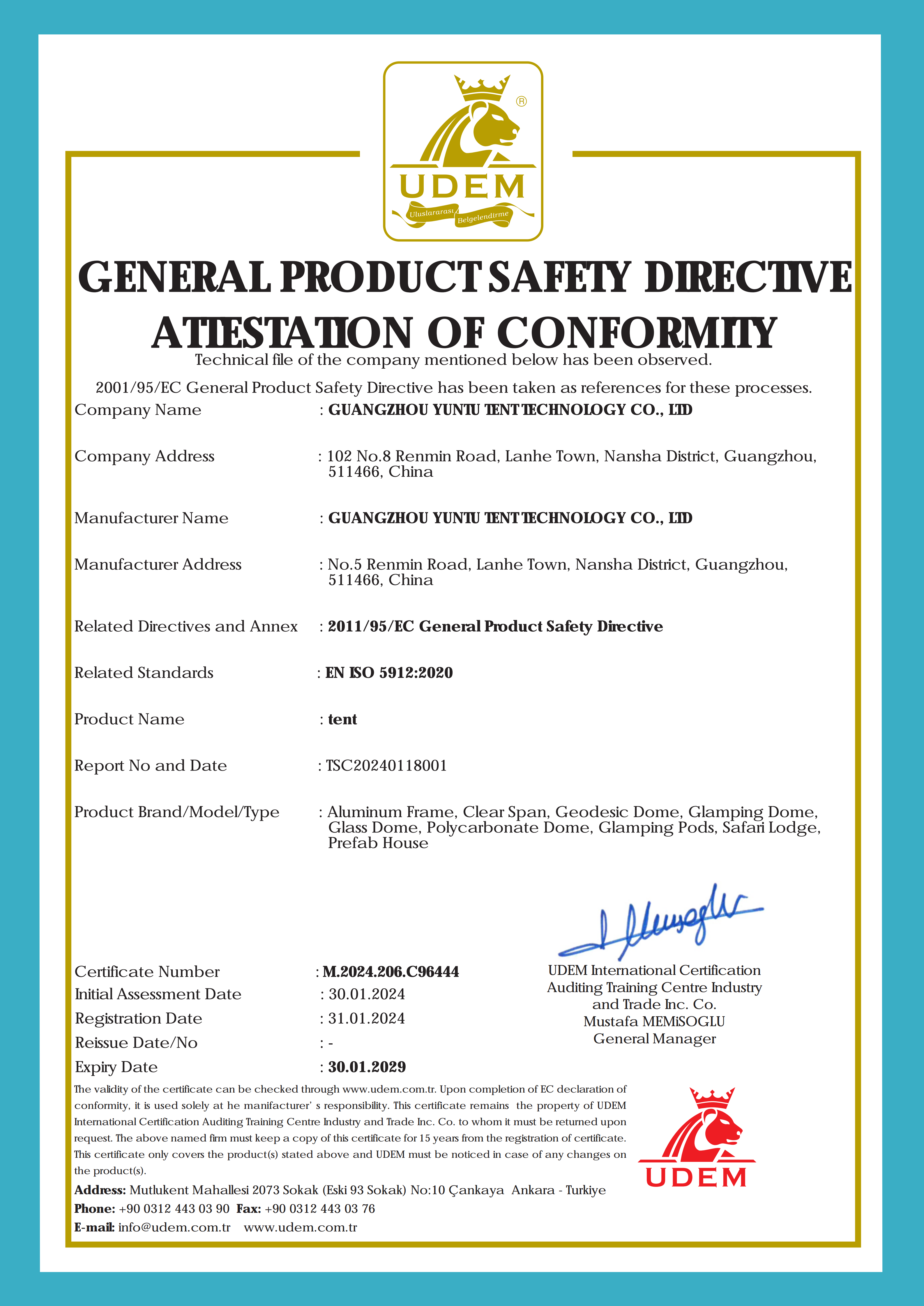
Compliance documentation: CE Attestation of Conformity M.2024.206.C96444, issued by UDEM, valid to 30 January 2029 for the EU market. Image: Stars Glamping.
Fire performance on the range is published as B1/M2 fire-retardant. Separately, hospitality projects in the United States and Europe commonly reference NFPA 701 or EN 13501-1 fire retardancy standards for commercial tent use, so buyers should confirm which standard the local authority having jurisdiction will accept before the submittal stage.
On the manufacturing side, quality control runs through raw material inspection, in-process control and pre-shipment inspection, with third-party inspection available on request. Production capacity for the luxury tent range is published at 50–80 units per month depending on project size, with an annual output of 600–900 luxury tent units, and lead times of 15–20 days for standard models and 20–30 days for customised projects.
Where these numbers have already been tested in the field
Published load ratings become more useful when they map onto real project conditions:
- Mountain resort, Nepal: 19 luxury tents for a full resort project, applied to luxury mountain resort accommodation for long-term permanent use. Key highlights were a custom mountaintop design, high wind resistance, thermal insulation and panoramic views; the reported result was an enhanced guest experience and an increased resort occupancy rate.
- Desert resort, Saudi Arabia: 30 luxury tents for a full resort project in the Middle East market, applied to luxury desert resort accommodation. Key highlights were a custom desert design, high wind resistance, thermal insulation and panoramic views, with the same reported outcome of enhanced guest experience and increased occupancy.
- Beachfront resort, India: 100 luxury tents for a full resort project delivered for government tourism developers, applied to beachfront resort accommodation. Highlights included environmentally friendly construction, high wind resistance, thermal insulation and panoramic views.
- Wildlife safari resort, Cape Verde: 12 luxury hotel tents applied to wildlife safari accommodation for long-term outdoor use of 8+ years. Highlights were eco-friendly materials, an off-grid solution and natural ventilation design; the reported result was an improved eco-tourism experience and more international visitors.
The Cape Verde case is a useful calibration point. A safari-format lodge in continuous outdoor use at the 8-year mark sits squarely inside the 8–12 year published life of that product family, and comfortably inside the 25–30 year figure for the PVDF luxury models. Which number applies depends on which product family the project is specified with — not on the site’s location alone.
Market context: why buyers are asking harder technical questions
The glamping market was valued at approximately USD 3.8 billion in 2025, with tents forming a major accommodation segment alongside cabins and pods, according to Grand View Research. Fortune Business Insights projects the market to reach USD 9.15 billion by 2034, growing at a CAGR of 10.67% during the forecast period. Europe accounted for a 35% revenue share in 2025, according to Grand View Research.
Market sizing in this category should be read with care. Published estimates diverge considerably depending on whether recreational vehicles and cabins are included in the definition, with figures ranging broadly across research houses for overlapping periods. The direction, however, is consistent: more capital is flowing into tent-based hospitality assets, and those assets are increasingly financed, insured and reviewed like permanent accommodation. That is precisely why wind, snow, temperature and service-life data now sit at the centre of the purchase decision rather than in an annex.
Luxury hotel tents versus permanent resort buildings: the trade-off
Against a conventional resort building, the engineered tent structure wins on speed and site flexibility. Standard models are published with 15–20 day lead times and customised projects at 20–30 days, with delivery of 7–15 days for domestic orders and 15–30 days for overseas orders. A steel-framed, membrane-clad unit also imposes far less foundation and site work than a concrete structure of comparable footprint, which matters on rocky, sloping or environmentally sensitive land where heavy construction access is difficult or restricted.
The limitations are equally real, and buyers should enter the decision with them stated plainly:
- Design life is shorter than a permanent building. Even the PVDF models are published at 25–30 years, and the PVC-based Pisces and safari families at 10–15 years and 8–12 years respectively. That is a long asset life for a tent, but it is not the 50-year-plus structural horizon a concrete building may be planned around.
- Ratings are envelope ratings. The 120 km/h wind figure assumes a defined anchorage and load case. A site whose exposure exceeds that assumption needs project-specific engineering rather than a catalogue selection.
- Glass wall systems add constraints. The luxury models are described as steel frame plus PVC/PVDF fabric plus insulated glass wall system. Glazing adds weight and stiffness that must be coordinated with the frame design at the specification stage, not added afterwards.
- Code treatment varies by jurisdiction. Membrane and tent structures are frequently regulated under separate provisions from permanent buildings, so the compliance path — not just the certificate — needs confirming locally.
The practical conclusion is that a luxury hotel tent is not a cheaper building. It is a different asset class with a different risk profile, and the specification sheet is where that profile is either managed or left unmanaged.
Future outlook
Three shifts are likely to shape procurement through the next cycle. First, four-season operation is becoming a design assumption rather than a special request, which pushes insulated wall systems and higher-grade membranes into mainstream specifications. Second, lifecycle planning is moving earlier in the buying process, with owners asking for service-life data at the same stage they ask about wind and snow — the 25–30 year PVDF figure versus the 10–15 year PVC figure is now a budget input, not a footnote. Third, verification is becoming standard practice: CE certification scope, fire standard acceptance, third-party inspection availability and engineering drawings are increasingly part of the tender package rather than post-award negotiation.
FAQ: luxury hotel tent procurement questions
What is the maximum wind speed a luxury hotel tent can resist?
The Stars Glamping luxury hotel tent models Tethys, Villa, Octagon, Shell and Pisces are published at up to 120 km/h, described as Level 10 wind. The safari lodge range — Epic, Vega and Lodestar — is published at up to 100 km/h (Level 9). Because the rating depends on the assumed anchorage and load case, buyers should confirm the fixation and foundation assumptions for their specific site before treating the figure as a project design value.
What snow load can a luxury hotel tent support?
The luxury hotel tent range is published at 80 kg/m² snow load, while the safari lodge range is published at 60 kg/m². Snow load is sensitive to roof geometry, drifting and melting patterns, so the published figure should be checked against site-specific snow conditions and the expected heating regime during peak snowfall.
What temperature range can these tents operate in?
All five luxury hotel tent models are published with a temperature resistance of −30 °C to +70 °C. The safari lodge range is published at −25 °C to +60 °C. These figures describe material and coating performance under thermal cycling and UV exposure. Indoor guest comfort is determined separately by the insulation package, the insulated glass wall system and the tent’s climate control design.
How long does a luxury hotel tent last?
Published service life is 25–30 years for the Tethys, Villa, Octagon and Shell models, which use a 1050 g/m² PVDF architectural membrane on a steel pipe frame. The Pisces model, built with an 850 g/m² PVC polyester fabric and a solid wood plus steel pipe frame, is published at 10–15 years, and the safari lodge range at 8–12 years. Independent fabric references place PVDF architectural membranes at roughly 15–30 years in this application, consistent with the range published for the higher-grade models.
Which models are best matched to cold, snow-exposed sites?
On published specifications, the models combining a steel pipe frame, a 1050 g/m² PVDF architectural membrane, an insulated glass wall system and a 25–30 year service life are the ones aligned with four-season mountain conditions: Tethys, Villa, Octagon and Shell. All of them share the same 120 km/h wind, 80 kg/m² snow and −30 °C to +70 °C ratings, so the selection between them is driven by layout, footprint and architectural form rather than by load class. Pisces carries the same load ratings but a shorter 10–15 year service life, which changes the lifecycle cost calculation more than the structural suitability.
How can a buyer verify these specifications before purchase?
Start with the compliance documents. The Stars Glamping range carries a CE Attestation of Conformity issued by UDEM under certificate M.2024.206.C96444, referencing EN ISO 5912:2020, valid from 31 January 2024 to 30 January 2029 for the EU market, with the Tethys, Villa, Octagon, Shell, Pisces, Epic, Lodestar and Vega models listed among applicable products. Fire performance is published as B1/M2 fire-retardant, and buyers should confirm whether the local authority accepts NFPA 701 or EN 13501-1 as the reference standard. On the manufacturing side, quality control covers raw material inspection, in-process control and pre-shipment inspection, with third-party inspection available, and engineering drawings form part of the standard after-sales documentation set.
The full technical brochure, including model specifications and configuration options, is available for download: Stars Glamping product brochure (PDF).