
Luxury Hotel Tents: A Capability Review for Resort Projects
Resort developers evaluating luxury hotel tent suppliers rarely face a single product decision. The larger question is whether a supplier can translate site conditions, guest expectations, and compliance requirements into a structure that performs as permanent accommodation.
The global glamping market has grown beyond seasonal camping. Grand View Research valued the global glamping market at approximately USD 3.8 billion in 2025, and Fortune Business Insights projects it will reach USD 9.15 billion by 2034, a compound annual growth rate of 10.67%. Within this market, luxury hotel tents are increasingly specified as long-term resort assets rather than temporary structures.
Problem: Site Variability Creates Different Procurement Requirements
Resort sites differ in ways that directly affect tent engineering. Beachfront sites face salt air, high humidity, and strong coastal winds. Desert resorts face UV radiation, sand abrasion, and large temperature swings. Mountain projects need snow-load capacity and cold-climate insulation. Eco-tourism and safari lodges often require low-impact foundations, off-grid solutions, and natural ventilation. Island resorts, meanwhile, can be exposed to typhoons and require materials that resist saltwater corrosion.
For a buyer, this variability means a luxury hotel tent cannot be chosen solely by looks. The supplier must be able to engineer the frame, fabric, insulation, and glazing system to meet the physical demands of a specific location. A waterproof luxury hotel tent with a robust membrane may be the right choice in one environment, while a desert project prioritises UV resistance and thermal performance. The same model can often be adapted, but only when the supplier has the engineering capacity to adjust materials, frames, and accessories.
Opportunity: Permanent Accommodation with a Lighter Footprint
Modern luxury hotel tents can be built to perform like permanent buildings. Steel frames, architectural membranes such as PVDF, insulated glass wall systems, and interior fit-outs allow these structures to offer a hospitality experience comparable to conventional rooms while requiring less foundation work and a shorter installation period. That combination is attractive to developers of eco-sensitive or remote sites where traditional construction is difficult.
Sustainable hotel tent accommodation is also becoming a practical consideration. Because membrane structures typically use lighter foundations and prefabricated components, they can reduce site disturbance compared with conventional buildings. For eco-tourism projects, this footprint advantage matters as much as the design itself.
Brand Solution: Capability-Led Manufacturing and Engineering
Stars Glamping Tent Co., Ltd., based in Nansha District, Guangzhou, provides an example of a supplier built around this capability. Founded in 2018, the company designs, manufactures, and installs luxury glamping tents and provides overall camp planning. Its manufacturing base covers 20,000 square meters, and it operates a 4,000-square-meter showroom. Annual output is approximately 600–900 luxury tent units depending on project size, with about 90% exported to Southeast Asia, the Middle East, Africa, Europe, North America, South America, and Australia.
For buyers in the evaluation-to-execution stage, the company offers OEM and ODM production services, custom luxury tent manufacturing, and glamping project solutions. Customization options include size and layout, tent structure design, fabric material, frame material, interior layout and furniture, bathroom integration, logo branding, and color customization. A buyer looking for a luxury hotel tent with bathroom integration, air conditioning support, or a glass wall system can address these requirements through the customization process rather than treating them as aftermarket additions.
The company also states that its R&D team covers architectural design, structural engineering, and materials science, and holds 54 national patents related to wind resistance, waterproofing, heat insulation, and quick assembly. To date, Stars Glamping reports having served more than 3,000 cultural and tourism projects, with a customer repurchase rate above 80%.
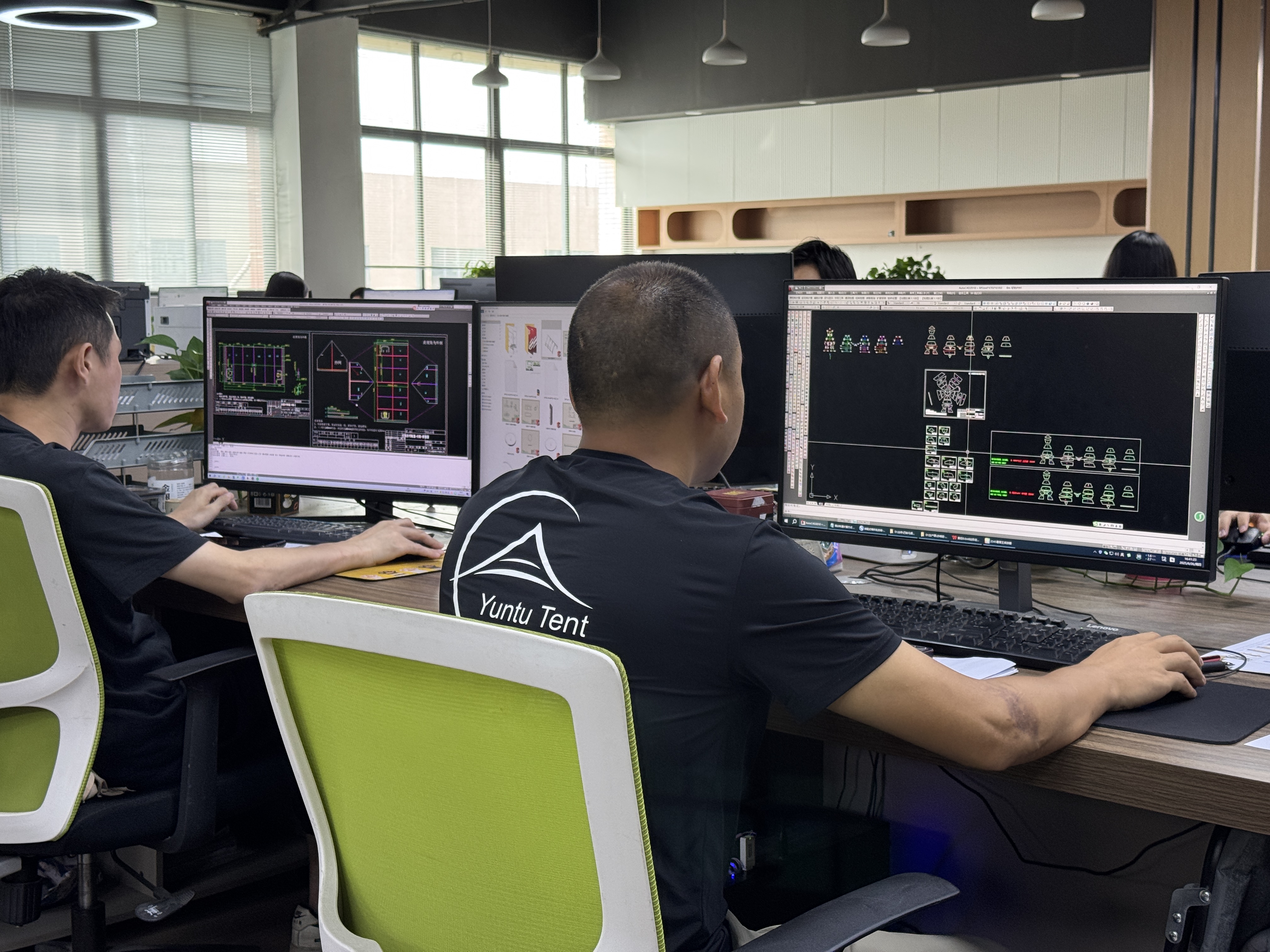
Engineering review at Stars Glamping’s R&D team.
From a procurement perspective, production capacity and quality control are as important as design. Stars Glamping’s stated lead time is 15–20 days for standard models and 20–30 days for customized projects, with a minimum order quantity of one unit for samples. Quality control follows raw material inspection, in-process checks, pre-shipment inspection, and optional third-party inspection. Flexible delivery terms are available under EXW, FOB, CIF, or DDP, and factory inspection can be arranged before shipment.
Technical Explanation: What Determines a Permanent Luxury Hotel Tent
The technical core of a luxury hotel tent is the combination of frame, membrane, and wall system. Stars Glamping’s luxury tent models, including Tethys, Villa, Octagon, and Shell, use a steel pipe frame and a 1050g/m² PVDF architectural membrane. The specified performance for these models includes waterproof resistance of at least 5000mm H2O, a B1/M2 fire-retardant rating, wind resistance up to 120km/h, snow load of 80kg/m², temperature resistance from -30°C to +70°C, and a service life of 25–30 years.
| Model | Frame and cover | Service life |
|---|---|---|
| Tethys / Villa / Octagon / Shell | Steel pipe frame, 1050g/m² PVDF membrane | 25–30 years |
| Pisces | Solid wood + steel pipe, 850g/m² PVC polyester fabric | 10–15 years |
The choice between PVDF and PVC is a major lifecycle decision. PVDF architectural membranes are associated with higher durability and a longer service life, while PVC-coated polyester fabric is often selected for projects with a shorter expected life cycle or a different budget profile. For an all-weather luxury hotel tent, the PVDF surface is UV-stabilized and anti-aging, which helps maintain its appearance under intense sun. For cold climates, an insulated luxury hotel tent benefits from the same thermal barrier system used in models rated for -30°C operation.
Glass wall luxury hotel tents are another example of capability. The panoramic view is a key design feature in mountain and beach resorts, but the glass wall system must be engineered to work with the membrane roof and the steel frame. This is where structural engineering support becomes necessary.
Compliance is another part of the technical review. The product line covering Tethys, Pisces, Octagon, Villa, Shell, and selected safari tent models holds a CE attestation of conformity issued by UDEM under the General Product Safety Directive. The certificate number is M.2024.206.C96444, and the applicable standard is EN ISO 5912:2020. In other regions, hospitality projects commonly reference fire-retardancy standards such as NFPA 701 or EN 13501-1; buyers should confirm the applicable framework with local authorities. Building-code-compliant hotel tents therefore require both product certification and project-level review.
Application and Use Cases Across Terrain
Documented projects show how the same product platform is adapted to different environments.
Mountain Resort, Nepal
A full mountain resort project in Nepal installed 19 luxury tents for permanent accommodation. The highlight was a custom mountaintop design with high wind resistance, thermal insulation, and panoramic views. The tents used a steel frame with PVDF fabric, offering wind resistance up to 120km/h and a service life of 25–30 years. The client reported an enhanced guest experience and increased resort occupancy.
Beachfront Resort, India
A government tourism development in India used 100 luxury tents for permanent beachfront accommodation. The model was the Luxury Tent - Shell, with a steel pipe frame and a cover made of 1050g/m² PVDF architectural membrane. The project emphasized environmental friendliness, high wind resistance, thermal insulation, and panoramic views. Reported results included an enhanced guest experience and higher occupancy.
Wildlife Safari, Cape Verde
A 12-tent project in Cape Verde was implemented for wildlife safari accommodation. The solution used eco-friendly materials, off-grid operation, and natural ventilation design, supporting long-term outdoor use and helping attract more international tourists. This use case is a practical example of a luxury hotel tent for safari lodge operations, where self-sufficient design is a priority.
Desert Resort, Saudi Arabia
A 30-tent full resort project in Saudi Arabia was installed for permanent desert accommodation. The highlight was a custom desert design with high wind resistance, thermal insulation, and panoramic views. The project demonstrates the role of a luxury hotel tent for desert resort development, where daytime heat and nighttime temperature swings must be managed by the building envelope.
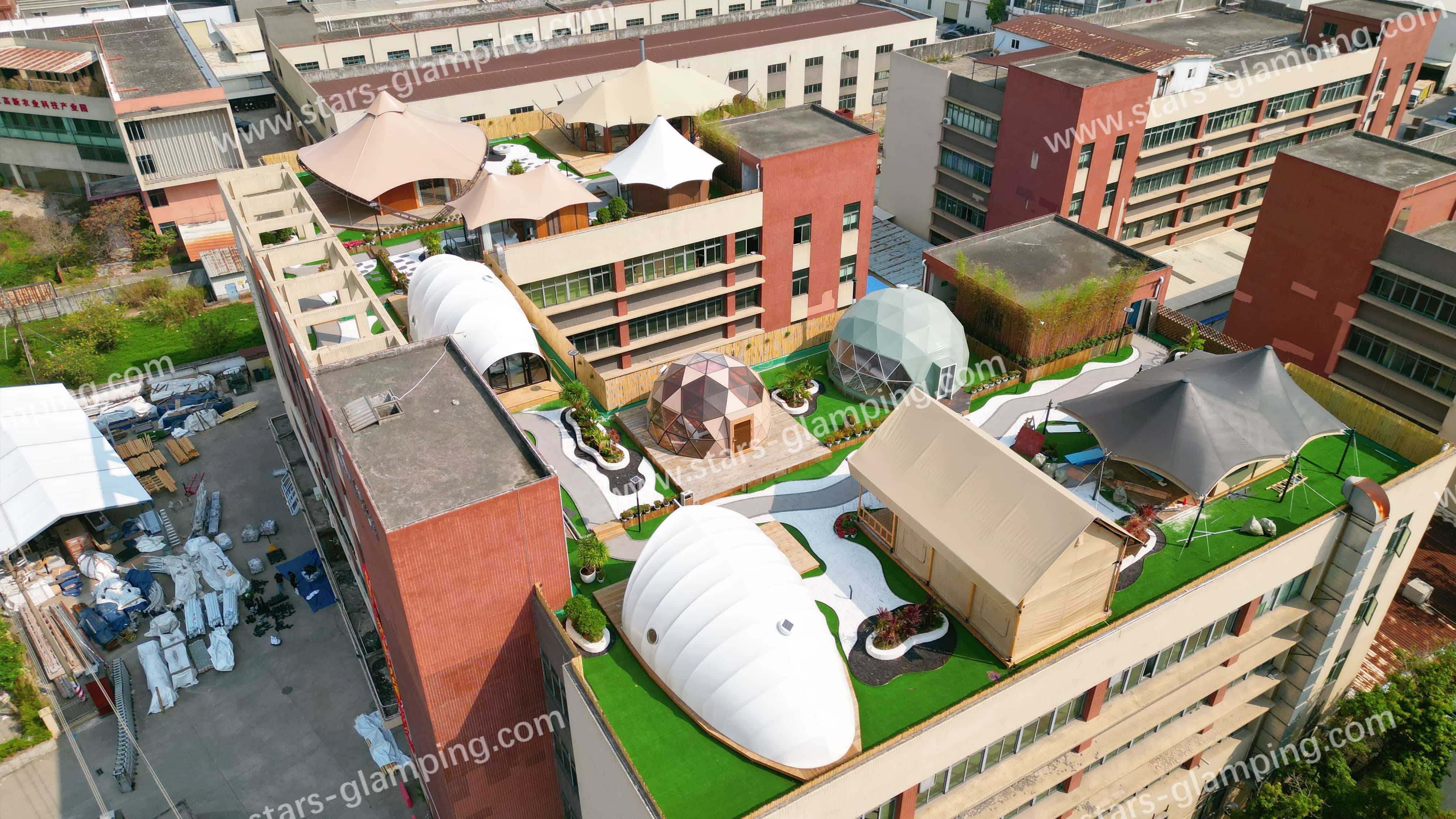
Luxury hotel tent models displayed at Stars Glamping’s showroom.
Market Trend Analysis
Third-party data supports the shift towards durable luxury tent accommodation. Europe accounted for roughly 35% of global glamping revenue in 2025, according to Grand View Research. Fortune Business Insights expects the overall glamping market to grow at a CAGR of 10.67% through 2034. For procurement, this signals rising demand for structures that can operate year-round and meet hotel-grade requirements.
Modular and platform-based tent systems, such as the Tethys and Villa models, are well positioned in this trend because they allow resort developers to repeat a proven structural system while customizing the layout and finishes for each site. A modular luxury hotel tent system also simplifies the supply chain: a resort group can order multiple units with consistent engineering and only vary the interior or facade details.
Comparison with Traditional Hotel Construction
Compared with concrete or masonry hotel buildings, luxury hotel tents generally involve lighter foundations, shorter assembly times, and less construction waste. For a remote site, this can lower logistics risk and environmental impact.
The comparison is not one-sided. Fabric-based building envelopes usually deliver different acoustic isolation than thick concrete partitions. In layouts where noise separation between guest rooms is a critical design driver, additional insulation layers, internal partitions, or increased spacing between units may be required. This is especially relevant when a soundproof luxury hotel tent is part of the brief. The membrane surface also needs periodic inspection, cleaning, and occasional maintenance to preserve its performance over a 25–30 year service life. These realities should be part of the project’s lifecycle plan.
Future Outlook
As glamping moves closer to mainstream hospitality, luxury hotel tents will continue to be evaluated as permanent building systems. Suppliers with certified products, structural engineering support, and terrain-specific customization will be better positioned to support resort developers through execution. Further advances can be expected in modular design, all-season wall technologies, and integration with building services such as HVAC and smart controls.
For buyers, the implication is clear: a luxury hotel tent supplier should be assessed on capability, not only on product images. Documented project references, engineering support, certification documents, and after-sales service are the evidence that separates a manufacturing partner from a product vendor.
For further technical reference, the Stars Glamping brochure is available here: Stars Glamping Company Brochure (PDF).
FAQ
What is a luxury hotel tent?
A luxury hotel tent is a membrane structure engineered for hospitality accommodation. It typically combines a steel frame, architectural fabric, insulation, and an interior fit-out, and is used in applications such as resort accommodation, beachfront hotels, mountain eco lodges, desert glamping, and event spaces.
Can luxury hotel tents be used for beachfront resorts?
Yes. A beachfront resort project in India used 100 luxury tents for permanent accommodation. The tents used a steel pipe frame and 1050g/m² PVDF architectural membrane, with a waterproof rating of at least 5000mm H2O and wind resistance up to 120km/h.
Are luxury hotel tents suitable for desert resorts?
Yes. A project in Saudi Arabia installed 30 luxury tents for permanent desert resort accommodation. The design included high wind resistance, thermal insulation, and panoramic views, which are key requirements for desert sites.
What certifications should a luxury hotel tent have?
For EU-bound projects, a CE attestation of conformity for the tent product line can be issued under EN ISO 5912:2020. In other markets, fire-retardancy standards such as NFPA 701 or EN 13501-1 are commonly referenced for commercial hospitality use. Local building code requirements may add further conditions.
How long does a luxury hotel tent last?
Models using a steel frame and 1050g/m² PVDF architectural membrane can have a service life of 25–30 years. Models using a wood and steel frame with 850g/m² PVC polyester fabric, such as the Pisces, have a service life of 10–15 years.
Can luxury hotel tents be customized with bathrooms and climate control?
Bathroom integration is a standard customization option in luxury hotel tent manufacturing. Other options include size and layout, structure design, fabric and frame materials, furniture, logo branding, and color. Climate control can be supported through the insulated wall system and project-specific HVAC planning.