
M3 vs. Apple Capsule MINI: An Independent Buyer Review of Two Steel Modular Capsules
Hospitality buyers evaluating prefabricated capsule accommodation are often drawn to compact steel modular capsule houses for glamping sites, resorts and off-grid hospitality projects. Two models that appear in the same BOITO-MINGSU product family serve fundamentally different space and occupancy needs: the M3 Capsule House and the Apple Capsule MINI. This independent buyer review compares their dimensions, guest capacity, power demand and intended use, and explains which one suits different project scales.
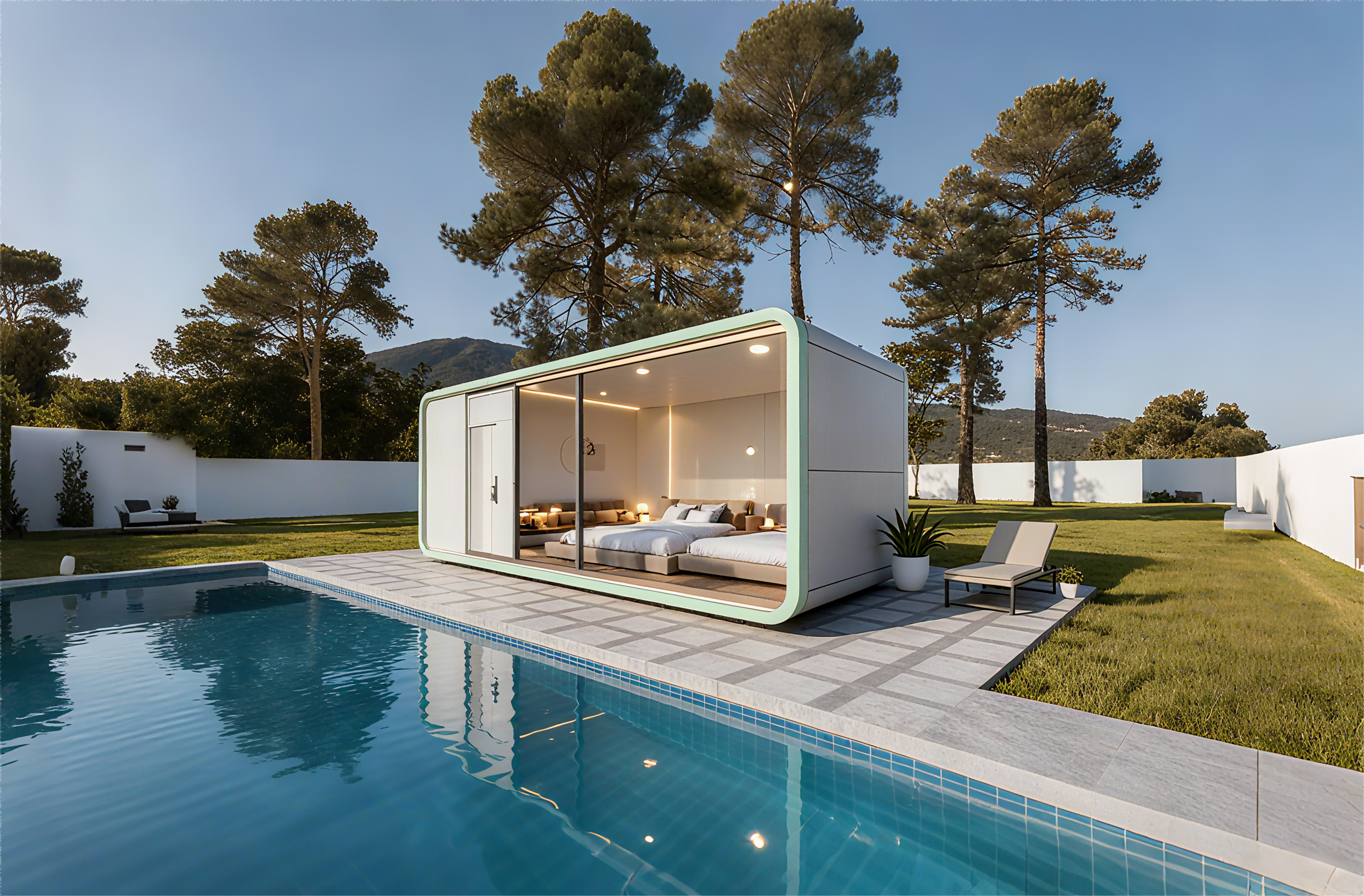
Apple Capsule MINI — BOITO-MINGSU steel modular capsule for hospitality use.
The selection problem: not all capsule houses are the same footprint
In the prefabricated accommodation market, the term “capsule house” covers a wide range of products. Buyers evaluating hospitality units often compare models by floor area, sleeping capacity or exterior style, but a common oversight is the difference in weight, power supply and site planning requirements among units that look similar in marketing photos.
The distinction between the two BOITO-MINGSU models is worth attention because both belong to the same capsule house range and both use a hot-dip galvanized steel frame structure. However, the M3 is a compact single-guest capsule, while the Apple Capsule MINI is a full-size modular room covering roughly 27.39 m² of floor area. That difference is close to a fourfold increase in footprint — and it has consequences for purchase cost, logistics, foundation preparation and potential revenue per installed unit.
For a hospitality operator, the right question is not simply “which capsule house is better” but “which unit fits the site, the target guest profile and the expected revenue model”.
M3 Capsule House: compact single-occupancy design
The M3 Capsule House, classified as the “Breeze Single Capsule”, is a compact accommodation unit intended for the hospitality industry. Its dimensions are 3 m length x 2.3 m width x 2.5 m height, giving a covered area of 6.9 m². It is designed to accommodate one guest, making it closer to a premium sleeping pod than a full hotel room.
Key specifications of the M3 Capsule House:
- Dimensions: 3 m x 2.3 m x 2.5 m (L x W x H)
- Area covered: 6.9 m²
- Guest capacity: 1 person
- Power consumption: 6 kW
- Total weight: approximately 2 t
- Frame material: hot-dip galvanized steel frame structure
- Intended industry: Hospitality
Because the M3 is roughly one third of the length of the larger Apple Capsule MINI, it can be placed on smaller land parcels, hillside layouts and dispersed camping environments where site disturbance and spacing are key constraints. Its relatively low power consumption also makes it easier to support with off-grid electrical supply. In short, the M3 is suitable for solo-traveller accommodation or as an additional unit within a larger resort layout rather than as a standalone family suite.
Apple Capsule MINI: full-size steel capsule with 27.39 m² of space
The Apple Capsule MINI belongs to the “Apple Capsule” family of prefabricated steel structures. It measures 8.3 m length x 3.3 m width x 3.2 m height and covers an area of 27.39 m². Unlike the M3, it is designed to accommodate 1 to 4 guests, which positions it as a complete modular guestroom for couples, small families or groups of friends.
Key specifications of the Apple Capsule MINI:
- Dimensions: 8.3 m x 3.3 m x 3.2 m (L x W x H)
- Area covered: 27.39 m²
- Guest capacity: 1 to 4 persons
- Power consumption: 7 kW
- Total weight: approximately 6.5 t
- Frame material: hot-dip galvanized steel frame structure
- Intended industry: Hospitality
The Apple Capsule MINI shares the same covered area as the M8 Sleep Pod (27.39 m²) and is very close to the M10 (27.36 m²). However, its power consumption is lower than both: 7 kW versus 8 kW for the M8 and 10 kW for the M10. From an energy-planning perspective, that makes the Apple Capsule MINI an interesting option for hospitality operators who want a full-size capsule room but need to limit electrical load across multiple units.
Core building specifications shared by both units
Although the M3 and the Apple Capsule MINI occupy very different size categories, they are built on the same structural logic. Both use a hot-dip galvanized steel frame structure, which is the defining feature of BOITO-MINGSU capsule houses.
Hot-dip galvanized steel frame
Hot-dip galvanized steel is used to protect the frame from corrosion, especially in outdoor environments such as coastal resorts, mountain sites and humid glamping grounds. The frame is designed to be seismic-resistant, which is relevant for projects in earthquake-prone regions. This is not a surface treatment only: the complete structure is factory-prefabricated, which allows the building to be transported and lifted without on-site structural work.
Building envelope: Low-E glass and insulation
Both capsule house models are associated with a building envelope that includes double-layer tempered Low-E hollow glass and thermal insulation materials. Low-E glass helps reduce solar heat gain while preserving natural light, which is important in glamping capsules with large windows. The exterior wall insulation in the wider BOITO-MINGSU capsule system uses thermal insulation composite panels, and polyurethane foam can be applied with a thermal resistance of 3.2 m²K/W. Polyurethane insulation provides a high level of thermal performance in a relatively thin layer, helping to keep indoor temperature stable and reduce HVAC energy consumption.
Factory prefabrication and installation
The commercial and hospitality capsule houses produced by BOITO-MINGSU are fully prefabricated. According to the company’s product documentation, no complex foundation is required on site: after leveling the ground, a capsule can be lifted and placed, and installation of a single capsule can be completed in two hours. This approach eliminates most on-site construction waste and can substantially reduce the project cycle compared with traditional masonry or light-steel construction.
Side-by-side comparison: M3 vs. Apple Capsule MINI
| Comparison point | M3 Capsule House | Apple Capsule MINI |
|---|---|---|
| Product type | Breeze Single Capsule | Apple Capsule |
| Dimensions | 3 m x 2.3 m x 2.5 m | 8.3 m x 3.3 m x 3.2 m |
| Area covered | 6.9 m² | 27.39 m² |
| Guest capacity | 1 person | 1 to 4 persons |
| Power consumption | 6 kW | 7 kW |
| Total weight | ≈ 2 t | ≈ 6.5 t |
| Frame material | Hot-dip galvanized steel frame structure | Hot-dip galvanized steel frame structure |
| Intended use | Compact single-guest hospitality stay | Full-size modular guestroom for up to four guests |
This comparison table summarises the two BOITO-MINGSU units using only the specifications published in the manufacturer’s product data. Buyers should also consider that the interior layout, bathroom configuration and glazing design can vary between individual projects.
Which capsule house fits which hospitality project scale?
Hospitality projects differ not only in the number of guests they accommodate but also in the operational model. The choice between the M3 and the Apple Capsule MINI should be guided by the intended guest type, the revenue target and the physical constraints of the site.
Project scale and use cases where the M3 is the more appropriate unit
- Budget-conscious boutique campsites that need to offer a small number of private sleeping capsules without investing in full-size units.
- Single-traveller accommodation where occupancy is expected to be one person per unit.
- Undulating or dispersed terrain where shorter, lighter units are easier to place and less visible in the landscape.
- Off-grid or generator-powered sites, since a 6 kW power load is lower than most full-size capsule houses.
- Mixed-unit projects where the operator wants a few premium single pods beside larger modular rooms.
Project scale and use cases where the Apple Capsule MINI is the better fit
- Resort or glamping developments targeting couples, families or small groups.
- Higher-end accommodation projects where the capsule is the room itself, not just a sleeping pod.
- Sites requiring a standard resort room experience, including an en-suite bathroom and space for two or more guests.
- Moderate power availability, since the 27.39 m² Apple Capsule MINI requires only 7 kW — lower than comparable M8 or M10 capsules in the same manufacturer range.
- Tenant or revenue models based on per-room nightly pricing, where the Apple Capsule MINI can be marketed as a full resort suite.
Case reference: steel capsule houses in camping resort operation
BOITO-MINGSU has supplied steel capsule houses for camping resort projects in Asia. A project in Malaysia involved the installation of 10 units for camping resort accommodation. The capsule houses feature a hot-dip galvanized steel frame structure and have achieved stable operation for 20 years. Key highlights of that installation include low noise operation and successful use by tourism resort OEM clients.
This case is relevant to both the M3 and the Apple Capsule MINI because it demonstrates that steel-framed capsule units can operate reliably in outdoor hospitality environments over a long period. Low noise is an important factor in camping resorts where guests sleep in relatively close proximity to each other and to the surrounding natural environment.
Market context: steel modular capsules and glamping demand
The comparison between the M3 and the Apple Capsule MINI comes at a time when the broader prefabricated housing and glamping markets are growing. According to Mordor Intelligence, the global prefabricated housing market is projected to reach approximately USD 152.74 billion by 2026. Within the modular segment, modular homes are estimated to grow at a compound annual growth rate of 7.05% through 2031.
Grand View Research estimates that the global glamping market will reach USD 7.9 billion by 2033, with a CAGR of 9.5%. Cabins and pods represented the largest accommodation segment in the glamping market in 2025, holding a 43.0% share. These figures help explain why hospitality investors are actively evaluating capsule house suppliers and specific models rather than treating capsule houses as a niche product.
For buyers, the implication is not that every project needs the largest possible capsule. The M3 and the Apple Capsule MINI serve different segments of the same hospitality market, and matching the model to the guest occupancy model is as important as evaluating the supplier’s production capability.
Supplier context: what buyers should verify
Both the M3 and the Apple Capsule MINI are produced by Guangdong Mingsu Sojourn Technology Co., Ltd., which operates under the leading brand BOITO-MINGSU and is a member of the BOITO Group. The company specialises in the research, development, manufacturing and export of modular hospitality buildings and capsule houses.
From a procurement perspective, the following supplier facts can help buyers evaluate whether either model is realistic for their project:
| Supplier capability | Reported detail |
|---|---|
| Founded | 2003 |
| Factory size | 10,000 m² |
| Annual output | 1,000 units |
| R&D team | 25 engineers |
| Monthly capacity | 30 to 50 units |
| Lead time | 30–45 days |
| MOQ | 10 units |
| Quality control | 100% testing of all units |
| Export markets | Southeast Asia, EU, USA, Middle East |
| Main products | Capsule houses, modular hotel units, glamping cabins, mobile sleep pods, modular villas |
In addition to these operational data points, BTOITO-MINGSU holds an ISO 14001 environmental management certificate. The certificate number is ISC-E-2025-5371-R, issued by Beijing International Standard United Certification Co., Ltd., valid from 2025 to 2028. This matters for hospitality projects with sustainability requirements, but buyers should note that ISO 14001 is an environmental management certificate, not a product certification for building safety or energy performance.
Limitations and boundaries of this comparison
A responsible buyer review should also state what this comparison does not claim. First, both compared models come from a single manufacturer, so this article is not a ranking of capsule house suppliers. Hospitality buyers looking for a full market comparison should also evaluate brands such as Liansheng and Glamni, which are cited in some Chinese export-sector industry sources, along with regional manufacturers in the Pearl River Delta.
Second, the M3 and the Apple Capsule MINI belong to different product categories within the capsule house segment. The M3 is a single-guest sleeping pod with a floor area of 6.9 m², while the Apple Capsule MINI is a full guestroom with a floor area of 27.39 m². Directly comparing them on price per unit or price per square metre may be misleading unless the operating model is defined first.
Third, power consumption figures are nominal values provided by the manufacturer. Actual energy use depends on occupancy, climate, HVAC settings and local electrical standards. Buyers should always verify voltage compatibility for their target country. BOITO-MINGSU supports customisation of voltage and logo, which is useful for international hospitality buyers.
Fourth, the 20-year operational case cited in this article relates to a steel capsule house project with a hot-dip galvanized steel frame structure. It does not necessarily imply that the M3 or the Apple Capsule MINI will last 20 years, but it supports the durability of the construction method used across the product family.
Finally, regulatory classification matters. In the EU, capsule houses fall under the Construction Products Regulation and must bear CE marking for legal installation. In the United States, capsule units may be classified as RVs, ADUs or state-certified modular construction, each requiring different foundation and approval paths. Buyers must verify the regulatory status of steel capsule accommodation in their specific market before signing a procurement contract.
Future outlook for capsule house procurement in hospitality
It is increasingly likely that hospitality developers will not choose a single capsule model for every site. Instead, projects may combine compact single units and full-size modular rooms in the same development. This is consistent with the product strategy of manufacturers that offer differentiated models such as the M3 and the Apple Capsule MINI under one order framework.
Another visible trend is the shift toward customisation and lower power demand. As Asia-Pacific becomes a faster-growing region for glamping and luxury modular pods, with a projected CAGR of 12.6% through 2034 according to IMARC Group, suppliers will need to accommodate different voltage standards, branding requirements and building codes. BTOITO-MINGSU already lists voltage and logo customisation as part of its ODM offering, which aligns with this direction.
Buyers should also watch how modular housing continues to reduce construction timelines. Modular housing projects can reduce construction periods by 30–50% compared with traditional on-site building, and modular construction minimizes on-site waste by approximately 30% on average. These efficiency factors are often what make steel capsule houses attractive to resort developers who need to open quickly and avoid long construction disruption.
Frequently asked questions
A: There is no absolute “better” model. The M3, with 6.9 m² and one-guest capacity, is better suited to single-traveller campsites and dispersed terrain. The Apple Capsule MINI, with 27.39 m² and up to four guests, is better for resorts that need full-size guestrooms for couples and families.
A: The M3 has a specified power consumption of 6 kW. The Apple Capsule MINI has a specified power consumption of 7 kW. Although the Apple Capsule MINI covers almost four times the floor area and accommodates up to four guests, its designed power load is only 1 kW higher than the M3.
A: Yes. Both the M3 Capsule House and the Apple Capsule MINI use a hot-dip galvanized steel frame structure. The associated building envelope in the wider BOITO-MINGSU capsule system includes double-layer tempered Low-E hollow glass and thermal insulation panels.
A: The Apple Capsule MINI has a 7 kW nominal power consumption, which is relatively low for its 27.39 m² area. However, off-grid suitability depends on the solar array, battery bank or generator capacity, as well as the climate and guest usage patterns. Buyers should request a complete electrical design review before assuming off-grid operation.
A: The manufacturer holds ISO 14001 environmental management certification under certificate number ISC-E-2025-5371-R. This certifies the environmental management of its manufacturing site. It is not a product safety or building code certificate. EU imports also require CE marking under the Construction Products Regulation, so buyers should verify the product’s compliance status for their destination country.
A: The MOQ is reported as 10 units. Production capacity is 30 to 50 units per month, with a 30–45 day lead time. Each unit undergoes 100% testing as part of the quality control process.
If you are evaluating capsule house models for a specific hospitality project, the BOITO-MINGSU 2026 catalogue is available for download here: Download the BOITO-MINGSU brochure (PDF).
This article is published for independent procurement reference. All product specifications are based on the published BOITO-MINGSU product data. Market data and third-party figures are cited from the sources listed in the text. Buyers should verify current certification status, import compliance and project-specific engineering requirements before placing an order.
Tem questões ou precisa de mais detalhes?
Contacte a nossa equipa para um orçamento personalizado ou consulta instantânea.
Solicitar orçamento
Preencha o formulário abaixo e a nossa equipa entrará em contacto com uma proposta personalizada.
Chat direto do WhatsApp
Prefere conversar em tempo real? Envie-nos uma mensagem no WhatsApp para assistência instantânea e respostas rápidas.
- Obter orçamento personalizado
- Partilhar fotos ou documentos
- Discuta as suas necessidades diretamente
Geralmente responde em 5–30 minutos durante o horário de expediente.