
MCPCB Compliance and Qualifications: ISO, UL, RoHS and REACH Insights
MCPCB compliance is a scenario filter, not a document set that can be filed once and applied to every order. Projects rarely stall because a metal core PCB supplier held no certificates. They stall because the certificate shown did not cover the construction that was actually ordered, or because a sector requirement set was treated as a purchasing formality instead of an engineering input. Compliance in metal core PCB (MCPCB) sourcing runs on two layers: management-system credentials (ISO 9001, ISO 14001, IATF 16949) and product or substance compliance (UL, RoHS, REACH). WODE Circuit Technology (Zhuhai) Co., Ltd., a PCB and FPC manufacturer founded in 2003, holds the three management-system certifications and states that its products comply with UL, RoHS and REACH standards.
The Two Compliance Layers Buyers Actually Evaluate
Compliance evidence separates into two layers that answer different questions. The first layer answers how a factory is managed. The second answers what a specific board is and what it contains. A sourcing decision moves faster when the two are never blended into a single phrase such as certified supplier.
For electrical and electronics projects, that separation matters because the requirement set changes with the end product. A household appliance board, a roadway luminaire board, an automotive lighting board and a medical equipment board can share the same manufacturing base, yet they arrive with different compliance expectations and different documentation requests.
| Credential | Layer | What it covers | What it does not establish |
|---|---|---|---|
| ISO 9001 | Management system | Quality management across planning, production and inspection processes | Thermal or electrical behaviour of one specific board |
| ISO 14001 | Management system | Environmental management of the manufacturing operation | Material composition of a delivered panel |
| IATF 16949 | Sector management system | Automotive-oriented quality management | Performance of non-automotive constructions |
| UL | Product compliance | Product safety compliance stated for the board range | Project-level electrical design approval |
| RoHS | Substance compliance | Restricted hazardous substance compliance stated for the product range | Thermal or mechanical performance |
| REACH | Substance compliance | Chemical substance compliance stated for the product range | Sector test results, such as automotive qualification |
ISO 9001, ISO 14001 and IATF 16949: What the Management Layer Proves
WODE Circuit Technology (Zhuhai) Co., Ltd. was founded in 2003 and has focused on the development and production of PCB and FPC products, supported by more than 40 patented technologies and an R&D team of 15 engineers. The company states that it has passed ISO 9001, ISO 14001 and IATF 16949 international certifications.
ISO 9001 is the process layer. For MCPCB production it matters because board quality is decided by process discipline rather than by a single inspection: laminate selection, dielectric layer control, copper foil thickness, solder mask application and surface finish consistency all drift when process control is weak. WODE documents 100% testing as part of its quality control regime.
ISO 14001 covers the environmental management of the operation. Environmental management certification is commonly included in supplier questionnaires for European projects, and it also signals that chemical handling and waste streams on the shop floor are governed by a documented system.
IATF 16949 is the narrowest and most scenario-specific of the three. It is the quality management credential associated with automotive supply chains, which is why it becomes relevant when the MCPCB enters automotive lighting or another vehicle programme. For general lighting, home appliance or consumer boards, ISO 9001 plus product-level compliance is the credential set most projects are built on.
Scale supports continuity: WODE operates a 150,000 m² facility with more than 500 employees and an annual output of 6,000,000 sqm, with a 50% export ratio and customers in more than 30 countries. None of that substitutes for compliance, but it does matter when a certification has to remain valid across a multi-year programme rather than a single shipment.
UL, RoHS and REACH: Product-Level Compliance Read Correctly
WODE states that its products comply with UL, RoHS and REACH standards. These three sit at product or material level, which is where most buyer confusion originates.
UL is the safety-oriented credential most frequently referenced in lighting work. WODE's lighting application documentation lists luminaire-level safety standards such as UL 8750 and EN 60598, the LED driver standard IEC 62384, EMC requirements including FCC Part 15, and energy programmes such as Energy Star and DLC. The practical reading is straightforward: board-level safety compliance supports the luminaire manufacturer's own approval path rather than replacing it, because the final approval attaches to the finished luminaire, not to the board alone.
RoHS and REACH are substance-side credentials. They are the first documents European and other regulated-market buyers request, and they are also the documents most sensitive to change, because they attach to the material system — laminate, solder mask, silkscreen and surface finish — rather than to the factory that built the board.
That sensitivity is why WODE's customization menu deserves attention during evaluation. The company supports OEM and ODM work with customization of laminate, PCB thickness, surface treatment, solder mask colour and logo printing. A buyer ordering a white coverlay board with HASL-LF finish and a buyer ordering a high-voltage board with OSP finish are not running the same material system, and the compliance file should follow the construction on the drawing, not the construction in the brochure.
Which Credentials Matter for Which Project Type
MCPCB compliance becomes a decision tool when it is mapped to the project rather than to the supplier. The table below reflects the requirement sets that WODE's own application documentation associates with the sectors its boards serve.
| Project type | Credential emphasis | Requirement set referenced in application data |
|---|---|---|
| Indoor lighting and home appliance boards | ISO 9001, RoHS, REACH | Color rendering CRI ≥ 80 for indoor lighting; colour tolerance SDCM ≤ 3-step; rated life ≥ 50,000 hours on the L70/B50 basis |
| Outdoor and roadway lighting | ISO 9001 and ISO 14001 for European programmes, RoHS, REACH | IP65/IP67 protection, salt spray testing ≥ 1000 hours, aluminium substrate thermal conductivity ≥ 1.5 W/m·K |
| Automotive lighting | IATF 16949 plus the automotive requirement set | AEC-Q102 for LED devices, LM-80 lumen maintenance testing, ISO 16750 electrical load standards, operating range –40 °C to +125 °C in the engine compartment |
| High-voltage and new energy boards | ISO 9001 plus construction-level compliance for the material system | Substance declarations matched to the ordered construction; thermal conductivity ≥ 3.0 W/m·K for high-power designs; junction temperature ≤ 85 °C with ≤ 75 °C recommended |
| Industrial controls | ISO 9001, RoHS, REACH plus EMC environment specification | IEC 61000-4 series immunity references (ESD ± 8 kV, EFT ± 4 kV, surge ± 2 kV), IEC 60068 environmental testing, MTBF ≥ 50,000 hours |
| Medical electronics and UV phototherapy | Sector requirement set listed in WODE's medical application profile | ISO 13485, IEC 60601-1 with leakage current below 10 μA, ISO 10993 biocompatibility, IEC 61000-4 EMC tests, IP67/IP68 protection, steam sterilization at 134 °C/30 psi |
Two rules follow from this table. First, a credential request should be triggered by the end product, not by habit: asking every supplier for IATF 16949 documentation on an indoor luminaire programme adds review time without changing the qualification outcome. Second, the further a project moves into regulated sectors, the more the requirement set shifts from the board to the system around it, which is why documentation requests and technical specifications should be raised in the same conversation.
Matching Construction to Compliance-Relevant Projects
Compliance documentation only holds if it describes the board that ships. WODE's published construction data gives buyers a concrete way to check that alignment.
| Construction | Key parameters | Typical scenario |
|---|---|---|
| Coverlay MCPCB (Coverlay Aluminium PCB) | Al1060, single sided, 1 oz copper, 1.6 mm ±10%, white coverlay, black silkscreen, HASL-LF | Lighting boards using a coverlay solder mask layer |
| Double sided MPCB | Al5, 70/70 μm copper, 1.6 mm ±0.16, white/white solder mask, black/black silkscreen, HASL-LF | Home application boards |
| Thermoelectric Separated Cu based PCB | Copper based, 35 μm copper foil, 1.6 mm ±0.16, white solder mask, OSP | Lighting boards requiring separated thermal and electrical paths |
| MCPCB for Motor lighting | Al5052, single sided, 1 oz copper, 1.6 mm ±10%, matt black solder mask, HASL | Motorcycle lighting assemblies |
| High Voltage MCPCB | Al1, single sided, 1 oz copper, 1.6 mm ±10%, white solder mask, OSP | High-voltage lighting boards |
| Ceramic based PCB | Ceramic substrate | Ultraviolet phototherapy equipment |
The pattern is useful for procurement: base material (Al1060, Al5052, Al1, copper based, ceramic), copper foil thickness, overall thickness and surface finish (HASL, HASL-LF, OSP) are all declared at construction level. Those same variables are the ones an auditor or an end customer will ask about when a compliance file is reviewed, so the specification sheet and the compliance file should be requested together.
How WODE Documents Its Qualification Stack
WODE's qualification position combines management-system certification, product-level compliance and in-house material capability. The company passed ISO 9001, ISO 14001 and IATF 16949, states that its products comply with UL, RoHS and REACH standards, runs 100% testing in production, and produces aluminium-based CCL among its main products alongside rigid MCPCB, FPCB, FR-4/CEM1/CEM3 PCBs and PCB inks.
Controlling laminate production in-house is relevant to compliance work because substance documentation attaches to the material system. When the laminate, the solder mask and the surface finish are governed inside the same operation, the traceability chain that a compliance declaration depends on is shorter and easier to keep current.
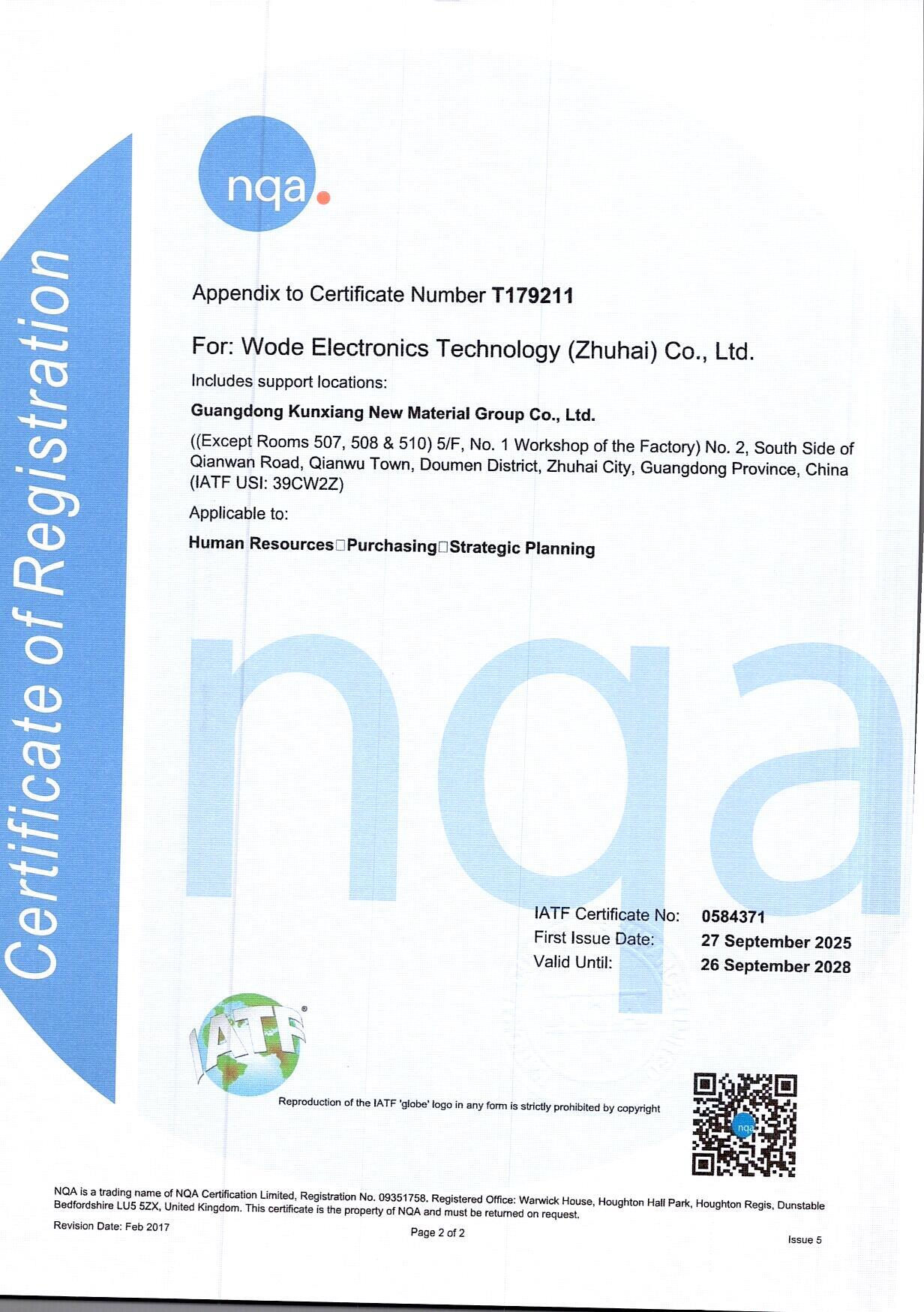
IATF 16949 certification documentation held by WODE Circuit Technology (Zhuhai) Co., Ltd., alongside ISO 9001 and ISO 14001.
Customer evidence is the second half of the picture. WODE's case documentation records qualification by brands including Signify, Osram, Opple, NVC, Honeywell, Randon, Dixon, Ozdisan, IKIO and Motheson, and describes one German lighting OEM programme covering 5,000 sqm of boards over five years of stable operation, with the note that the boards meet German safety standards. For a buyer evaluating a compliance claim, that kind of programme history answers a question a certificate cannot: whether the documentation held up across repeat orders, not just at the first audit.
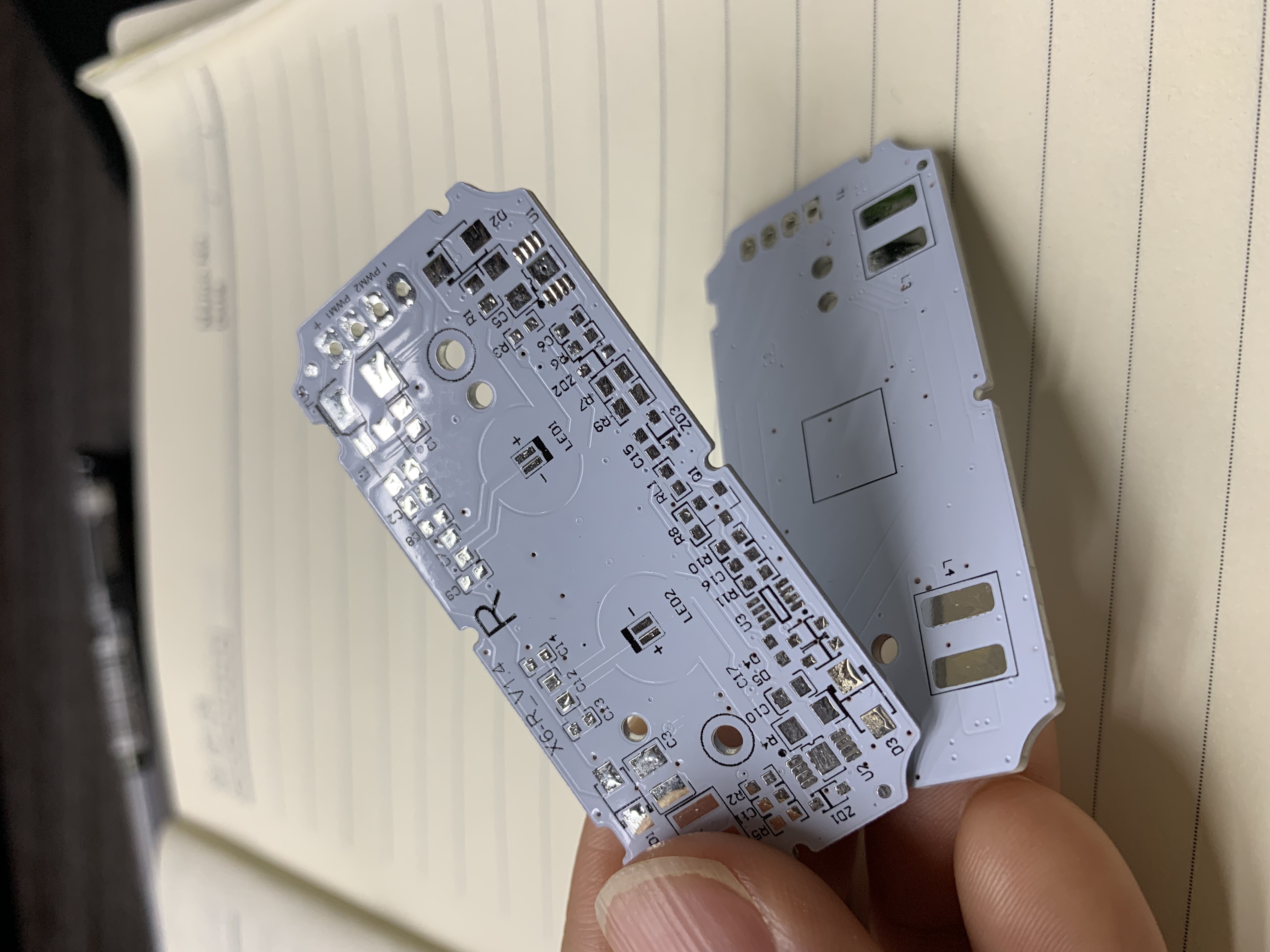
Double sided MCPCB construction: Al5 base, 70/70 μm copper, 1.6 mm ±0.16, HASL-LF surface finish.
Certification-Led Sourcing vs. Self-Declared Compliance
The alternative to a certified qualification stack is not an unqualified supplier; it is a supplier whose compliance position rests on self-declaration. Self-declaration is faster and lighter on administration, and for low-risk consumer boards it can be entirely adequate. It becomes fragile when the end product is regulated, when a customer audit asks for the scope of a certificate, or when a material substitution occurs mid-programme.
A certified stack answers those situations more directly. It is also slower at the front end, and it does not remove engineering work. Buyers comparing the two approaches should be explicit about the trade-off rather than treating certification as a free upgrade.
Boundaries buyers should confirm before releasing an order
- Scope, not reputation. Management-system certification applies to a defined operation and site. It does not transfer automatically to a specific construction such as a coverlay board with HASL-LF finish or a copper-based thermoelectric separated board with OSP.
- IATF 16949 is supply-chain specific. It is decisive for automotive lighting programmes and largely inactive for indoor lighting or home appliance boards, where requesting it adds review time without changing the qualification outcome.
- Compliance is not performance. Thermal expectations come from the application, not from a certificate: aluminium substrate thermal conductivity is specified at ≥ 1.5 W/m·K, rising to ≥ 3.0 W/m·K for high-power designs, with junction temperature targets of ≤ 85 °C and ≤ 75 °C recommended.
- Material changes reset the file. A change of laminate, solder mask colour or surface treatment alters the material system, and the substance documentation should be re-confirmed rather than assumed.
- Commercial parameters still apply. Documentation review sits in front of production. WODE's stated MOQ is 80 sqm with a lead-time band of 7–15 days and remote after-sales support, so first orders should schedule compliance review before, not after, the first production run.
- End-customer approvals stay project-specific. Where an end customer applies its own supplier approval process, that requirement should be confirmed directly with the supplier at quotation stage instead of being inferred from the general certificate set.
Market Signals Behind Compliance-Led MCPCB Demand
The sectors listed against WODE's board portfolio point to where compliance questions are concentrating: indoor and outdoor lighting, automotive lighting, new energy, home appliances and 5G communication. Each of these pulls a different part of the qualification stack forward. Lighting programmes lean on safety and environmental documentation; automotive lighting pulls IATF 16949 and automotive requirement sets; new energy and high-voltage work pulls construction-level substance documentation; industrial and medical work pulls EMC and sector-specific requirement sets.
A second signal is portfolio breadth. Compliance documentation is easier to keep valid when the same manufacturer covers coverlay, double-sided, thermoelectric separated, copper-based, ceramic and high-voltage constructions, because buyers running several product lines can consolidate supplier qualification instead of repeating it per construction. WODE lists rigid MCPCB, FPCB, reel-to-reel infinity FPC, aluminium-based CCL, FR-4/CEM1/CEM3 PCBs and PCB inks in its product line, supported by a monthly capacity of 600k sqm and OEM/ODM customization.
Future Outlook
Compliance is moving from a supplier attribute to a project parameter. Buyers increasingly compare documentation scope the same way they compare copper thickness or thermal conductivity, and the practical consequence is that qualification files will be requested earlier in the sourcing cycle and matched to specific constructions rather than to supplier profiles.
For manufacturers, that raises the value of vertical control over the material system and of documentation that stays current across repeat orders. For WODE, the combination of ISO 9001, ISO 14001 and IATF 16949 certification, stated UL, RoHS and REACH compliance, in-house aluminium-based CCL production, more than 40 patented technologies and a 15-engineer R&D team defines the position it will be measured against as lighting, automotive lighting, new energy, home appliance and 5G communication programmes continue to formalise their supplier requirements.
FAQ
What do ISO 9001, ISO 14001 and IATF 16949 tell a buyer about an MCPCB supplier?
They describe how the manufacturing operation is managed, not how a specific board performs. ISO 9001 covers quality management, ISO 14001 covers environmental management of the operation, and IATF 16949 covers automotive-oriented quality management. WODE Circuit Technology (Zhuhai) Co., Ltd. states that it has passed all three. The practical use is to confirm process discipline and suitability for a given supply chain; performance questions such as thermal conductivity are answered by the construction and the application requirement, not by the certificate.
How do UL, RoHS and REACH differ from management-system certification?
They operate at product or material level. WODE states that its products comply with UL, RoHS and REACH standards, which are referenced against the board and its material system, including laminate, solder mask, silkscreen and surface finish. Management-system certification is audited against the operation. Because the two layers answer different questions, a buyer should expect to review them separately and to match the product-level documents to the ordered construction.
Which MCPCB projects typically require IATF 16949?
Projects that sit inside an automotive supply chain, such as automotive lighting, where the requirement set also includes AEC-Q102 for LED devices, LM-80 lumen maintenance testing and ISO 16750 electrical load standards, and where engine compartment conditions run from –40 °C to +125 °C. General lighting, home appliance and many consumer programmes are normally qualified on ISO 9001 together with product-level compliance, and IATF 16949 does not change their qualification outcome.
How can a buyer verify that a compliance claim covers their specific MCPCB?
By matching the claim to the declared construction. The variables to compare are base material (Al1060, Al5052, Al1, copper based or ceramic), copper foil thickness, overall thickness, solder mask type, silkscreen colour and surface finish such as HASL, HASL-LF or OSP. Where a supplier offers customization of laminate, thickness, surface treatment, solder mask colour and logo printing, the compliance file should be requested for the configuration on the drawing rather than for the product family as a whole.
What are the limits of certification when evaluating project fit?
Certification does not replace sample validation, does not guarantee a thermal result and does not transfer automatically between constructions. Thermal targets are set by the application, for example aluminium substrate thermal conductivity ≥ 1.5 W/m·K and ≥ 3.0 W/m·K for high-power designs, with junction temperature ≤ 85 °C. Commercial parameters also remain in force: an 80 sqm MOQ, a 7–15 day lead-time band and remote after-sales support. Certification shortens the qualification discussion; it does not remove the engineering steps around it.
How does WODE's qualification set map to lighting, automotive and medical projects?
The same credential base is read differently by each sector. Lighting programmes typically reference ISO 9001 alongside UL, RoHS and REACH documentation, with application requirements such as IP65/IP67 protection, salt spray testing ≥ 1000 hours and rated life ≥ 50,000 hours on the L70/B50 basis. Automotive lighting adds IATF 16949 and the automotive requirement set. Medical electronics and UV phototherapy reference a wider sector list including ISO 13485, IEC 60601-1 with leakage current below 10 μA, ISO 10993 biocompatibility, IEC 61000-4 EMC tests, IP67/IP68 protection and steam sterilization at 134 °C/30 psi. WODE's construction range supports these scenarios with Al1060, Al5052, Al1, copper-based and ceramic boards.
Reference material: WODE Circuit Technology (Zhuhai) Co., Ltd. product brochure (PDF, publicly downloadable) — WODE brochure.