
MCPCB Qualification Files: Reading ISO 9001, IATF 16949, UL, RoHS and REACH Correctly
MCPCB Qualification Files: Reading ISO 9001, IATF 16949, UL, RoHS and REACH Correctly
A qualification dossier for a metal core printed circuit board order usually arrives as one PDF bundle, and it is tempting to read the whole bundle as a single blended claim of quality. The documents inside it do not work that way. ISO 9001 and ISO 14001 describe how a site manages its processes. IATF 16949 describes automotive-specific process requirements within a scope the certificate states for itself. UL recognition attaches to a specific board construction and its designation. RoHS and REACH evidence speaks to substances in a specific build on a specific date. Procurement and engineering teams that separate those four levels before evaluating a supplier avoid the most common qualification error in this category: accepting a management-system certificate as proof of a product, or a substance test report as proof of process control.
This reading method applies directly to MCPCB sourcing, where the same plant may ship aluminium-base lighting boards, copper-base thermoelectric separated constructions, ceramic substrates and double-sided builds that differ in laminate, copper weight, solder mask and surface finish. Each of those differences changes which document in the file is actually relevant to your order.
The five document families and the question each one answers
A well-built qualification file contains documents that answer different questions, and a strong supplier will tell you which document answers which question. The table below is the shortest version of that map; the sections that follow explain how to read each entry against a real order.
| Document family | What it is evidence of | What it does not establish |
|---|---|---|
| ISO 9001:2015 | That the certified site operates a quality management system audited against the standard | Board performance, material grade, thermal or dielectric values |
| ISO 14001:2015 | That environmental management activities at the site are audited against the standard | Product compliance with any substance regulation |
| IATF 16949 | Automotive quality management conformity within the scope named on the certificate | Product approval, part-level validation, or coverage of processes outside that scope |
| UL recognition (UL 796 / UL 796F) | Safety evaluation of a named printed wiring board construction and designation | Thermal performance, substance compliance, or constructions not covered by the entry |
| RoHS declaration or test report | Restricted-substance status of the build described | REACH SVHC status; process capability |
| REACH SVHC report or declaration | Candidate-list substance status of the build and date described | RoHS status; any other construction or finish |
ISO 9001 and ISO 14001 describe a site, not a board
ISO 9001 and ISO 14001 are the foundation documents in an MCPCB file and also the ones most often over-read. Both are certification-body judgements about a management system at a defined organisation and site. Neither contains a specification for copper thickness, thermal conductivity, dielectric strength or dimensional tolerance, and neither can be used to argue that a particular lot met a drawing.
In the WODE Circuit Technology (Zhuhai) Co., Ltd. dossier, the two certificates are recorded as follows. ISO 9001:2015 certificate 51325Q4258ROM was issued on 13 October 2025 by Shenzhen Meiao Testing and Certification Co., Ltd and is valid to 12 October 2028, with a scope covering the production of circuit boards under IAF Code 19. The ISO 14001:2015 certificate 51325E2142ROM was issued by the same body on the same date with the same validity period, and its scope covers environmental management activities related to the production of circuit boards, again under IAF Code 19. WODE is a Zhuhai-based PCB and FPC manufacturer founded in 2003, with a 150,000 m² plant, more than 500 employees and a 15-engineer R&D team holding more than 40 patented technologies.
Four checks turn these documents into useful procurement evidence. First, confirm the certificate holder's full legal name and address match the entity you are contracting with and the site that will produce the boards — a group with several legal entities can hold certificates in a name that differs from the sales office on your quotation. Second, read the scope sentence rather than the standard number: an IAF Code and a process description tell you what was audited. Third, note the expiry date and set a revalidation reminder; the WODE pair runs to October 2028, which is long enough that nobody will remember it without a system trigger. Fourth, verify the certificate with the issuing body rather than relying on the PDF, since a certificate number is only meaningful if it resolves in the issuer's records.
Practical rule: management-system certificates support supplier selection and consistency arguments. They should never appear in the acceptance-criteria column of a purchase order as a substitute for a dimensional, thermal or electrical specification.
IATF 16949: the scope line matters more than the logo
IATF 16949 is the automotive quality management standard, and in an MCPCB file it carries more procurement weight than ISO 9001 because automotive programmes typically flow down process expectations — control plans, APQP and PPAP discipline, measurement systems analysis, statistical process control and structured corrective action. Those are process requirements. They are not a part-level approval, and they do not by themselves certify that a specific board passes an automotive application's validation.
The document also states its own boundary, and that boundary is the part buyers most often skip. WODE's IATF 16949 certificate 0584371 was issued by NQA Certification Limited on 27 September 2025 and expires on 26 September 2028. As recorded, its scope names human resources, purchasing and strategic planning for automotive printed circuit board manufacturing, and identifies Guangdong Kunxiang New Material Group Co., Ltd. as a support site.
That wording is not a formality. When an automotive customer's qualification argument depends on production-line control at a named plant, the certificate text and the supporting audit documentation must be read together, because the certificate itself defines which functions and sites it covers. The correct procurement action is to request the certificate, ask the supplier to explain in writing how the scope maps to the process that will build your part, and keep that written mapping in the supplier file alongside the certificate number and validity dates. Where the flow-down requires it, ask for the control plan and the change-notification procedure as separate documents rather than assuming they travel with the certificate.
UL recognition: construction-level and designation-specific
UL evidence is where MCPCB buyers most often misread the level of the claim. Printed wiring board evaluations under UL 796 and UL 796F are normally recognitions of a component construction, published on the supplier's yellow card. The card identifies the construction and the designation under which it is recognised; it is not a statement that every board the plant makes is covered, and it is not a thermal or electrical performance rating for your design.
WODE's file contains two separate UL entries, which is itself the useful lesson. Certificate E323980, recorded against UL 796, Standard for Printed Wiring Boards, covers single-layer metal base printed wiring boards under designations WD-14, WD-15, WD-16 and WD-17, and single-layer rigid printed wiring boards under RXD-11, WD-12, WD-13 and RXD-10. Certificate E498836, recorded against UL 796F and IPC-TM-650 2.6.27, covers single-layer FMIC flexible printed circuits under models WD-F1 and WD-F2 (ASP1). Both entries carry an issue date of 1 January 2022 in the supplied record.
For an MCPCB order, the rigid entry is the relevant one, and the flexible entry should not be offered as coverage for a metal base board. Three questions belong in every UL review: which designation does my part number fall under; has anything in the construction changed since that designation was established, including base metal source, copper weight, dielectric or surface finish; and can the supplier show the yellow card entry itself rather than a summary slide. A construction change is exactly the kind of event that can move a board outside the recognised build, so change notification deserves a clause of its own in the quality agreement.
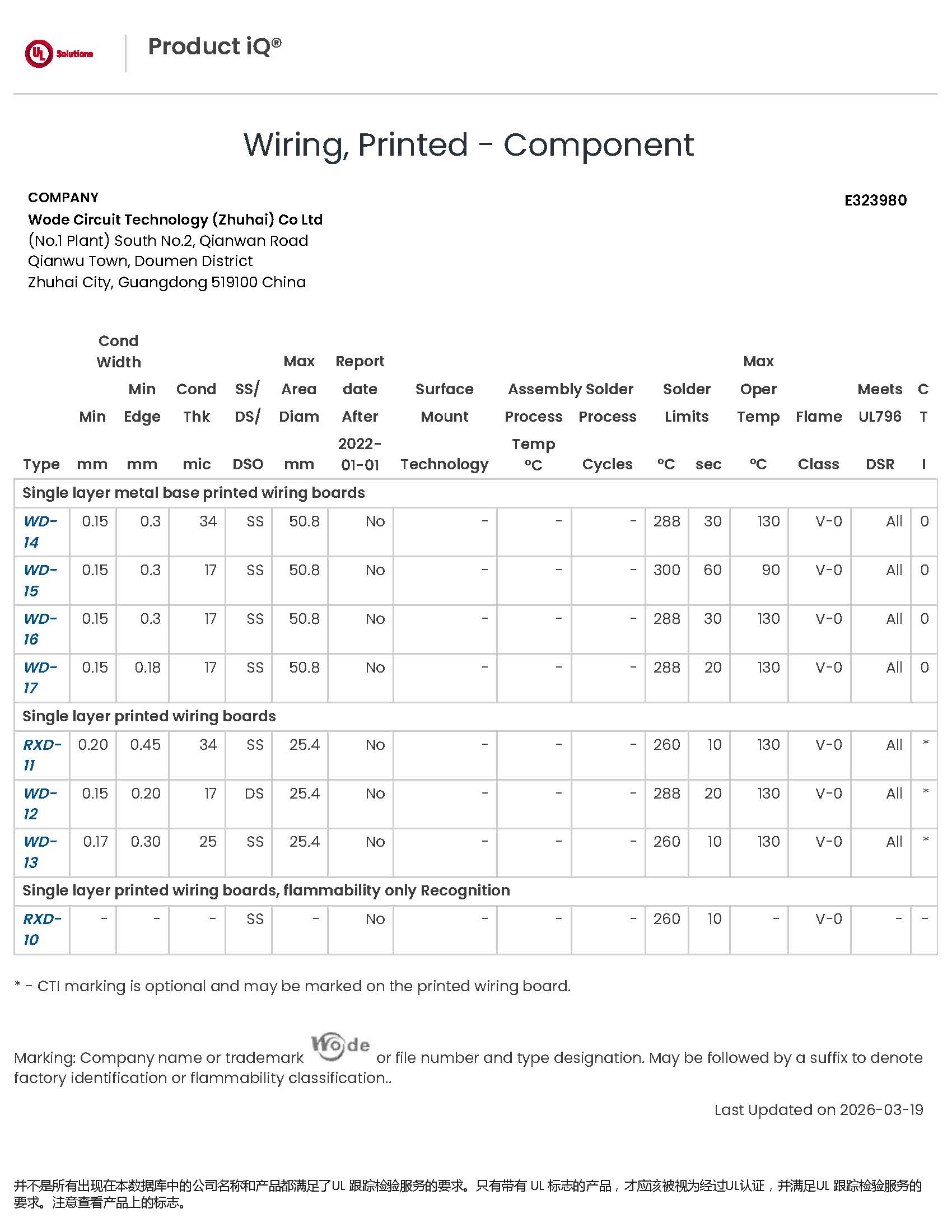
UL yellow card E323980: recognition is tied to the named constructions and designations, not to the plant's full output.
RoHS and REACH: substance-level evidence, dated and build-specific
RoHS and REACH answer a different question from every document above. They address what is in the board, not how the site is managed or whether the construction is safety-recognised. Because both are substance frameworks, the evidence must name the build and carry a date that can be judged against the current regulatory list.
REACH is the framework most often supplied as a test report. WODE's file records test report DGC251204025BD03, issued by NSTL on 10 December 2025, covering SVHC substances and resorcinol for a double-sided aluminium-based board against EU REACH Regulation (EC) No 1907/2006 and the ECHA SVHC candidate list. Two features of that description matter more than the pass result. The subject is a specific construction — double-sided aluminium base — and the reference framework is a candidate list that is updated periodically. A report for one construction does not silently extend to a copper-base thermoelectric separated board, a ceramic substrate or a different surface finish, and an older report should be read with the list revision in mind.
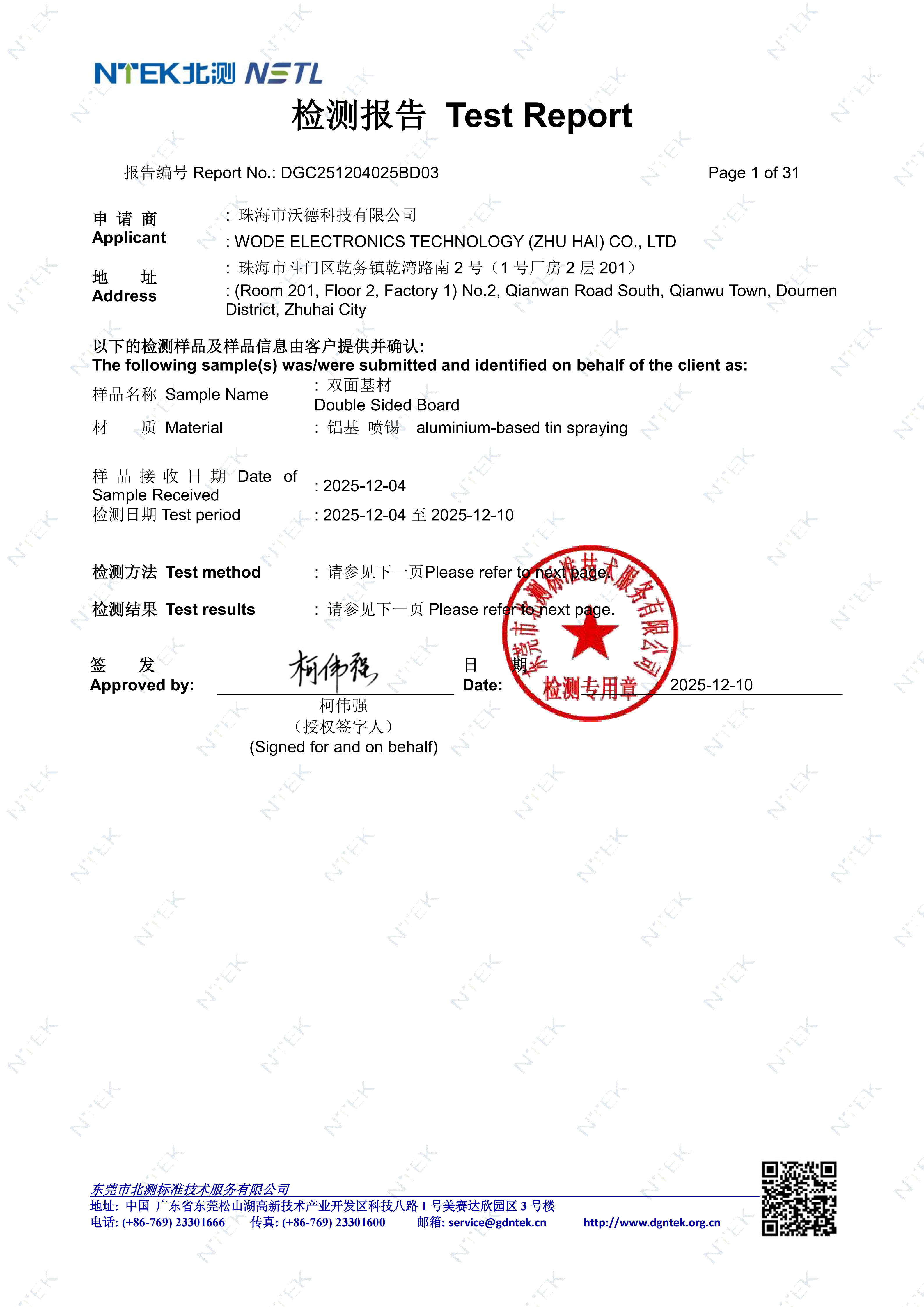
REACH SVHC test report DGC251204025BD03: the subject is one named construction on one date, not a plant-wide statement.
RoHS is a separate framework, and the two should not be treated as interchangeable. WODE's company profile states that its products comply with UL, RoHS and REACH standards, and the specific substance document supplied in this set is the REACH SVHC report described above. A buyer who needs RoHS evidence for a particular build should therefore request the RoHS declaration or test report that names that build, with the responsible signatory and the date, rather than treating a REACH report as covering both frameworks. This is not a criticism of any supplier; it is simply how substance documentation works, and asking precisely is faster than arguing later.
Market-specific product certificates: the CQC example
Beyond the international set, some markets add product-level certification that names substrates rather than processes. WODE holds CQC product certificate CQC22001367683, issued by the China Quality Certification Centre on 13 January 2026 and valid to 16 November 2027, under GB 4943.1-2022. Its scope names printed circuit boards in four substrate types — 22F CEM1 5152, CEM-1, FR-4 GF211 and FR-4 KB6160 — at thicknesses from 0.2 mm to 3.2 mm, with V-0 flammability.
Read carefully, this is a good example of a scope that is precise and therefore limited. Metal base constructions are not among the substrate types named in the certificate, so an aluminium or copper base MCPCB buyer should not present it as product-level coverage for that board; it is directly relevant to FR-4 and CEM orders from the same plant. The general lesson holds across every market scheme: a product certificate names the products it covers, and the buyer's job is to check that the name on the certificate matches the board on the drawing.
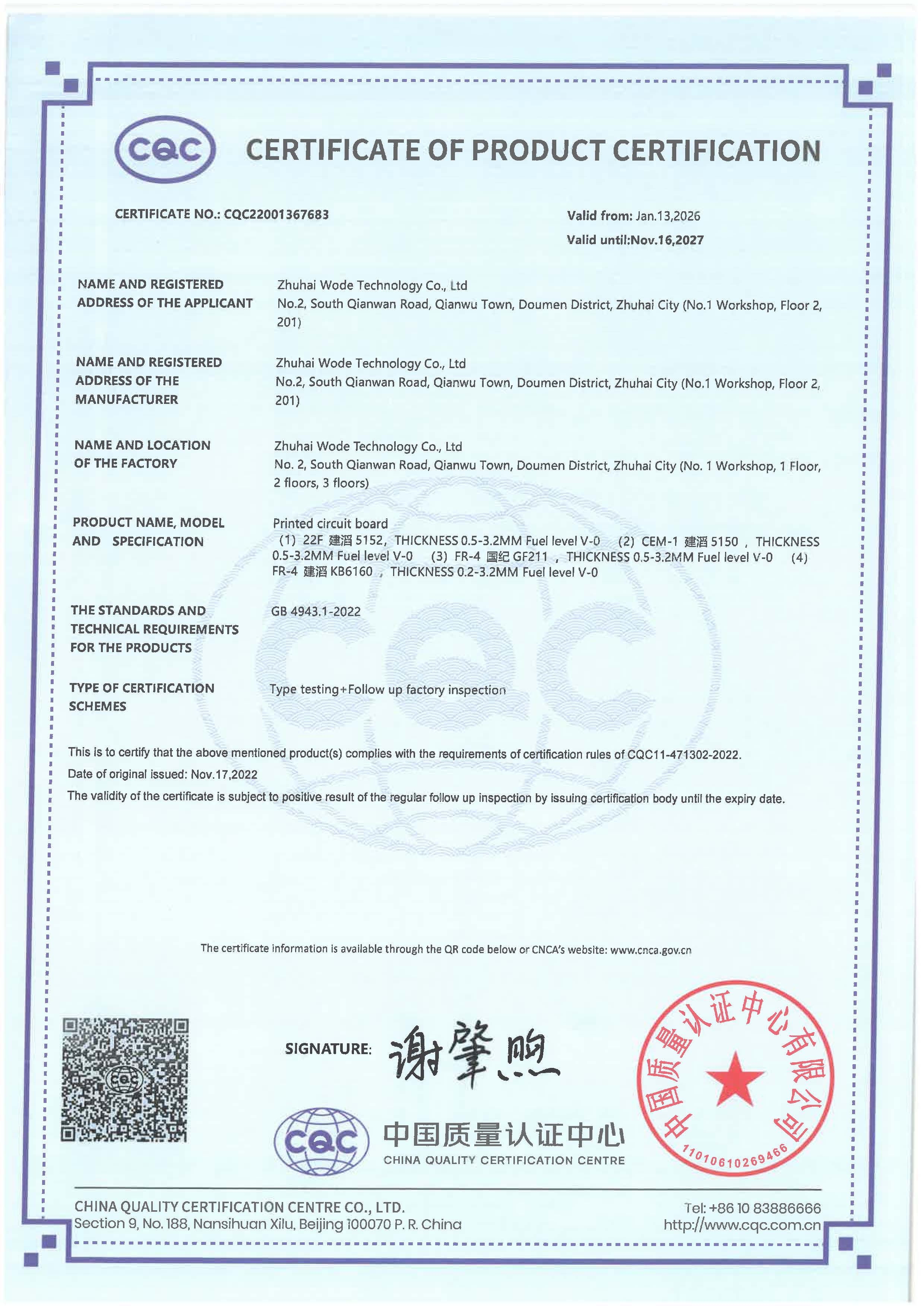
CQC certificate CQC22001367683: the scope names FR-4 and CEM substrate types, so it should not be read as metal base coverage.
Mapping the documents to WODE board families
The value of the four-level reading method becomes concrete when it is applied board by board. The table below takes the constructions named in WODE's product data and shows which document in the file carries the most weight for each, plus the additional evidence a buyer should request rather than assume.
| Board family | Recorded construction | Primary documents | Evidence to request |
|---|---|---|---|
| High Voltage MCPCB | Single-sided aluminium base, 1 oz copper, 1.6 mm ±10%, white solder mask, OSP finish | ISO 9001 for the site; UL metal base recognition; REACH SVHC record | Which UL designation applies; dielectric spacing and insulation data for the voltage class; substance data for the OSP finish |
| Coverlay MCPCB | Single-sided Al1060, 1 oz copper, 1.6 mm ±10%, white coverlay, HASL-LF | UL metal base recognition; RoHS and REACH for the coverlay and finish | Declaration naming coverlay material and HASL-LF finish, since the cover layer is part of the build |
| Ceramic based PCB | Ceramic substrate, specified for ultraviolet phototherapy use | ISO 9001; RoHS/REACH declarations | Construction-specific safety and substance position, because a ceramic build sits outside the metal base designation list |
| Double sided MPCB | Aluminium base, 70/70 µm copper, 1.6 mm ±0.16, white/white mask, HASL-LF | REACH SVHC report DGC251204025BD03 (closest match); ISO 9001 | Written confirmation that the laminate and finish match the tested build; UL position for a double-sided construction |
| Thermoelectric Separated Cu based PCB | Copper base, 35 µm copper, 1.6 mm ±0.16, white mask, OSP finish | ISO 9001; IATF 16949 where automotive flow-down applies | Confirmation that the copper base build falls under a recognised designation; substance data for the copper base and OSP |
Two patterns emerge from that mapping. The double-sided aluminium board is the construction with the closest substance coverage in the current file, which is a genuine advantage for home appliance and general lighting orders of that build. The ceramic and copper base families, by contrast, rely more heavily on management-system evidence plus build-specific declarations, so the buyer's request list is longer. None of this suggests a gap in capability; it reflects the fact that substance and safety evidence is written per construction, and a plant with a wide product range will always have a wider evidence map than a narrow one.
WODE's public dossier at a glance
Consolidating the numbers is the fastest way to see how a real file is structured, and to plan revalidation. All entries below are as recorded in the supplied certification data.
| Document | Number | Issuer | Subject or scope | Validity recorded |
|---|---|---|---|---|
| ISO 9001:2015 | 51325Q4258ROM | Shenzhen Meiao Testing and Certification Co., Ltd | Production of circuit boards (IAF Code 19) | 13 Oct 2025 – 12 Oct 2028 |
| ISO 14001:2015 | 51325E2142ROM | Shenzhen Meiao Testing and Certification Co., Ltd | Environmental management for circuit board production | 13 Oct 2025 – 12 Oct 2028 |
| IATF 16949 | 0584371 | NQA Certification Limited | HR, purchasing and strategic planning for automotive PCB manufacturing; support site Guangdong Kunxiang New Material Group | 27 Sep 2025 – 26 Sep 2028 |
| UL 796 (rigid) | E323980 | UL Solutions | Single-layer metal base boards WD-14/15/16/17; single-layer rigid RXD-11, WD-12, WD-13, RXD-10 | Issued 1 Jan 2022 |
| UL 796F (flexible) | E498836 | UL Solutions | Single-layer FMIC flexible circuits WD-F1, WD-F2 (ASP1) | Issued 1 Jan 2022 |
| CQC product certificate | CQC22001367683 | China Quality Certification Centre | PCB in CEM1 5152, CEM-1, FR-4 GF211, FR-4 KB6160; 0.2–3.2 mm; V-0 | 13 Jan 2026 – 16 Nov 2027 |
| REACH SVHC test report | DGC251204025BD03 | NSTL | Double-sided aluminium-based board, EU REACH (EC) No 1907/2006, ECHA SVHC list | Report dated 10 Dec 2025 |
Writing qualification scope into purchasing terms
The common failure in MCPCB procurement is not a missing certificate; it is a certificate that was reviewed once during supplier selection and never referenced again. The fix is to move document numbers and scope limits into the commercial documents, where they act as acceptance criteria rather than background reading.
- Name documents by number in the quality agreement. A clause that requires ISO 9001 and UL is weak; a clause that requires certificate 51325Q4258ROM for the producing site and states which UL designation the ordered construction falls under is testable.
- Define acceptance as scope coverage, not document existence. The criterion should be that the certificate's scope covers the ordered construction and that it is valid on the shipment date. This is where double-sided, ceramic and copper base boards separate from a generic file review.
- Make change notification a document trigger. A change of base metal source, laminate, solder mask, surface finish or production site can invalidate prior substance and safety evidence. Requiring notification before the change, and re-confirmation after it, protects both sides.
- Ask for a certificate of conformity per shipment. Batch-level conformity statements connect the file to the lot, which is what an auditor or a customer's quality engineer will eventually ask for.
- Set revalidation dates from the certificates themselves. In this file, the CQC certificate is the earliest to expire at 16 November 2027, followed by IATF 16949 on 26 September 2028 and the ISO pair on 12 October 2028. Adding those dates to a supplier calendar is more reliable than an annual reminder email.
- Keep the commercial frame realistic. WODE's stated OEM/ODM terms include a minimum order of 80 sqm, 100% testing and customisation of laminate, thickness, surface treatment, solder mask colour and logo printing. Because those variables are customisable, the document set should be re-confirmed whenever one of them changes on a repeat order.
A five-step reading routine for any MCPCB dossier
- Identify the entity. Match the legal name, address and site on each document to your contracting party and producing plant. Name similarity is not identity, and mixed-up entities are a real risk in this category.
- Check validity and issuer. Confirm the certificate number resolves with the issuing body and the expiry date is in the future at shipment.
- Read the scope sentence word by word. Scope is where certificates become precise — functions, sites, substrate types, designations and constructions.
- Keep the levels separate. System evidence answers process questions, UL answers construction safety, RoHS and REACH answer substance questions. Do not let one stand in for another.
- Record and re-trigger. Put document numbers, scope notes and expiry dates into the supplier file and the quality agreement, with change notification as the trigger for re-review.
Market context and what it means for documentation
The pressure to read these files properly is increasing with the application mix. Future Market Report's 2025 assessment, as recorded in the supplied industry data, values the global MCPCB market at USD 935.75 million in 2025 with a projection of USD 1,948.90 million by 2033, and places China at 28.7% of that market. That is a single commercial-research source and should be treated as directional context for category attention rather than a forecast for any specific construction.
The practical implication is narrower and more useful: as boards move into higher-voltage lighting, automotive lighting and power applications, the questions buyers ask shift from price per square metre toward scope, traceability and change control. Suppliers who can answer a scope question in writing — which designation, which tested construction, which revision of the candidate list — will spend less time in qualification loops than suppliers who can only send a folder. For buyers, the same shift argues for a file structure of their own: one page per board family, listing the documents that apply, their numbers and their revalidation dates.
FAQ
Does an ISO 9001 certificate mean an MCPCB meets a specification?
No. ISO 9001:2015 certifies that the site operates a quality management system that has been audited against the standard. It says nothing about the thermal conductivity, dielectric strength, copper weight or dimensional tolerance of a particular board. Use it to judge process discipline and consistency across lots, and use drawings, datasheets and test reports to judge the product itself.
What is the difference between UL recognition and UL listing for a printed circuit board?
Printed wiring board evaluations under UL 796 and UL 796F are normally recognitions of a component construction, recorded on the supplier's yellow card together with the construction and its designation. Listing generally describes an end product rather than a board supplied as a component. For a board buyer, the operative question is which recognised construction and designation the ordered part is built to, not simply whether the supplier holds UL documentation.
Is one REACH test report valid for every MCPCB construction?
Not as a general rule. A test report records a result for the construction and sample it names, on the date it was issued. A different base metal, laminate, solder mask or surface finish is a different build and should carry its own declaration or test data. Because the ECHA SVHC candidate list is updated periodically, the report date matters alongside the result.
Does IATF 16949 certification cover an entire factory?
The certificate states its own scope, which may name particular functions, processes or sites rather than every activity under one roof. Buyers should read that scope against the process and plant their order will use, and record the certificate number, issuing body and validity dates in the supplier file so the mapping can be checked again at the next review.
What documents should accompany an MCPCB purchase order?
Typically: the current ISO 9001 certificate for the producing site; IATF 16949 where automotive flow-down applies; the UL yellow card reference and the designation the ordered construction falls under; a RoHS declaration or test report naming that build; a REACH SVHC declaration or test report with its issue date; and a certificate of conformity per shipment. Naming each document by number in the quality agreement is what turns the list into an acceptance criterion.
WODE's wider product and capability information is available in its company brochure, and the manufacturer's own site is WODE Circuit Technology (Zhuhai) Co., Ltd.
Tem questões ou precisa de mais detalhes?
Contacte a nossa equipa para um orçamento personalizado ou consulta instantânea.
Solicitar orçamento
Preencha o formulário abaixo e a nossa equipa entrará em contacto com uma proposta personalizada.
Chat direto do WhatsApp
Prefere conversar em tempo real? Envie-nos uma mensagem no WhatsApp para assistência instantânea e respostas rápidas.
- Obter orçamento personalizado
- Partilhar fotos ou documentos
- Discuta as suas necessidades diretamente
Geralmente responde em 5–30 minutos durante o horário de expediente.