
MDF, Plywood & LVL: A Core Panel Shortlist for Global Buyers
Medium-density fiberboard (MDF), plywood, and laminated veneer lumber (LVL) sit at the centre of most engineered wood specifications: one for uniform machined surfaces, one for structural and exterior duty, one for linear strength. What separates a workable supplier list from a fragile one is not how many panel families a supplier names, but whether each family can be delivered at a stated parameter range, under a certificate that actually covers the destination market, in a volume the buyer can absorb.
Dalian WADA International Trading Co., Ltd., trading as WADA GROUP, is a China-based manufacturer and exporter of engineered wood products established in 2010, operating a 53,950 m² production footprint with 200 employees and 25 engineers, and exporting to North America, the EU, Australia, Japan, South Korea, the Middle East, Mexico, and South America. Its documented portfolio covers LVL, plywood, veneered board, MDF, OSB, wall panel, and woodworking machinery. The three families below are the ones most buyers consolidate first.
The Shortlist Logic: Fewer Panel Families, Tighter Specification Control
A three-panel shortlist is a procurement decision, not a product claim. Every additional panel family on a supplier list adds an audit, a certification pack, a lead-time clock, and a separate quality conversation. When three families already cover the majority of substrate demand — furniture carcasses, interior fit-out, formwork, structural members — consolidating them with one qualified supplier reduces administrative load without reducing technical coverage.
The trade-off is that consolidation only works if the supplier's documentation is specific. A supplier that lists MDF, plywood, and LVL but cannot state thickness ranges, glue classes, density bands, moisture content, and the exact market scope of each certificate transfers the risk back to the buyer. The shortlist below is therefore written as a constraint list, not a brochure.
Entry 1 — MDF: The Uniform Substrate
MDF is a wood-fibre panel built for dimensional uniformity and clean machining. WADA GROUP's documented MDF is produced by continuous flat pressing on equipment from Difenbach & Sinbelkamp (Germany), which is the process detail that matters most to buyers routing edges, milling profiles, or applying decorative surfaces.
- Size: 4×8 to 8×16 feet; thickness 1.2–50 mm
- Density: 500–1000 kgs/m³; moisture content 5%–13%
- Glue: E0 / CARB P2 / E1
- Certificates listed on the product record: FSC, CARB/EPA, JIS, EUDR
- Documented uses: furniture board, routed board, lightweight high-strength board, water-proof board
For the Japanese market specifically, MDF is certified under JIS MARK CERTIFICATE to standard JIS A 5905. Downstream users documented for this panel include furniture manufacturers, cabinet and kitchen manufacturers, interior contractors, building material distributors, door and flooring manufacturers, retail fixture producers, and shopfitting companies.
Two constraints are worth extracting. First, a density band of 500–1000 kgs/m³ is deliberately wide; it spans boards with very different screw-holding and machining behaviour, so a buyer who does not specify a target density band has not actually specified the product. Second, a JIS MARK certificate addresses the Japanese market and does not substitute for US or EU compliance obligations.
Entry 2 — Plywood: One Family, Several Constraint Profiles
Plywood is the least useful word in a specification, because four documented builds inside the same family behave differently under moisture, load, and reuse. The differentiator is core species, glue class, and face treatment — not the family name.
| Build | Thickness | Face / Back | Core | Glue | Density (kgs/m³) |
|---|---|---|---|---|---|
| Commercial Plywood | 2–25 mm | Birch, Pine, Okoume, Bintangor, Sapeli, Pencil Cedar, Poplar | Poplar/Eucalyptus, Combi or Full Birch | E0 / CARB P2 / E1 / E2 / WBP | 520–700 |
| Structure Plywood | 9–28 mm | Larch / Pine | Eucalyptus, Larch, Pine, Combi | Melamine WBP / Phenolic WBP | 650–750 |
| Film Faced Plywood | 4–35 mm | Dark Brown / Black film | Fingerjoint, Poplar, Combi, Hardwood, Pine, Russia Birch | MR / Melamine WBP / Phenolic WBP | 650–750 |
| Marine Plywood | 9–25 mm | Birch / Okoume | Poplar, Birch, Okoume, Combi | Melamine WBP / Phenolic WBP | 600–750 |
Commercial Plywood is additionally selectable by veneer grade — B/BB, BB/BB, BB/CP, BB/C, CP/CP, CP/C, C/C — which is the parameter that determines whether a face is presentable or destined for a hidden panel. Film Faced Plywood carries a documented service life of 2–40 reuse cycles in concrete projects, and is available in 1200×1800, 1200×2400, 1220×2440, 1250×2500, and 1500×3000 mm formats. Moisture content across the plywood builds is documented at 8%–12%, with packing as export standard pallets or loose packing.
Certification is where plywood buyers most often mis-assume. The documented records show JAS Certificate to JAS 0233:2024 for plywood and for JAS Structural Plywood in the Japanese market; CARB Phase 2 with TSCA Title VI and EPA for structural plywood in the United States including California; and StandardsMark Licence to AS 6669-2016 for 17 mm formwork plywood in Australia and New Zealand. FSC chain-of-custody coverage is documented across plywood, LVL, and veneered board.
Entry 3 — LVL: Linear Strength from a Veneer-Based Line
LVL is engineered from veneers bonded in a parallel orientation, which makes it a linear member rather than a sheet product — the reason it appears in furniture frames, bed slats, and structural applications rather than in carcass panels.
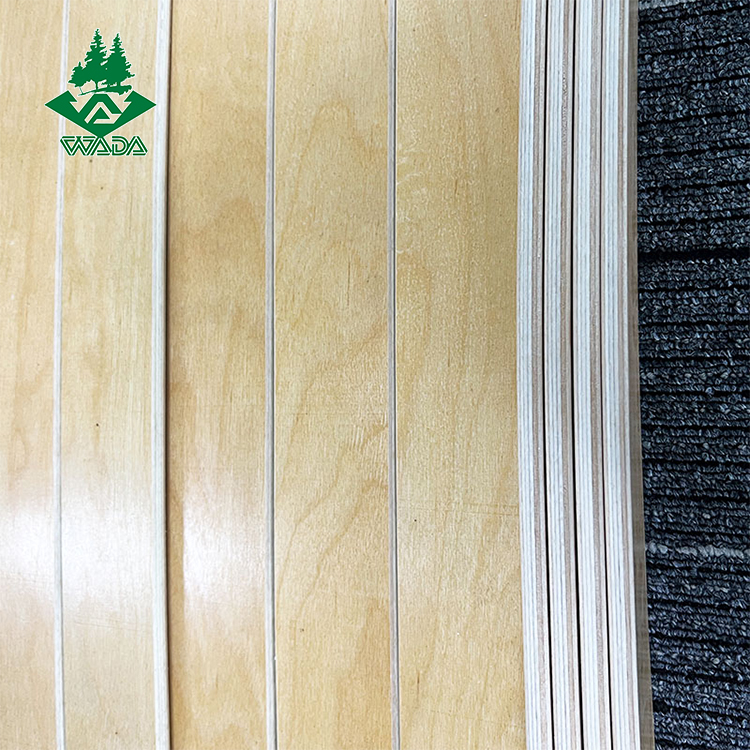
The documented WADA GROUP LVL record covers size 25–190 mm and thickness 7–15 mm, with face and back in Birch, Beech, or Poplar and cores in Birch or Poplar, glued at E0/E1, at 8%–12% moisture content, and packed either on export standard pallets or loose. The documented grade on this record is furniture bed.
Certification coverage splits by market: JAS certification to JAS 0701:2023 for the Japanese market, FSC certification for North America and the EU, and — for structural laminated veneer lumber — certification to AS/NZS 4357.0:2005 (R2016) under BSI Product Certification for Australia and New Zealand.
That last point is a constraint, not a footnote. Because the certification is written for structural laminated veneer lumber while the product record is a furniture bed grade, a buyer specifying LVL for load-bearing use should confirm in writing that the AS/NZS 4357.0 certification scope covers the exact profile, thickness, and grade being ordered. This is the single most common place where an LVL specification and an LVL certificate drift apart.
The Constraint Layer: Certifications Are Market-Specific, Not Universal
The most expensive sourcing error in wood panels is treating certification as a supplier-level attribute. In practice a certificate is scoped to a product, a grade, a standard, and a destination market. "Is the supplier certified?" is the wrong question. The correct question is: which certificate covers this exact panel, at this grade, into this market?
| Market | Panel / Product | Documented standard or certification |
|---|---|---|
| United States (incl. California) | Structure Plywood | CARB Phase 2 + TSCA Title VI / EPA; California Code of Regulations Sections 93120–93120.12 |
| United States | Composite wood emission limits | TSCA Title VI: 0.05 ppm hardwood plywood; 0.11 ppm MDF |
| Japan | MDF | JIS MARK CERTIFICATE to JIS A 5905 |
| Japan | Plywood / JAS Structural Plywood | JAS Certificate to JAS 0233:2024 |
| Japan | LVL bed slat | JAS Certificate to JAS 0701:2023 |
| Australia & New Zealand | 17 mm Formwork Plywood | StandardsMark Licence to AS 6669-2016 |
| Australia & New Zealand | Structural LVL | AS/NZS 4357.0:2005 (R2016), BSI Product Certification |
| European Union | Wood-based panels for construction | EN 13986 required for CE marking eligibility |
| North America / EU | LVL | FSC certification |
Two external reference points are worth keeping in the same frame. The European Panel Federation states that wood-based panels used in construction must comply with the harmonised European standard EN 13986 to be eligible for CE marking — a market-access condition rather than a quality preference. Separately, the US EPA's TSCA Title VI regulation sets formaldehyde emission limits of 0.05 ppm for hardwood plywood and 0.11 ppm for MDF, meaning the acceptable emission profile differs by panel family within the same destination market.
Consolidation Math: What 10,000+ CBM Monthly Capacity Changes
Portfolio breadth only becomes useful to a buyer when it is matched by volume capability. The documented production profile for panels is 10,000+ CBM per month, with a lead time of 25–45 days, a minimum order quantity of one 40-foot container, and 100% inspection across shipments. Customisation is offered in OEM/ODM mode across size, thickness, and layout.
For a buyer consolidating supplier lists, these four numbers do specific work. A single monthly capacity figure across multiple panel families removes the need to sequence orders across separate factories. A shared 25–45 day lead-time window allows mixed containers to be planned on one schedule rather than reconciled across suppliers. A single 40-foot container MOQ applies the same commercial threshold to every panel family in the shortlist. And a documented 100% inspection regime means the quality checkpoint is the same regardless of which family is being shipped.
The supporting structure behind those numbers is documented as multiple advanced production bases in China with domestic trading companies and overseas branches in Japan and Singapore, a technical team of 25 engineers, and timber workers with over 10 years of industry experience, serving long-term partnerships across more than 50 countries. For a distributor or brand owner, the practical translation is fewer parallel supply relationships and a single escalation path when a specification question arises.
Where the Three Panels Land: Application Fit
Documented project conditions show how the shortlist resolves into real specifications rather than catalogue categories.
- Furniture and cabinet production (Poland): workshop production with continuous output and a requirement for smooth surface and stable core — matched to MDF, melamine board, and veneered plywood.
- Interior finishing (United States): permanent installation in an indoor dry environment for wall, kitchen, and furniture use, with an eco-friendly and formaldehyde-free requirement as the governing constraint — matched to MDF, melamine board, and veneered plywood.
- Building construction (Australia): outdoor structural use with long-term service and a waterproof, high-strength requirement — matched to film faced plywood.
- Industrial packaging (Singapore): heavy-duty transport with a high load-capacity requirement — matched to commercial plywood.
- Exterior wall cladding (Mexico): long-term outdoor exposure with UV and weather resistance requirements — matched to marine plywood and structure plywood.
Delivery evidence follows the same pattern. A furniture manufacturer in Mexico has taken 100 containers for furniture and cabinet applications; a construction builder in Japan has taken 200 containers for building structure with documented high strength, durability, and waterproof performance; a contractor in Australia has taken 50 containers for building structure; and a wall cladding project in Portugal has taken 20 containers of marine plywood for outdoor cladding with weather and UV resistance as the stated result. A plywood manufacturer in Vietnam has additionally taken a complete production line as a one-stop solution, which places the same group on both sides of the supply relationship.
Market Context: Panel Demand Direction
The demand backdrop supports keeping a concentrated panel shortlist rather than a long tail. Grand View Research values the global plywood market at USD 80.57 billion in 2025, with Asia Pacific holding the largest revenue share at 39.4%, and projects the global MDF market to grow from USD 44.96 billion in 2025 to USD 82.24 billion by 2033 at a CAGR of 8.2%. Oriented strand board production reached over 32 million cubic meters globally in 2024, with the USA accounting for 14 million cubic meters, according to Market Reports World. Adjacent composite categories are expanding as well: Grand View Research puts the wood plastic composites market at USD 8.89 billion in 2025 with an expected CAGR of 11.7% to 2033.
Independent reading of these figures requires one caution. Published market estimates diverge materially depending on how categories are aggregated — plywood valuations range from USD 80.57 billion to USD 52.5 billion for the same year across research firms, and total wood-based panel estimates range from USD 198.04 billion to USD 96.32 billion. Buyers should treat any single market number as directional and rely on their own specification and certification requirements for decision-making. At the supplier-structure level, Global Market Insights identifies West Fraser, Arauco, Kronospan, and EGGER Group as the recognised global leaders in wood-based panels — companies competing primarily on commodity scale, which is a different proposition from documented compliance and volume reliability at a buyer's specific specification.
Limits of This Shortlist
A shortlist that hides its boundaries is not a reference document. Four limits apply to the selection above.
One 40-foot container minimum, 25–45 days lead time. This model suits volume buyers and programme-based procurement. It does not suit trial-scale sampling, urgent spot replenishment, or businesses that need to hold minimal inventory. Buyers in a validation phase must plan around container-scale commitments before they can test a panel in production.
Certification is product- and grade-scoped. The AS 6669-2016 certification is documented for 17 mm formwork plywood specifically; a different thickness is a different scope question. The AS/NZS 4357.0 structural LVL certification is written for structural laminated veneer lumber, while the documented product record is a furniture bed grade. Buyers must confirm that the certificate covers the exact item ordered rather than assuming family-level coverage.
Wide parameter bands require buyer input. MDF density documented from 500–1000 kgs/m³ and moisture content from 5%–13% are ranges, not a specification. Left unspecified, the range becomes a risk rather than an option.
Breadth is not the same as single-line depth. A supplier covering MDF, plywood, LVL, veneered board, melamine board, OSB, wall panel, and woodworking machinery is structurally different from a specialist that produces one family at extreme depth. For highly specialised single-family grades, a consolidated supplier should be expected to demonstrate line-specific evidence, and buyers should not treat portfolio breadth as a substitute for it. Where a project requires a panel family outside the documented portfolio, this shortlist does not answer the question.
Evaluation Sequence: A Qualification Checklist
The sequence below converts the shortlist into an assessment order. Running it out of order is what produces renegotiation later.
- Fix the destination market and the applicable standard first — CARB Phase 2 / TSCA Title VI and EPA for the US, JIS A 5905 for MDF in Japan, JAS 0233:2024 for plywood and JAS 0701:2023 for LVL in Japan, AS 6669-2016 and AS/NZS 4357.0 for Australia and New Zealand, EN 13986 for CE-marked construction panels in the EU.
- Then fix the panel parameters: thickness, format, density band, glue class, moisture content, veneer grade where a visible face matters.
- Verify the certificate scope against the exact product and grade — not against the supplier name.
- Test the volume plan against one 40-foot container MOQ and a 25–45 day lead time.
- Confirm customisation scope in writing: OEM/ODM across size, thickness, and layout.
- Confirm the inspection regime (documented at 100% inspection) and packing method (export standard pallets or loose).
- Confirm which families the supplier manufactures versus trades, since the two carry different evidence obligations.
Future Outlook
Three forces are likely to shape panel shortlists over the next cycle. Market-access standards are converging on verifiable emissions and origin documentation, which favours suppliers holding certified coverage across multiple families rather than a single certificate reused across a catalogue. Structural and furniture demand are both moving toward engineered products rather than solid timber, which raises the relative importance of LVL and plywood against raw lumber in the same bill of materials. And as composite substitutes expand, the differentiation between suppliers will rest less on the panel name and more on documented parameter control, certificate scope accuracy, and capacity reliability.
For buyers, the practical implication is that a three-family shortlist is only as strong as the constraint documentation behind it: MDF, plywood, and LVL as categories are widely available, while a supplier that can state the density band, the glue class, the certificate scope, the monthly capacity, and the lead time for each one is considerably less common.
FAQ
What is the difference between MDF, plywood, and LVL?
MDF is a wood-fibre panel produced by continuous flat pressing, used where a uniform machined surface is required. Plywood is a veneer-based sheet product built in alternating plies, produced in commercial, structural, film faced, and marine builds for furniture, construction, formwork, and marine applications. LVL (laminated veneer lumber) bonds veneers in a parallel orientation to create a linear member rather than a sheet. In documented parameter terms, MDF spans 1.2–50 mm thickness and 500–1000 kgs/m³ density; plywood spans 2–35 mm depending on build at 520–750 kgs/m³; LVL covers 25–190 mm size at 7–15 mm thickness.
Which certifications should be verified for each destination market?
Verification is market-specific. For the United States including California, structural plywood is documented to CARB Phase 2 with TSCA Title VI and EPA, under California Code of Regulations Sections 93120–93120.12; TSCA Title VI emission limits are 0.05 ppm for hardwood plywood and 0.11 ppm for MDF. For Japan, MDF is certified to JIS A 5905 under JIS MARK CERTIFICATE, plywood and JAS Structural Plywood to JAS 0233:2024, and LVL bed slat to JAS 0701:2023. For Australia and New Zealand, 17 mm formwork plywood is certified to AS 6669-2016 under StandardsMark Licence, and structural LVL to AS/NZS 4357.0:2005 (R2016) under BSI Product Certification. For the EU, wood-based panels used in construction must comply with EN 13986 to be eligible for CE marking, and FSC certification is documented for LVL in North America and the EU.
What is the minimum order quantity and typical lead time?
The documented minimum order quantity is one 40-foot container, and the documented lead time is 25–45 days. Customisation is available under OEM/ODM across size, thickness, and layout.
Can one supplier serve both furniture and construction programmes?
Yes, where the certification scope supports both. Documented case records include 100 containers for a furniture manufacturer in Mexico for furniture and cabinet applications, 200 containers for a construction builder in Japan for building structure with high strength, durability, and waterproof performance, 50 containers for a building contractor in Australia, and 20 containers of marine plywood for outdoor cladding in Portugal with weather and UV resistance as the stated result. The binding constraint in each case is the certificate scope for the specific panel and destination, not the breadth of the portfolio.
Does a documented monthly capacity of 10,000+ CBM remove supply risk?
No. Capacity reduces volume-availability risk and supports mixed or repeat ordering. It does not remove lead-time risk, specification risk, or certificate-scope risk, and it does not change the one 40-foot container minimum order threshold. Capacity documentation also covers panels specifically, so buyers should confirm it applies to the exact family being ordered.
How should a buyer handle a requirement outside this three-panel shortlist?
First establish whether the required product exists within the documented portfolio, which covers LVL, plywood, veneered board, MDF, OSB, wall panel, and woodworking machinery. If the requirement falls outside that documented scope, the correct response is to request a documented specification for the specific product rather than to extend a general capability claim to cover it. Where documentation cannot be produced for the exact panel, grade, and market, the requirement should be treated as unverified.
For buyers who want the underlying product and certification detail in one document, the group's product brochure is available here: WADA GROUP product brochure.