
MELODY E-Bike: Scenario Fit for Sports Campus Mobility
MELODY E-Bike: Scenario Fit for Sports Campus Mobility
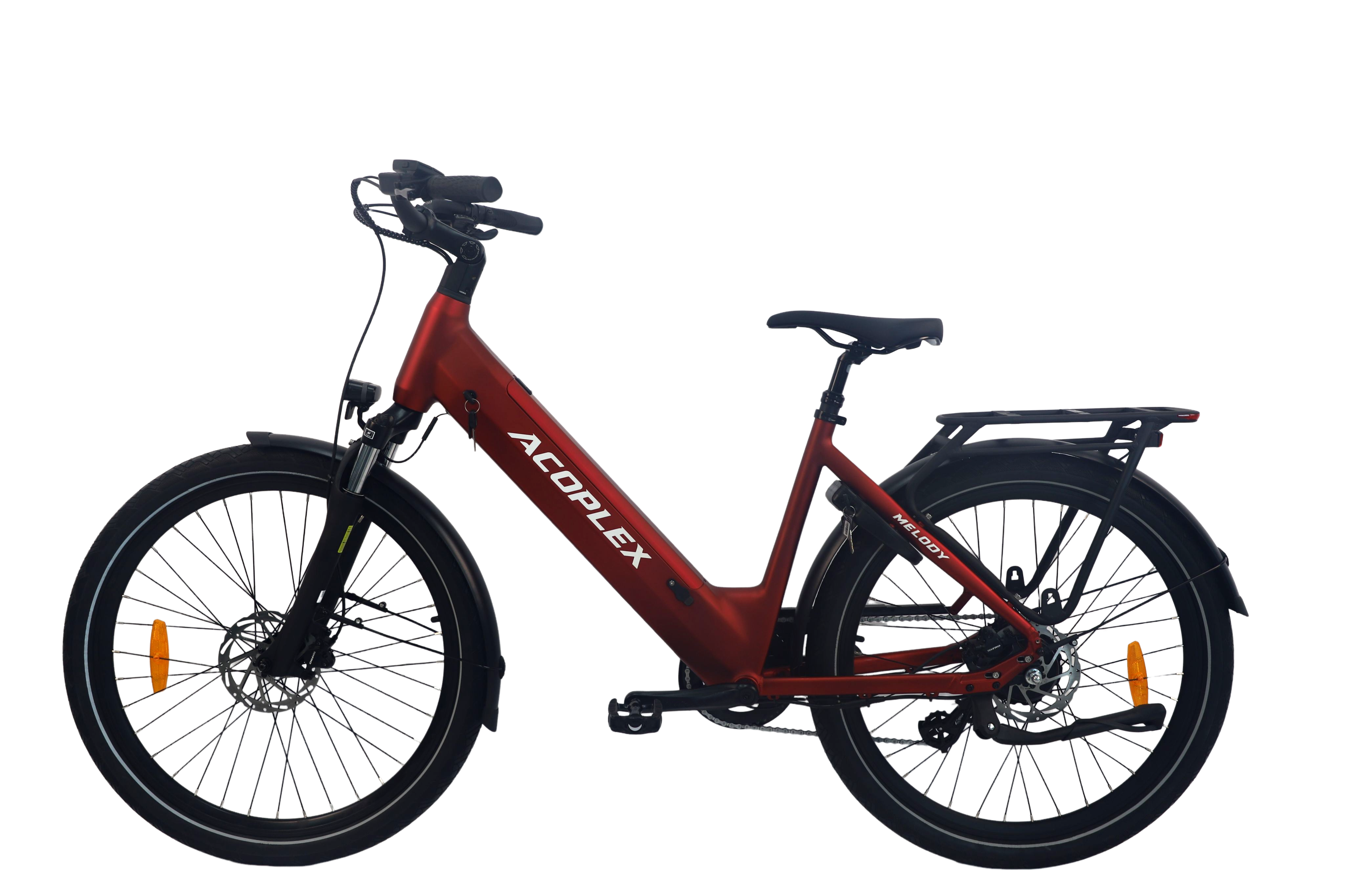
MELODY is an ACOPLEX electric city bike specified with a 6061 aluminum alloy frame, a Suntour suspension fork, 26×2.0 CST tyres, front and rear hydraulic disc brakes, a 48V 350W motor, a 48V 17.4Ah lithium-ion battery, a SHIMANO 8-speed drivetrain and an LCD display. On an outdoor sports facility campus, those components describe a single-rider assisted vehicle for paved paths, service roads and light gravel. It is a staff and guest mobility tool, not a cargo platform and not a trail bike. Whether it fits a particular site comes down to three verifiable questions: what surfaces the campus actually has, what duty cycle the rider will run, and which specifications the buyer confirms in writing before ordering.
Why campus mobility is a vehicle-fit problem, not a catalogue problem
Outdoor sports facilities concentrate a large number of short trips into a small area: between pitches, courts, car parks, equipment stores and maintenance yards. A coach moving between two training areas, a groundskeeper doing a perimeter round, or a guest riding from reception to a far court may each cover a few hundred metres to a few kilometres repeatedly through the day. On a large site, those repeated short trips are the real mobility workload, and walking absorbs a disproportionate amount of staff time.
ACOPLEX lists campus and resort rental among the application scenarios for its electric bicycle range, alongside urban commuting and leisure or weekend riding, and it treats campus and park procurement as a distinct project type. The same scenario documentation separates retail and distributor procurement from commercial fleet and rental deployment, and states that commercial or rental use requires enhanced durability and after-sales provisions. That separation is a useful starting point for facility managers, because a bicycle bought for one rider's commute and a bicycle bought for a shared campus pool are judged against different criteria even when the underlying product is the same.
The practical consequence is that a facility specification should be written around the site rather than around the brochure. A campus with wide asphalt service roads, gentle gradients and a staff pool of mixed riding confidence has a different requirement from one with narrow gravel paths, steep service ramps and a rental fleet that turns over daily. The MELODY specification can be read against both, and the reading produces different conclusions.
MELODY at a glance: the specifications a facility manager can verify
The MELODY sheet is compact and specific on hardware. The table below reproduces the listed values without interpretation, so that a buyer can compare them directly against site requirements and supplier documentation.
| Specification item | MELODY listing (ACOPLEX product data) |
|---|---|
| Model and type | MELODY, electric city bike |
| Frame material | 6061 aluminum alloy |
| Front fork | Suntour brand, suspension, aluminum alloy |
| Tyres | 26×2.0 CST |
| Brakes | Front and rear hydraulic disc |
| Motor | 48V 350W Oxygen comfort |
| Battery | 48V 17.4Ah lithium-ion |
| Drivetrain | SHIMANO 8-speed |
| Display | LCD display |
| Stated application | Sports industry |
Frame, fork and tyres: the three contact points that decide campus fit
The MELODY frame is listed as 6061 aluminum alloy. In bicycle construction, 6061 is a widely used heat-treatable aluminum alloy chosen for a workable balance of strength, weight and corrosion behaviour; it is also why aluminum frames dominate volume e-bike production, with one commercial research estimate putting aluminum at roughly 73% of global e-bike frame output. For a facility, the practical translation is maintenance-related rather than performance-related: an aluminum frame does not require the paint-protection regime that steel does in humid or coastal environments, and it keeps the vehicle light enough for one person to move by hand when parking is tight.
The Suntour suspension fork is listed as aluminum alloy with suspension travel. On a campus, its value is concentrated on the surfaces facilities actually own: expansion joints in concrete, paved path edges that have lifted with tree roots, speed-hump transitions and gravel service tracks. A suspension fork reduces the amount of that roughness transferred to the rider's hands and shoulders over repeated laps. It does not convert a city bike into a trail bike, and it does not compensate for a poorly maintained path surface.
The 26×2.0 CST tyres define the terrain envelope more than any other single item on the sheet. A 26-inch wheel diameter generally rolls across surface irregularities with less disturbance than a smaller wheel, and a 2.0 section provides more contact area and a more forgiving ride than a narrow road tyre. The application guidance published for the ACOPLEX range describes working conditions as urban pavement, gravel and light off-road trails, with hilly and steep climbs included in the usage profile. That is a realistic description of a sports campus: asphalt loops, concrete aprons, compacted gravel access roads and short ramps. It is not a description of loose sand, deep mud or technical singletrack, and readers who need those surfaces should be looking at a different model in the range rather than at a tyre change.
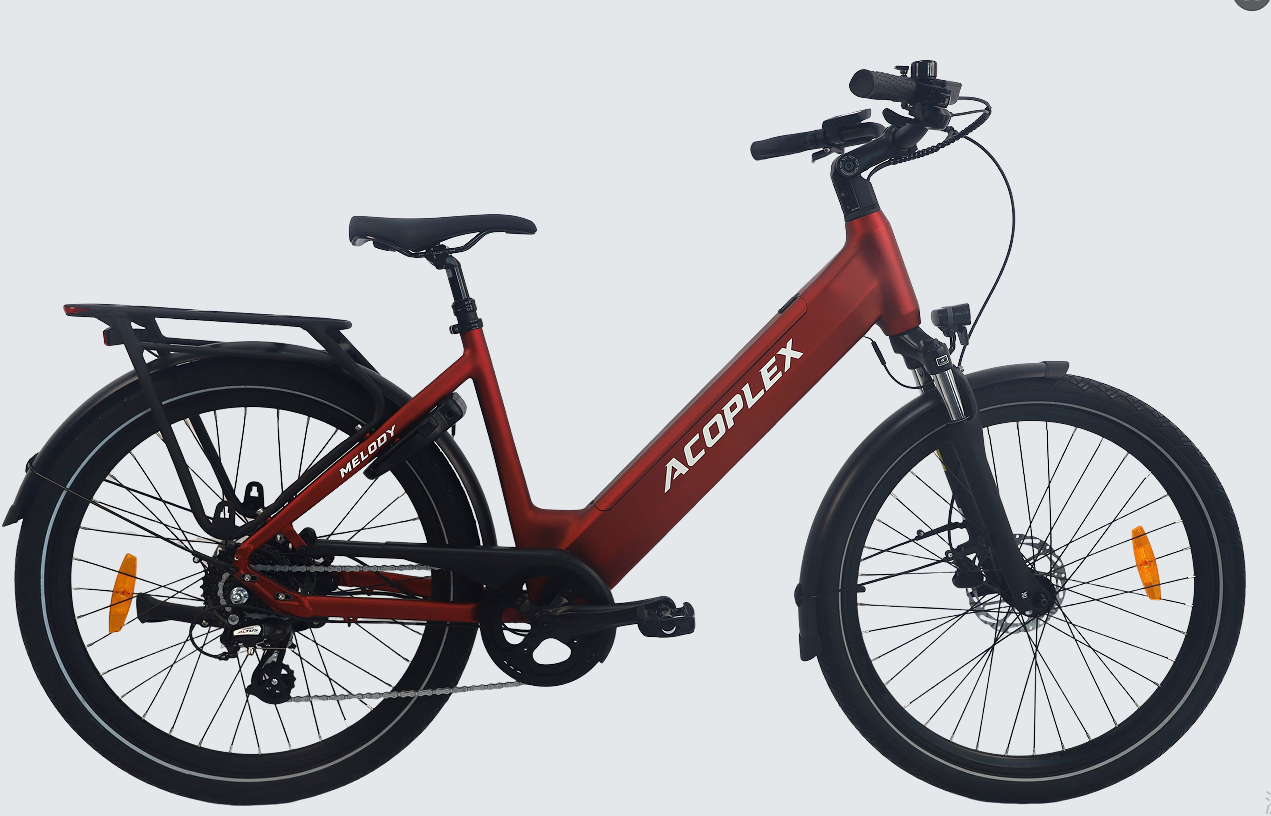
Braking is listed as front and rear hydraulic disc. On a shared campus, hydraulic disc brakes matter for a reason that has little to do with top speed: they retain lever feel with less hand force than cable-actuated systems, which helps when a rider is stopping and starting repeatedly at gates, crossings and pedestrian areas, and they are less affected by wet weather than rim brakes. Facilities should still treat braking as a rider-briefing item, because a heavier assisted bike needs a longer stopping distance than an unassisted bicycle at the same speed, and campus speed limits should be set with pedestrian density in mind rather than with the vehicle's capability.
Motor, battery, gearing and display under daily duty
The MELODY motor is listed as 48V 350W Oxygen comfort, paired with a 48V 17.4Ah lithium-ion battery. Two observations follow directly from the specification, and both are procurement points rather than performance claims.
First, the battery capacity is on the larger side within the brand's own city-bike listings. Several other ACOPLEX city models list 48V 7Ah packs, while MELODY lists 17.4Ah. Nameplate capacity is not a range figure: assisted range depends on assist level, rider weight, gradient, surface, tyre pressure and ambient temperature, and no range value appears on the MELODY sheet. A facility planning shift patterns should therefore ask the supplier for tested range data under stated conditions, or run its own measurement on a representative campus loop before committing to a fleet size. Treating ampere-hours as kilometres is the most common specification error in facility e-bike procurement.
Second, the 350W motor rating is higher than the 250W figure listed on several other models in the range. A wattage rating is a specification, not a measured outcome, and it carries regulatory weight: EN15194 is the mandatory standard for e-bike sales in the EU market, and ACOPLEX states that its electric bicycles hold CE and EN15194 certification. Because the MELODY sheet lists a 350W motor, buyers intending to use the model on EU public roads or in a leased fleet should confirm with the supplier how the model is classified for the destination market and what speed setting is configured at shipment. Facilities in other regions should apply their own local rules. This is a documentation question, and it is answered in writing or not at all.
The SHIMANO 8-speed drivetrain and the LCD display complete the daily-use picture. Eight speeds are enough spread for a campus with mixed gradients, and gearing lets a rider keep a comfortable cadence with or without assistance, which matters when a facility restricts assist use in crowded areas. The LCD display gives the rider a visible state-of-charge reference, which is the single most useful feature for a shared pool: a dispatcher can check a bike's status at the rack instead of discovering a flat battery mid-round. The sheet does not state whether the display includes a USB charging port; buyers who want that feature on MELODY should confirm it rather than assume it from other models in the range.
Scenario mapping: where MELODY fits on a sports campus
The clearest fit is single-rider staff mobility. Coaches moving between training areas, facility managers doing inspection rounds, medical and support staff responding across a large site, and maintenance technicians carrying small hand tools all run the kind of short, repeated, low-load trips that a city bike with a 17.4Ah pack and an LCD display is specified for. The riding is mostly on prepared surfaces, the routes are known, and the vehicle is parked at a staff rack where charging can be organised.
The second fit is guest and spectator movement in a rental or loan arrangement. ACOPLEX lists campus and resort rental among its application scenarios, and this is where the specification's rider-facing items earn their place: step-through city geometry, suspension to soften long paths, hydraulic brakes for riders with weaker grip, and a display that shows charge level to a first-time user. Rental use also raises the durability and after-sales question that the scenario documentation flags, and that should be settled contractually rather than assumed.
The third fit is off-season and leisure use on service roads and perimeter loops, which the range's scenario guidance covers under leisure and weekend riding.
Equally important is where MELODY does not fit. The MELODY sheet lists no rack, box or cargo capacity, and the range's own scenario documentation states that cargo applications require supporting equipment such as racks and boxes on cargo-capable models. A facility that needs to move ball carts, water containers, boundary flags or groundskeeping equipment should be specifying a cargo-capable model or a three-wheel model rather than adding loads to a city bike outside its stated configuration. Likewise, a site with steep loose-surfaced trails, sand or snow should be looking at the range's trail-oriented models, which are specified with much wider tyres and different gearing. Matching the model to the surface is cheaper than repairing a mismatched fleet.
How MELODY compares with other ways of moving around a facility
Most facilities already move people around, so the e-bike decision is a substitution decision. The comparison below is qualitative and describes documented characteristics of each option type; it does not rank them, because the right answer depends on site size, staffing model and budget structure.
| Option | Typical campus role | What it requires from the site | Main constraint to plan for |
|---|---|---|---|
| Walking | Short internal trips, officiating, spectator movement | Nothing beyond paths and signage | Slow across large sites; staff time absorbed by transit |
| Utility cart or small site vehicle | Equipment movement, multi-passenger transfer | Service-road width, parking, trained drivers, fuel or charging | Higher capital and running cost; harder to place close to pedestrian areas |
| Conventional bicycle | Staff rounds, short errands | Secure parking and path access | Rider effort and fatigue on repeated laps and gradients |
| MELODY electric city bike | Single-rider assisted staff and guest mobility | Charging points, secure parking, rider briefing, battery rotation | One rider per vehicle; no cargo configuration listed; not a trail vehicle |
The verified fit boundary is worth stating plainly: MELODY is specified as a city bike with 26×2.0 tyres, and its documented working conditions are pavement, gravel and light off-road trails. It complements walking and site vehicles on prepared surfaces. It does not replace a utility cart for equipment, and it does not replace a wide-tyre trail model on soft or loose ground.
Fit boundaries and practical constraints buyers should record
- Surface envelope. Paved paths, concrete aprons, compacted gravel and short ramps are inside the documented working conditions. Loose sand, deep mud, snow and technical singletrack are outside them.
- One rider per vehicle. MELODY is a city bike with no passenger or cargo configuration listed. Facilities planning to carry equipment need a cargo-capable or three-wheel model with the appropriate racks or boxes.
- Charging logistics. Charge time is not published on the MELODY sheet. A shared pool needs a charging plan, a spare-battery arrangement or a rotation schedule, and the charge time must be obtained from the supplier before the fleet size is fixed.
- Motor configuration. The sheet does not state whether the motor is mid-drive or hub-mounted. This affects service access, spare-part stocking and how the bike behaves under load, so it should be confirmed before ordering.
- Market classification. The 350W rating should be checked against destination-market rules and against the configured speed setting at shipment, particularly for EU fleets where EN15194 applies.
- Rental durability. Shared and rental use requires enhanced durability and after-sales provisions; consumables such as brake pads, tyres and batteries should be priced into the whole-life cost rather than treated as exceptions.
- Storage and security. Assisted bikes need secure, weather-protected parking with power access. A rack without charging turns the battery into a scheduling problem.
Market context: why facilities are specifying fleets more carefully
The category context is well documented even where facility-level demand data is not. Germany's ZIV bicycle industry association reported 2.05 million e-bikes sold in 2024, equal to 53% of total bicycle sales in that market, and e-MTB models were reported at around 40% of German e-bike sales in the same year. Those figures describe consumer and retail categories at national scale; they do not measure demand at any individual sports facility, and they should not be read as a forecast for a specific procurement.
Trade data adds balance. Eurostat recorded EU e-bike imports falling 27% in 2023 to 867,000 units, which is a reminder that category growth is not linear and that supply planning should not assume uninterrupted expansion. For a facility buyer, the useful conclusion is procedural rather than directional: because the category is large and moving, specification discipline and documented supplier terms matter more than brand familiarity alone.
Supplier context and what to put in the enquiry
ACOPLEX is the electric bike brand of Wuxi Purino International Trade Co., Ltd, a Wuxi, Jiangsu-based supplier that states CE and EN15194 certification for its electric bicycles and a 100% export focus across EU, USA and other markets. The broader ACOPLEX range includes city, mountain and three-wheel models, together with OEM and ODM customisation covering frame and fender colour, wheel size, battery capacity and drive-system options. Published capability terms list an MOQ of 50 pcs and a lead time of 45–60 days, with 100% component inspection and whole-bike test riding before shipment.
Those terms are planning inputs, not commitments for a specific order. A facility enquiry should quote the site, the duty cycle and the required documentation, then ask for the MELODY configuration that satisfies them in writing.
Scenario-fit checklist: terrain, rider needs and verification points
1. Terrain checks
- Map the actual riding routes and record surface type: asphalt, concrete, compacted gravel, loose gravel, grass or earth.
- Identify gradients on each route and note where riders would need assistance on a ramp or slope.
- Flag path defects that a 26×2.0 tyre cannot absorb safely, such as kerb drops, unguarded edges or standing water.
- Confirm the surface envelope covers 100% of intended routes. If any regular route falls outside pavement, gravel or light off-road, MELODY is the wrong specification for that route.
2. Rider-need checks
- Define the duty cycle in trips per day and distance per trip, then test one MELODY on a representative loop before sizing the fleet.
- Assess rider confidence and physical capability, especially where hydraulic brakes and assisted weight differ from a conventional bicycle.
- Set a campus speed limit that reflects pedestrian density at crossings, gates and spectator areas.
- Define who checks battery state, who moves bikes to charging points and who reports faults, so that the pool does not degrade into uncharged vehicles.
3. Verification points to confirm with the supplier
- Written confirmation of motor mounting type, rated torque and configured speed setting for the destination market.
- Assisted range data under stated test conditions, plus published charging time and charger specification.
- Vehicle weight and any stated maximum load, and whether a rear rack or other accessories are available for the MELODY configuration.
- Whether the LCD display includes USB charging, and what information it displays to the rider.
- Battery chemistry, expected service life and the availability of spare batteries as a stocked item.
- Consumable and warranty terms for commercial or rental use, including brake pads, tyres and drive components.
- Certification documents relevant to the destination market, and confirmation that the shipped configuration matches the certified configuration.
Outlook for facility e-bike procurement
Facility mobility is gradually being treated as a managed fleet rather than an ad-hoc purchase, and that shift favours suppliers who can answer specification questions precisely. The questions that decide a campus order are unglamorous: motor configuration, charge time, spare-part availability, consumable pricing and the paperwork behind a certification claim. A model like MELODY, with a clearly listed component set and a stated application in the sports industry, is a workable starting point for that conversation on paved and light-gravel campuses, provided the buyer closes the specification gaps before committing and treats the vehicle as a single-rider transport tool rather than a general-purpose site vehicle.
FAQ
What surfaces is the MELODY electric city bike intended for?
The published application guidance for the ACOPLEX range lists urban pavement, gravel and light off-road trails, including hilly and steep climbs, as working conditions. Combined with MELODY's 26×2.0 CST tyres and Suntour suspension fork, that points to paved campus paths, concrete aprons, service roads and compacted gravel. Loose sand, deep mud, snow and technical singletrack fall outside the documented envelope and call for a wider-tyre model.
What motor and battery does MELODY use, and what does that mean for daily campus duty?
MELODY is listed with a 48V 350W Oxygen comfort motor, a 48V 17.4Ah lithium-ion battery, a SHIMANO 8-speed drivetrain and an LCD display. The larger-capacity pack and the visible charge indicator suit shared pools where bikes are dispatched repeatedly through the day. Because the sheet publishes no assisted range, charging time or torque figure, facilities should obtain tested range data and charge time from the supplier before sizing a fleet.
Can MELODY be used for a rental or fleet programme at a sports facility?
ACOPLEX identifies campus and resort rental, and commercial fleet and rental deployment, as project types within its range's application scenarios, and states that commercial or rental use requires enhanced durability and after-sales provisions. MELODY can therefore be considered for a supervised pool, but the rental case depends on contractual durability terms, consumable pricing, battery rotation and rider briefing rather than on the bicycle specification alone.
What should a facility manager verify before ordering MELODY units?
Confirm in writing the motor mounting type, rated torque, configured speed setting, charging time, vehicle weight, any stated maximum load, accessory availability such as a rear rack, and whether the LCD display includes USB charging. Also confirm certification documents for the destination market and that the shipped configuration matches the certified configuration. This matters particularly where the 350W rating is intended for EU use under EN15194.
How does MELODY differ from ACOPLEX trail-oriented models for campus use?
MELODY is a city bike specified with 26×2.0 CST tyres, an 8-speed drivetrain and a 48V 17.4Ah battery. Trail-oriented models in the range are listed with much wider tyres, such as 29×4.0, and different drivetrain and battery configurations, and they are intended for rougher surfaces. For prepared campus paths, the city specification is the closer match; for soft or loose ground, the trail specification is.
Tem questões ou precisa de mais detalhes?
Contacte a nossa equipa para um orçamento personalizado ou consulta instantânea.
Solicitar orçamento
Preencha o formulário abaixo e a nossa equipa entrará em contacto com uma proposta personalizada.
Chat direto do WhatsApp
Prefere conversar em tempo real? Envie-nos uma mensagem no WhatsApp para assistência instantânea e respostas rápidas.
- Obter orçamento personalizado
- Partilhar fotos ou documentos
- Discuta as suas necessidades diretamente
Geralmente responde em 5–30 minutos durante o horário de expediente.