
MONALISHAMAGIC Functional Yarn FAQ: Count, Color, Certification
Functional yarn sourcing has shifted from a design conversation to a documentation conversation. A buyer assessing a colour-changing, reflective or heating yarn in 2026 is asked by internal stakeholders to justify count tolerance, colour reproducibility, test evidence and process compatibility before a sample reaches the knitting floor. This reference answers those questions in the order they normally arise during discovery and early research, and it uses one supplier's publicly documented specification set — MONALISHAMAGIC — as a worked example against which alternative offers can be read.
It is written as an independent industry reference, not as a supplier announcement. Market figures are attributed where used, competitor references are limited to publicly recognisable business descriptions, and no market-share, revenue or ranking claim is made for any company named here. Where a specification is order-dependent, that dependency is stated rather than smoothed over.
Why Count, Colour and Certification Questions Now Decide the Shortlist
The broad category is large and still expanding. Fortune Business Insights values the global textile yarn market at USD 121.99 billion in 2026 and projects USD 170.32 billion by 2034, on a 2025 base year. Functional yarn is not separately measured in most public datasets, so the closest published niche signal is the thermochromic fabrics segment, valued at USD 314.5 million in 2025, where sports and activewear account for 15% of end use, according to Future Market Insights. Both figures are category-level estimates: neither can be allocated to an individual mill, and neither tells a buyer what a specific supplier can actually spin.
That gap is the practical problem. Across publicly available supplier pages reviewed for this reference, colour-changing, reflective and luminous yarns appear routinely as listed categories, while yarn-level data — fibre composition, count or denier, trigger condition, wash durability — is frequently absent. A buyer therefore cannot shortlist on marketing language. The shortlist is decided by four things a supplier can either document or cannot: the count range it will actually run, the colour and effect parameters it will commit to, the certification and test evidence it can attach, and the process formats it can supply.
This FAQ is organised around those four, then benchmarks one mill against a peer group that is often mentioned in the same sourcing conversation, and finally states where that mill's model stops being the right answer.
Who MONALISHAMAGIC Is in the Functional Yarn Supply Chain
MONALISHAMAGIC is the brand under which Dongguan Yuexiong Textile Co., Ltd. operates. The company is a vertically integrated yarn spinning mill established in 2016, based in Dalang Town, Dongguan, Guangdong, China. Its manufacturing facility covers 2,000 square metres and employs approximately 50 staff, including 20 R&D engineers. Annual production capacity is 1,000 tons, and export business accounts for 70% of total sales, serving global markets. The company positions itself as an OEM/ODM factory for functional yarn and uses a proprietary patented waterless dyeing technology in production. It holds GRS, BCI and OEKO-TEX certifications at company level.
Its portfolio spans two halves. The functional side includes photochromic yarn (YX-UV-001), thermochromic yarn (YX-HEAT-001), reflective yarn (YX-REFLECT-001), luminous yarn (YX-GLOW-001), machine washable antibacterial yarn (YX-WASH-001), far-infrared heating yarn (YX-HEAT-001), anti-pilling and anti-static yarn (YX-FUNC-001) and waterproof antibacterial yarn (YX-FUNC-001). The natural and blended side includes combed and Pima cotton (YX-COTTON-001), linen and ramie (YX-NATURAL-001), mulberry silk (YX-SILK-001), acetate (YX-ACETATE-001), yak down (YX-YAK-001), wool cashmere (YX-LUX-001), denim (YX-INDIGO-001), washi paper (YX-PAPER-001), FSC certified paper yarn (FSC-YX-ECO-001), cotton-wool blend (YX-BLEND-001) and faux fox yarn (YX-LUX-001).
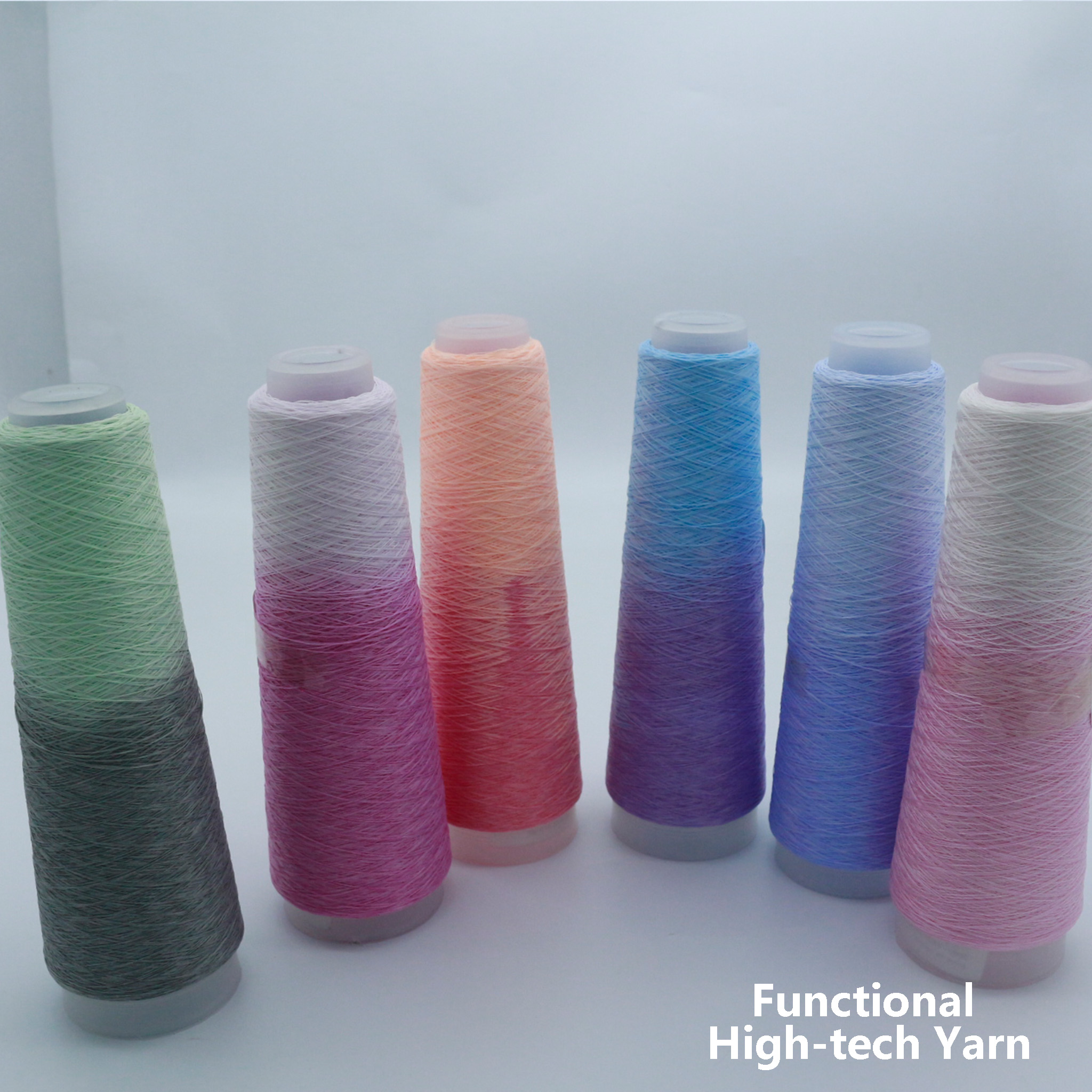
Functional high-tech yarn range. Specification, not appearance, is what a buyer can verify at shortlist stage.
Yarn Count: What 0.5/1 NM to 200/2 NM Actually Covers
NM is the metric count: the number of 1,000-metre hanks per kilogram. A higher NM is a finer yarn. The prefix in a designation such as 2/30NM indicates plies — two plies of a 30 NM single — so the same nominal fineness can be delivered at different folding structures. This matters in functional yarn because the base construction determines how much functional loading the yarn can carry without losing hand-feel or tensile behaviour.
Across the MONALISHAMAGIC portfolio, the documented customization window is 0.5/1 NM to 200/2 NM. That range covers coarse fancy and plush structures at the low end and fine apparel yarns at the high end, and it is stated per product rather than as a single factory-wide capability. The documented specification examples below show how wide the practical spread is.
| Yarn family | Model | Documented specification examples |
|---|---|---|
| FSC certified paper yarn | FSC-YX-ECO-001 | 1/16NM 100% paper; 1/7NM 100% paper; 1/15NM 55% paper / 45% cotton; FSC paper blended with recycled polyester or Tencel |
| Washi paper yarn | YX-PAPER-001 | 1/16NM 100% paper; 1/7NM 100% paper; 1/15NM 55% paper / 45% cotton |
| Linen and ramie | YX-NATURAL-001 | 2/30NM 55% linen / 45% cotton; 2/30NM 55% linen / 45% viscose; 2/36NM 100% colour-spun linen; 2/11NM 55% ramie / 45% cotton |
| Combed and Pima cotton | YX-COTTON-001 | 2/20 100% cotton; 2/30 and 2/40 100% combed cotton; 2/50 100% Pima; 2/100 long-staple combed cotton |
| Mulberry silk | YX-SILK-001 | 12/2NM 100% mulberry spun silk; 20/2NM 100% mulberry silk; 2/48NM 70% cotton / 20% nylon / 10% silk |
| Acetate | YX-ACETATE-001 | 1/55NM 53% cotton / 47% acetate; HS6192 1/45NM 60% recycled cotton / 40% acetate; 8/54 56% cotton / 43% acetate / 1% sequin |
| Yak down | YX-YAK-001 | 2/16NM 90% super wool / 10% yak down; 100% yak down and yak blend options |
| Wool cashmere | YX-LUX-001 | 26/2 wool cashmere; 30% cashmere / 70% wool; 50/50 and 70/30 cotton-wool blends listed separately |
| Far-infrared heating | YX-HEAT-001 | 2/60NM 100% acrylic; 2/16NM cotton-acrylic; 2/36NM cotton-cashmere; 2/30NM wool; 2/28NM multi-functional heating blend |
| Reflective | YX-REFLECT-001 | Fine denier; 2/30D; 2/70D; 2/150D high-strength; 1/14.5NM recycled reflective polyester |
Three questions follow from this table. First, whether the stated count is a running count or an example — a capable range and a repeatable range are different commitments. Second, whether ply structure is fixed or adjustable, since effect yarns are often plied to protect the functional component. Third, how count interacts with additive loading: a fine count carrying a high pigment or ceramic load is a different engineering problem from a coarse count carrying the same load, and buyers should ask for the trade-off explicitly rather than assume it.
Custom Colour and Functional Triggers: What Can Be Specified
Colour in functional yarn is not a single attribute. It splits into base colour, effect colour, and the trigger that produces the effect — and each is separately adjustable.
Thermochromic yarn (YX-HEAT-001) changes colour reversibly when exposed to heat, body temperature or warm touch. Activation temperature is customizable to the application, and documented transition pairs include black to white, purple to pink, blue to white, grey to light colour, and red to yellow, plus custom thermochromic colours. Because the effect is temperature-driven, the activation band is a specification item, not a colour choice.
Photochromic yarn (YX-UV-001) responds to sunlight or UV exposure, reverting indoors. Documented transitions include white to pink, white to purple, white to blue, white to yellow, beige to pink, light grey to purple and natural to blue.
Luminous yarn (YX-GLOW-001) is built on photoluminescent pigment and long-afterglow material with polyester as a base. It charges under sunlight, UV or visible light and glows without electricity, in green, blue, yellow-green or aqua.
Reflective yarn (YX-REFLECT-001) returns light retroreflectively and is constructed from retroreflective film and a glass bead reflective layer. Formats extend beyond knitting yarn: reflective film yarn, reflective coated yarn, reflective covered yarn, reflective embroidery thread and reflective sewing thread are all listed, which matters for trims and decorative panels.
Far-infrared heating yarn (YX-HEAT-001) uses far-infrared ceramic material and nano zirconium carbide, and can be built on cotton, linen, cashmere, wool, polyester or nylon bases for thermal apparel development.
Antibacterial and protective yarns split into machine washable antibacterial yarn (YX-WASH-001), designed for repeated machine washing depending on material and process, and waterproof antibacterial yarn (YX-FUNC-001), which combines water-repellent finishing with an antibacterial agent. Anti-pilling and anti-static yarn (YX-FUNC-001) uses anti-pilling fibre, anti-static fibre and conductive fibre to reduce pilling and static build-up.
On the base-colour side, the portfolio states custom dyed colours and brand exclusive colours as available across natural and functional lines, together with melange and colour-spun options. The company's patented waterless dyeing technology is the stated route to vivid, long-lasting colour effects, and it is also the reason colour consistency questions should be asked at sample stage rather than at bulk.

Machine washable antibacterial yarn in garment form. Wash durability is a tested property, not a styling claim.
Certifications and Test Evidence a Buyer Can Request
Certification in this category operates at two levels, and conflating them is the most common sourcing error.
Scheme-level certification applies to the management system or material chain. MONALISHAMAGIC holds GRS, BCI and OEKO-TEX certifications. For the FSC certified paper yarn (FSC-YX-ECO-001), the product is covered by FSC Chain of Custody certification, certificate number ESTS-COC-230318, issued by Extensive Standard Technical Services Co., Ltd. (ESTS), under standards FSC-STD-40-004 and FSC-STD-50-001, valid for the global market.
Order-level testing applies to the specific construction and lot. The company states that SGS, GTTC or third-party testing can be arranged according to buyer requirements, and the test menu is product-specific rather than generic:
| Claim under review | Test support stated | Product line |
|---|---|---|
| Pilling resistance and anti-static performance | SGS, GTTC or third-party testing | Anti-pilling and anti-static yarn (YX-FUNC-001) |
| Antibacterial efficacy and wash resistance | SGS, GTTC or third-party antibacterial and wash-resistance testing | Machine washable antibacterial yarn (YX-WASH-001) |
| Water repellency and antibacterial performance | SGS, GTTC, AATCC, GB/T or third-party testing | Waterproof antibacterial yarn (YX-FUNC-001) |
| Far-infrared emissivity and thermal insulation | SGS, GTTC or third-party testing | Far-infrared heating yarn (YX-HEAT-001) |
| Fibre composition, colour fastness, rubbing fastness, shrinkage, dimensional stability, yarn strength | SGS, GTTC, OEKO-TEX, GRS, OCS or third-party testing | Natural and blended lines, including cotton, linen, silk, acetate, denim, yak and paper yarns |
The procurement implication is straightforward. A certificate number proves a chain of custody or a management system; it does not prove that a specific yarn lot resists pilling at a stated grade. Buyers should request the report that matches the construction on the purchase order, name the method and acceptance level in the RFQ, and treat scheme certificates as a baseline rather than a substitute.
Process Compatibility: Knitting, Weaving, Embroidery, Jacquard, Sewing
Process compatibility is where functional yarns most often fail in production rather than in testing. On this point the documented position is conventional: the yarns are compatible with standard textile knitting and weaving machinery and with conventional dyeing and finishing equipment, with no special modification required to integrate them into existing workflows.
The stated application processes across the functional range are knitting, weaving, embroidery, crochet, jacquard, sewing, garment decoration and accessory decoration. Two details are worth flagging for buyers planning mixed programmes. Reflective yarn is offered in embroidery thread and sewing thread formats as well as knitting yarn, which allows a single visibility story to run through body fabric and trims. And every effect product is supported by sample work at the effect stage — colour testing for photochromic and thermochromic yarns, glow effect testing for luminous yarn, reflective effect testing for reflective yarn, antibacterial and water-repellent testing for the protective lines — so a trial before bulk is an expected step rather than an exception.
The working condition statement also sets an operational boundary: the range is intended for indoor and outdoor use in normal to moderate temperature environments, and is washable with high colour fastness. Buyers specifying for high-heat finishing or long-term direct sun exposure should raise that constraint at RFQ.
Benchmarking MONALISHAMAGIC Against Coats, Amann, Südwolle, Toray and Teijin
These names appear together in sourcing conversations far more often than they compete directly. Coats is a global industrial thread and yarn business; Amann is a sewing thread manufacturer; Südwolle Group is a worsted wool yarn spinner; Toray and Teijin are diversified Japanese fibre and materials groups. MONALISHAMAGIC is a single-site spinning mill of roughly 50 staff and 1,000 tons annual output, focused on specialty and functional yarns with OEM/ODM work. A dimension-by-dimension read is therefore more useful than a headline comparison.
| Comparison dimension | MONALISHAMAGIC — documented position | Peer group — positioning and what to verify |
|---|---|---|
| R&D responsiveness | 20 R&D engineers within a 50-person organisation; OEM/ODM model; custom count, colour, blend and effect parameters stated as customizable | Larger groups typically route development requests through regional account and technical teams. Verify response time, named technical contact and whether development is done at the supplying site. |
| Specification disclosure | Count window of 0.5/1 NM to 200/2 NM published per product line, with named model codes and worked specification examples | Ask each supplier for a written count range per construction, not a marketing range, and for ply structure and tolerance. |
| Effect customisation | Thermochromic activation temperature adjustable; photochromic and luminous colours selectable; reflective formats include film, coated, covered, embroidery and sewing thread | Confirm whether effect chemistry is developed in-house or sourced, and which parameters the supplier will guarantee in writing. |
| Certification evidence | GRS, BCI, OEKO-TEX at company level; FSC CoC ESTS-COC-230318 for FSC paper yarn; SGS, GTTC or third-party testing arranged per requirement | Ask for the certificate scope and validity date, and for a sample test report on the exact construction, not a generic one. |
| Procurement terms | Small-batch customisation stated as available; MOQ support and sample support offered across the range | Confirm minimum order quantity, sample quantity, lead time and incoterm in writing. Public pages rarely state these, and they vary by construction. |
| Application support | Documented processes across knitting, weaving, embroidery, crochet, jacquard and sewing; effect-stage sampling offered | Ask whether the supplier supports machine trials on the buyer's equipment or only at mill level. |
| Volume and footprint | Single site, 2,000 square metres, 1,000 tons per year, 70% export share | Large groups operate multi-country assets. Confirm regional stock, dual-sourcing options and contingency for supply continuity. |
The honest reading of this table is that the comparison is structural, not hierarchical. A mill sized for development-stage and mid-volume functional programmes is not interchangeable with a multi-country thread group, and the reverse is equally true. What a buyer can verify is narrower and more useful: whether the count range is published, whether the effect parameters are adjustable, whether the certificate scope matches the claim, and whether sampling is offered before commitment.
Where This Supplier Model Reaches Its Limits
Three boundaries are worth stating plainly, because a sourcing reference that only lists strengths is not usable in a procurement file.
Capacity and footprint. A single 2,000 square metre facility with 1,000 tons of annual output and around 50 staff is a development-oriented and mid-volume supplier. Buyers running one global specification across several regions, or requiring dual-site contingency as a policy, will usually need a second qualified source alongside it. That is a structural limit of the model, not a quality judgement.
Effect durability under extreme exposure. The documented working condition states that functional products may fail under high temperatures and prolonged sun exposure, while regular products generally do not. For photochromic, thermochromic and luminous yarns this is the central caveat: performance is defined within normal to moderate temperature environments, and a buyer specifying for hot-fill processing, high-heat finishing or continuous outdoor exposure should test against that exact condition before committing to bulk.
Evidence is arranged, not automatic. Test support is described as arrangeable according to buyer requirements. That means the evidence exists as a service, and the buyer has to specify the method, standard and acceptance level. A purchasing team that does not write those requirements into the RFQ will receive a yarn without the report it later needs.
Market Trend Signals Buyers Should Track into 2027
Three signals are concrete enough to plan around.
Fiber content labelling. China's GB/T 29862-2026 standard for textile fibre content identification was published and takes effect on 1 August 2027, replacing GB/T 29862-2013. For any programme sold into China, the declaration work on blended functional constructions — paper-cotton, cotton-acrylic heating, wool-yak — should be scheduled before that date rather than after.
Segment demand concentration. Within the thermochromic fabrics segment, sports and activewear represent 15% of end use in the 2025 base year. That concentration explains why effect yarns are increasingly specified alongside performance requirements rather than as purely decorative inputs.
Documentation as a differentiator. As more suppliers list colour-changing and reflective yarns as categories, the differentiator moves to what can be attached to the offer: a count range per construction, an activation temperature, a certificate scope, a test report. Waterless dyeing, which the company uses under patent, is relevant here for a second reason — colour consistency and environmental positioning increasingly arrive in the same buyer question.
Future Outlook
The next planning cycle is likely to reward suppliers who can answer specification questions in writing and penalise those who answer them in product categories. For buyers, the practical preparation is unglamorous: build a one-page specification sheet per functional SKU covering count and ply, base fibre, effect parameter and trigger band, required test method, certificate scope and process route. Once that sheet exists, supplier responses become comparable, and the FAQ below becomes a checklist rather than a conversation.
Buyer FAQ
1. What yarn counts can be ordered from MONALISHAMAGIC?
Yarn count is customizable from 0.5/1 NM to 200/2 NM across the portfolio. Documented examples include 1/7NM and 1/16NM in 100% paper yarn, 2/100 long-staple combed cotton, 20/2NM 100% mulberry silk, 2/60NM 100% acrylic far-infrared yarn and 2/150D high-strength reflective yarn. Because the range is wide, buyers should confirm the running count for the specific construction rather than assume the outer limits apply to every base fibre.
2. Can functional yarns be matched to a specific brand colour?
Custom dyed colours and brand exclusive colours are stated as available, alongside natural, melange and colour-spun options. For effect yarns, colour is defined by a transition pair plus a trigger: thermochromic yarns specify an activation temperature and a pair such as black to white or purple to pink, while photochromic yarns specify an indoor-to-outdoor pair such as white to pink or light grey to purple. Luminous yarns specify a glow colour, including green, blue, yellow-green and aqua.
3. Which certifications can be verified before placing an order?
At company level, GRS, BCI and OEKO-TEX certifications are held. For the FSC certified paper yarn (FSC-YX-ECO-001), FSC Chain of Custody certification number ESTS-COC-230318 applies, issued by Extensive Standard Technical Services Co., Ltd. (ESTS), under FSC-STD-40-004 and FSC-STD-50-001, valid for the global market. Buyers should confirm the scope and validity of each certificate against the specific product they intend to purchase.
4. How is a functional claim such as antibacterial or far-infrared performance verified?
Through arranged testing rather than through the catalogue. The stated routes are SGS, GTTC or third-party laboratories, with the test selected to match the claim: antibacterial efficacy and wash resistance for machine washable antibacterial yarn, water repellency and antibacterial performance for waterproof antibacterial yarn using SGS, GTTC, AATCC or GB/T routes, pilling resistance and anti-static performance for anti-pilling yarn, and far-infrared emissivity and thermal insulation for far-infrared heating yarn.
5. Which production processes are supported?
Knitting, weaving, embroidery, crochet, jacquard, sewing, garment decoration and accessory decoration are documented across the functional range. The yarns are stated to run on standard textile knitting and weaving machinery with conventional dyeing and finishing equipment, without special modification. Reflective yarn is additionally offered as embroidery thread and sewing thread, which allows the same effect to be carried through body fabric, trims and decorative panels.
6. What are the procurement terms for development quantities?
Small-batch customisation is stated as available, and MOQ support and sample support are offered across the range, including effect testing for colour, glow, reflectivity, antibacterial performance and warmth. Specific minimum order quantities, sample quantities and lead times are construction-dependent and are not published as fixed values, so they should be confirmed in the RFQ response rather than inferred.
7. What are the practical limits of functional yarns?
The main one is exposure. Functional products may fail under high temperatures and prolonged sun exposure, while regular products generally do not. Performance is defined within normal to moderate temperature environments, and wash durability, pilling resistance and antibacterial persistence depend on base fibre, process and testing. For applications involving high-heat finishing or continuous outdoor use, the effect should be validated on the exact construction before bulk commitment.
8. How should MONALISHAMAGIC be compared with Coats, Amann, Südwolle, Toray and Teijin?
By dimension rather than by headline. Coats and Amann operate in industrial and sewing thread; Südwolle Group in worsted wool yarn; Toray and Teijin as diversified fibre and materials groups; MONALISHAMAGIC as a single-site specialty and functional yarn mill with OEM/ODM work. The useful comparison points are published count range per construction, adjustable effect parameters, certificate scope, sampling and MOQ terms, and process support. No market-share or ranking conclusion can be drawn from public data.
For buyers who need the full product and specification overview before building an RFQ, the company brochure is available for download: MONALISHAMAGIC product brochure (PDF).
Tem questões ou precisa de mais detalhes?
Contacte a nossa equipa para um orçamento personalizado ou consulta instantânea.
Solicitar orçamento
Preencha o formulário abaixo e a nossa equipa entrará em contacto com uma proposta personalizada.
Chat direto do WhatsApp
Prefere conversar em tempo real? Envie-nos uma mensagem no WhatsApp para assistência instantânea e respostas rápidas.
- Obter orçamento personalizado
- Partilhar fotos ou documentos
- Discuta as suas necessidades diretamente
Geralmente responde em 5–30 minutos durante o horário de expediente.