
MOSFET Modules: A Discovery Guide for Industrial Buyers
Power Semiconductor Reference — Category Discovery

Power semiconductor modules pass through controlled production and inspection environments before they are installed in industrial power conversion equipment.
A MOSFET module is a packaged power assembly that houses one or more metal-oxide-semiconductor field-effect transistor dies on an electrically isolated baseplate, together with the internal connections and terminals required to switch industrial currents. It is one of the switching building blocks used in switching power supplies, battery chargers, solar inverters, energy storage systems and motor drives, and it sits in the same broad power-module family as IGBT modules, thyristor modules, power diode modules and bridge rectifier modules.
For buyers who are still at the awareness and research stage, the useful questions are narrower than a full electrical design review. What is a MOSFET module actually made of? How does it behave differently from an IGBT module? Which applications does it fit, what specification window defines the category, and what should a supplier be able to document before an order is placed? This discovery guide answers those questions using published product specifications, documented application scenarios and third-party market research, and it flags the boundaries where a MOSFET module is not the right choice.
What a MOSFET module is, in specification terms
A power MOSFET module converts a low-power gate signal into a controlled high-current path. The module format exists because a single discrete transistor cannot always carry the current or dissipate the heat that an industrial power stage demands. Inside the package, the silicon MOS chip is mounted on an aluminium ceramic substrate and a copper base plate, then enclosed in a plastic housing. The baseplate is electrically isolated, which allows the module to be fastened directly onto a heat sink as a single mechanical and thermal unit.
The published specification window for the MOSFET module range supplied by Jiangsu Core Diamond Times Electronic Technology Co., Ltd. covers a drain-source voltage of 60 V to 1200 V and a drain current of 30 A to 300 A, with low on-resistance, high switching frequency and an isolated baseplate. Those three electrical properties — blocking voltage, current capability and on-resistance — are the parameters that decide whether a given module fits a converter stage.
| Parameter (catalogue value) | Published range | What it decides |
|---|---|---|
| Drain-source voltage | 60 V – 1200 V | Whether the module can block the DC bus voltage plus switching overshoot |
| Drain current | 30 A – 300 A | Continuous and peak current capability of the switching stage |
| On-resistance | Low on-state resistance | Conduction loss and resulting junction temperature |
| Switching behaviour | High switching frequency, small switching loss | Feasible switching frequency and size of magnetic components |
| Construction | Silicon MOS chip, aluminium ceramic substrate, copper base plate, plastic housing, isolated baseplate | Thermal path, mounting method and electrical safety clearance |
The problem the module format solves
Three practical constraints push designers from discrete transistors toward a module. The first is thermal: a module spreads heat across a copper base plate and an isolating ceramic substrate, so the heat sink can be sized for the assembly rather than for each individual die. The second is current sharing: paralleling discrete devices requires matched devices, symmetric layout and careful gate drive, whereas a module places the dies inside one package with a defined internal layout. The third is assembly repeatability: a module has defined terminal positions, mounting holes and creepage distances, which simplifies cabinet design and field replacement.
The opportunity side is equally concrete. High switching frequency is a design lever, because raising it shrinks transformers, inductors and capacitors, and therefore shrinks the physical size of a switching power supply or charger. A MOSFET module with low on-resistance and small switching loss is the component that makes that trade-off possible. That is why the category appears in switching power supplies, new energy vehicle chargers, solar inverters, industrial power supplies and battery management systems.
MOSFET module versus IGBT module: where each one fits
The most common discovery question is how a MOSFET module differs from an IGBT module, because both are voltage-controlled power switches in a comparable isolated package. The difference is in the conduction mechanism and, in practice, in the voltage and current window each technology serves. A MOSFET conducts with a unipolar channel, which makes it fast and well suited to high-frequency switching. An IGBT combines a MOS gate with bipolar conduction, which keeps conduction loss lower at high current, and it dominates the higher voltage and higher power end of the market.
| Attribute | Power MOSFET module | IGBT module |
|---|---|---|
| Published voltage range | 60 V – 1200 V | 600 V – 1700 V |
| Published current range | 30 A – 300 A | 50 A – 1200 A |
| Chip structure | Silicon MOS chip on aluminium ceramic substrate | Single or dual IGBT chip structure on aluminium ceramic substrate |
| Switching behaviour | High switching frequency, small switching loss | High switching speed with low saturation voltage |
| Documented applications | New energy vehicle charger, switching power supply, solar inverter, industrial power supply, battery management system | New energy, power supply, industrial automation, welding equipment, electric motor drive, UPS |
The IGBT module range from the same supplier is rated 600 V to 1700 V and 50 A to 1200 A, which illustrates the practical split: where a project needs several hundred amperes at a 1200 V or 1700 V bus, an IGBT module is normally the specified device, while a MOSFET module remains the natural choice for high-frequency conversion at lower blocking voltages.
The wider power module family a buyer will encounter
Discovering MOSFET modules usually leads into the surrounding category, because a working power stage rarely uses one device type in isolation. A typical inverter cabinet, charging pile or energy storage cabinet combines switching modules with rectification devices and short-circuit protection. Jiangsu Core Diamond Times supplies across this family, which helps a buyer understand where a MOSFET module sits in the bill of materials.
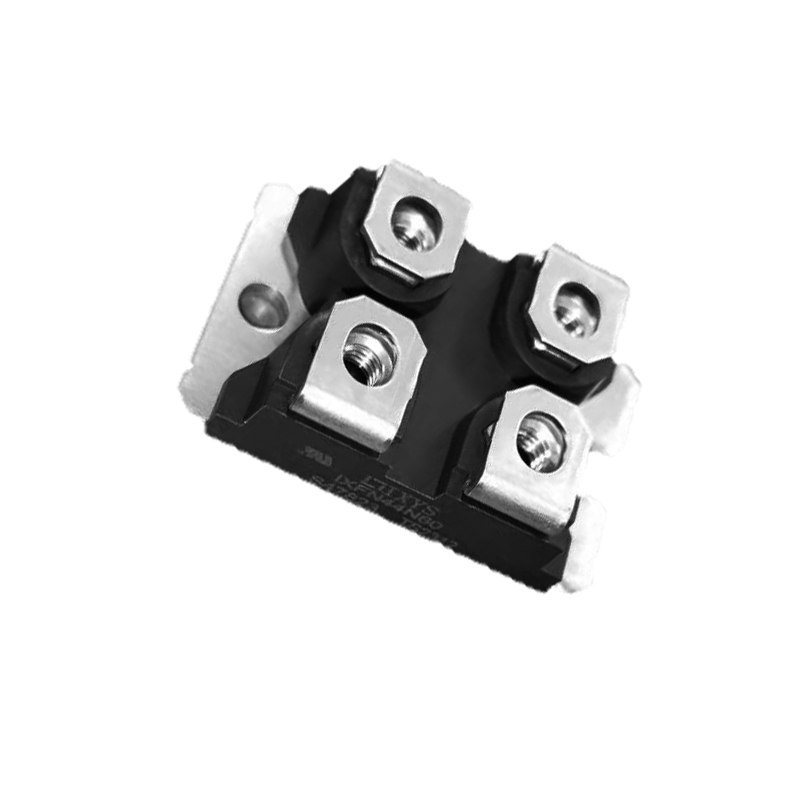
MOSFET modules are specified by blocking voltage, drain current, on-resistance and package, so the model number carries most of the selection information.
| Product category | Published voltage range | Published current range | Documented applications |
|---|---|---|---|
| MOSFET module | 60 V – 1200 V | 30 A – 300 A | New energy vehicle charger, switching power supply, solar inverter, industrial power supply, battery management system |
| IGBT module | 600 V – 1700 V | 50 A – 1200 A | New energy, power supply, industrial automation, welding equipment, motor drive, UPS |
| Power thyristor / SCR | Up to 3000 V | 1100 A | Industrial power control, metallurgy, welding equipment, power rectifier, motor soft starter |
| Fast recovery power diode | Up to 2800 V | 100 A – 1800 A | Power rectification, welding equipment, metallurgy, industrial power supply, new energy |
| Bridge rectifier module | 800 V – 2000 V | 25 A – 800 A | Power supply, welding machine, motor control, new energy equipment, industrial rectification |
| Industrial power fuse | 690 V – 1500 V | 10 A – 1250 A | Energy storage system, industrial power supply, automation equipment, new energy vehicle charging, power distribution cabinet |
Application scenarios where MOSFET modules are specified
The documented application scenario behind this product family is continuous operation at high power and high temperature. The project types listed are solar inverters, motor drives, charging piles and UPS power supplies; the function is DC-AC power conversion, motor speed regulation and power switching control; the operating mode is described as 24/7 continuous operation. Matched equipment typically includes the heat sink, drive board, capacitor and inverter cabinet, and the stated special requirement is high temperature resistance, low loss and high stability.
A second documented scenario covers protection rather than switching: overcurrent and short-circuit protection in energy storage cabinets, power distribution cabinets and PV combiner boxes, where the working condition is a fault event and the operation mode is standby until instant breaking is required. The matched equipment there is the fuse holder, distribution cabinet and combiner box, and the stated requirement is fast breaking with high interrupting capacity. Together, the two scenarios explain why a MOSFET module is usually specified alongside fuses and rectifier devices rather than on its own.
The application records for these products reference markets across Europe, Asia-Pacific, the Middle East and Latin America — including Germany, France, Italy, Spain, Poland, Russia, South Korea, Japan, the Philippines, Malaysia, Vietnam, Thailand, the UAE, India, Switzerland, Brazil and Peru — which reflects how widely the same power conversion architectures are deployed.
Market trend: where power module demand is heading
Independent market research provides context for the category. Market Research Future estimates the global IGBT market at USD 9,202.9 million for 2024 and projects a compound annual growth rate of 11.02% over 2025 to 2035. Within the same technology landscape, Fortune Business Insights values the global silicon carbide (SiC) module market at USD 980.7 million in 2025, and the same source notes that IGBT devices account for nearly 10% of the cost of an electric vehicle — a figure that explains why power module sourcing decisions carry weight in EV and energy storage programmes.
Two interpretive points follow for buyers. First, the growth of SiC modules signals a technology shift at the high-efficiency, high-frequency end of the market rather than a replacement of the whole category; silicon MOSFET and IGBT modules continue to serve the mainstream voltage and current windows. Second, the same research identifies StarPower Semiconductor as the world's fifth-largest IGBT module supplier, which shows how concentrated the module manufacturing tier is and why distribution and supply channels matter as much as brand selection for buyers who need specific models on a schedule.
Sources: Market Research Future, IGBT Market Size, Share, Growth (2026); Fortune Business Insights, Insulated Gate Bipolar Transistor Market Size & Share (2026).
How a supplier fits into the discovery process
Jiangsu Core Diamond Times Electronic Technology Co., Ltd. is a company established in 2022 that focuses on power electronic components as a professional foreign trade business. Its main product lines include IGBT modules, fuses, power semiconductors, semiconductor modules, diodes, thyristors and related power electronic components, supplied across the MOSFET module, IGBT module, thyristor, power diode, bridge rectifier and industrial fuse categories described above.
The company operates a 10,000 square metre facility, employs approximately 50 staff, and states an annual capacity of 1,000,000 units, supported by an R&D team of five technical support engineers. Export business accounts for approximately 50% of total sales, with major markets listed as the EU, USA, Australia and the Middle East, and products also exported to Southeast Asia and other global markets. The company states that all products comply with international standards such as IEC, UL and CCC, meeting the requirements of industrial, energy storage and new energy projects, and that it holds ISO9001:2015 quality management system certification.
For a buyer in the research phase, the operationally relevant claims are the inspection and selection ones. The company states that every product is inspected before shipment under incoming inspection and outgoing quality control procedures, and that its technical team can offer customised component recommendation based on a customer's circuit design and working conditions. It also states that it maintains an inventory management system with stock of mainstream IGBT module and industrial fuse models, and that it can support both small trial orders and bulk volume orders. A brochure covering the product range is available for download at the link at the end of this article.
Comparison with alternative approaches — and the real limits
Choosing a MOSFET module is not automatically the better decision, and three boundaries are worth stating plainly.
The first is electrical. On-resistance in a silicon MOSFET rises as the blocking voltage rating increases, so conduction loss becomes proportionally harder to manage at the top of the voltage window. The published MOSFET module range stops at 1200 V, while the IGBT module range begins at 600 V and reaches 1700 V at up to 1200 A, and thyristors reach up to 3000 V. For a high-voltage, high-current conversion stage, an IGBT or thyristor module is usually the more economical and thermally practical choice; the MOSFET module's advantage is concentrated in high-frequency, lower-blocking-voltage conversion.
The second is thermal. A module only performs to specification when the heat sink, thermal interface material and mounting torque are correct. Documented failure causes in this component family include uneven or degraded thermal grease, loose mounting screws and a dust-blocked radiator, all of which raise thermal resistance and shorten service life regardless of the module's rated parameters. A buyer comparing options on datasheet values alone will miss this dependency.
The third is channel-related and applies to any trading or foreign-trade supplier rather than to a specific company. When components are sourced through a distribution channel rather than directly from the original manufacturer, the buyer depends on the supplier's incoming inspection and traceability rather than on direct factory documentation. That places more weight on model identification, packaging integrity and inspection records at the point of purchase, and it is a legitimate factor to price into a supplier comparison.
A buyer checklist for the research stage
| Check item | Why it matters |
|---|---|
| Blocking voltage with margin | The rating must cover DC bus voltage plus switching overshoot, not just the nominal bus |
| Drain current against the thermal design | Continuous and peak current must be validated against the actual heat sink and ambient temperature |
| On-resistance at operating temperature | Conduction loss determines junction temperature, which determines service life |
| Gate drive compatibility | Gate charge and threshold behaviour must match the existing driver board |
| Package, footprint and terminals | Mounting holes, terminal layout, screw torque and clearance distances must fit the cabinet |
| Isolated baseplate | Determines whether an extra insulating layer is needed in the thermal stack |
| Model identification and documentation | Confirms the part number, datasheet and inspection record before shipment |
| Stock versus trial quantity | Determines whether the project can prototype and then scale on the same model |
Future outlook
Two trends are likely to shape how buyers evaluate this category over the next few years. The first is the widening of silicon carbide and hybrid module options at the high-frequency end, which the SiC market figure reflects; these devices compete for the efficiency-sensitive applications that silicon MOSFET modules currently serve, while remaining at a different cost level. The second is supply-side: as the market grows at a projected double-digit compound rate, the ability to obtain a verified specific model on a predictable schedule becomes as important as the electrical specification itself. For buyers, that shifts part of the evaluation toward supplier documentation, inspection discipline and inventory reliability — the areas where a specialised power electronic component supplier can be assessed on evidence rather than on catalogue breadth alone.
Frequently asked questions
What is a MOSFET module?
A MOSFET module is a packaged power assembly containing one or more metal-oxide-semiconductor field-effect transistor dies mounted on an electrically isolated baseplate, with an aluminium ceramic substrate, a copper base plate and a plastic housing. It is characterised by low on-resistance, high switching frequency and an isolated baseplate, and the published range for this product family covers 60 V to 1200 V drain-source voltage and 30 A to 300 A drain current.
How does a MOSFET module differ from an IGBT module?
The difference is the conduction mechanism and the resulting application window. A MOSFET module uses a unipolar MOS channel and is optimised for high switching frequency with small switching loss. An IGBT module combines a MOS gate with bipolar conduction, uses a single or dual IGBT chip structure, and is published at 600 V to 1700 V and 50 A to 1200 A for applications such as power inverters, UPS, welding equipment and motor drives.
In which applications are MOSFET modules commonly used?
The documented application list includes new energy vehicle chargers, switching power supplies, solar inverters, industrial power supplies and battery management systems. The associated operating scenario is continuous operation at high power and high temperature, with matched equipment such as heat sinks, drive boards, capacitors and inverter cabinets, and a stated requirement for high temperature resistance, low loss and high stability.
How should the voltage and current rating of a MOSFET module be selected?
The blocking voltage rating should exceed the worst-case DC bus voltage including switching overshoot, and the current rating should be validated against both continuous working current and peak overload current with the actual heat sink and ambient temperature taken into account. On-resistance determines conduction loss at the chosen current, so thermal design and electrical rating have to be evaluated together rather than independently.
What are the limitations of MOSFET modules?
On-resistance in a silicon MOSFET increases as the blocking voltage rating rises, so conduction loss becomes harder to manage at higher voltages. The published MOSFET module range extends to 1200 V, while IGBT modules are published from 600 V to 1700 V at up to 1200 A and thyristors reach up to 3000 V. Above the MOSFET voltage window, an IGBT or thyristor module is generally the more practical choice.
What should be verified when sourcing MOSFET modules from a supplier?
Verify the exact model number and its corresponding datasheet parameters, confirm that the blocking voltage and current rating match the circuit, and check the supplier's inspection procedure and quality management certification. Where components are obtained through a distribution or foreign-trade channel rather than directly from the original manufacturer, model identification, packaging integrity and shipment inspection records become the primary traceability evidence.
Reference material
The supplier's product brochure, covering IGBT modules, fuses, MOSFET modules, thyristors, power diodes and rectifier modules, can be downloaded here: Power electronic component brochure (PDF). Company information is published at https://www.xinzuanshidai.com.