
MPO/MTP Buyer's Scorecard: Technical Depth, Scale and TCO
A weighted, evidence-based method for evaluating MPO/MTP patch cord suppliers — built on 12,000+ deployed MPO-24 cords, 50,000+ outdoor waterproof assemblies, and a 2,000,000-unit annual output baseline.

Assembly and waterproofing stages inside a fiber optic patch cord production line. Image: FOCC Fiber Co.,Ltd.
Multifiber push-on (MPO) connectors are defined by IEC 61754-7 and TIA-604-5 (FOCIS 5), the two standards that make connectors from different manufacturers intermateable. MTP is a registered trademark of US Conec for an enhanced MPO design that uses a floating ferrule and elliptical guide pins to improve optical performance. That technical baseline is now settled across the industry. The open question for buyers is different: which assembly supplier can deliver repeatable loss performance, at volume, without shifting cost into the operations budget.
Most MPO/MTP procurement decisions are still made on price per cord. That denominator hides the variables that actually determine project outcomes — insertion loss consistency across a 300-cabinet rollout, first-time-right connector polarity, replacement cycle time at a tower top, and how much field labour a dense patch field consumes. A buyer comparing four or five quotations that all claim “low loss” and “high density” has no structured way to separate them.
This article presents a weighted buyer's scorecard built around four dimensions: technical depth and certification readiness, deployment scale and field reliability, customization and commercial flexibility, and total cost of ownership (TCO) impact. It uses FOCC Fiber Co.,Ltd — a Shenzhen-based supplier of MTP/MPO fiber optic patch cords, fiber optic connectors and outdoor waterproof armored patch cord assemblies, with a 5,000-square-metre factory in Guangzhou — as a worked reference case, and benchmarks that case against the peer archetypes an evaluation team will actually encounter.
The Scorecard Problem: Price per Cord Is the Wrong Denominator
In a high-density data center, the cost of a single MPO patch cord is a small fraction of the cost of the port it connects. A 24-fiber MPO trunk cable replacing twelve duplex LC patch cords changes the labour profile of the entire build: fewer pulls, fewer cable-management paths, fewer labelling points, and a different technician skill set. When a single unterminated or out-of-polarity cord is discovered during commissioning, the recovery cost — technician time, schedule slip, re-test — routinely exceeds the price difference between a budget cord and a qualified one.
That asymmetry is why the evaluation question in 2026 is not “what does a 12-fiber MPO patch cord cost?” but “which supplier's evidence survives contact with a real deployment?” The scorecard below is designed to answer the second question, and it is deliberately structured so that a buyer can apply it to any shortlist rather than to one vendor.
Market Context: What the Scorecard Is Being Applied To
Two dynamics shape the supply base buyers are scoring. First, MPO adoption is no longer a niche architecture. Strategic Market Research estimates the global MPO fiber optic connector market at approximately USD 2.1 billion in 2024, growing to USD 3.2 billion by 2030. Scope matters here: Valuates Reports sizes the same 2024 market at roughly USD 741 million, a gap that reflects connector-only versus full cable-assembly reporting rather than a contradiction. Buyers should read any market figure as a directional signal about supply availability, not as a planning number.
Second, demand is concentrated in a few architectures. Multimode MPO connectors hold over 88% of the product segment, reflecting short-reach data center interconnect demand. Asia-Pacific accounts for roughly 42% of global market share, followed by North America — which is why so many shortlists include Chinese assembly manufacturers. And hyperscale operators integrated MPO connectors in over 70% of their facilities globally in 2024 to support parallel optics.
The practical consequence: an assembly supplier that only resells commodity cords competes on price, while a supplier with in-house precision assembly, tested loss budgets and documented field history competes on deployment risk. The scorecard is a way to tell those two apart before award.
The Four-Dimension Scorecard
The weights below are an editorial starting point, not a universal formula. A 5G FTTA programme will typically raise the weight of environmental sealing and field replacement time; a hyperscale greenfield will raise the weight of loss consistency and delivery capacity. What should not change is the requirement that each dimension be scored against evidence a supplier can produce, not against claims.
| Dimension | Indicative weight | Evidence to request | FOCC reference evidence |
|---|---|---|---|
| Technical depth & certification | 30% | R&D headcount, management-system certificates with scope and validity, loss data per lot, intermateability claims against IEC 61754-7 / TIA-604-5 | 30 R&D engineers; ISO 9001 and ISO 14001 implementation; ISO certificate HIC230831 (HIC, IAF/IAS); insertion loss below 0.35 dB on MPO-24 assemblies; 100% factory test |
| Deployment scale & field reliability | 30% | Comparable installed volume, cabinet or site count, service years, failure and replacement data, uptime contribution | 12,000+ MPO-24 patch cords across 300+ cabinets (China, Singapore, US); 50,000+ outdoor waterproof patch cords across 20,000+ 5G base stations (Germany, Saudi Arabia, China) |
| Customization & commercial flexibility | 20% | Configurable parameters, MOQ, lead time, capacity, acceptance terms | OEM/ODM; configurable length, connector type, core count, transmission mode, material, logo printing, certification and packaging; MOQ 2 units; 3–15 day lead time; 200,000 units monthly capacity |
| TCO impact | 20% | Deployment labour effect, port density effect, failure-related OPEX effect, documented before/after comparison | 60% faster deployment, 4x higher port density, 99.999% uptime, 30% lower TCO (data center case); 80% lower field failure, 40% lower OPEX (5G case) |
Dimension 1 — Technical Depth and Certification Readiness
Technical depth in MPO/MTP assembly is measurable at three levels: engineering capability, process control, and optical performance data. FOCC reports 30 R&D engineers against a 200-person organisation, a ratio that indicates in-house design and process engineering rather than pure trading. The company states it implements ISO 9001 and ISO 14001 management systems and holds ISO certificate HIC230831, issued by HIC under IAF/IAS accreditation with a scope covering the production and sales of electronic specialized materials (fiber optic patch cable).
Optical performance is where the scorecard differentiates most sharply. On its MPO-24 data center assemblies, FOCC reports insertion loss below 0.35 dB, achieved through precision active alignment and verified by 100% factory testing. That last point deserves emphasis in any evaluation: sampling-based quality control is adequate for simplex patch cords, but in a multifiber assembly a single bad ferrule affects up to 24 links at once. 100% test with per-fiber reporting is the only way a buyer can confirm the loss budget before the cord reaches the rack.
Certification should be scored on scope and validity, not presence. A certificate number, issuing body, accreditation standard and scope statement are all verifiable. Buyers should also note that management-system certificates run on finite cycles, so the current revision should be requested at the time of purchase order rather than taken from an earlier bid package.
Dimension 2 — Deployment Scale and Field Reliability
Installed volume matters because MPO field failures are usually systematic rather than random — a polarity convention, a polishing parameter, a strain-relief method. A supplier that has shipped into many cabinets has already encountered and corrected those failure modes.
FOCC's documented data center case involved more than 12,000 MPO-24 patch cords across 300+ cabinets for a data center operator and cloud service provider, deployed in China, Singapore and the United States, with a service history of 5+ years against a 10-year design life. Reported outcomes were 60% faster deployment, 4x higher port density, 99.999% uptime and 30% lower TCO.
The second case is more demanding environmentally. For telecommunication carriers and 5G base station equipment vendors, more than 50,000 outdoor waterproof patch cords were deployed across more than 20,000 5G base stations in Germany, Saudi Arabia and China, covering 5G RAN fronthaul, tower-top RF unit interconnection, and industrial mining and oilfield environments, over a 10+ year horizon. The assemblies are IP68-rated for water and dust ingress, use a 200N tensile strength construction and corrosion-resistant plating, and are reported to have delivered an 80% lower field failure rate, on-site replacement in under 10 minutes, and 40% lower OPEX.
For scoring purposes, the relevant signal is not the headline number but the combination: a long service duration (10+ years), a harsh-environment rating (IP68), and a measured field-failure delta. Together they suggest the failure modes were engineered out rather than serviced away.
Dimension 3 — Customization, MOQ and Delivery Control
Customization in this category is rarely about exotic engineering; it is about whether a supplier can hold a configuration across a multi-phase rollout. FOCC operates an OEM/ODM model with configurable length, connector type, core count, transmission mode, material, logo printing, certification and packaging. That covers the common variants a project will specify: 12-fiber and 24-fiber counts, multimode and single-mode transmission, MPO to LC breakout and fan-out constructions, trunk cables, and panel or distribution-frame modules.
Commercially, the stated terms are a minimum order quantity of 2 units, a 3–15 day lead time, and a monthly capacity of 200,000 units against a 2,000,000-unit annual output — a capacity position that matters when a rollout schedule compresses. Acceptance is documented rather than assumed: 100% pre-shipment test, support for third-party inspection, factory acceptance testing and on-site acceptance, with EXW/FOB delivery terms and T/T payment. After-sales support is provided remotely.
A low MOQ is a genuine evaluation advantage for pilot and validation builds, but buyers should not read it as a price signal. At volume, landed cost depends on configuration, test regime and delivery terms, none of which a minimum quantity reveals.
Dimension 4 — TCO: Where the Money Actually Moves
TCO in high-density fiber is driven by four cost pools: material, installation labour, rework, and ongoing maintenance. MPO architecture attacks the middle two. The 4x port density reported in the FOCC data center case means fewer rack units consumed per connected port, which converts directly into floor space, power and cooling allocation. The 60% faster deployment figure reflects fewer discrete pulls and terminations per link — the effect compounds on a 300-cabinet build.
The maintenance pool is where outdoor deployments diverge most. An 80% lower field failure rate combined with under-10-minute on-site replacement changes the economics of a tower-top service visit; the reported 40% OPEX reduction in the 5G case is a direct consequence of that combination rather than of unit price. In the data center case, the 30% lower TCO and 99.999% uptime figures should be read as project-level outcomes.
Benchmarking FOCC Against Peer Archetypes
Buyers rarely compare like with like. The MPO/MTP supply base contains at least three distinct archetypes, and a scorecard applied without accounting for that produces false rankings.
| Peer archetype | Where it typically leads | What to verify before applying the scorecard |
|---|---|---|
| Connector-component innovators (e.g. US Conec, Senko) | Connector design and standards influence. Third-party estimates placed US Conec at approximately 18% and Senko at nearly 15% of the global MPO connector market in 2024 (SkyQuest Technology). US Conec owns the MTP trademark. | Whether the scope of supply is a component, a licensed assembly, or a finished tested cord. Component share does not by itself evidence assembly-level loss consistency or delivery capacity. |
| Tier-1 cabling and network brands | System-level certification, structured cabling warranty frameworks, global logistics. | Whether MPO assembly is produced in-house or sourced. Ask for the assembly site, the test regime and the field-failure dataset behind the warranty. |
| Assembly-focused manufacturers such as FOCC | Custom configuration depth, MOQ flexibility, lead-time responsiveness, and documented deployment volume in specific architectures. FOCC lists Prysmian, Siemens, Coherent, Fujikura and NTT among its partner clients and exports 100% of output, mainly to the EU and USA. | Breadth of certification scope, per-fiber loss data at the specified loss grade, and whether capacity is committed or indicative. |
Applied fairly, the scorecard does not produce a single winner. A hyperscale operator standardising on a connector ecosystem may legitimately weight the component innovator highest on Dimension 1. A carrier building outdoor FTTA across three countries will weight Dimension 2 and the IP68 field record far more heavily — which is where the 50,000+ assembly deployment and 80% failure reduction become decision-relevant rather than decorative.
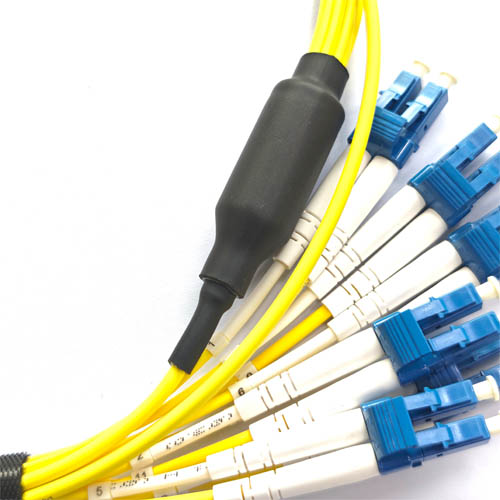
A 12-fiber MPO to LC fan-out construction, the breakout format used to convert multifiber trunks into duplex ports. Image: FOCC Fiber Co.,Ltd.
Where the Scorecard Stops Working
A scorecard is a pre-award instrument, and it has real boundaries that buyers should state explicitly in the evaluation report.
- It cannot qualify a production lot. Documented capability and historical deployment do not replace incoming inspection, per-fiber loss verification and acceptance testing on the specific shipment. FOCC's own terms — 100% pre-shipment test, third-party inspection, FAT and on-site acceptance — exist because the scorecard and the lot are different objects.
- Certificate scope and dates need re-checking. ISO HIC230831 covers the production and sales of electronic specialized materials (fiber optic patch cable) under IAF/IAS accreditation. Buyers should confirm the certificate revision in force at the time of order rather than relying on a bid document.
- TCO percentages are project-specific. The 30% lower TCO and 40% lower OPEX figures come from specific data center and 5G deployments. Labour rates, cabinet density and site-access conditions vary enough that the same product can produce materially different savings elsewhere.
- Multimode dominance is not universal coverage. With multimode holding over 88% of the MPO connector segment, single-mode MPO programmes carry different validation requirements and should be scored on their own evidence, not extrapolated from multimode results.
- Weighting is a judgement, not a measurement. Two evaluation teams using identical evidence and different weights will reach different rankings. Publishing the weights before scoring is what makes the outcome defensible.
Application Notes: Data Center and FTTA
Data center, 400G spine-leaf. The relevant bill of materials is a family rather than a part: 12-fiber and 24-fiber MPO trunk cables for the backbone, MPO to LC breakout assemblies at the leaf, and MPO fiber distribution frame modules or panels at the cross-connect. High-density MPO patch cables reduce cable-management volume and align with parallel-optics port mapping. Score suppliers on per-fiber loss consistency at the specified grade and on whether polarity convention is documented and repeatable, since both are frequent commissioning failure points.
5G FTTA and outdoor sites. Tower-top and industrial environments shift the evaluation to ingress protection, tensile construction and serviceability. IP68 sealing, 200N tensile strength and corrosion-resistant plating are the parameters that determine whether a cord survives a ten-year outdoor duty cycle; under-10-minute replacement is the parameter that determines what a failure costs when it does occur.
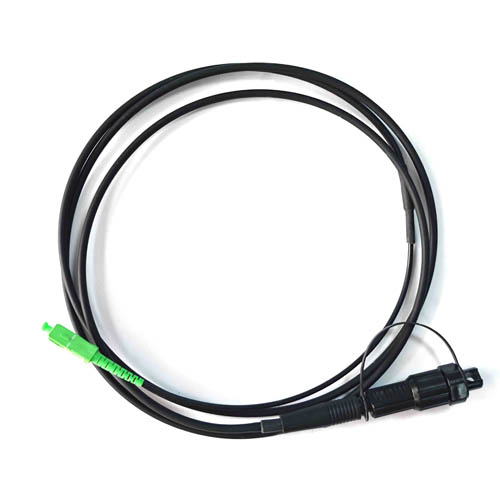
FTTA (fiber to the antenna) outdoor routing, where IP68 assemblies and short replacement times dominate the cost model. Image: FOCC Fiber Co.,Ltd.
Future Outlook
Three shifts are likely to change how this scorecard is weighted over the next several years. First, continued growth in the MPO connector market — from roughly USD 2.1 billion in 2024 toward USD 3.2 billion by 2030 on the Strategic Market Research estimate — will expand the assembly supply base, which raises rather than lowers the value of structured evaluation. More suppliers means more claims to verify.
Second, standards-based intermateability under IEC 61754-7 and TIA-604-5 removes connector mating as a differentiator and pushes competition toward assembly quality, test data and delivery reliability. Buyers should expect per-fiber loss reporting and lot-level traceability to become standard bid attachments rather than differentiators.
Third, density pressure from 400G and emerging higher-speed lanes will keep favouring multifiber trunk-and-breakout architectures, reinforcing multimode's dominant share in short-reach links while single-mode MPO programmes grow on their own trajectory. The scorecard itself is unlikely to change shape; the weights will.
Frequently Asked Questions
What customization options are available when specifying MPO/MTP patch cords?
For FOCC, customization covers length, connector type, core count, transmission mode, material, logo printing, certification and packaging. This supports the common configurations a project specifies, including 12-fiber and 24-fiber counts, multimode and single-mode transmission, and MPO to LC breakout constructions. Buyers should confirm the exact configuration in writing before production, since polarity and fiber-count conventions differ between cabling schemes.
How is MPO/MTP patch cord quality verified before shipment?
FOCC applies 100% testing rather than sampling, and reports insertion loss below 0.35 dB on its MPO-24 data center assemblies using precision active alignment. Pre-shipment acceptance is backed by 100% test, support for third-party inspection, factory acceptance testing and on-site acceptance. This matters in multifiber assemblies because one failing ferrule can affect up to 24 links simultaneously.
What deployment evidence exists for MPO-24 patch cords in high-density data centers?
In a deployment for a data center operator and cloud service provider, more than 12,000 MPO-24 patch cords were used across more than 300 cabinets in China, Singapore and the United States, supporting 400G spine-leaf interconnection and server-to-switch high-density cabling. The service history spans 5+ years against a 10-year design life, with reported outcomes of 60% faster deployment, 4x higher port density, 99.999% uptime and 30% lower TCO.
Can MPO/MTP assemblies be used in outdoor 5G deployments?
Yes, where the assembly is specified for the environment. In FOCC's carrier and 5G base station vendor projects, more than 50,000 outdoor waterproof patch cords were deployed across more than 20,000 5G base stations in Germany, Saudi Arabia and China, covering 5G RAN fronthaul, tower-top RF unit interconnection and industrial mining or oilfield use. Those assemblies are IP68-rated, use a 200N tensile construction and corrosion-resistant plating, and are reported to have delivered an 80% lower field failure rate, under-10-minute on-site replacement and 40% lower OPEX.
What are the purchasing terms and acceptance criteria?
FOCC states a minimum order quantity of 2 units, EXW/FOB delivery terms, and T/T payment. Acceptance criteria comprise 100% pre-shipment test, support for third-party inspection, factory acceptance testing and on-site acceptance. Production capacity is 200,000 units per month against a 2,000,000-unit annual output, with a lead time of 3–15 days depending on configuration.
What is the difference between MPO and MTP connectors?
MPO is the generic multifiber push-on connector type, defined by IEC 61754-7 and TIA-604-5 (FOCIS 5) to ensure intermateability across manufacturers. MTP is a registered trademark of US Conec for an enhanced MPO version that uses a floating ferrule and elliptical guide pins for improved optical performance. Because the standards guarantee mating, buyers can compare MPO and MTP assemblies on loss data and build quality rather than on connector compatibility.
Applied consistently, the four-dimension scorecard converts a subjective shortlist into a documented decision: technical depth and certification establish whether a supplier can hold a loss budget; deployment scale establishes whether that capability has been tested in the field; customization and commercial terms establish whether the supply relationship can carry a rollout schedule; and TCO establishes what the decision costs over the life of the network rather than at the point of purchase.
Tem questões ou precisa de mais detalhes?
Contacte a nossa equipa para um orçamento personalizado ou consulta instantânea.
Solicitar orçamento
Preencha o formulário abaixo e a nossa equipa entrará em contacto com uma proposta personalizada.
Chat direto do WhatsApp
Prefere conversar em tempo real? Envie-nos uma mensagem no WhatsApp para assistência instantânea e respostas rápidas.
- Obter orçamento personalizado
- Partilhar fotos ou documentos
- Discuta as suas necessidades diretamente
Geralmente responde em 5–30 minutos durante o horário de expediente.