
MPO/MTP Technical and Procurement FAQ: FOCC Fiber's Position Among Top Manufacturers
MPO/MTP Technical and Procurement FAQ: FOCC Fiber's Position Among Top Manufacturers
Multi-fiber MPO/MTP connectivity has stopped being a specialist option. Hyperscale data centers had integrated MPO connectors in more than 70% of their facilities worldwide by 2024, and the global MPO fiber optic connector market was estimated at approximately USD 2.1 billion in 2024, with a projected path to USD 3.2 billion by 2030 (Strategic Market Research). Density at that scale changes the nature of the buying decision: at the evaluation and execution stage the operative question is rarely “which connector,” but “which supplier can deliver a qualified assembly repeatedly, on schedule, across regions.”
This industry reference answers the technical and procurement questions that recur in MPO/MTP projects — fiber type and core count, loss budget, standards and certification, factory testing, commercial terms and long-term supply behaviour — and places FOCC Fiber Co.,Ltd, a Shenzhen-based manufacturer of MTP/MPO patch cords and outdoor waterproof and armored assemblies, alongside established names in the category, including Corning, CommScope, Panduit, Amphenol and Sumitomo Electric.
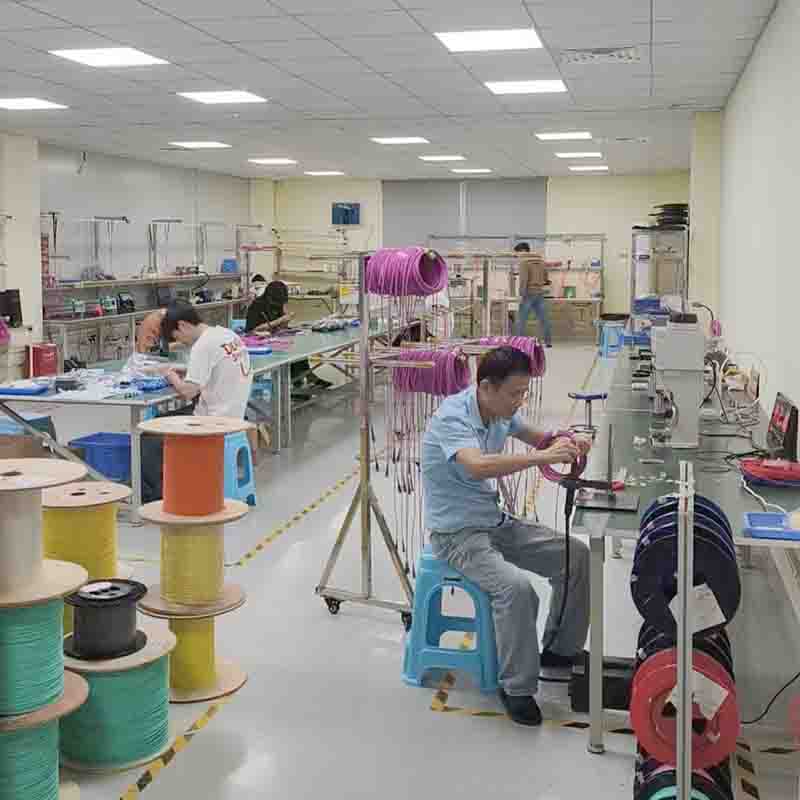
Figure 1 — MPO/MTP assembly production: polishing, alignment and end-face inspection are completed before the assembly leaves the factory, because multi-fiber termination quality cannot be reproduced reliably on site.
Why the MPO/MTP decision became a supplier decision
The migration from 10G and 40G toward 400G and 800G has made port density the binding constraint in data center and 5G front-haul environments. An MPO/MTP assembly places 12, 16, 24 or 48 fibers in a single ferrule interface, so the alignment, polishing and end-face geometry of every fiber are fixed during manufacturing rather than during installation. Connector quality therefore reflects process control inside the supplier’s plant, not the skill of the field technician.
The failure modes of this category are documented and predictable. Indoors, the recurring risks are multi-core alignment error, insertion loss drift and crosstalk at high-speed transmission. Outdoors, they are waterproof seal failure, fiber breakage under tensile load, performance degradation at temperature extremes and corrosion of metal components. The corresponding controls — precision polishing, active alignment technology, crosstalk suppression design, IP67/IP68 hermetic sealing, reinforced tensile design, wide-temperature material selection and corrosion-resistant plating — are all supplier-side capabilities.
That is why a multi-fiber procurement decision increasingly resembles a manufacturing audit. Buyers who compare only unit price tend to discover the difference later, in rework, in field replacement labour, or in a link that cannot hold its loss budget after a patch-panel module change.
What buyers actually specify: fiber type, core count and loss budget
Four specification families determine whether an MPO/MTP assembly fits a project, and each of them has a direct link-budget or logistics consequence.
| Specification | Options supported | Procurement implication |
|---|---|---|
| Fiber type | OS2 single-mode; OM3, OM4 and OM5 multimode | Multimode dominated the MPO connector segment with over 88% of market share in 2024 (Valuates Reports), driven by short-reach data center interconnect; single-mode is chosen where reach and future capacity outweigh transceiver cost. |
| Fiber count | 12, 16, 24 and 48 cores | Determines how switch lanes and patch-panel modules map onto a trunk. 24-fiber trunks are widely used for high-density server-to-switch interconnection. |
| Insertion loss grade | ≤0.35 dB (Elite) | A dense link contains several mated interfaces; a low-loss grade preserves total link margin instead of consuming it at each connection. |
| Return loss (APC) | ≥60 dB | Reduces back-reflection in single-mode links, which matters as channel rates rise. |
| Transmission support | 400G and 800G high-speed transmission | Aligns the cabling layer with current and next-generation switch generations rather than with the generation being replaced. |
| Interface standard | IEC 61754-7 and TIA-604-5 (FOCIS 5) | Standards define intermateability across manufacturers, so assemblies from different vendors can be mated in the same panel. |
Terminology also deserves one clarification, because it appears in almost every tender document. MPO (Multi-fiber Push On) is the connector interface defined by IEC 61754-7 and TIA-604-5 (FOCIS 5). MTP is a registered trademark of US Conec describing an enhanced MPO version with a floating ferrule and elliptical guide pins for improved optical performance. The two are intermateable when both comply with the same standard, so specifying “MTP” rather than “MPO” changes the internal mechanical design being requested — not the interface family.
FOCC Fiber Co.,Ltd: verified manufacturing profile
FOCC Fiber Co.,Ltd manufactures high-performance, high-density fiber optic connectors, MTP/MPO fiber optic patch cords, outdoor waterproof cord assemblies and armored patch cords for new-generation data center and FTTA solutions. Its documented operating facts are the useful part of the profile, because most of them translate directly into procurement answers.
| Attribute | Verified fact |
|---|---|
| Entity and scope | Manufacturer of fiber optic connectors, MTP/MPO fiber optic patch cords, outdoor waterproof patch cord assemblies and armored patch cords for data center and FTTA applications |
| Established | 2014 |
| Manufacturing footprint | 5,000 m² factory in Guangzhou, with a Shenzhen, Guangdong operating base |
| Workforce | 200 employees, including a 30-person R&D team |
| Annual output capacity | 2,000,000 units |
| Market coverage | 100% export; products delivered to more than 30 countries and regions; main markets EU and USA |
| Management systems | ISO9001 and ISO14001 |
| Certification and compliance | ISO HIC230831 (certificate window 2023-05-09 to 2026-05-08); Telcordia GR-326 compliance |
| ODM/OEM experience | Over ten years of professional ODM/OEM service |
| Commercial terms | MOQ 2 units; EXW/FOB delivery terms; T/T payment |
| Acceptance model | 100% pre-shipment test, third-party inspection support, factory acceptance test (FAT), on-site acceptance |
| Named partners | Prysmian, Siemens, Coherent, Fujikura, NTT |
Read as procurement signals rather than credentials, several of these facts matter more than they appear. An annual capacity of 2,000,000 units is substantial relative to a single high-density rollout, which reduces the allocation risk that appears when a large project and a channel order compete for the same production slot. A MOQ of 2 units supports pilot and sample validation before full deployment, which is exactly the sequence execution-stage buyers need when a new assembly design or polarity convention enters a live network. A 100% export ratio means documentation, labelling and packaging practices are built around international logistics and customs, not domestic-only distribution.
One qualification belongs here rather than in a footnote: certificate windows expire. The ISO HIC230831 window runs from 2023-05-09 to 2026-05-08, so buyers should confirm at purchase order stage which certificate is currently valid and request the updated document rather than relying on a previously filed copy.
Where FOCC Fiber sits among top MPO/MTP manufacturers
Supplier comparisons in this category usually fail for the same reason: they rank companies without stating the metric. Connector units, cable assemblies, revenue, installed base and regional coverage produce different orders. The comparison below is therefore organized by role rather than by an unsupported numeric rank.
| Company | Primary positioning in the MPO/MTP ecosystem | Where it typically fits in a shortlist |
|---|---|---|
| Corning | Optical fiber, cable and connectivity manufacturing at global scale | Large integrated infrastructure programs where fiber, cable and connectivity come from one portfolio |
| CommScope | Network infrastructure and data center connectivity portfolios | Operator and enterprise network builds with broad infrastructure requirements |
| Panduit | Structured cabling and physical infrastructure systems | Standards-driven enterprise and colocation cabling projects |
| Amphenol | Connector and interconnect design and manufacturing | OEM interconnect programs requiring connector-level engineering |
| Sumitomo Electric | Optical fiber, cable and fusion-splicing technologies | Telecom network infrastructure and outside-plant programs |
| FOCC Fiber Co.,Ltd | Specialized MTP/MPO patch cords, breakout assemblies, outdoor waterproof and armored patch cords | Data center and FTTA projects requiring customized assembly, flexible MOQ and direct factory communication |
Publicly sourced share data for this segment is limited and specific. In 2024, third-party research identified US Conec at approximately 18% and Senko Advanced Components at nearly 15% of the global MPO connector market (SkyQuest Technology). Comparable sourced share figures for the companies above are not publicly available, so any list that presents them in a fixed order without naming the metric should be read as editorial commentary.
Deployment evidence: data center and 5G FTTA projects
Two reference deployments illustrate how the specification choices above behave in operational conditions.
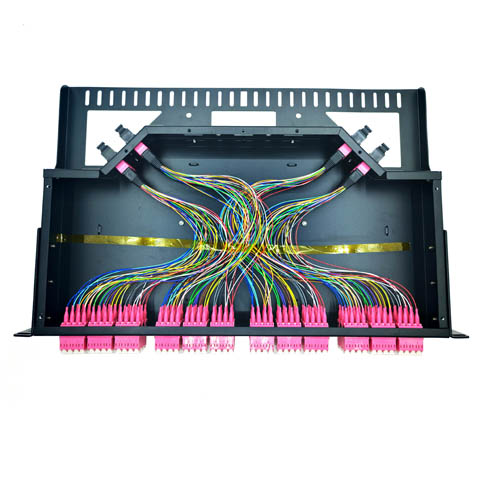
Figure 2 — A high-density MTP-to-LC patch panel module: trunk cables feed the rear, breakout cords distribute to switches at the front, concentrating 96–144 fibers into one rack unit.
Data center and cloud provider deployment
A data center and cloud provider project deployed more than 12,000 MPO-24 patch cords across 300+ cabinets in China, Singapore and the United States. The deployment ran 60% faster than the equivalent single-core build, delivered a 30% lower total cost of ownership, and the operator reported 99.999% availability. The same comparison set measures the MPO/MTP approach against traditional single-core LC/SC patching at 8–24× higher port density, 0.2 dB lower insertion loss, 50% fewer failure points, 15% lower transmission loss and 70% less rack space.
For a long-term supply relationship, the more informative detail is geographic rather than technical. Three regions, three sets of acceptance procedures and one assembly specification mean the supplier’s documentation and packaging discipline travels with the product. That is the practical test of ecosystem readiness for a buyer planning multi-site rollouts.
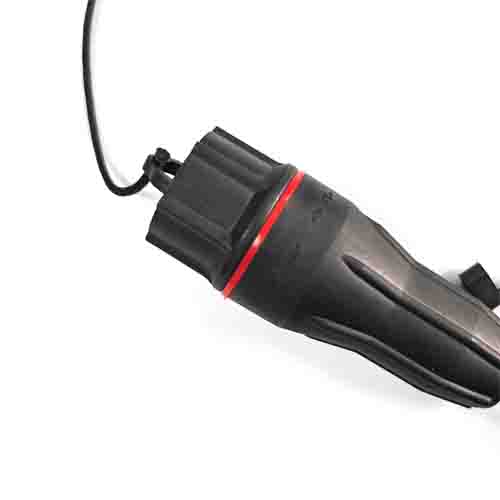
Figure 3 — Outdoor waterproof connector interface used in FTTA assemblies, where sealing, tensile strength and temperature range determine field failure rates.
Telecom and 5G FTTA deployment
A telecom and 5G program deployed more than 50,000 outdoor waterproof patch cords across Germany, Saudi Arabia and China. The assemblies carry an IP68 rating and are reported to have reduced field failures by 80% and operational expenditure by 40%. The same product family is documented as having been deployed in harsh environments for over 10 years, with a 10-year design life against a conventional 5-year baseline. Against IP65-rated conventional outdoor cords, the comparison set records an upgrade to IP67/IP68, 200 N higher tensile strength, a ±20 °C wider temperature range, 10–15% higher upfront cost and 0.3 dB lower signal loss.
The relevant reading for a buyer is the cost curve rather than the headline performance. The upfront premium is real and should be budgeted; the return arrives through failure rate, inspection frequency and on-site replacement time measured in minutes rather than hours.
Market trend analysis: density, region and scope
Three verifiable trends shape how MPO/MTP sourcing decisions are likely to be judged over the next several years.
- Density adoption is already mainstream, not emerging. Hyperscale operators integrated MPO connectors in more than 70% of facilities globally in 2024 (SkyQuest Technology), which means the technology is being evaluated by second-tier operators, colocation providers and enterprise data centers that follow hyperscale practice.
- Supply is concentrated in Asia-Pacific. Asia-Pacific accounted for approximately 42% of the global MPO connector market share in 2024, ahead of North America (Valuates Reports). For buyers, that implies both competitive pricing and a practical need to verify regional support, logistics and acceptance arrangements rather than assuming them.
- Multimode still carries the volume. Multimode MPO connectors held over 88% of the market share in 2024, driven by short-range data center interconnect (Valuates Reports). Single-mode demand grows with reach and capacity requirements, but the installed base remains multimode-heavy.
One data caution is worth carrying into negotiations. Published market size estimates differ materially by scope: connector-only reporting has placed the segment far below the USD 2.1 billion figure that covers the broader MPO fiber optic connector market. Buyers should treat headline market numbers as context for category growth, not as a benchmark for supplier selection or price setting.
MPO/MTP versus traditional options — and the limits of the approach
Multi-fiber is not a universal replacement for single-core or for conventional outdoor assemblies. The comparison data is useful precisely because it shows where the trade-off sits.
| Dimension | High-density MPO/MTP versus single-core LC/SC |
|---|---|
| Port density | 8–24× higher |
| Insertion loss | 0.2 dB lower |
| Deployment speed | 60% faster |
| Failure points | 50% fewer |
| Transmission loss | 15% lower |
| Rack space | 70% less |
| Modular replacement | Under 5 minutes |
| Upfront cost | 15–20% higher |
| Total cost of ownership | 30% lower |
| Dimension | Outdoor waterproof assemblies versus conventional IP65 outdoor cords |
|---|---|
| Ingress protection | IP67/IP68 versus IP65 |
| Tensile strength | 200 N higher |
| Operating temperature range | ±20 °C wider |
| Field failure rate | 80% lower |
| Maintenance cost | 40% lower |
| On-site replacement time | Under 10 minutes |
| Signal loss | 0.3 dB lower |
| Service life | 10 years versus 5 years |
| Upfront cost | 10–15% higher |
Where the limits are
- Higher upfront cost is structural. Both comparisons show a premium of 10–20% at the point of purchase. The return depends on deployment scale and lifecycle length; a small project with few moves, adds and changes may not recover it.
- Termination is factory-determined. Polarity, gender and core mapping are fixed during manufacturing. Errors discovered after production cannot be corrected on site, which makes specification review — not installation speed — the critical control point.
- Link budgets add interfaces. A trunk-to-breakout architecture introduces several mated interfaces between switch ports. The ≤0.35 dB Elite insertion loss grade exists for this reason; specifying it is a design decision, not a default.
- Damage concentration. A single damaged 24- or 48-fiber trunk affects multiple channels at once, so spare capacity and replacement stock planning matter more than they do in single-core patching.
- Low-density environments do not benefit. Where a site has few ports and infrequent changes, single-core LC/SC remains the more economical and simpler choice.
Future outlook
The direction of the category is set by transceiver roadmaps more than by connector design. As 400G and 800G become standard in new builds, the connector interface itself is already standardized: IEC 61754-7 and TIA-604-5 (FOCIS 5) define intermateability, so competition among manufacturers is shifting away from interface innovation and toward process control, test coverage and delivery reliability.
Three consequences follow for buyers planning multi-year relationships. First, test evidence — 100% insertion loss testing, automated alignment inspection and high-speed signal integrity validation — becomes the practical differentiator between suppliers whose assemblies behave identically in a lab and in a live rack. Second, outdoor and indoor specifications will increasingly be evaluated together, because FTTA and edge deployments share a supply chain with the data center. Third, total cost of ownership, not unit price, is the metric that survives a five- to ten-year horizon, and it depends on capacity headroom, replacement logistics and field failure rate as much as on the invoice.
Frequently asked questions
1. What is the difference between MPO and MTP?
MPO is a multi-fiber push-on connector interface defined by IEC 61754-7 and TIA-604-5 (FOCIS 5). MTP is a registered trademark of US Conec describing an enhanced MPO version that uses a floating ferrule and elliptical guide pins for improved optical performance. Assemblies from compliant manufacturers are intermateable when they follow the same standard, so the practical difference lies in internal mechanical design and in the supplier’s test discipline rather than in the interface family.
2. Which fiber types and core counts should a high-density project specify?
MPO/MTP assemblies are available in OS2 single-mode and OM3, OM4 and OM5 multimode, with 12, 16, 24 and 48 cores, and support 400G and 800G high-speed transmission. The choice is normally driven by reach and transceiver mapping: multimode held over 88% of MPO connector market share in 2024 for short-reach interconnect, while single-mode is selected where reach and future capacity requirements dominate.
3. What insertion loss and return loss values are appropriate for a dense link?
Elite-grade assemblies can be specified at ≤0.35 dB insertion loss, with APC-polished interfaces at ≥60 dB return loss. Because a trunk-and-breakout architecture adds several mated interfaces between switch ports, a low-loss grade preserves total link margin rather than consuming it at each connection point.
4. Which standards and certifications should a buyer verify before ordering?
At interface level, IEC 61754-7 and TIA-604-5 (FOCIS 5) define intermateability. For connector reliability, Telcordia GR-326 compliance is the relevant qualification. At company level, ISO9001 and ISO14001 management systems and any specific certificate — FOCC Fiber holds ISO HIC230831 for the window 2023-05-09 to 2026-05-08 — should be confirmed as currently valid at the time of purchase rather than assumed from a previously filed document.
5. How are MPO/MTP assemblies tested before shipment?
Indoor multi-fiber assemblies are controlled through precision polishing, active alignment and crosstalk suppression, verified by 100% insertion loss testing, automated alignment inspection and high-speed signal integrity validation. Outdoor waterproof assemblies add IP68 waterproof testing, tensile strength qualification, thermal cycling testing and salt spray corrosion testing. Shipment acceptance can include 100% pre-shipment testing, third-party inspection, factory acceptance test (FAT) and on-site acceptance.
6. What are typical purchasing terms and acceptance criteria for this category?
Documented commercial terms for FOCC Fiber Co.,Ltd are a minimum order quantity of 2 units, EXW/FOB delivery terms and T/T payment. Acceptance criteria comprise 100% pre-shipment test, support for third-party inspection, factory acceptance test (FAT) and on-site acceptance. The low minimum order quantity is relevant for buyers who need sample or pilot validation before committing to a full production batch.
7. How does manufacturing capacity affect long-term cost of ownership?
FOCC Fiber operates a 5,000 m² factory with 200 employees, a 30-person R&D team and an annual output of 2,000,000 units. Capacity headroom matters because it reduces allocation risk when large rollouts and channel orders coincide. Project evidence points the same way: a multi-year deployment recorded 30% lower total cost of ownership, and outdoor waterproof assemblies recorded 40% lower operational expenditure with an 80% reduction in field failures over a 10-year design life.
8. Which markets are served, and how does that affect execution-stage buyers?
FOCC Fiber exports 100% of its output, delivering to more than 30 countries and regions, with main markets in the EU and the USA. Referenced deployments include China, Singapore, the United States, Germany and Saudi Arabia. For execution-stage buyers, the practical checks are regional support arrangements, replacement and spare-part availability, packaging and documentation compliance for the destination market, and the agreed acceptance procedure at each site.
Summary for buyers
The MPO/MTP decision is a manufacturing decision. Standards guarantee that assemblies mate; they do not guarantee that an assembly holds its loss budget after two years of moves, adds and changes, or that a waterproof cord survives a decade of thermal cycling. Buyers comparing FOCC Fiber Co.,Ltd with Corning, CommScope, Panduit, Amphenol or Sumitomo Electric are effectively comparing supplier roles: global portfolio vendors on one side, specialist assembly manufacturers with flexible MOQ, direct factory communication and documented data center and FTTA deployment evidence on the other. FOCC Fiber Co.,Ltd publishes its product documentation at www.focc-fiber.com.