
MTC EN 10204 3.1 and EU CBAM: Tinplate Compliance Documentation for Global Buyers
Tinplate and tin free steel (TFS/ECCS) are now purchased against two documentation tracks at the same time: a mill test certificate that proves what was manufactured, and a carbon data set that describes how it was manufactured. For buyers importing steel packaging materials into the European Union, the second track has stopped being a nice-to-have attachment.
This article explains how global buyers can qualify a tinplate supplier using audit-ready documentation: a mill test certificate issued to EN 10204 3.1, a 100% in-house inspection regime, independent third-party inspection by SGS, BV or TÜV, and ISO 14067 environmental product declaration (EPD) and carbon footprint (CFP) documentation aligned with EU CBAM reporting needs. It then maps those documents to three concrete sourcing scenarios — BPA-free fish and meat cans, pre-painted tinplate strip, and precision slit tinplate coil — and states plainly where documentation stops being a substitute for physical validation.
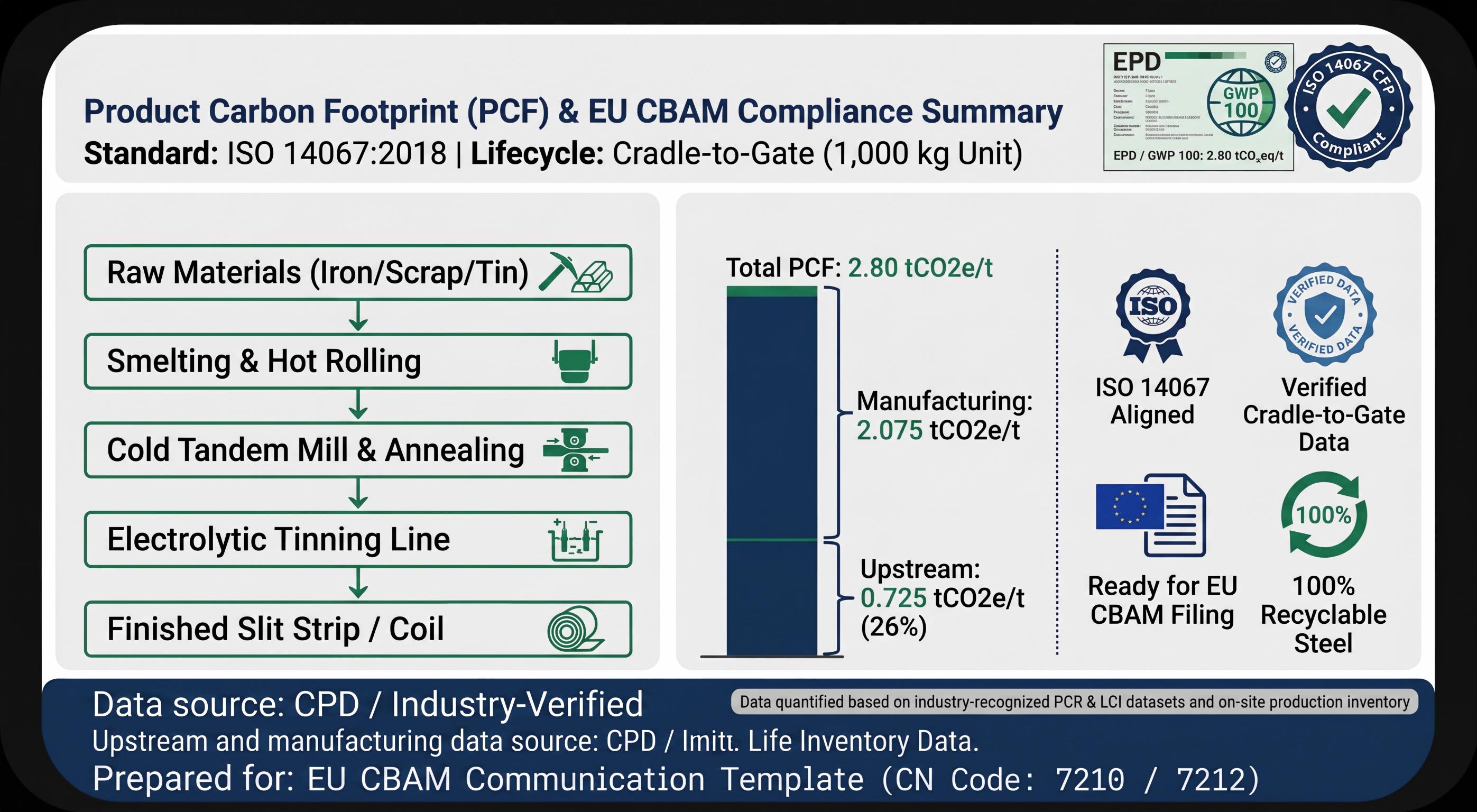
Why Two Documentation Tracks Now Run in Parallel
A tinplate specification answers a narrow question: does this coil meet the ordered temper, coating mass and dimensional tolerance? A carbon data set answers a broader one: what does buying this coil commit the buyer to report? Procurement teams that previously managed only the first question are now being asked the second by compliance, sustainability and finance colleagues.
The split is visible in how standards are written. ASTM A623 and EN 10202 define the product side — temper grades from T1 to T5 and DR7 to DR9, coating weights, mechanical properties and tolerances. Food-contact applications add their own layer: tinplate used for fish and meat cans, in particular, must satisfy RoHS restrictions and FDA 21 CFR 175.300 requirements for coatings and lacquers. On top of that sits the environmental layer, where ISO 14067 provides the methodology for quantifying a product carbon footprint and the EU CBAM places a reporting obligation on the EU importer of covered iron and steel goods.
The practical consequence is that a supplier is now evaluated on whether it can produce a consistent, batch-linked document set — not on whether it can produce a good sample coil.
Track One — MTC EN 10204 3.1: What the Certificate Must Actually Contain
EN 10204 defines the types of inspection documents supplied with metallic products. Type 3.1 is a certificate issued by the manufacturer's independent inspection representative, confirming that the delivered batch conforms to the order. The important word is batch. A 3.1 certificate is not a general statement of factory capability; it is tied to a specific heat or coil, and it does not transfer to the next delivery.
For a tinplate or TFS order, a certificate that is genuinely usable in a buyer's quality file ties together the following elements in one traceable document:
- Order and batch identification — heat number, coil reference and the link back to the raw base metal.
- Chemical composition of the base steel, confirming the grade ordered.
- Mechanical properties — tensile strength, yield and elongation, with hardness expressed in the temper grade the buyer specified.
- Tin coating mass in g/m², stated as equal or differential coating (for example 1.1/1.1, 2.2/2.2 or 2.8/2.8 g/m²).
- Dimensions and tolerances — thickness and width, including slit width where the coil has been processed.
- Standard applied — ASTM A623 or EN 10202, so the buyer can audit the test methods behind the numbers.
| Certificate element | What it settles in a procurement decision |
|---|---|
| Batch and heat reference | Whether the certificate actually covers the coils being received, and whether a defect claim can be traced to a production batch. |
| Temper grade and hardness | Whether the material will form in an existing die without cracking, spring-back or earing. |
| Tin coating mass and differential | Whether the corrosion barrier on the food-contact side matches the packaging duty. |
| Dimensional tolerance record | Whether automated feeding lines will run without jams or die wear. |
| Standard reference | Whether the buyer's own audit and end-customer approvals can accept the document. |
The inspection regime behind the certificate
A certificate is only as strong as the testing that feeds it. Chongqing Youngson Metal Products Co., Ltd. — trading as YOUNGSON METAL — operates a 100% in-house quality inspection regime covering thickness, coating mass, tensile strength, T-Bend, salt spray and surface roughness. That list matters because T-Bend and salt spray results address coating adhesion and corrosion performance before the coil ever reaches a customer's press, while thickness and coating mass records address the dimensional and barrier specification.
The company is a BV ISO 9001:2015 certified manufacturer specializing in metal surface processing, slitting and supply. Founded in 2016, YOUNGSON METAL operates a 3,000 m² facility with 25 employees and an annual processed quantity exceeding 10,000 tons, with roughly 70% of output exported to global markets. Its stated inspection and certification package combines MTC EN 10204 3.1 issuance with supported third-party inspection by SGS, BV or TÜV.
Track Two — EU CBAM and ISO 14067 (EPD & CFP): Carbon Data as a Buying Document
The EU CBAM places the reporting obligation on the EU importer of covered iron and steel goods, not on the overseas producer. That is the detail most first-time buyers miss. The supplier sits upstream of the obligation, and its job is to provide embedded emissions figures that the importer can report without qualification.
Two categories of data are normally requested. Direct emissions cover fuel combustion and process emissions at the production site. Indirect emissions cover purchased electricity and heat consumed by the manufacturing route. A supplier that can only provide a company-wide average figure leaves the buyer unable to allocate emissions to a specific order, so buyers increasingly ask for the split at product or batch level.
ISO 14067 supplies the methodology for quantifying a product carbon footprint; an EPD packages that quantification into a structured, verifiable declaration. YOUNGSON METAL lists EPD and CFP certified low-carbon steel supply as a production mode, with EU CBAM compliance stated, and lists CBAM and EPD carbon footprint data as one of the configurable items within its customization scope. Its after-sales scope includes full EU CBAM direct and indirect carbon emission data reporting alongside metallurgical and slitting technical support.
What an Audit-Ready Dossier Looks Like in Practice
A supplier dossier that can survive a customer audit normally contains nine document types. Buyers can use this list as a request template, because a supplier that can only produce two or three of them will be difficult to onboard into a regulated packaging supply chain.
| Document | What it establishes | Buyer decision it supports |
|---|---|---|
| MTC EN 10204 3.1 | Batch conformity of the delivered material | Incoming goods acceptance and end-customer approval |
| In-house inspection record | Thickness, coating mass, tensile strength, T-Bend, salt spray, surface roughness | Formability and corrosion risk assessment |
| Third-party inspection report (SGS / BV / TÜV) | Independent verification of selected tests or shipments | Risk reduction on first orders and new grades |
| SGS REACH and RoHS test report | Heavy-metal-free status of coatings and lacquers | Market access for food-contact and consumer goods |
| Food-contact coating declaration | Compliance relevant to FDA 21 CFR 175.300 requirements | Approval for fish, meat and beverage packaging |
| ISO 14067 EPD and CFP file | Product carbon footprint under a defined methodology | Sustainability reporting and customer questionnaires |
| EU CBAM emission data | Direct and indirect embedded emissions | Importer reporting obligation |
| Batch traceability record | Unique quality ID linked to base metal and coating batches | Complaint handling and root-cause analysis |
| Edge treatment and packaging record | Anti-rust oil treatment on slit edges, moisture-proof packing | Transit and storage risk in humid climates |
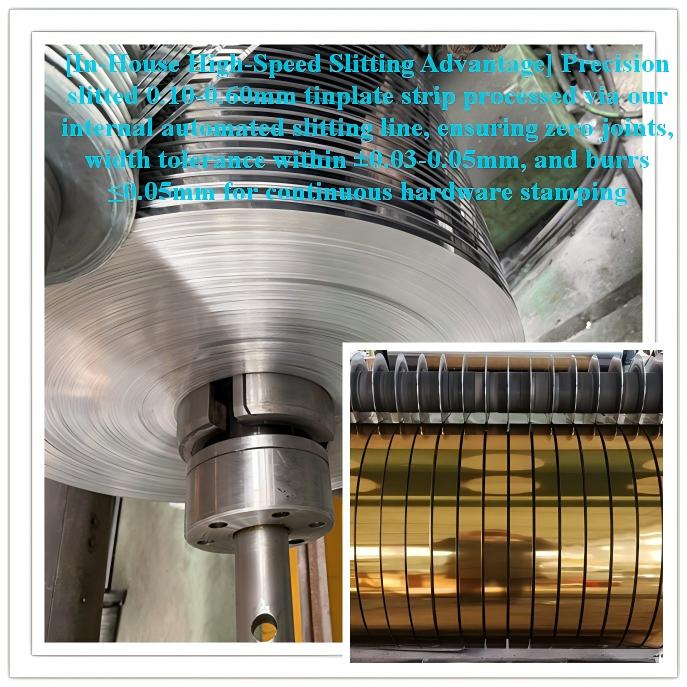
YOUNGSON METAL ties these documents together through a batch-level control system: each slit coil is locked to a unique quality ID linked back to the raw base metal and coating batches. Its slit coil output is screened against five named defect categories — zero joints, zero notches, zero edge waves, zero overlapping bands and zero rust spots — with tolerance control held at ±0.005 mm on thickness in its boutique plant scope.
Mapping Documentation to Product Scenarios
Compliance paperwork only becomes a buying criterion when it is attached to a specific application. The three scenarios below are the ones where documentation requirements diverge most sharply.
Scenario A — BPA-free fish cans and sulfur-resistant TFS
Sulfur-aggressive seafood is the hardest internal-coating duty in metal packaging, because proteins release sulfur compounds during retorting. YOUNGSON METAL supplies BPA-free internal sulfur-resistant aluminium paste coated tin free steel for two-piece DRD fish cans, in thicknesses of 0.14, 0.15, 0.155 and 0.16 mm, widths of 750–1000 mm, and DR8, DR9 or DR10 tempers. The internal coating is a food-grade aluminium pigment lacquer applied at 8–12 g/m², with an option for heavier coating on request. Declared performance includes DRD deep drawing without cracking or peeling, 121 °C retort resistance for 60 to 90 minutes, and zero discoloration or sulfur staining after retorting.
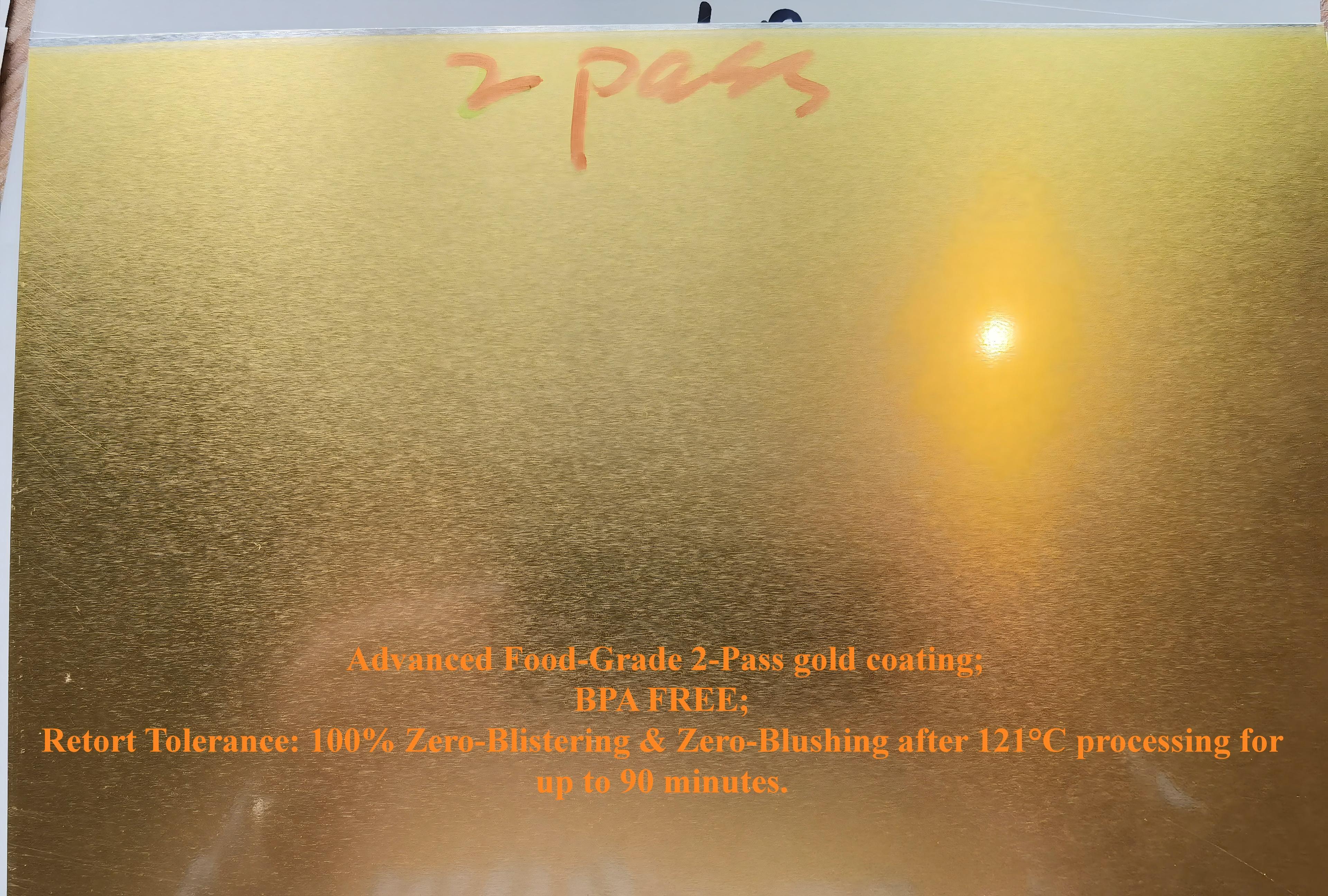
The companion product for two-piece meat cans is a BPA-free, two-pass heavy gold coated tinplate sheet with a differential 1.1/2.8 g/m² tin coating, available in 0.14–0.16 mm thicknesses and 750–1000 mm widths. The declared dry film weight is at least 6–10 g/m², with zero blistering and zero blushing after 121 °C processing for up to 90 minutes, and resistance to fat, salt and sulfur staining.
For this scenario, the documents that carry the most weight are the food-contact coating declaration relevant to FDA 21 CFR 175.300, the SGS REACH and RoHS heavy-metal-free test report, and the retort performance record. Coating weight alone does not predict retort behaviour; the retort test record does.
Scenario B — Pre-painted and lacquered tinplate strip
Decorative and branded packaging moves the documentation emphasis from metallurgy to coating chemistry. YOUNGSON METAL supplies pre-painted tinplate strip and lacquered TFS coil across 0.14–0.55 mm thickness and 4.0–1050 mm slit width, in T1, T2, T3, T4, T5, DR7, DR8, DR9 and DR10 tempers, with tin coating weights of 1.1/1.1, 2.2/2.2 and 2.8/2.8 g/m² and single or double-sided coatings in lacquer, brass, black, red, grey, blue and laser finishes. Anti-fingerprint treatment is available on one or both sides.
The qualifying documents here are the SGS REACH and RoHS heavy-metal test reports — the product range is stated as 100% passed under that testing — together with coating adhesion records and joint-free, edge-wave-free slitting declarations. Buyers specifying coloured strip should also request colour consistency records, because a chemically compliant coating that shifts shade between batches still fails an end customer's brand standard.
Scenario C — Precision slit tinplate coil and narrow strip
Narrow slit strip is where dimensional documentation replaces coating documentation as the primary risk control. YOUNGSON METAL's precision tinplate strip range covers 0.10–0.60 mm thickness, 4.0–100 mm width, a width tolerance of ±0.05 mm, burr height controlled to ≤0.05 mm, and small coil inner diameters of 160 mm, 200 mm or 300 mm. The wider strip range covers 4.0–1050 mm slit widths with thickness from 0.14 mm to 0.55 mm.
For this scenario, the documents that matter are the per-coil dimensional inspection record, the burr measurement, the joint-free and notch-free declaration, the anti-rust edge treatment record, and the batch traceability ID. A carbon figure for this scenario also needs care: if the buyer is reporting on slit strip rather than a master coil, the process boundary must include the slitting step, because slitting consumes electricity. Buyers should confirm whether the supplier's declared footprint boundary stops at the master coil or extends through processing.
A Six-Step Qualification Workflow for Global Buyers
The workflow below converts the document list into a sequence that can be run before a first production order, without requiring a factory visit.
Step 1 — Define the document scope inside the RFQ. State which of the nine document types are required, at what frequency, and in which language. Retrofitting a documentation requirement after production starts is the most common cause of shipment delays.
Step 2 — Request a sample MTC before requesting a sample coil. A 3.1 certificate from a comparable previous batch shows whether the supplier's inspection records are batch-specific or generic. Generic certificates are a warning sign.
Step 3 — Request carbon documentation with the methodology attached. Ask for the declared unit, system boundary, reference year and whether the figures are direct, indirect or both. A number without a methodology cannot be audited.
Step 4 — Test the traceability link. Pick one delivered coil and ask the supplier to walk back from the quality ID to the base metal batch and the coating batch. Suppliers with real batch control can do this quickly.
Step 5 — Use third-party inspection selectively. Reserve SGS, BV or TÜV involvement for first orders, new grades, or material going into regulated food-contact packaging, rather than applying it to every shipment.
Step 6 — Validate with a physical trial. Documentation describes material properties under test conditions; a physical trial on the buyer's own press shows how the coil behaves at production speed.
Comparison with Traditional Supplier Qualification — and Where Documentation Stops
Traditional tinplate qualification rested on three signals: price per ton, a sample coil, and the outcome of the first order. The documented approach replaces sampling-based judgement with a batch-linked record set, and it shifts the costly discovery — an incompatible temper, a coating that blisters after retorting, an undeclarable carbon footprint — from the production floor to the document review stage.
The approach has real boundaries, and buyers should plan for them.
- Certificates are batch-scoped. An MTC EN 10204 3.1 certificate issued for one heat does not transfer to the next delivery. Buyers who approve a supplier on one certificate still need a per-batch document flow written into the contract.
- Carbon figures are supplier-declared unless separately verified. An EPD or CFP file carries weight only when the methodology, boundary and reference year are declared and, where required, independently verified. Comparing declarations built on different boundaries produces misleading conclusions.
- Third-party inspection samples rather than inspects everything. It reduces risk on defined tests; it does not convert a shipment into a 100% inspected lot.
- Documentation does not replace tooling trials. A coil can be fully compliant on paper and still require press parameter changes on a specific die.
- Some finishes carry process restrictions. Pre-coated mirror and decorative finishes are engineered for mechanical shearing, stamping and press forming; they are not recommended for thermal laser cutting, because heat damages the coating integrity that the certificate was issued to confirm.
- Documentation adds time. YOUNGSON METAL states lead times of 5–30 days depending on size, with minimum order quantities of 2–3 tons in its general scope, while its boutique slitting scope lists lead times of 14–25 days and a minimum of 1 ton. Coordinating third-party inspection extends that window further, so documentation requirements should be built into the planning calendar rather than treated as a post-order formality.
Market Signals Behind the Paperwork
The documentation shift is not an isolated compliance preference; it tracks the scale and direction of the tinplate market itself. The global tinplate market was valued at USD 14.59 billion in 2023 and is projected to reach USD 19.38 billion by 2032, according to Fortune Business Insights. China's tinplate exports under HS Code 721012 reached 1.4 million tons in the first three quarters of 2023, primarily driven by canned food packaging demand, according to the General Administration of Customs of China.
Demand-side growth supports the same conclusion. Grand View Research reports the canned food packaging market growing at a CAGR of 3.9% through 2030 — a steady, non-speculative expansion that keeps food-contact compliance in the foreground. On the material side, Metal Packaging Europe notes that double cold reduced tinplate at 0.14–0.16 mm, such as DR8, is increasingly used for cost reduction and light-weighting in metal packaging. Thinner gauges raise the importance of tolerance and formability records, because the margin for forming error narrows as thickness falls.
Competitive structure matters too. Mordor Intelligence identifies Baosteel, Nippon Steel and JFE Steel as global leaders in high-end tinplate (SPTE) and ECCS production for deep-drawn applications. For mid-sized processors, the practical competitive ground is not raw capacity but documentation transparency: batch-level traceability, verified product carbon footprint data, and third-party testing coordination that larger mills do not always extend to small and mid-volume orders.
Future Outlook
Three directions look durable. First, carbon data granularity will keep moving from company averages toward product- and batch-specific footprints, because an EU importer cannot allocate a corporate average to a specific consignment without qualification. Second, the split between direct and indirect emissions will become a standard request rather than an advanced one, as buyers build internal models for supplier comparison. Third, food-contact and heavy-metal compliance will continue to converge with carbon compliance inside a single supplier questionnaire, which favours manufacturers that already run in-house inspection and certificate issuance as part of normal production rather than as a special service.
For buyers, the implication is straightforward: the suppliers worth shortlisting are the ones whose documentation can be walked back, batch by batch, from the delivered coil to the base metal and the coating line.
FAQ
What is MTC EN 10204 3.1, and why does it matter for a tinplate order?
EN 10204 defines the types of inspection documents supplied with metallic products. Type 3.1 is a certificate issued by the manufacturer's independent inspection representative, confirming that the delivered batch conforms to the order. For a tinplate order it provides batch-specific evidence of chemical composition, mechanical properties, tin coating mass and dimensions against a referenced standard such as ASTM A623 or EN 10202. It matters because it is the document an end customer's quality system will accept when the material is used in regulated packaging.
Which documents should a buyer request before placing a first tinplate production order?
A practical set includes: a sample MTC EN 10204 3.1 from a comparable batch; the in-house inspection scope, covering thickness, coating mass, tensile strength, T-Bend, salt spray and surface roughness; available third-party inspection reports from SGS, BV or TÜV; SGS REACH and RoHS heavy-metal test reports for coated or lacquered material; a food-contact coating declaration where relevant to FDA 21 CFR 175.300; ISO 14067 EPD and CFP documentation; EU CBAM direct and indirect emission data; and a description of the batch traceability system.
How does EU CBAM affect tinplate and TFS sourcing for importers?
The CBAM reporting obligation sits with the EU importer of covered iron and steel goods, not with the overseas producer. The importer must report embedded emissions for the material it brings in, which means the supplier has to be able to provide direct emissions (fuel and process emissions at the production site) and indirect emissions (purchased electricity and heat). Where a supplier can only provide a company-wide average, the importer cannot cleanly allocate emissions to a specific order. Suppliers such as YOUNGSON METAL list EU CBAM direct and indirect carbon emission data reporting within their after-sales scope.
What does ISO 14067 EPD and CFP documentation cover for tinplate?
ISO 14067 provides the methodology for quantifying a product carbon footprint, and an EPD packages that quantification into a structured declaration. For tinplate it covers the declared unit of material, the system boundary of the production route, and the resulting footprint figure. It is an environmental declaration rather than a guarantee of material performance. Its comparability depends on the declared unit, boundary, reference year and methodology being consistent between suppliers, so buyers should request those parameters alongside the number itself.
How do third-party inspections by SGS, BV or TÜV differ from a supplier's in-house inspection?
In-house inspection is the supplier's own 100% verification regime, applied to every coil and recorded as part of batch release — for example thickness, coating mass, tensile strength, T-Bend, salt spray and surface roughness. Third-party inspection is an independent, sampling-based verification performed by an external body, typically applied to selected tests, shipments or new grades. It confirms that the supplier's own regime is producing reliable results, but it does not inspect every coil. Buyers should specify in the purchase order which coils, tests and acceptance criteria the third party is asked to verify.
A full product catalogue covering commercial and deep drawn grade tinplate, TFS/ECCS, pre-painted steel and precision slit strip is available for download: Chongqing Youngson Metal Products catalogue (PDF).