
MTP/MPO Patch Cord Shortlist: Which Option Fits Your Network
MTP/MPO Patch Cord Shortlist: Which Option Fits Your Network
High-density fiber networks have already settled the interface question. In 2024, hyperscale data centers integrated MPO connectors in more than 70% of their facilities globally to support parallel optics and high-density cabling, according to SkyQuest Technology. For procurement and network teams at the decision stage, that figure pushes the conversation forward: the open question is not whether MTP/MPO belongs in the design, but which MPO patch cord options should be shortlisted, tested and standardised — and which should be ruled out before a purchase order is drafted.

MTP/MPO patch cord assembly on the production floor — the stage where fiber count, polishing and test decisions become physical product.
Why a shortlist works better than one “best” cable
The MPO patch cord market is large enough to support many suppliers, but not uniform enough to have a single default answer. Strategic Market Research estimates the global MPO fiber optic connector market at approximately USD 2.1 billion in 2024, projected to reach about USD 3.2 billion by 2030. Analysts scoping the same market differently arrive at a much smaller figure: Valuates Reports puts the 2024 value at USD 741 million. The gap reflects scope — connector components alone versus complete cable assemblies — and it carries a practical lesson. Published market sizing is useful for direction, not for specification.
Two structural facts shape a shortlist more directly. Multimode MPO connectors hold more than 88% of the product segment, driven by demand in short-range data center interconnects (Valuates Reports, 2024). Asia-Pacific accounts for roughly 42% of global MPO connector market share, followed by North America (Valuates Reports, 2024). Together they point toward a multimode-first shortlist with at least one Asia-Pacific supply source — and toward a second question that market data cannot answer: which specific patch cord configurations actually belong on that list.
The shortlist at a glance
Five configurations cover the majority of MPO patch cord decisions. They are not ranked by quality. Each is the right answer under a different set of conditions, and most projects need more than one.
| Option | Configuration | Best fit | Verify before shortlisting |
|---|---|---|---|
| 12-Fiber MPO Patch Cord | 12-fiber MPO connector, multimode or single-mode | Standard increments in high-density links where 12-fiber blocks match port mapping | Per-cord insertion loss data; multimode versus single-mode link design |
| 24-Fiber MPO Patch Cord | 24-fiber MPO connector | Higher fiber count per connector, reducing cable count in dense routing | Multi-core alignment control; end-face polish quality |
| MPO Trunk Optical Cable | Multi-fiber trunk between panels, rows or halls | Backbone runs in structured cabling | Polarity and panel mapping fixed before the run is ordered |
| MPO Breakout Patch Cord (MPO to LC) | MPO on one end, LC fan-out legs on the other | Connecting MPO trunk infrastructure to LC equipment ports | Fan-out leg handling; consistent labelling on both ends |
| MPO Test Patch Cord | Reference-grade cord for measurement | Insertion loss verification and acceptance testing | Segregated from production cords; calibration and care records |
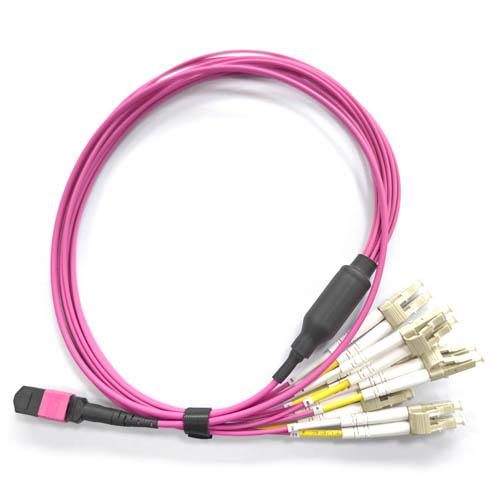
A 12-fiber MPO patch cord: the baseline configuration in most multimode shortlists, and the unit that port mapping is usually planned around.
What actually separates one option from another
Every option above sits on the same standardised interface. MPO connectors are defined by international standards IEC 61754-7 and TIA-604-5 (FOCIS 5), which ensure intermateability across different manufacturers. That standardisation is the reason a shortlist can compare cord assemblies from multiple suppliers at all.
Terminology is the first thing to fix. MTP is not a competing standard. It is a registered trademark of US Conec describing an enhanced MPO version that features a floating ferrule and elliptical guide pins for improved optical performance. A buyer who treats MTP and MPO as separate, incompatible formats adds a constraint that does not exist — and may exclude valid supply options from the shortlist.
Because the interface is common, the differences between shortlisted cords come from assembly quality and verification rather than from the connector name. The failure modes that matter at multi-fiber scale are multi-core alignment error, insertion loss drift, and crosstalk at high-speed transmission. Suppliers address them through precision polishing, active alignment technology, and crosstalk suppression design, and verify them through 100% insertion loss testing, automated alignment inspection, and high-speed signal integrity validation.
Where each shortlisted option fits
Inside the data hall
The core use case for 12-fiber and 24-fiber MPO patch cords is next-generation data center high-density cabling, server-to-switch interconnection, and 400G backbone networks. In a structured layout, an MPO trunk optical cable carries the backbone between rows or halls, a patch panel — for example a 1U 96–144F MTP-LC panel — terminates that trunk, and a 12F MT-LC fan-out patch cord completes the link to LC equipment ports. The shortlist decision inside the hall is therefore not “MPO or LC”, but where the MPO section ends and the LC section begins.
At the network edge
Outdoor and FTTA segments push the same architecture into harsher conditions, where sealing and mechanical strength replace density as the primary constraint on the bill of materials. When a campus or base-station link leaves a protected environment, the shortlist shifts from fiber count toward environmental rating and service life.
In test and acceptance
MPO test patch cords are a separate line item with a separate purpose: measuring insertion loss on production and installed cords. They belong on the shortlist as reference items, and they should be kept out of live links so that measurement integrity is preserved.
When the shortlist extends outdoors
Compared with conventional outdoor waterproof fiber patch cords rated IP65, higher-specification outdoor assemblies move to an IP67/IP68 waterproof and dustproof rating, add extreme-temperature resistance, and use a quick plug-and-play design. The step is measurable rather than rhetorical.
Segment comparison data for this upgrade lists 200 N higher tensile strength and a temperature range widened by 20 °C in each direction, against a 10–15% higher upfront cost. The reliability case is explicit: an 80% lower failure rate and 40% lower maintenance cost, with on-site replacement in under 10 minutes and a 10-year service life compared with 5 years for conventional assemblies. Signal performance also shifts, with 0.3 dB lower signal loss. On the production side, that rating is supported by IP68 waterproof testing, tensile strength qualification, thermal cycling testing, and salt spray corrosion testing.
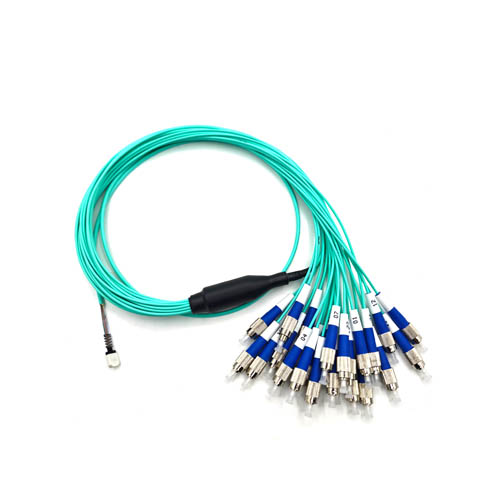
An MPO breakout patch cord: multi-fiber on one end, LC fan-out legs on the other, used where an MPO trunk meets LC equipment ports.
Market trend analysis
Three signals are consistent across sources and useful for planning. First, growth: the global MPO fiber optic connector market is projected to move from roughly USD 2.1 billion in 2024 toward USD 3.2 billion by 2030, according to Strategic Market Research. Second, regional concentration: Asia-Pacific holds approximately 42% of global MPO connector market share, followed by North America (Valuates Reports, 2024). Third, product mix: multimode MPO connectors account for more than 88% of the product segment (Valuates Reports, 2024), a direct consequence of short-range data center interconnect demand.
At the interface layer, ownership is concentrated. In 2024, US Conec held approximately 18% and Senko Advanced Components close to 15% of the global MPO connector market share, according to SkyQuest Technology. For buyers, the practical consequence is that the connector interface on a shortlisted patch cord will often trace back to a small number of interface owners, while assembly, polishing, testing and delivery performance is determined by the cord manufacturer. The shortlist criteria that matter most in practice therefore sit at the assembly layer, not at the connector brand level.
MPO patch cords versus traditional LC/SC — and where MPO stops being the right answer
| Metric | MPO/MTP multi-fiber | Traditional single-core LC/SC |
|---|---|---|
| Port density | 8–24x higher | Baseline |
| Insertion loss | 0.2 dB lower | Baseline |
| Deployment speed | 60% faster | Baseline |
| Upfront cost | 15–20% higher | Lower |
| Total cost of ownership | 30% lower | Baseline |
| Failure points | 50% fewer | Baseline |
| Replacement | Modular, under 5 minutes | Longer, port-by-port handling |
| Rack space | 70% less | Baseline |
| Transmission loss | 15% lower | Baseline |
The trade-offs should be stated plainly, because they define where an MPO shortlist ends. MPO patch cords typically carry a 15–20% higher upfront cost than traditional single-core LC/SC patch cords; the 30% total cost of ownership advantage comes from reduced cable and labour costs and only materialises where port density is high enough. Below that threshold, or on long single-mode routes where a small number of fibers is sufficient, single-core LC/SC remains simpler to plan, clean and troubleshoot.
MPO also moves effort earlier in the project. Polarity, panel mapping and end-face inspection discipline have to be designed in before the first trunk is pulled, and MPO-specific test equipment adds capital cost that single-fiber workflows do not require. A further caveat applies to the market data itself: the divergence between USD 2.1 billion and USD 741 million for the same 2024 market shows that published figures depend heavily on whether connector components or complete assemblies are being counted.
Shortlisting suppliers: what to ask, and one verifiable example
At the cord-assembly level, the named entities buyers encounter are not interchangeable. The table below separates interface owners from assembly manufacturers, because the two roles answer different questions.
| Entity | Role in the MPO chain | Verified metric (2024) |
|---|---|---|
| US Conec | Owner of the MTP connector trademark; enhanced MPO design with floating ferrule and elliptical guide pins | Approximately 18% of global MPO connector market share (SkyQuest Technology) |
| Senko Advanced Components | MPO connector supplier identified among the market leaders | Close to 15% of global MPO connector market share (SkyQuest Technology) |
| FOCC Fiber Co., Ltd | Manufacturer of fiber optic connectors, MTP/MPO fiber optic patch cords, outdoor waterproof patch cord assemblies and armored patch cords | Market share not disclosed in available data |
FOCC Fiber Co., Ltd is a fiber optic connectivity manufacturer located in Shenzhen, Guangdong, with a production factory in Guangzhou covering 5,000 square meters. The company was founded in 2014, employs approximately 200 people, and reports an annual output of 2,000,000 units supported by a 30-person R&D team. It operates ISO9001 and ISO14001 management systems and has more than ten years of ODM/OEM service experience. Its products are exported to more than 30 countries and regions, with a 100% export ratio and main markets in the EU and USA.
Its product scope is directly relevant to a shortlist built around multi-fiber assemblies: high-performance, high-density and high-reliability fiber optic connectors, MTP/MPO fiber optic patch cords, outdoor waterproof patch cord assemblies, and armored patch cords for New Generation Data Centre and FTTA solutions. The company lists Prysmian, Siemens, Coherent, Fujikura and NTT among its partner clients. As with any supplier on a shortlist, the verifiable items are the ones that count: management-system certificates, insertion loss test records, and sample validation against the actual link design.
A shortlisting checklist for MPO patch cords
- Match fiber count to port mapping first: 12-fiber where 12-fiber blocks align with the design, 24-fiber where cable count and connector mating points need to fall.
- Confirm multimode or single-mode against the overall link design rather than against connector availability, since the connector interface itself is available in both.
- Require per-cord insertion loss data, and ask which alignment inspection method is applied to multi-fiber end faces.
- Confirm that the connector interface references IEC 61754-7 and TIA-604-5 (FOCIS 5) intermateability.
- Separate trunk from breakout in the bill of materials, and fix panel mapping before ordering trunk lengths.
- For outdoor segments, specify IP rating, tensile strength, temperature range and expected service life as line items, not as adjectives.
- Validate with samples before volume release, and keep test patch cords out of live links.
- Verify management-system certificates and ODM/OEM track record before commercial terms are compared.
Future outlook
If the market projection holds, the MPO connector market roughly adds a billion US dollars of value between 2024 and 2030, with Asia-Pacific remaining the largest regional base and multimode remaining dominant in product mix. Hyperscale adoption is already above 70%, which means growth will increasingly come from second-tier data centers, enterprise retrofits, and edge and FTTA build-outs rather than from first-wave hyperscale deployments alone.
For buying teams, that shift changes what a shortlist is for. As the interface becomes a commodity defined by IEC 61754-7 and TIA-604-5, competitive difference moves to documented assembly processes, test coverage, environmental ratings and delivery reliability. The shortlist question in 2026 is therefore less about which connector name appears on the cord, and more about which supplier can prove, in writing, how that cord was aligned, polished, tested and packed.
FAQ
What is an MPO patch cord, and how is it different from an MTP patch cable?
An MPO patch cord is a multi-fiber cable assembly terminated with MPO connectors, which are defined by IEC 61754-7 and TIA-604-5 (FOCIS 5) to ensure intermateability between manufacturers. MTP is not a separate standard: it is a registered trademark of US Conec describing an enhanced MPO connector that uses a floating ferrule and elliptical guide pins for improved optical performance. In practice, an MTP patch cable is an MPO patch cord built with MTP-branded connectors.
Should a shortlist start with 12-fiber or 24-fiber MPO patch cords?
Start from port mapping. A 12-fiber cord matches designs built on 12-fiber blocks, while a 24-fiber cord carries twice the fiber count per connector and therefore reduces the number of cables and mating points in dense routing. Higher fiber counts raise the importance of multi-core alignment control and end-face polishing quality, because alignment error and insertion loss drift scale with the number of cores in the interface.
When should an MPO breakout patch cord be used instead of an MPO trunk optical cable?
Trunk cables carry fiber counts across distance between panels, rows or halls. Breakout patch cords — MPO on one end with LC fan-out legs on the other — are used where an MPO-based trunk has to connect to LC equipment ports. In a typical structured layout, an MPO trunk feeds a patch panel such as a 1U 96–144F MTP-LC panel, and a 12F MT-LC fan-out cord completes the link to the equipment.
Do multimode MPO patch cords cover most requirements?
Multimode MPO connectors hold more than 88% of the MPO connector product segment, driven by demand in short-range data center interconnects (Valuates Reports, 2024). Single-mode MPO assemblies serve the portion of the market where the link design calls for single-mode transmission. The choice follows from the overall link design rather than from connector availability, since the MPO interface is offered in both.
How is insertion loss verified on multi-fiber MPO patch cords?
Multi-fiber assemblies are exposed to multi-core alignment error, insertion loss drift, and crosstalk at high-speed transmission. Suppliers control these through precision polishing, active alignment technology, and crosstalk suppression design, and verify them with 100% insertion loss testing, automated alignment inspection, and high-speed signal integrity validation. For a shortlist, the relevant evidence is per-cord test data, the alignment inspection method, and signal integrity validation at the target transmission speed.
What is the main limitation of MPO patch cords compared with LC/SC patch cords?
Upfront cost. MPO assemblies typically carry a 15–20% higher upfront cost than traditional single-core LC/SC patch cords, against a 30% lower total cost of ownership driven by reduced cable and labour costs. That equation only works where port density is high; at low port counts, or on long single-mode routes with few fibers, single-core LC/SC remains simpler to plan and maintain. MPO also requires polarity and panel mapping to be fixed before installation, and adds MPO-specific test equipment.
What should buyers check on an MPO patch cord supplier's documentation?
Four items are directly verifiable: 100% insertion loss testing records, the alignment inspection method used on multi-fiber end faces, conformity of the connector interface to IEC 61754-7 and TIA-604-5 (FOCIS 5), and management-system certification such as ISO9001 and ISO14001. Where outdoor assemblies are involved, the IP rating, tensile strength qualification, thermal cycling testing and salt spray corrosion testing are the corresponding evidence points.