
Machine Lifespan and Upgrade Paths in Pharma Packaging Lines
A pharmaceutical packaging line is decided twice: once when it is specified, and again several years later when the product mix, the output target or the regulatory file has changed. Only the second decision reveals whether the original capital was well spent.
Buyers researching a pharmaceutical packaging machine commonly compare speed, footprint and price. Those are installation-day metrics. Machine lifespan and upgrade path are life-cycle metrics, and they are harder to compare because they are rarely written on a datasheet. They show up in the control architecture, the format-changeover design, the output balance between the blister side and the cartoning side, and the documentation that has to be re-issued every time the line changes.
This analysis sets out how to evaluate those four things using documented specifications rather than marketing claims. The worked examples come from the DHL8005H blister-cartoning line and the surrounding Hoping model range, because that range publishes enough technical detail for the method to be checked step by step. Zhejiang Hoping Machinery Co., Ltd. (HOPING) is a pharmaceutical packaging machinery manufacturer based in Ruian City, Zhejiang Province, China, established in 2001, with a manufacturing facility covering 28,800 square meters, approximately 300 staff, an R&D team of 56 engineers and an annual production capacity of 500 units. The company exports approximately 25% of its output, with major markets in Southeast Asia, the Middle East, Eastern Europe, South America and Africa.
Why Lifespan Became a Procurement Question
Two published market signals frame the second decision. The global pharmaceutical packaging machinery market has been reported at USD 7.09 billion in 2026, growing at a 7.15% CAGR toward USD 10.02 billion (Mordor Intelligence; the forecast end year was not stated in the available excerpt, and the figure rests on a single commercial research source, so it should be treated as directional rather than consensus). Blister packaging machines specifically were valued at USD 2.57 billion in 2025 (Custom Market Insights), with Asia-Pacific identified as the fastest-growing region at an 8.87% CAGR to 2031.
Those numbers describe a market in which new capacity and replacement capacity are being purchased at the same time. A separate observation from Mordor Intelligence adds a structural detail: horizontal cartoning systems held 70.12% of cartoning market share in 2024, indicating that the dominant line architecture is the inline blister-to-carton flow rather than a non-linear alternative.
A third signal is technical rather than commercial. Trade media reporting association (PMMI) content states that pharmaceutical manufacturers are turning toward digitised data collection and integrated solutions in order to meet regulations and improve visibility. That trend changes what “upgrade” means: a retrofit today is often about adding capture, traceability and interface capability to equipment that already exists, not only about adding mechanical throughput.
Three Lifespans Inside One Blister-Cartoning Line
A single machine does not have a single lifespan. On a pharmaceutical blister-cartoning line, three clocks run at different speeds, and they fail in different ways.
Mechanical lifespan
This is the clock most buyers understand. It is set by structure, motion components and tooling. On the DHL8005H, the machine structure is stainless steel and aluminum-alloy, with transparent guarding and servo-driven motion components; product-contact parts and tooling are configured according to a technical agreement. Mechanical life is restored by replacing wear parts and re-machining or re-ordering format tooling — provided those parts remain available and the format envelope has not changed.
Control-platform lifespan
This clock is set by electronics and software, and it usually runs shorter than the mechanical clock. It determines whether new stations, new data interfaces and new format recipes can be added to an existing frame, or whether the cabinet has to be replaced first. It is the single most under-examined line item in pharmaceutical packaging machine procurement.
Compliance and documentation lifespan
This clock is set by regulators and by the buyer's own quality system. The U.S. FDA states that Current Good Manufacturing Practice (cGMP) establishes the foundation for quality pharmaceuticals through regulatory standards, and the FDA also publishes official guidance on cGMP production and process controls, although the available evidence does not establish machine-specific clauses. ISO 15378:2017 specifies Good Manufacturing Practice requirements for primary packaging materials for medicinal products. Separately, a regulatory-affairs source reports that China has a draft GMP guidance for pharmaceutical packaging materials under public consultation, which guides pharmaceutical marketing licence holders in reviewing packaging material suppliers — a draft that, if finalised, would flow through to the equipment and processes that form those materials.
Where Output Quality Actually Degrades
Quality degradation on a blister-cartoning line is rarely dramatic. It appears as drift in a small number of measurable places, and each one maps to a specific module.
- Forming geometry. On the DPH320H fully servo high-speed roller blister packing machine, the forming area is 320 × 280 mm, forming depth is 12 mm and the stroke range is 100–280 mm. Pocket definition depends on these dimensions holding over time; tooling is customized to blister format.
- Sealing consistency. Blister machines in this range use dedicated heating and sealing modules, with PVC/Alu foil auto splicing on the DHL8005H. Material supply continuity and sealing control are the variables that most often move first.
- Transfer accuracy. The DHL8005H uses a D3 intelligent top-loading parallel tracking transfer system between blister and carton. Transfer is where format changes and wear interact most visibly.
- Replenishment balance. The DHL8005H uses a three-channel servo-driven independent replenishment system; the DHL1000/5H uses a four-channel version. Independent servo replenishment exists to keep stations fed without stopping the line.
- Carton-side handling. The line scope covers leaflet handling, carton opening, insertion, closing, coding and inspection, then connection to bundling, case packing and palletizing.
None of this is a claim that the equipment degrades on a particular schedule — no such published data exists in the sources used here. The evaluation point is different: buyers should ask which of these five points can be restored on site with available spares and tooling, and which require returning to the supplier. That question separates a maintainable line from a line that is only maintainable while the supplier chooses to support it.
What Makes an Upgrade Path Genuine
Control architecture: a PC-based platform with a repeat pattern
The DHL8005H uses a Beckhoff motion controller together with a CP9315 industrial PC. That is a PC-based control architecture. The buyer-relevant question is not the badge on the cabinet but whether the architecture can accept additional stations, data interfaces and stored format recipes over the life of the frame.
A useful check is whether the same platform repeats across a supplier's range. Within this range, the Beckhoff motion controller and CP9315 industrial PC combination also appears on the DHL6004 and on the IXW600 and IXW800 blister-flow-wrap-cartoning lines. The DHL7005H instead uses a Siemens motion controller with a TP900 HMI, and the IXW400 liquid dosage line uses a Siemens controller with a CP9315 industrial PC. For a buyer running a mixed fleet, that pattern matters: platform commonality reduces the engineering knowledge, spare parts and training that a future upgrade has to buy. Platform diversity inside one supplier's range is not a defect, but it is a fact worth confirming before a second line is ordered.
Format and tooling flexibility
The DHL8005H is documented with mold-change and preset-memory functions; the DHL1000/5H is documented with mold-change and recipe memory functions. On the application side, the same platform is described as supporting recipe storage and format changeover according to configuration, with alarm stop, fault indication and synchronized multi-station control. For a multi-SKU producer, changeover memory is the difference between adding a product format and adding a project.
Output headroom — and where the line actually balances
Documented maximum capacities in this range reveal a pattern that buyers should test explicitly.
| Model | Blister output (max, stated) | Cartoning output (max, stated) | Transfer system | Controller / IPC |
|---|---|---|---|---|
| DHL8005H | up to 800 blisters/min | up to 500 cartons/min | D3 intelligent top-loading parallel tracking transfer system | Beckhoff motion controller + CP9315 industrial PC |
| DHL1000/5H | up to 1000 blisters/min | up to 500 cartons/min | D3 intelligent top-loading parallel tracking transfer system | Beckhoff motion controller + high-bus industrial control system |
| DHL7005H | up to 700 blisters/min | up to 500 cartons/min | Self-developed IRB24 intelligent transfer robot | Siemens motion controller + TP900 HMI |
| DHL6004 | up to 600 blisters/min | up to 400 cartons/min | High-speed transfer and cartoning linkage | Beckhoff motion controller + CP9315 industrial PC |
| IXW600 | up to 600 blisters/min | up to 300 cartons/min (with 300 packs/min flow wrapping) | Linked blister, flow-wrap and cartoning | Beckhoff controller + CP9315 industrial PC |
Figures are manufacturer-stated maximum capacities for the stated line configurations. They are not sustained-output guarantees.
The pattern is that blister-side capacity rises substantially across the family — from 600 to 1000 blisters per minute — while the cartoning side is documented at 500 cartons per minute on three of the models shown. A buyer who plans an upgrade purely by increasing blister speed may find that the constraint simply moves downstream. This is why a supplier-stated maximum should always be read together with a line-balance walkthrough.
Downstream expansion
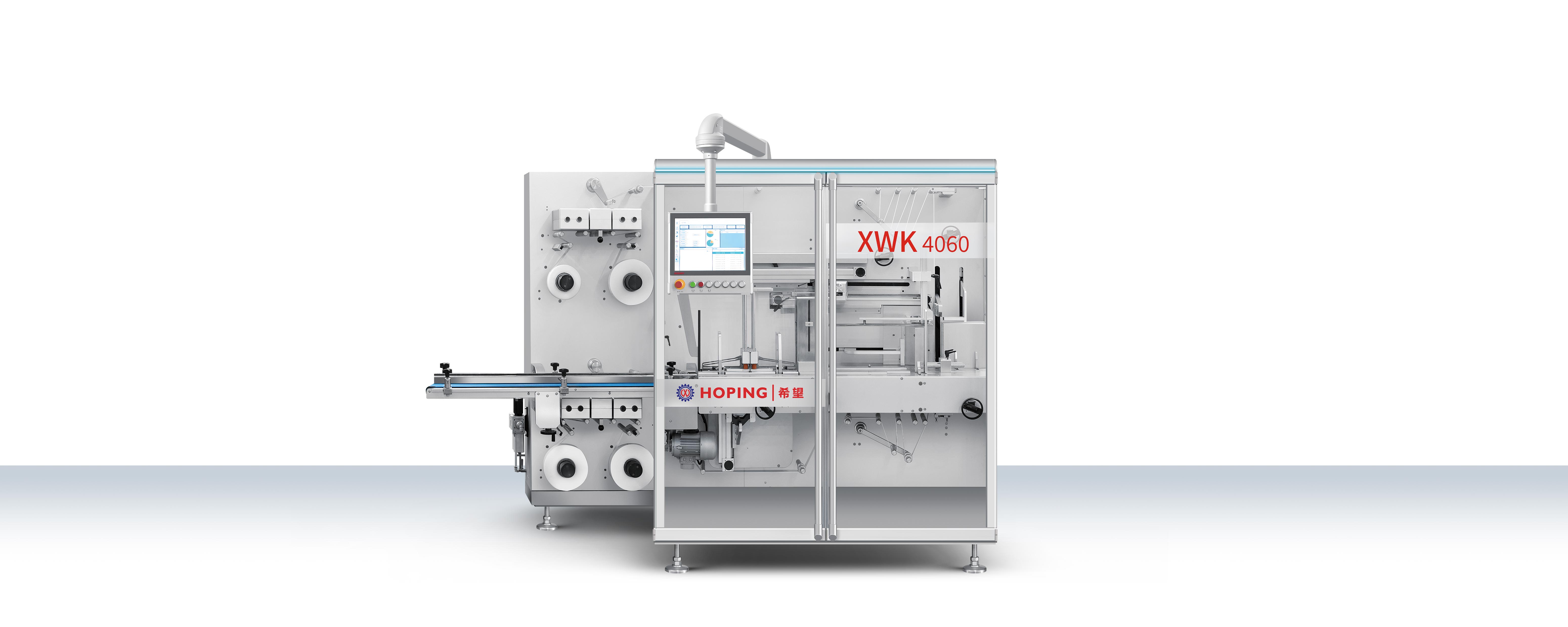
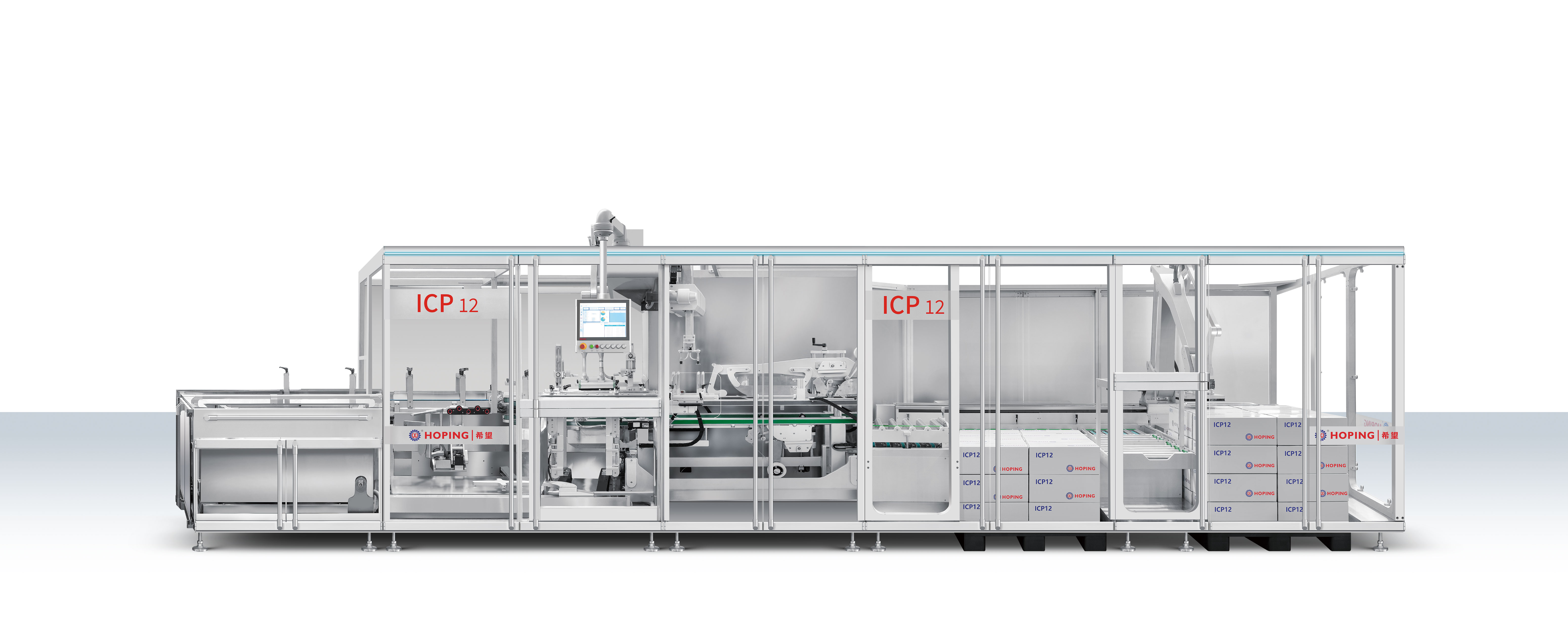
The DHL8005H scope explicitly includes connection to bundling, case-packing and palletizing equipment. The available modules in the same range include the XWK4060 intelligent fully servo stretch bander for cartons, boxes and grouped products after cartoning; the XWK Series case packing machine; and the ICP12 intelligent fully servo case packing and palletizing integral machine. Matched equipment for the packaging scenario is listed as including a leaflet folder, coding machine, vision inspection, checkweigher, bundler, case packer, palletizer and an ERP/MES data interface, depending on project configuration. The practical test is whether those interfaces are designed into the original line or bolted on afterwards.
Reading a Specification for Upgrade Potential: The DHL8005H
The DHL8005H is documented as an intelligent fully servo high-speed blister-cartoner integrated machine and a solid dosage turnkey packing line, with a maximum stated capacity of up to 800 blisters per minute and 500 cartons per minute. Its documented features that bear directly on long-term evaluation are the Beckhoff motion controller and CP9315 industrial PC, the three-channel servo-driven independent replenishment system, the D3 intelligent top-loading parallel tracking transfer system, multiple feeding methods, PVC/Alu foil auto splicing, mold-change and preset-memory functions, and a GMP-oriented line design. Structure is stainless steel and aluminum-alloy with transparent guarding, and tooling and product-contact parts are configured according to a technical agreement.
Read as a lifespan document rather than a speed sheet, three things stand out. First, transfer, replenishment and format memory are all electronic functions on a shared PC-based platform, so their renewal path is software and module replacement rather than frame replacement. Second, the format-dependent parts are explicitly delegated to a technical agreement, which means the buyer controls how much of the machine is format-locked. Third, the GMP-oriented design language indicates that cleanability and documentation were considered at design stage — which is what determines the cost of re-qualification after any future change.
| Evaluation dimension | Question to put to the supplier | Evidence to request |
|---|---|---|
| Control architecture | Which controller and industrial PC does the line use, and does the same platform appear elsewhere in your range? | Controller and IPC models named in the technical agreement; spare-parts list |
| Format memory | Can a new SKU be called up as a stored recipe or preset rather than re-set manually? | Demonstrated mold-change and preset-memory function |
| Format envelope | What blister and carton sizes sit inside the mechanical envelope, and what falls outside it? | Forming area, forming depth and stroke range; carton size limits |
| Output headroom | Is the stated output a maximum or a sustained figure, and where is the bottleneck? | FAT/SAT protocol; sustained-output and rejection data |
| Downstream expansion | Can bundling, case packing and palletizing be added later without redesigning the line? | Interface, layout and connection documentation |
| Compliance continuity | Which documents support re-qualification after a format or control change? | GMP-oriented design documentation; change-control records |
| Spares and tooling | Which parts are single-source, and what is the stated lead time? | Spare-part list and tooling schedule |
Comparison With Traditional Line Design — and the Limits of Upgradability
Traditional blister-cartoning procurement optimized for a fixed product: a fixed blister format, a fixed carton size, a mechanical transfer and a closed control cabinet. That approach still produces good output for a single high-volume SKU, and it is often cheaper at the point of purchase. Its weakness is that every subsequent change — a new format, a new data requirement, a downstream extension — is treated as a new project rather than as a configuration change.
A servo-driven, PC-controlled architecture with stored format recipes is designed against that weakness. The trade-off is real, though, and it is worth stating plainly rather than presenting upgradeability as a universal advantage.
- Control renewal cannot change mechanical geometry. Forming area and forming depth are physical. A control platform upgrade does not widen the blister format envelope, and it does not change the design of GMP-relevant product-contact parts.
- The bottleneck can move rather than disappear. Within the documented range, cartoning output is stated at 500 cartons per minute on several models even as blister output rises. Raising primary capacity on an existing line may simply expose the secondary packaging constraint.
- Stated maxima are not validated sustained output. The verified dataset used for this article explicitly notes, for the maximum-output claim in this range, that the exact model and format were not established and that “maximum output may not equal sustained validated output.” Any upgrade must therefore be proven at acceptance testing, under the buyer's own format, station count and rejection conditions.
- There is a point where a second line beats a retrofit. When format envelope, cartoning ceiling and downstream layout all have to move at once, adding capacity in parallel is frequently more rational than rebuilding the original machine.
- Regulatory dependencies are outside the supplier's control. China's packaging-material GMP remains a draft under public consultation, and the underlying issuing-authority document was not retrievable in the source material used here. Buyers should confirm the final text before treating it as a design requirement.
Market Signals Behind Long-Term Line Decisions
Three published signals support the argument that lifespan planning is becoming a mainstream procurement criterion rather than a specialist one.
The first is regional growth. Asia-Pacific has been identified as the fastest-growing region for pharmaceutical blister packaging at an 8.87% CAGR to 2031 (Custom Market Insights). Faster-growing markets tend to buy capacity in phases, which makes a phased upgrade path more valuable than a single oversized purchase.
The second is the digitisation signal: trade media reporting PMMI content states that pharmaceutical manufacturers are turning toward digitised data collection and integrated solutions to meet regulations and improve visibility. On a packaging line, that requirement lands on the control architecture and on the availability of an ERP/MES data interface, not on the blister forming station.
The third is standards continuity. ISO 15378:2017 specifies GMP requirements for primary packaging materials for medicinal products, and the FDA provides official cGMP guidance on production and process controls. Neither document names a machine model, which is precisely the point: compliance attaches to the process, and the process has to be re-evidenced after any significant change to the line.
Future Outlook
On the evidence available, three developments are likely to shape how pharmaceutical packaging lines are evaluated over the next purchasing cycle. Control-platform consistency across a supplier's range will become a more visible selection criterion, because it determines how much of a future upgrade can be delivered as configuration rather than as a new machine. Format and recipe memory will increasingly be treated as standard rather than optional on multi-SKU pharmaceutical cartoning machines, since changeover flexibility is the mechanism by which a line serves more than one product family. And documentation continuity will keep tightening, particularly in markets where packaging-material GMP obligations are still being finalised.
For buyers, the practical implication is that the specification conversation should include the maintenance conversation. Asking which controller, which format parts and which downstream interfaces will still make sense in ten years costs nothing at the quotation stage and is expensive to fix afterwards.
FAQ
What does “machine lifespan” actually mean for a pharmaceutical blister-cartoning line?
It means three separate service lives measured on different clocks. The mechanical clock is set by structure and tooling — for example, stainless steel and aluminum-alloy construction with format parts configured to a technical agreement. The control clock is set by the controller and industrial PC, such as the Beckhoff motion controller and CP9315 industrial PC used on the DHL8005H. The compliance clock is set by the buyer's GMP file, which has to be re-evidenced whenever the line changes. A line is only genuinely at end of life when all three clocks have run out.
How can a buyer tell whether a line can be upgraded later without replacing it?
Three documented features indicate an upgrade path. The first is stored format capability: the DHL8005H is documented with mold-change and preset-memory functions, and the DHL1000/5H with mold-change and recipe memory functions, which means a new SKU can be called up rather than re-set from scratch. The second is a control architecture that supports additional stations and data interfaces, including an ERP/MES data interface where project configuration allows. The third is explicit downstream connection scope — on the DHL8005H, connection to bundling, case-packing and palletizing equipment is stated in the line scope rather than added later.
What role does the control platform play in long-term upgrade potential?
It determines how much of a future change is software and module work rather than frame work. Within the Hoping range, the Beckhoff motion controller with CP9315 industrial PC combination appears on the DHL8005H, DHL6004, IXW600 and IXW800, while the DHL7005H uses a Siemens motion controller with a TP900 HMI and the IXW400 liquid dosage line uses a Siemens controller with a CP9315 industrial PC. Buyers running or planning more than one line should compare platform commonality, because it affects spare parts, engineering familiarity and training across the fleet.
Which parts of a blister-cartoning line affect output quality first as the machine ages?
The documented modules point to five areas: forming geometry, where dimensional stability depends on forming area, forming depth and stroke range; sealing consistency, supported on the DHL8005H by PVC/Alu foil auto splicing; transfer accuracy, handled on the DHL8005H by the D3 intelligent top-loading parallel tracking transfer system; replenishment balance, handled by the three-channel servo-driven independent replenishment system; and carton-side handling covering leaflet insertion, carton opening, closing, coding and inspection. No published degradation rates exist for these components in the sources used here, so the relevant question is which of them can be restored on site with available spares and tooling.
When is it better to add a second line than to upgrade an existing one?
When more than one constraint has to move at the same time. Documented cartoning output is stated at up to 500 cartons per minute on the DHL8005H, DHL1000/5H and DHL7005H, so increasing blister-side speed alone does not automatically increase finished-carton output. In addition, stated outputs are manufacturer maxima: the verified dataset notes that the exact model and format were not established for the maximum-output claim and that maximum output may not equal sustained validated output. If a buyer needs a different blister format, a higher cartoning ceiling and additional downstream modules together, a parallel line is usually the more predictable route than a rebuild.
For readers who want the full specification set behind the examples used above, the Hoping Machinery product catalog is available here: Hoping Machinery Catalog (PDF).
Tem questões ou precisa de mais detalhes?
Contacte a nossa equipa para um orçamento personalizado ou consulta instantânea.
Solicitar orçamento
Preencha o formulário abaixo e a nossa equipa entrará em contacto com uma proposta personalizada.
Chat direto do WhatsApp
Prefere conversar em tempo real? Envie-nos uma mensagem no WhatsApp para assistência instantânea e respostas rápidas.
- Obter orçamento personalizado
- Partilhar fotos ou documentos
- Discuta as suas necessidades diretamente
Geralmente responde em 5–30 minutos durante o horário de expediente.