
Magic Plus, Smart T Plus, FRL/FRSL: Certifications, Awards, Patents
Magic Plus, Smart T Plus, FRL/FRSL: Certifications, Awards, Patents
Rollable and foldable LED displays have moved from exhibition novelty to procurement line item. Third-party market research values the global flexible display market at approximately USD 20.1–21.6 billion in 2024, while the foldable and rollable sub-segment is projected to grow from USD 5.1 billion in 2024 to nearly USD 60 billion by 2035. The consequence for buyers is not excitement but homework: a rollable LED screen is now assessed against a destination market's certification rules, a venue's structural limits, and the supplier's patent position on the folding or rolling mechanism itself.
This industry reference profiles three flexible-format lines manufactured by Onumen Technology Co., Ltd. — Magic Plus (FPS), Smart T Plus (FTS) and the Rolling Rollable LED Display (FRL/FRSL) — and matches each to a different set of deployment priorities. Onumen Technology is a Shenzhen-based LED display manufacturer founded in 2009 that specialises in lightweight foldable and rollable display systems; the company operates a 2,000 m² production facility with a 20-engineer R&D team, reports annual output of 9,000 m², and exports roughly 70% of production to the USA, Europe, Japan, South Korea, Russia and the Middle East.
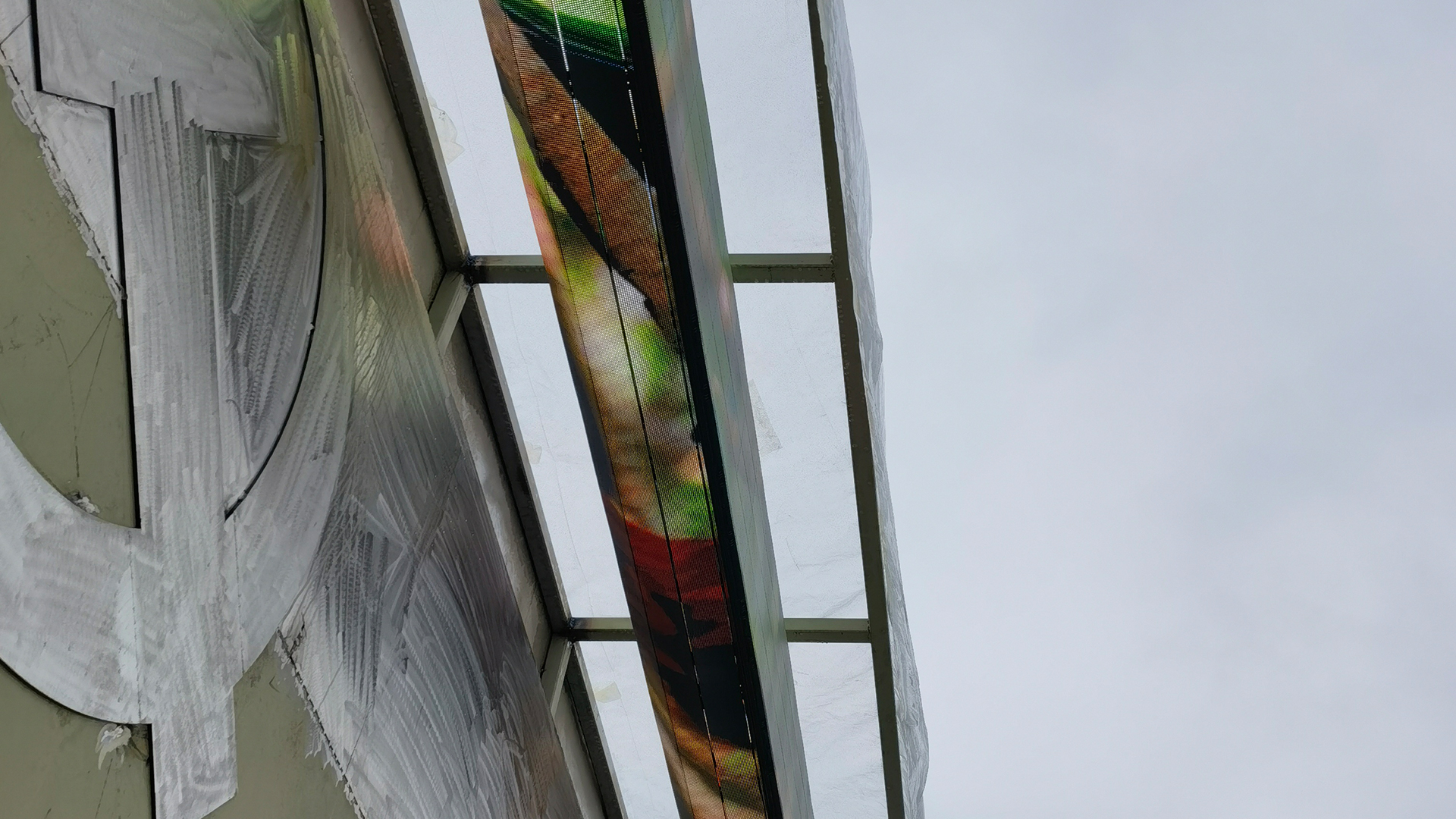
Outdoor rollable LED display deployment in Shanxi, China: a stored-and-deployed installation built around the Rolling Rollable LED Display (FRL/FRSL).
Why a compliance brief, not a feature list, decides the shortlist
Two buyers can examine the same flexible LED panel and reach opposite conclusions, because their obligations differ. A rental operator moving equipment across the EU needs CE safety and EMC files plus RoHS documentation before the product can be placed on the market. A US venue operator works to a different instrument: FCC Part 15 Subpart B for electromagnetic compliance, and — for public-space installations such as airports and theatres — published standard summaries reference UL 62368-1 for electrical safety and UL 94 V-0 for fire resistance. In the EU and China, IEC 62471 photobiological safety is a separate requirement intended to limit blue-light hazard from LED products. In mainland China, foldable LED display models require China Compulsory Certification; a CCC certificate (number 2021200903000314, issued by CEPREI under GB4943.1-2011) is documented for the OM-F foldable display platform.
Design recognition plays a second, quieter role. Awards such as the iF DESIGN AWARD, Red Dot and the French Design Award are third-party evaluations that do not depend on a supplier's own marketing narrative. For buyers assessing engineering and design maturity — particularly rental houses and integrators who must justify inventory to their own clients — they function as an external reference point rather than a specification.
Mechanism patents are the third filter. A foldable or rollable screen is a mechanical product as much as an electronic one, and the hinge, module and drive designs are frequently patented in specific jurisdictions. That is why certificate numbers and patent family coverage belong in the evaluation file, alongside pixel pitch and brightness:
- Market access: CE LVD and CE EMC for the EU; FCC Part 15 Subpart B for the US; CCC for mainland China.
- Public-space safety: UL 62368-1 and UL 94 V-0 referenced for installations in airports and theatres.
- Photobiological safety: IEC 62471 required for LED products in the EU and China.
- Design evaluation: iF DESIGN AWARD, Red Dot and French Design Award records.
- Format freedom: invention patents covering the foldable and rollable mechanism, jurisdiction by jurisdiction.
The shortlist at a glance
The three lines below share a common engineering philosophy — separated power and screen architecture, lightweight modules and 3,840 Hz refresh — but they answer different procurement questions.
| Option | Documented compliance and recognition | Flexibility and key parameters | Priority it fits |
|---|---|---|---|
| Magic Plus (FPS) 180° foldable flexible LED display |
CE EMC (TÜV Rheinland, AE 50336726 0001; also filed as CE EMC BST11030273Y-1RC-4), FCC, ISO 14001:2015 | Pixel pitch P2.6 / P3.9; 6,000 nits; 3,840 Hz; 15 mm thick; 15 kg/m²; IP65 by double-sided potting, up to IP68; 180° fold; 140° horizontal / 140° vertical viewing | Outdoor advertising, stage and rental work where brightness and a compact fold matter more than see-through |
| Smart T Plus (FTS) foldable transparent LED display |
iF DESIGN AWARD coverage, ISO 14001:2015, CE; RoHS (BST11030273Y-1RC-4); product data lists CE, RoHS and FCC | Pixel pitch P3.9-7.8 to P37.5; transparency 16.37%–56%; 1,100–9,700 nits; 3,840 / 7,680 Hz; 8–12 kg/m²; IP65, up to IP68; 360° fold; 30 m maximum single power cable load | Glass curtain walls, architectural media facades and retail where the display must stay see-through |
| Rolling Rollable LED Display (FRL/FRSL) automatic rollable LED display |
ISO 9001:2015 (95722Q0036R0S), ISO 14001:2015 (95722E0015R0S), CE LVD (BST13030465Y-1SC-2), CE EMC (BST13030465Y-1EC-1), FCC (BST13030465Y-1EC-3), RoHS (BST11030273Y-1EC-1), French Design Award 2026 Gold (Gold 9867); patents EP 2755459, US 8,899,791 B2 and others | Indoor P1.25 / P1.56 / P1.953 / P2.6 / P3.9; outdoor P2.6 / P3.9; indoor 600–1,000 nits, outdoor 2,000–6,000 nits; 3,840 Hz; 2,500:1 contrast; indoor 13–15 kg/m², outdoor 18 kg/m²; indoor front IP54 / rear IP43, outdoor IP65 both faces; 500 × 62.5 mm module | Roll-up storage and large-format backdrops where the screen must disappear between events |
Magic Plus (FPS): high-brightness 180° folding
Magic Plus is a 180° foldable flexible LED display built on the FPS series, and its defining number is brightness: 6,000 nits from a module measuring 250 × 250 mm and 15 mm thick. That output, combined with IP65 protection achieved through double-sided potting (up to IP68), positions the line for outdoor advertising, stadium and sports-event environments where ambient light is the constraint rather than mounting elegance. Weight is stated at 15 kg/m², with a 3,840 Hz refresh rate, 16-bit grey scale, 140° horizontal and 140° vertical viewing angles, and a working range of −20 °C to +45 °C on DC24V or DC48V with AC100–240V input.
From a compliance standpoint, Magic Plus carries CE EMC certification issued by TÜV Rheinland under number AE 50336726 0001, with a second CE EMC file recorded under BST11030273Y-1RC-4, and it is FCC certified for the US market. Environmental management documentation applies at company level: the ISO 14001:2015 certificate is registered against the scope of research, development, manufacturing and sales of LED displays, with Magic Plus listed among the applicable products.
The boundary to note is mechanical rather than electrical. A 180° fold suits panels that must close flat for transport or be concealed in a wall recess; it does not produce the wrap-around geometry of a 360° folding cabinet, and the documented pixel-pitch options stop at P2.6 / P3.9, which is a fine pitch for outdoor work but not the finest pitch available in the wider portfolio.
Smart T Plus (FTS): transparent 360° folding
Smart T Plus moves the problem from brightness to visibility through the screen. It is a foldable transparent LED display with a 360° fold angle, transparency from 16.37% to 56%, and brightness from 1,100 to 9,700 nits depending on configuration. The module range is unusually wide — 250 × 375 mm, 375 × 500 mm and 300 × 450 mm — and pixel pitch spans P3.9-7.8, P7.8, P7.8-15.6, P15.6, P31.25 and P37.5. Weight is the lightest of the three lines at 8–12 kg/m², thickness runs 18.2–22.5 mm, protection is IP65 with up to IP68 available, and a single power cable can carry a maximum load of 30 m. Refresh rates of 3,840 Hz and 7,680 Hz are documented, with a 2,500:1 contrast ratio and 16-bit grey scale.
Its recognition profile is design-led: the line is covered by iF DESIGN AWARD criteria and holds CE certification, with RoHS documentation recorded under number BST11030273Y-1RC-4. The same product data sheet that lists its physical parameters also states CE, RoHS and FCC certification. Environmental management coverage follows the company-level ISO 14001:2015 certificate.
The limitation is inherent to transparency. As pitch coarsens toward P15.6 and beyond, resolution per square metre falls sharply — the line's documented pixel density runs from 711 to 32,768 pixels/m² — so close-viewing applications such as conference content or fine text call for the finer end of the range, where transparency is lower. Buyers who want both maximum see-through and maximum resolution are choosing between two ends of one scale.
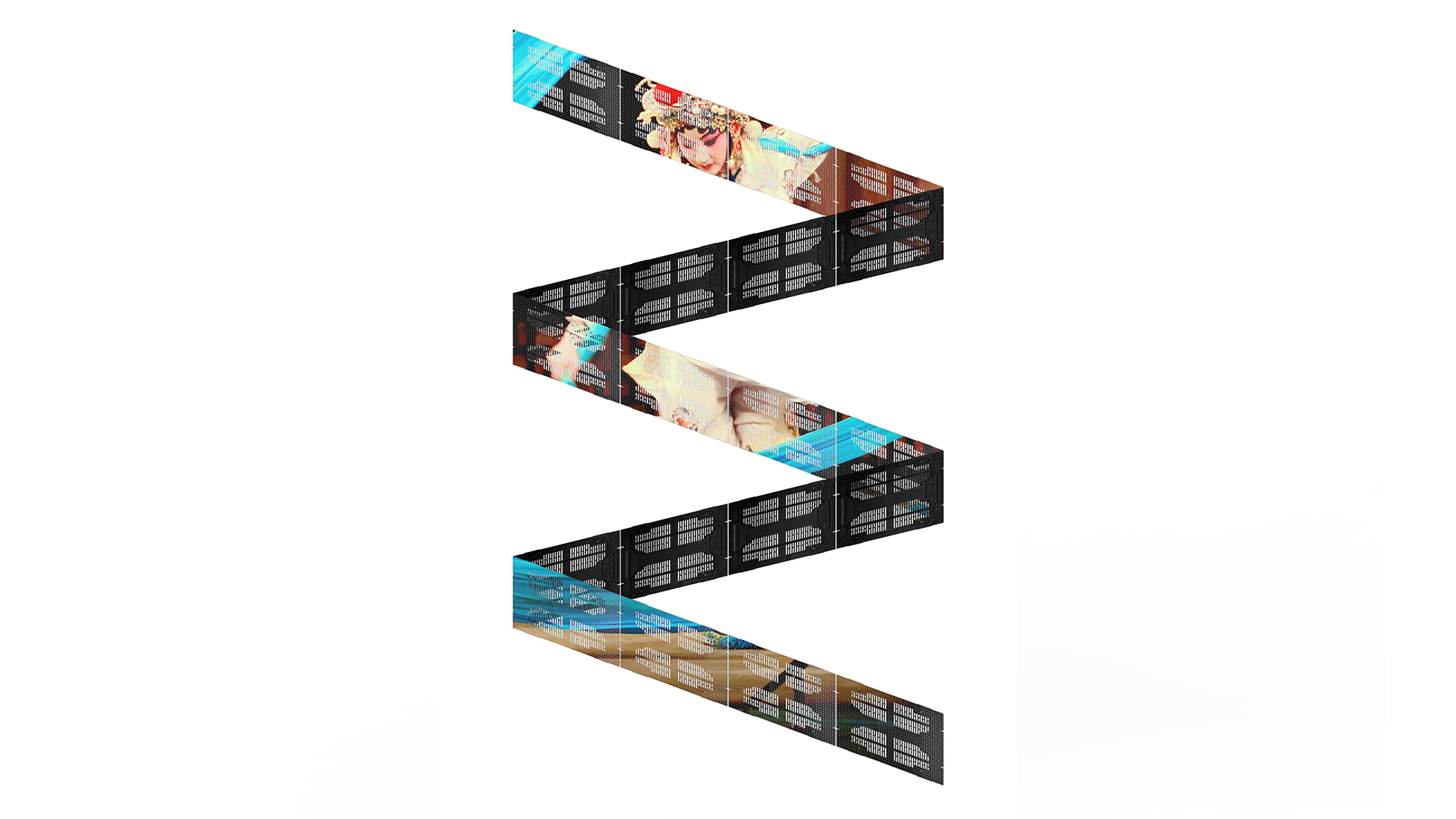
Smart T Plus (FTS): a foldable transparent LED display with a 360° fold angle and 16.37%–56% transparency.
Rolling Rollable LED Display (FRL/FRSL): automatic roll-up
The FRL/FRSL line is the only automatic rollable option in this shortlist, and it also carries the most complete documented certification set. It is certified to ISO 9001:2015 (certificate 95722Q0036R0S) and ISO 14001:2015 (certificate 95722E0015R0S) for the global market, and to CE LVD under EN 60950-1:2006+A11:2009+A1:2010+A12:2011 with certificate BST13030465Y-1SC-2, CE EMC under EN 55022:2010 with certificate BST13030465Y-1EC-1, FCC with certificate BST13030465Y-1EC-3 for the US, and RoHS under EPA3050B:1996 with certificate BST11030273Y-1EC-1. It also received the French Design Award 2026 Gold Award under certificate Gold 9867.
Technically, the platform runs indoor pixel pitches from P1.25 through P1.56, P1.953, P2.6 and P3.9, and outdoor pitches of P2.6 and P3.9. Indoor brightness is 600–1,000 nits, outdoor 2,000–6,000 nits, with 3,840 Hz refresh, 16-bit grey scale, a 2,500:1 contrast ratio, DC48V working voltage and AC100–240V input. Module size is 500 × 62.5 mm — a narrow strip designed to coil — and weight is 13–15 kg/m² indoors against 18 kg/m² outdoors. Protection ratings separate the two variants clearly: indoor front IP54 with rear IP43, outdoor IP65 on both faces.
Patent coverage is where the rollable format shows its age as an engineering discipline rather than a marketing category. The freely-foldable flexible LED screen technology is covered by European Patent EP 2755459, granted by the European Patent Office, and by United States Patent US 8,899,791 B2 from the USPTO, with national validations including Germany (DE602013014598.9), Italy, the Netherlands and Belgium. Rollable-specific registrations include Japanese Patent JP 7852969 for a rollable screen, granted by the Japan Patent Office, and Chinese Invention Patent ZL202310190465.7 for rollable LED screen technology issued by CNIPA, alongside Canadian Patent CA 2,855,934. Korean Patent KR 10-1692125 is recorded within the same flexible-format family for the foldable LED display screen. Related registrations in Taiwan (TW I560662 and TW I560663), Hong Kong (HK1195436), Mexico (MX 349091), Singapore (SG 2014014856), Australia (AU 2013317305) and South Africa (ZA 2014/05969) complete a portfolio that spans Asia, Europe, the Americas and Oceania.
What actually differs between folding and rolling
Folding and rolling are often marketed as variations of one idea, but they impose different constraints on a project. A folding screen articulates along defined fold lines, so its transport geometry is predictable and its installed geometry can be sculpted — a 180° fold closes flat against a wall or recess, while a 360° fold allows panels to wrap, wave or form circular and staircase layouts. A rolling screen coils into a housing around a narrow module strip, so its transport geometry is compact along one axis and its installed geometry is a flat span that retracts vertically or horizontally.
Across all three lines, several parameters are consistent: synchronous or asynchronous control modes, 16-bit grey scale, a 3,840 Hz refresh baseline, and a working temperature range of −20 °C to +45 °C with storage from −20 °C to +60 °C. Production-side facts matter as much as the datasheet when a flexible screen is specified for a fixed date: monthly capacity is stated at 3,000–5,000 m², lead time at 30–90 days after order confirmation, minimum order quantity at 1 m², and every shipment is subject to a 100% aging test and quality inspection. Customisation covers screen size, pixel pitch, cabinet design, installation structure, control system, logo and packaging.
Where the three lines have been deployed
Deployment records are the most useful counterweight to specification sheets, because they show which format survives contact with a real venue. The rollable FRL/FRSL platform is documented in an outdoor cultural tourism installation at the former site of the Eighth Route Army Headquarters in Mata Town, Zuoquan County, China — a 50+ m² outdoor rollable display in service for more than five years, where the screen stores safely when not in use and deploys quickly for exhibitions while preserving the historical site's appearance.
Folding formats dominate the performance and architectural records. In South Korea, a 500+ m² liftable foldable LED display was integrated into a SHINee concert stage, enabling lifting and folding movement during the performance. In Japan, three large screens totalling 1,670 m² (3 units of 33 m × 16 m) supported the Fukuyama Masaharu tour. In France, a 100+ m² liftable foldable display was built into a stadium concert stage structure. Corporate and civic installations follow the same pattern: a three-sided immersive foldable display wrapped a vehicle at a Geely launch event, a 100+ m² hidden liftable foldable display was integrated into the 2024 MAMA AWARDS Japan stage beneath the floor, and a 50+ m² hidden liftable foldable display was installed in the Tai Wai MTR shopping mall in Hong Kong, where the screen stays concealed when idle and lowers for promotions.
Education and transport venues show the space-saving logic at smaller scale: a 30+ m² liftable foldable display retracts into a lecture hall ceiling at Wenzhou Foreign Language School, a 15+ m² outdoor liftable foldable display sits in a kindergarten playground in Ordos, Inner Mongolia, hiding when not in use, and a 50+ m² ultra-thin fixed LED display with a separated power supply structure operates at Tokyo Shibuya Station.
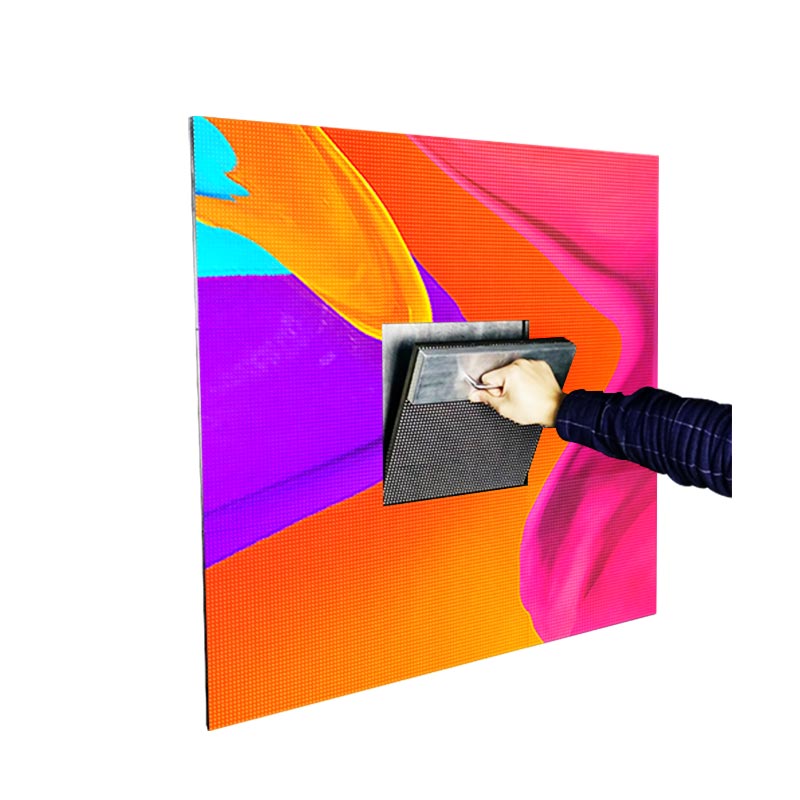
Magic Plus (FPS): a 250 × 250 mm, 15 mm thin foldable module rated at 6,000 nits and IP65.
Market direction: flexible formats moving into standard procurement
The macro numbers explain why specification questions are getting sharper. The rollable and foldable display segment is projected to grow from USD 5.1 billion in 2024 to nearly USD 60 billion by 2035, according to third-party research aggregated by Meticulous Research and openPR. Independent market estimates for the broader flexible display market differ by scope — Grand View Research places 2024 at about USD 20.1 billion, while Spherical Insights estimates USD 21.55 billion — and that divergence itself is a useful reminder that category-level figures should be treated as directional rather than contractual.
Competitive structure is also documented. Third-party industry reporting identifies Samsung Electronics, Leyard and LG Electronics as the three largest players in the outdoor and flexible LED display market in 2024, with specialist manufacturers competing on flexible-format engineering, patent coverage and market-specific certification. On the demand side, one industry compilation of venue case studies reports revenue increases of 15% to 25% from advertising and premium sponsorship after venues upgrade to advanced LED video walls; that figure is aggregator-level rather than audited, so it is best used as a directional indicator of why venues keep investing rather than as a forecast for any single project.
What the data does not show is any relaxation of market-access rules. If anything, the direction of travel is toward more documentation per shipment — safety standard version, photobiological test file, chemical compliance and management-system currency — because flexible screens are now installed in public buildings, not only on temporary stages.
Where flexible formats still give up ground
A shortlist is only credible if it states where a product loses. Compared with conventional cabinet-based fixed or rental LED screens, flexible and rollable formats trade a set of engineering certainties for transportability and architectural integration, and several of those trades are visible in the documented parameters.
- Pixel pitch ceiling. The FRL/FRSL line begins at P1.25 indoors and offers only P2.6 and P3.9 outdoors. Projects requiring finer indoor pitch than P1.25, or finer outdoor pitch than P2.6, sit outside the documented range of these lines.
- Rear-face protection. The indoor FRL/FRSL variant is rated front IP54 and rear IP43. Dusty, humid or washable environments call for the outdoor IP65 configuration, and indoor installations should not be assumed to carry outdoor sealing.
- Structural weight. Outdoor FRL/FRSL is stated at 18 kg/m² against 8–12 kg/m² for Smart T Plus. Rigging, truss and recess design must follow the heavier figure when the outdoor variant is selected.
- Mechanical service paths. Rolling screens include a drive and housing, and folding screens articulate along fold lines. Both need maintenance access and handling procedures that a flat cabinet does not, and that requirement should appear in the venue drawing set rather than in the delivery schedule.
- Safety and photobiological documentation. The certificates documented in this shortlist cover CE LVD, CE EMC, RoHS, FCC and ISO management systems. UL 62368-1 and UL 94 V-0 are referenced in published standard summaries for public-space installations, and IEC 62471 applies to LED products in the EU and China. Where a project falls under those requirements, the corresponding test file should be requested and matched to the destination market before contract award.
- Certificate currency. Management-system certificates and national market approvals are renewed on defined cycles. Buyers should confirm the current certificate version, scope and validity date at the time of purchase rather than relying on a previously filed copy.
What buyers should expect next
Three developments are reasonable to plan for. First, flexible-format procurement will keep shifting from project-specific engineering toward catalogue configuration: the documented customisation scope already covers pixel pitch, cabinet design, installation structure, control system, logo and packaging within a single order flow, with a 1 m² minimum order quantity and a 30–90 day lead time. Second, patent geography will matter more, not less, because rollable and foldable mechanisms are protected in specific jurisdictions and distributors increasingly ask which registrations cover the product they resell. Third, documentation will become the differentiator at tender stage, since CE, FCC, RoHS and ISO files — and any project-specific safety or photobiological test data — are what convert a promising product into an approved one.
FAQ
Which certifications should an EU buyer verify on a rollable LED screen?
EU buyers typically need CE marking files covering both safety and electromagnetic compatibility, plus RoHS documentation. In this shortlist, the Rolling Rollable LED Display (FRL/FRSL) is documented under CE LVD to EN 60950-1:2006+A11:2009+A1:2010+A12:2011 with certificate BST13030465Y-1SC-2, under CE EMC to EN 55022:2010 with certificate BST13030465Y-1EC-1, and under RoHS with certificate BST11030273Y-1EC-1 (standard EPA3050B:1996). Magic Plus (FPS) holds CE certification issued by TÜV Rheinland under number AE 50336726 0001. Smart T Plus (FTS) holds CE certification and RoHS documentation. IEC 62471 photobiological safety is a separate LED requirement in the EU and China, so the corresponding test file should be requested where the installation falls under it.
How does US market documentation differ from the EU requirement?
For the United States, electromagnetic compliance is demonstrated through FCC Part 15 Subpart B rather than CE marking. The Rolling Rollable LED Display (FRL/FRSL) is verified to FCC standards under certificate BST13030465Y-1EC-3, and Magic Plus is FCC certified; the Smart T Plus product data also lists FCC certification. For public-space venues such as airports and theatres, published standard summaries reference UL 62368-1 for electrical safety and UL 94 V-0 for fire resistance, and those files are project-specific, so they should be confirmed directly against the intended configuration.
What pixel pitch and brightness ranges do the three lines cover?
Magic Plus (FPS) is documented at P2.6 and P3.9 with 6,000 nits brightness. Smart T Plus (FTS) spans P3.9-7.8, P7.8, P7.8-15.6, P15.6, P31.25 and P37.5, with transparency from 16.37% to 56% and brightness between 1,100 and 9,700 nits. The Rolling Rollable LED Display (FRL/FRSL) covers indoor P1.25, P1.56, P1.953, P2.6 and P3.9 at 600–1,000 nits, and outdoor P2.6 and P3.9 at 2,000–6,000 nits. All three document a 3,840 Hz refresh rate, with Smart T Plus also offering 7,680 Hz.
What patent coverage exists for the flexible-format technology?
The freely-foldable flexible LED screen technology is covered by European Patent EP 2755459 granted by the European Patent Office and United States Patent US 8,899,791 B2 granted by the USPTO, with national validations including Germany (DE602013014598.9), Italy, the Netherlands and Belgium. Rollable-specific registrations include Japan Patent JP 7852969 and Chinese Invention Patent ZL202310190465.7, plus Canadian Patent CA 2,855,934. Within the same family, Korean Patent KR 10-1692125 is recorded for the foldable LED display screen. Additional registrations exist in Taiwan (TW I560662, TW I560663), Hong Kong (HK1195436), Mexico (MX 349091), Singapore (SG 2014014856), Australia (AU 2013317305) and South Africa (ZA 2014/05969).
What quality and environmental management systems sit behind the products?
Three management-system certificates are documented, all issued by Boston Certification and scoped to research, development, manufacturing and sales of LED displays: ISO 9001:2015 under certificate number 95722Q0036R0S, ISO 14001:2015 under certificate number 95722E0015R0S, and ISO 45001:2018 under certificate number 95722S0012R0S. The Rolling Rollable LED Display (FRL/FRSL) is explicitly listed under the ISO 9001:2015 and ISO 14001:2015 scope, and Magic Plus (FPS) and Smart T Plus (FTS) are listed among applicable products for the environmental management certificate. Because these certificates are renewed on a cycle, buyers should confirm the current version and validity date during evaluation.
What minimum order quantity, lead time and quality control apply?
The documented commercial parameters are a minimum order quantity of 1 m², a lead time of 30–90 days after order confirmation, and a monthly production capacity of 3,000–5,000 m². Every shipment undergoes a 100% aging test and quality inspection before dispatch. Remote technical support, installation guidance, maintenance support and spare parts supply are part of the after-sales scope, which matters for rollable formats because the drive and housing are serviceable mechanical components.
Which configuration choices affect project scope and delivery most?
Within these lines, the customisable variables are screen size, pixel pitch, cabinet design, installation structure, control system, logo and packaging. In practice, four of them change project scope fastest: pixel pitch, which sets resolution and price positioning; indoor versus outdoor rating, which determines the protection rating (indoor FRL/FRSL front IP54 / rear IP43 versus outdoor IP65 both faces); the format mechanism, since folding and rolling require different mounting and storage provisions; and the control system, which determines whether the screen runs synchronously or asynchronously. Lead time is quoted from order confirmation rather than from enquiry, so freezing the configuration early compresses the schedule.
Closing perspective
The three lines in this shortlist are not interchangeable, and that is the point of a compliance-led shortlist: Magic Plus answers daylight brightness with a 180° fold, Smart T Plus answers architectural transparency with a 360° fold, and the Rolling Rollable LED Display answers storage and logistics with an automatic roll mechanism supported by an unusually complete certification and patent record. Matching them begins with the destination market's documentation requirements and the venue's physical constraints — and only then with the datasheet.