
Magnesium Rotary Kiln to Ingot: ZK MACHINE Line Integration
Magnesium metal is produced along a chain of thermal and mechanical steps rather than inside a single furnace. Dolomite is calcined, the calcined material is ground and briquetted, the briquettes are reduced, and the result is refined into ingot. Because each stage defines the feed conditions of the next, the engineering question for a magnesium project is rarely which kiln to buy in isolation. It is whether the four stages are designed to meet each other.
That framing underpins how Henan Zhengzhou Mining Machinery Co., Ltd. (ZK MACHINE) presents its magnesium scope. ZK MACHINE is a Chinese process equipment manufacturer founded in 1956 that designs, manufactures, installs and commissions thermal processing and grinding systems, and it lists Magnesium Ingot Production Process — covering calcination, pelletizing, reduction and refining — among its metallurgical and chemical process systems. This article examines what that scope contains in engineering terms, what is documented about the magnesium rotary kiln at its centre, and where the boundary of the available evidence sits.
At a glance
- ZK MACHINE lists magnesium ingot production as a four-stage process system: calcination, pelletizing, reduction and refining.
- The Magnesium Rotary Kiln is specified for dolomite calcination at approximately 2–20 t/h, in a model range of Ø1.6×32 m to Ø4.0×80 m, with a kiln slope of approximately 3.5–4%.
- Documented integration extends from the kiln outward to grinding, briquetting, reduction and refining equipment.
- The published specification set does not state per-tonne energy consumption, magnesium recovery rate or guaranteed product purity; those values must come from project-level engineering data.
Why a magnesium project is evaluated as a line, not a machine
In a four-stage route, the output of one stage becomes the feed specification of the next. Calcined dolomite has to be reduced in size before it can be briquetted, briquettes have to meet a shape and density that the reduction step can accept, and the reduced product has to be handled in a form that refining can process. A mismatch at any interface surfaces downstream, and the further downstream it surfaces, the more costly it is to correct, because the correction usually means re-opening equipment that has already been installed and balanced.
This is why magnesium projects tend to be compared on procurement models rather than on individual machine specifications. In the first model, the buyer purchases a kiln from one supplier, a grinding circuit from another, briquetting equipment from a third, and reduction and refining units from specialists, then assembles the interfaces internally or through an engineering contractor. In the second model, a single process scope is defined from calcination through refining, and the interface engineering sits inside one organisation.
ZK MACHINE positions itself in the second category. Its stated capability is complete magnesium production line engineering, and its documented selling points for the Magnesium Rotary Kiln explicitly include the ability to be integrated with grinding, briquetting, reduction and refining processes. That is a scope claim, and scope claims should be read as engineering statements rather than as performance guarantees — which is the distinction the rest of this article tries to keep clear.
What the documented scope actually covers
ZK MACHINE organises its business around five process systems: new energy, new materials, environmental protection, metallurgical and chemical, and building materials. Magnesium ingot production sits inside the metallurgical and chemical system, alongside mineral processing flows for iron ore, bauxite, kaolin, copper ore, lead and zinc ore, gold ore, fluorite ore and graphite ore. Placing magnesium in that grouping is meaningful: the company treats it as a multi-stage metallurgical flow, not as a single kiln product line.
The equipment portfolio that supports these flows includes rotary kilns, ball mills, vertical preheaters, single-drum coolers, vertical coolers, dryers, granulators, feeders, dust collectors, bucket elevators, crushers, magnetic separators, flotation machines, classifiers and other auxiliary process equipment. Rotary kilns and ball mills are identified by the company as core equipment and key process units within many of its production systems — a detail that matters for magnesium, where the kiln provides calcination and the grinding circuit prepares material for the next stage.
Beyond individual machines, ZK MACHINE states that it integrates core equipment with crushing, screening, feeding, mixing, granulation, preheating, drying, cooling, conveying and dust collection systems to deliver complete, customised process solutions based on material characteristics, production capacity and process requirements. For a magnesium line, that integration list maps onto the practical interfaces: dolomite crushing and screening ahead of the kiln, preheating and cooling around it, granulation and briquetting after it, and dust collection across all of it.
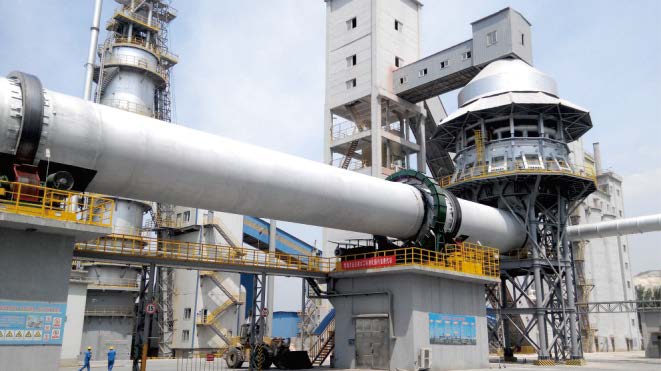
Magnesium rotary kiln — the calcination stage of a magnesium ingot production line, designed for high-temperature dolomite processing.
Inside the magnesium rotary kiln
The kiln is the stage where the process temperature is highest and where the structural and refractory decisions taken at the design stage determine how much of the operating campaign is available for production. ZK MACHINE's documented configuration for the Magnesium Rotary Kiln is summarised below. These are catalogue-level parameters, which is the correct level of precision to use when screening a supplier, not when signing a purchase order.
| Parameter | Documented value |
|---|---|
| Model range | Ø1.6×32 m to Ø4.0×80 m |
| Capacity | Approximately 2–20 t/h |
| Kiln slope | Approximately 3.5–4% |
| Applicable material | Dolomite |
| Application | Magnesium ingot production |
| Compatible equipment | Vertical preheaters and coolers |
| Fuel options | Multiple fuel options supported |
| Downstream integration | Grinding, briquetting, reduction and refining |
| Shell and structure | Carbon steel or alloy steel shell; refractory bricks or castable refractory; cast or forged steel riding rings and gears; forged or cast steel support rollers; heat- and wear-resistant seals; heat-resistant alloy steel burner components |
Documented configuration of the ZK MACHINE Magnesium Rotary Kiln. Material and component selection is customised according to temperature, material characteristics and operating conditions.
Three of these entries carry more weight than the rest. The first is the design intent: the kiln is described as designed for high-temperature dolomite calcination with stable calcination conditions, which is the functional requirement that separates a magnesium kiln from a lime or cement kiln of similar dimensions. The second is thermal management — compatibility with vertical preheaters and coolers, heat recovery from hot gases and improved fuel utilisation are all stated as characteristics of the unit, and they are the levers that determine how much of the fuel input reaches the material rather than the stack. The third is the integration statement, because a kiln that is designed to hand material to a briquetting and reduction circuit is specified differently from one that discharges to a stockpile.
Material selection follows the process rather than a fixed bill of materials. Shell, refractory, riding rings, gears, support rollers, seals and burner components are chosen according to operating temperature, material characteristics and operating conditions, which is the normal approach for a kiln that will run continuously at elevated temperature against an abrasive feed.
The manufacturing and engineering base behind the line
A scope claim of this kind is only as credible as the organisation behind it, so the physical and technical base is worth setting out in concrete terms. ZK MACHINE was founded in 1956 and has since evolved from a machinery manufacturing enterprise into a company that combines research and development, process engineering, equipment manufacturing, installation, commissioning and technical services. Its site in the Qiaolou Caizhai Industrial Zone in Zhengzhou covers more than 80,000 m², including over 60,000 m² of workshop space and more than 5,000 m² of office space.
Manufacturing is organised across 8 modern workshops and 5 heavy-duty workshops, equipped with more than 300 sets of manufacturing equipment, including boring and milling machines, gear hobbing machines, vertical lathes and heavy-duty cranes. The company states that this configuration allows it to manufacture medium- and large-scale equipment and complete process systems independently — the relevant point for a magnesium line, where kiln shells, riding rings and large rotating assemblies cannot be outsourced piecemeal without creating tolerance and delivery risk.
Two further facilities matter for process engineering rather than fabrication. ZK MACHINE operates its own process testing workshop and a testing and analysis centre, supporting pilot testing and process data analysis for solid waste and hazardous waste treatment, building materials, metallurgical materials and other applications. It also provides pilot rotary kilns alongside its industrial-scale units. For a buyer, the practical value is that process assumptions can be examined before a full line is committed.
On the technical side, the company holds a Zhengzhou Municipal Enterprise Technology Center and an Industrial Solid Waste Disposal Equipment Engineering Technology Research Center, supported by a multidisciplinary team that includes 10 doctors, 5 senior engineers and 16 intermediate engineers among its 235 employees. It reports more than 150 core patents and over 20 software copyrights, and participation in the drafting of more than 10 industry standards. Its management systems include ISO 9001 quality management, ISO 14001 environmental management and ISO 45001 occupational health and safety certification, together with an Integration Management System Certification and an Environmental Protection Engineering Professional Contracting Qualification.
Commercially, the company reports an annual output of 200 units, a monthly capacity of 10 units, a minimum order quantity of one unit, a lead time of three months, 100% testing and an export ratio of 40%, with products and process systems supplied to customers in more than 130 countries and regions. Those figures describe an established export-oriented industrial supplier rather than a project-specific engineering start-up.
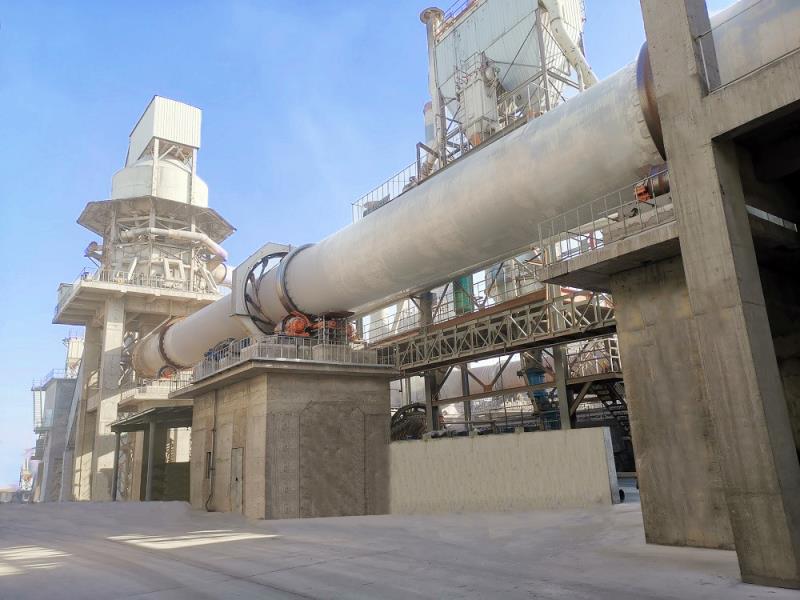
Magnesium project installation — the calcination stage is positioned upstream of briquetting, reduction and refining within the line.
What a buyer controls before engineering starts
Because rotary kilns and ball mills are not standard products, the quality of the engineering output depends heavily on the quality of the input data. ZK MACHINE states that every project requires customised engineering based on material properties, process requirements, production capacity, environmental regulations and site conditions. At the enquiry stage, the inputs that determine whether a proposal can be specific rather than generic are: the material name, required capacity, feed size, moisture content, target product, calcination temperature, fuel type and specific heat-consumption requirements.
For a magnesium project, the same list applies with dolomite as the material and magnesium ingot as the target product. Projects that arrive with assay data, size distribution and an agreed fuel strategy move into detailed engineering faster than projects that begin with a capacity figure alone, because the kiln diameter, length, slope and internal configuration all follow from the thermal duty rather than from the tonnage in isolation.
After the equipment scope is fixed, execution support becomes the next constraint. ZK MACHINE provides on-site installation guidance and commissioning, engineer dispatch, spare parts supply and technical training. Those four items are the practical definition of what happens between delivery and steady operation, and they are worth writing into a contract explicitly, since installation and commissioning are where schedules most often diverge from the plan.
Integrated line engineering versus multi-vendor procurement
The comparison that matters for a magnesium investor is not between two kiln brands. It is between two ways of allocating responsibility across a four-stage process. The table below sets out the difference in neutral terms; neither model is universally better, and the right choice depends on how much engineering capability the buyer already holds internally.
| Decision dimension | Multi-vendor equipment purchase | Single-scope line engineering |
|---|---|---|
| Interface responsibility | Interfaces between kiln, grinding, briquetting, reduction and refining are defined across separate contracts | Interfaces are defined inside one process scope covering calcination through refining |
| Process data | Each vendor holds data for its own unit; the buyer consolidates | Process data for the chain is held by one engineering team |
| Commissioning | Split by equipment boundary, coordinated by the buyer or a third party | Coordinated by the line supplier, with engineer dispatch and technical training included in scope |
| Spare parts and support | Multiple spare-parts channels and response paths | One spare-parts channel, one technical support path |
| Scope flexibility | Highest — each unit can be sourced on its own terms | Scope is built per project; there is no standard configuration to fall back on |
| Commercial transparency | Unit prices are individually comparable | Line pricing reflects engineering content, so unit-level comparison is difficult |
Comparison of procurement models for a four-stage magnesium line. The trade-off is between interface control and scope flexibility.
Where the integrated scope stops
A capability article that omits the boundary is a brochure, not a reference. Five limits are visible in the documented material, and a serious buyer should test each of them during evaluation.
- Capacity boundary. The published Magnesium Rotary Kiln range is approximately 2–20 t/h, with models from Ø1.6×32 m to Ø4.0×80 m. Requirements above that published envelope are not covered by the magnesium kiln specification and would need to be addressed as a separate engineering scope rather than assumed from the catalogue.
- Data dependency. Since the equipment is customised rather than standard, no firm proposal can be produced without feed and process data. A buyer who cannot supply material characterisation and site conditions will receive an indicative configuration, not an engineered one.
- Performance transparency. The published specification set does not state specific energy consumption per tonne, magnesium recovery rate or guaranteed product purity. Buyers comparing suppliers on operating cost should request those figures as project-level commitments rather than infer them from the kiln dimensions.
- Compliance scope. For projects requiring CE conformity, ZK MACHINE states that applicable requirements are determined from the final equipment configuration and applicable EU legislation and then incorporated into design and documentation. That is a configuration-dependent position, not a blanket marking on every unit.
- Concentration. Assigning the whole chain to one supplier concentrates both coordination and dependency. Spare-parts availability, engineer dispatch arrangements and technical training should be agreed in writing precisely because there is no second supplier holding the interface knowledge.
Market context: where metallurgy sits in rotary kiln demand
Magnesium is a metallurgical product, and the metallurgical segment is not the largest part of rotary kiln demand. One commercial research estimate for 2025 put cement kilns at roughly 62% of the global rotary kiln market, metallurgy at 24% and lime at 14%. Those shares describe where unit volume sits; they do not describe where engineering complexity sits, and a four-stage magnesium line is a considerably more integrated scope than a single cement kiln of comparable throughput.
Headline market-size figures for rotary kilns should be treated as directional only. Published estimates diverge substantially because some sources count complete production line value while others count only kiln cylinder hardware, and the definitions are rarely stated alongside the number. For a buyer, the useful conclusion is not the total market value but the structural point: metallurgy represents a material share of demand, and metallurgical projects are where multi-stage integration is normally required.
A second piece of context comes from the policy side. The U.S. Congressional Research Service has characterised the mining and processing of critical minerals for manufacturing as an energy-intensive and highly technical process requiring substantial space. Magnesium is not itself on the energy-critical mineral lists published by the WTO, but the same characterisation applies to dolomite-to-ingot processing: it is thermally intensive, it requires significant plot area, and its economics are decided by engineering rather than by the price of a single machine.
What to watch
Three developments are likely to shape how magnesium line capability is evaluated over the next procurement cycles.
The first is documentation depth. As more buyers compare suppliers across a full process chain rather than a single unit, the differentiator shifts from catalogue specifications to verifiable project data — acceptance records, measured energy consumption and refractory life. Suppliers who can supply that data at the proposal stage will be easier to shortlist.
The second is validation before commitment. Pilot rotary kilns and in-house process testing workshops make it possible to examine calcination behaviour on a specific dolomite source before the industrial line is frozen. ZK MACHINE operates both, which places early-stage process verification within the supplier scope rather than leaving it to a third-party laboratory.
The third is automation. Complete line scope as described by ZK MACHINE already includes feeding, preheating, combustion, cooling, dust collection, conveying and automated control systems configured to project requirements. In a four-stage line, control integration across stage boundaries is where operating stability is usually won or lost, and it is a natural extension of the integrated model rather than a separate purchase.
FAQ
What information is needed to start a magnesium rotary kiln enquiry?
Rotary kiln selection depends mainly on the material, required capacity, feed size, moisture content, target temperature, residence time and final product requirements. For a formal enquiry, the material name, required capacity, feed size, moisture content, target product, calcination temperature, fuel type and specific heat-consumption requirements should be provided.
Can a rotary kiln be customised for a specific dolomite source and site?
Yes. ZK MACHINE states that rotary kilns and ball mills are not standard products and that every project requires customised engineering based on material properties, process requirements, production capacity, environmental regulations and site conditions. Material and component selection for the kiln is adjusted according to processing temperature, atmosphere and material characteristics.
Should a magnesium project use a direct-fired or an indirect-fired kiln?
It depends on the material and process requirements. Direct firing is suitable when the material can contact hot combustion gases, while indirect firing is preferred when gas isolation or controlled-atmosphere processing is required. The choice determines the burner arrangement, sealing system and control strategy rather than only the kiln shell.
Can a complete production line be supplied instead of a single kiln?
Yes. In addition to the rotary kiln, ZK MACHINE can provide feeding, preheating, combustion, cooling, dust collection, conveying and automated control systems according to project requirements. For magnesium specifically, the documented Magnesium Rotary Kiln can be integrated with grinding, briquetting, reduction and refining processes, and complete magnesium production line engineering is stated as available.
What support is provided during installation and commissioning?
ZK MACHINE provides on-site installation guidance and commissioning, engineer dispatch, spare parts supply and technical training. Depending on the project scope, engineering services can cover process design, equipment manufacturing, installation, commissioning and related technical support, with the exact scope defined according to the project contract.
How is stable long-term kiln operation supported?
Stable long-term operation is supported by optimised thermal design, reliable kiln structures, suitable refractory materials, robust drive systems and automated process control. Maintenance intervals depend on operating hours, material abrasiveness, processing temperature and refractory condition, so a maintenance schedule should be developed from actual equipment status rather than from a fixed calendar.
Can rotary kilns meet CE requirements?
For projects requiring CE conformity, ZK MACHINE states that the applicable requirements can be determined based on the final equipment configuration and applicable EU legislation and incorporated into the equipment design and documentation. Applicable CE-related documents can be prepared according to the final equipment scope, including declarations of conformity, equipment manuals and safety-related documentation.
A summary of ZK MACHINE process systems, equipment portfolio and manufacturing capability is available in the company profile document for readers who need the underlying reference material rather than the analysis above.
Tem questões ou precisa de mais detalhes?
Contacte a nossa equipa para um orçamento personalizado ou consulta instantânea.
Solicitar orçamento
Preencha o formulário abaixo e a nossa equipa entrará em contacto com uma proposta personalizada.
Chat direto do WhatsApp
Prefere conversar em tempo real? Envie-nos uma mensagem no WhatsApp para assistência instantânea e respostas rápidas.
- Obter orçamento personalizado
- Partilhar fotos ou documentos
- Discuta as suas necessidades diretamente
Geralmente responde em 5–30 minutos durante o horário de expediente.