
Magnetic Rack Compliance Guide: Navigating Global Biotech Lab Standards in 2026

Compliance for a magnetic rack is decided before the first plate is loaded, by a single classification question: is the rack part of a regulated in-vitro diagnostic (IVD) device, or is it a general laboratory instrument used inside a regulated workflow? For the 96-well plate and 0.2 mL tube formats that dominate molecular diagnostics and next-generation sequencing (NGS), the answer in most markets is the second. That answer determines which standards apply, which documents a buyer can reasonably request, and which claims a supplier should not make.
Magnetic bead separation has become the default isolation step in molecular biology. In diagnostics it captures nucleic acids and proteins; in NGS it replaces centrifugal precipitation during library clean-up; in cell biology it enriches magnetically labelled cell populations. The rack that holds the plate or tube strip is therefore no longer a bench accessory. It is an item that appears in supplier files, incoming inspection records and change-control logs — and buyers moving from evaluation into execution are being asked to produce documentation that a catalogue page rarely provides.
This guide separates the regulatory layer from the commercial layer. It sets out the qualification items that regulated laboratories and IVD manufacturers typically need, states what is documented for the Carbonlinkai magnetic separation rack, and marks clearly where the available evidence ends.
Why magnetic rack compliance moved into the qualification file
Two independent forces pushed rack selection out of the purchasing drawer. The first is volume. Grand View Research reports that in-vitro diagnostics remained the largest application for magnetic beads in 2025, accounting for roughly 60.5% of revenue share, and projects the global magnetic beads market to reach USD 9.1 billion by 2033, driven by molecular biology and IVD applications. The second is regulation. Quality management systems for magnetic separation devices intended for clinical use are expected to comply with ISO 13485:2016 and EU IVDR 2017/746, the European framework governing organizations that place IVD devices on the market.
Neither figure changes the physics of magnetic separation. Both change the procurement conversation. Once bead-based chemistry sits inside a regulated test or a validated library preparation protocol, every item touching the sample inherits some documentation expectation — not necessarily device registration, but a defensible answer to the question "what is this, who made it, and how is it controlled?"
The classification question that determines the whole qualification file
ISO 13485:2016 and EU IVDR 2017/746 attach to the device as placed on the market and to the organization that places it there. A magnetic rack supplied as a general laboratory instrument normally sits outside that scope, while the assay kit or instrument it supports sits inside it. The practical consequence is that the rack is usually managed as a purchased item under supplier control rather than as a registered device.
Three questions resolve the classification for a specific project:
- Does the rack ship as part of an IVD device, or separately as a laboratory instrument?
- If it ships as part of a device, which legal entity is the manufacturer of record?
- Which supplier controls — incoming inspection, change notification, lot traceability, complaint handling — does the buyer's quality system require for that category of purchased item?
Where the first answer is "separately", buyers typically build the file from three sources: the supplier's quality management system evidence, a declaration of materials and intended use, and in-house acceptance testing on receipt. That is the position of most 96-well and 0.2 mL magnetic racks on the market, including the formats discussed below. It is also the reason a compliance guide for this category is really a guide to evidence, not a guide to certificates alone.
What regulated labs should request from a magnetic rack supplier
Across diagnostics, pharmaceutical and research environments, qualification requests tend to converge on nine items. They are not exotic; they are the minimum set that lets a buyer place a rack in a controlled workflow and defend the decision later.
- Intended use and applicable industries — does the supplier declare the rack for the environment in which it will be used?
- Format compatibility — will the rack hold the plates, strips and tubes actually in the protocol?
- Materials of construction — can the laboratory assess chemical and thermal compatibility?
- Magnet system description — is the separation mechanism defined well enough to compare alternatives?
- Quality control protocol — how is unit-to-unit consistency controlled?
- Quality management certification — is the production process audited by an external body, and within what scope?
- Warranty and support terms — what happens if a unit fails after installation?
- Supply terms — minimum order quantity, lead time and repeatable monthly capacity.
- Incoming acceptance criteria — what is checked on arrival, and within what window?
The order matters less than the coverage. A supplier that can answer eight of the nine items but cannot describe its magnet system, or cannot name the scope of its certification, leaves the buyer with an untraceable link in the file.
The Carbonlinkai magnetic separation rack: documented capability
Carbonlinkai is the trading name of Guangzhou Carbon Link Intelligent Technology Co., Ltd, a life-science instrument manufacturer founded in 2020 that supplies magnetic bead separation racks, automated liquid handling robots and vacuum centrifugal concentrators. The company states that its products are sold into 25 countries and regions, with export markets including the United States, China, Germany, the United Kingdom, Japan, India, South Korea, France, Canada and Brazil, and an export ratio of approximately 30%.
Its magnetic bead separation rack is defined in the company's technical documentation as a subclass of laboratory magnetic devices that employs high-gradient permanent magnets to rapidly and reproducibly isolate paramagnetic particles from suspension. The construction is declared as aluminium alloy and acrylic. The rack family covers 1, 8, 24 and 96 channels, and the formats documented for the series include 96-well microtiter plates, 0.2 mL tube and strip racks, 1.5 mL tube racks, 15 mL and 50 mL tube racks, and 6-tube and 12-tube configurations. The declared applicable industries are life sciences research, medical and clinical diagnostics, the pharmaceutical industry, biotechnology, agricultural sciences, and academic and research laboratories — the same environments in which the compliance questions above arise.
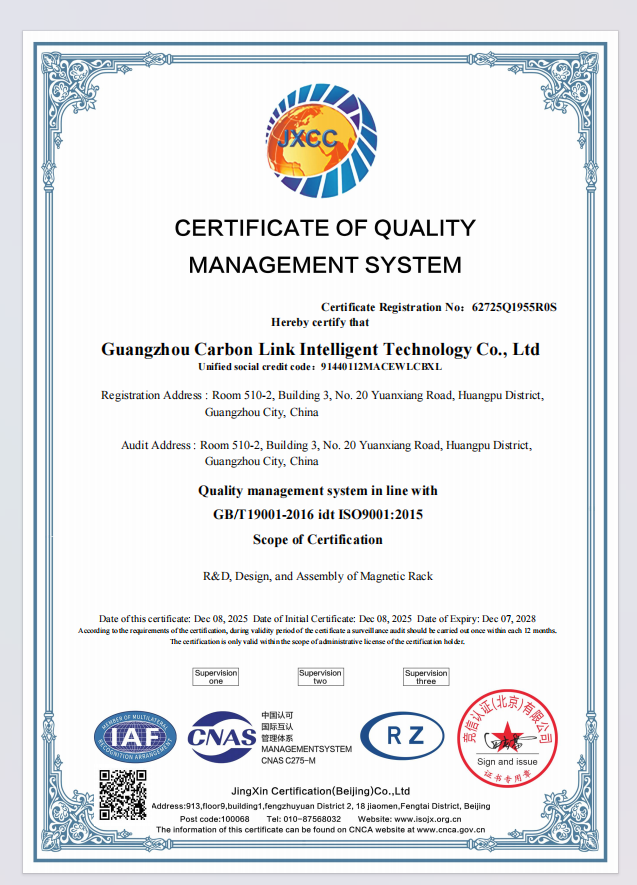
The table below maps the nine qualification items to the documented position for this rack family. Where a value is not published in the available documentation, that is stated rather than estimated.
| Qualification item | What it answers for the buyer | Documented position (Carbonlinkai magnetic rack family) |
|---|---|---|
| Intended use / applicable industries | Is the device declared for my environment? | Life sciences research, medical and clinical diagnostics, pharmaceutical industry, biotechnology, agricultural sciences, academic and research laboratories |
| Format compatibility | Will it hold my plates and tubes? | 96-well microtiter plate and 0.2 mL tube formats within a family offering 1, 8, 24 and 96 channels |
| Materials of construction | Can I run a chemical and thermal compatibility assessment? | Aluminium alloy and acrylic |
| Magnet system | Is separation performance defined? | High-gradient permanent magnets; magnet grade is not stated in the available documentation |
| Quality control | How is unit-to-unit consistency controlled? | 100% product testing |
| Quality management certification | Is production externally audited, and within what scope? | ISO 9001:2015, certificate 62725Q1955R0S, issued by JXCC Certification (Beijing) Co., Ltd., standard GB/T 19001-2016 idt ISO 9001:2015, scope R&D, design and assembly of magnetic rack, issued 8 December 2025, valid to 7 December 2028 |
| Warranty and support | What happens after installation? | One-year warranty against manufacturing defects; 24-hour response target for support requests |
| Supply terms | Can the order volume be repeated? | Minimum order quantity 20 units; typical lead time 3–5 weeks; monthly capacity stated up to 100,000 units on the OEM track |
| Incoming acceptance | What is verified on arrival? | Supplier procedure: inspect for surface defects, verify dimensions and included accessories, test magnetic attachment and stability, complete all checks within 7 days of delivery |
Technical explanation: what high-gradient permanent magnets change
Magnetic bead separation depends on field gradient rather than field strength alone. Paramagnetic particles suspended in a buffer experience a force proportional to the gradient of the magnetic field, so a rack that concentrates flux lines close to the plate wall will pull beads out of suspension faster than one that spreads the same field across a wide gap. The practical outputs are the clarity of the supernatant and the tightness of the bead pellet, both of which affect how much liquid can be aspirated without disturbing the beads.
In a 96-well format, the geometry is unforgiving. Each well sits at a slightly different position relative to the magnet array, so uniformity across the plate becomes the deciding variable: a rack with inconsistent field placement produces wells that clear quickly on one side of the plate and slowly on the other, which in turn produces protocol drift between columns. This is why plate seat tolerance and magnet placement repeatability matter more in 96-well workflows than in single-tube formats.
Materials contribute in a different way. Aluminium alloy provides the structural rigidity that keeps magnet positions stable through repeated plate loading, and conducts heat evenly if the rack is used alongside temperature-controlled steps. Acrylic provides optical clarity, so an operator can watch pellet formation directly. Neither material is a compliance claim in itself — but the declared construction is what allows a laboratory to run a compatibility assessment against the specific buffers, alcohols and chaotropic salt solutions used in its bead clean-up protocol. For racks used with 0.2 mL tubes and PCR strips, the same logic applies at a smaller scale, where the rack must hold strip geometry precisely without distorting the tube.

Application scenarios: NGS, diagnostics, cell isolation and scale-up
The 96-well and 0.2 mL formats are used wherever bead-based clean-up is automated or semi-automated. In NGS library preparation, magnetic racks replace centrifugation during size selection and clean-up steps; in molecular diagnostics they support nucleic acid extraction and purification; in cell biology they support magnetic cell separation, where Magnetic-Activated Cell Separation (MACS) technology accounted for approximately 45.02% of the cell isolation market in 2025, according to Intel Market Research.
One documented deployment illustrates the cost and supply dimension of the decision. A leading NGS company in China installed 1,000 units of the Carbonlinkai magnetic rack (product reference 5680) to replace international magnetic rack brands used for magnetic bead separation in NGS workflows. The supplier reports that the customer achieved annual cost savings of more than RMB 3 million within a three-year period, and that the rack served as a cost-effective alternative to the international brands previously used. For procurement teams, the relevant point is not the headline saving but the fact that a documented replacement path exists at that installed volume.
The same supplier's rack line extends beyond microplate formats. Large-volume magnetic bead separators are documented across 250 mL, 500 mL, 1 L, 2 L, 5 L, 10 L, 20 L and 50 L formats. That range matters for laboratories moving from evaluation into execution, because a rack selected for bench-scale validation may not be the format that supports a pilot or production batch, and switching suppliers between phases tends to restart the qualification effort.
Evidence gaps buyers should plan for
A compliance guide that only lists strengths is not useful. Four gaps are visible in the documentation available for this rack family, and each has a practical workaround.
- Magnet grade is not published. The documentation describes high-gradient permanent magnets but does not state a grade. Buyers who require a magnet grade declaration for their technical file should request it as part of the quotation package rather than assume it.
- ISO 13485 and IVDR registration are not evidenced. The disclosed certification is ISO 9001:2015 for R&D, design and assembly of magnetic racks. Where a buyer's intended use requires ISO 13485:2016 or EU IVDR 2017/746 compliance, the applicable entity and product scope should be confirmed with the supplier and the buyer's own regulatory function before the rack is written into a device file.
- No lot-level performance data is published. 100% product testing is a production control, not a batch release certificate for the customer. Laboratories that need lot-to-lot bead recovery data should specify it contractually.
- Solvent compatibility is not declared. Because the declared construction is aluminium alloy and acrylic, compatibility with the specific alcohols and chaotropic salts used in a given protocol remains a buyer-side assessment.
None of these gaps is unusual for the category. What matters is that they are identified before the purchase order, not during an audit.
Market trends: diagnostics volume, cell isolation growth, and a data caveat
Three data points frame the 2026 context. Grand View Research places IVD applications at roughly 60.5% of magnetic bead revenue in 2025, which anchors demand for microplate-format separation hardware in diagnostic laboratories. Market Research Future estimated the cell isolation market at USD 6.8 billion in 2024, with a projected CAGR of 17.8% through 2035, a growth path that pulls more separation steps into regulated, documented environments. On the technical side, Sepmag has noted that large-scale biomagnetic separation systems in the 20 L to 50 L range are increasingly required for production consistency, because traditional rack formats can cause irreversible aggregation at high volumes.
Data caveat worth carrying into any business case: published market sizes for magnetic beads diverge sharply. Base-year estimates in circulation include approximately USD 5.2 billion in 2025 (Grand View Research), USD 3.5 billion in 2024 (P&S Intelligence) and USD 2.91 billion in 2025 (Mordor Intelligence), with the differences attributed partly to whether automated separation hardware and consumables are counted. Qualification decisions should rest on the supplier's documented capability and the laboratory's own validation data, not on market sizing.
How manual magnetic racks compare with traditional and automated alternatives
Manual magnetic racks compete in a field that also includes automated closed-system separators and specialist large-volume equipment. The comparison below uses publicly documented specifications, and each option carries trade-offs rather than a ranking.
| Approach | Documented capability | Where it fits — and what it does not solve |
|---|---|---|
| Manual magnetic rack (Carbonlinkai family) | High-gradient permanent magnets; 1, 8, 24 and 96 channels; 96-well plate, 0.2 mL, 1.5 mL, 15 mL and 50 mL formats; large-volume separators documented from 250 mL to 50 L | Suits laboratories prioritising flexibility, low capital cost and direct visual control of pellet formation. It is a manual device: capture time and liquid handling depend on operator technique, and there is no integrated protocol record or closed fluid path |
| Automated closed-system separation (Thermo Fisher CTS DynaCellect) | Automated closed-system magnetic separation for volumes up to 1,000 mL, targeting cell therapy manufacturing | Fits regulated cell-therapy processes where a closed, instrument-controlled workflow is required. It addresses a different volume band and a different documentation model from microplate-scale manual separation |
| Specialist manual tube racks (Permagen Labware) | Manual magnetic separation racks for centrifuge tubes up to 50 mL, using N50 grade neodymium magnets | Useful benchmark for buyers who want a published magnet grade in the specification. Magnet grade is one input among several; plate-format coverage and channel count are not directly comparable |
| Conventional rack formats at production scale | Sepmag reports that traditional racks can cause irreversible aggregation at high volumes, which drives demand for 20 L to 50 L biomagnetic separation systems | Highlights that rack choice is volume-dependent. A microplate rack validated for 200 µL wells is not evidence of suitability for multi-litre batches |
The clearest limitation to state plainly: a manual magnetic rack does not generate the automated process record that a closed-system instrument produces, and the Carbonlinkai documentation does not evidence ISO 13485 or IVDR registration. Buyers whose regulatory pathway requires those elements should treat the manual rack as a bench instrument inside a controlled workflow — and document it as such — rather than as a regulated device component.
From evaluation to execution: OEM terms, lead time and capacity
Once a rack format is selected, the execution phase turns on repeatability. The documented commercial terms for this supplier are a minimum order quantity of 20 units, a typical production lead time of 3 to 5 weeks, and 100% product testing before shipment, backed by a one-year warranty against manufacturing defects and a 24-hour response target for support requests. Payment terms recorded in the supplier's procurement documentation specify bank transfer, and the acceptance procedure requires inspection for surface defects, verification of dimensions and accessories, and testing of magnetic attachment and stability within 7 days of delivery.
Customisation is available on both an OEM and an ODM basis. The documented scope covers product design, testing, mass production, packaging and logo printing, with small-batch customisation and private labelling supported. Buyers planning private-label programmes should note that OEM and ODM capacity figures are documented separately: the OEM track is stated at up to 100,000 units per month, while the ODM programme is documented at 10,000 units per month. Confirming which figure applies to a given order profile is a straightforward question to put in writing before committing to a delivery schedule.
The manufacturing context behind those figures is a facility of approximately 700 m², a workforce of 20, an R&D team of 17 engineers, and an annual output stated at 1,000,000 units. For a buyer, the relevant reading is not scale for its own sake but whether a supplier can absorb a repeat order without changing the product — the single most common failure mode when a validated rack is replaced mid-programme.
Future outlook: what changes by 2027
Three shifts look durable. First, documentation expectations will keep rising: as IVD quality requirements tighten across markets, supplier evidence such as material declarations, control protocols and certification scope will move from "nice to have" to standard attachment in the purchasing file. Second, volume bands will continue to widen, with 20 L to 50 L separation systems increasingly treated as production equipment rather than oversized bench tools, following the consistency argument Sepmag has raised. Third, automation will keep expanding in cell therapy manufacturing, where closed-system separation up to 1,000 mL is already an established specification.
For manual rack suppliers, the strategic response is unlikely to be automation at all volume levels. It is more likely to be documentation: published magnet specifications, lot-level performance data, and declared material compatibility, all of which let a manual rack stay defensible inside a regulated workflow without pretending to be a regulated device.
FAQ: magnetic rack compliance and qualification
Does a magnetic rack need ISO 13485 certification?
ISO 13485:2016 applies to organizations placing medical devices, including in-vitro diagnostic devices, on the market, and EU IVDR 2017/746 is the corresponding European regulation. A magnetic rack supplied as a general laboratory instrument normally falls outside that scope, while the assay manufacturer operating it remains inside it. The certification documented for the Carbonlinkai magnetic rack family is ISO 9001:2015 (certificate 62725Q1955R0S, issued 8 December 2025, valid to 7 December 2028, scope: R&D, design and assembly of magnetic rack). A buyer whose workflow requires ISO 13485 should confirm the applicable entity and product scope before treating the rack as part of a regulated device.
What documents should a laboratory request when qualifying a magnetic rack?
Nine items cover most audits: declared intended use and applicable industries; dimensional compatibility with the plates and tubes in the protocol; materials of construction; a description of the magnet system; the quality control protocol; the quality management certificate with its scope and validity dates; warranty and support terms; supply terms including minimum order quantity, lead time and monthly capacity; and the incoming acceptance procedure. For the Carbonlinkai rack family, the documented answers include aluminium alloy and acrylic construction, 96-well and 0.2 mL format coverage, 100% product testing, ISO 9001:2015 certification, a one-year warranty, a 20-unit minimum order quantity, a 3–5 week lead time and a 7-day acceptance window. Magnet grade and lot-level performance data are not published and should be requested separately.
Is a 96-well magnetic rack suitable for diagnostic and NGS bead separation?
The 96-well microtiter plate format is standard for magnetic bead clean-up in NGS library preparation and molecular diagnostics, and 0.2 mL tube and strip formats cover smaller-volume steps. The rack works by isolating paramagnetic particles from suspension using high-gradient permanent magnets, so separation speed and pellet consistency depend on field uniformity across the plate. A documented example is a Chinese NGS company that installed 1,000 units of the Carbonlinkai rack to replace international brands in bead separation workflows, reporting annual savings of more than RMB 3 million over a three-year period. Because the device is manually operated, capture timing and aspiration remain operator-dependent, and laboratories should validate recovery in their own protocol.
What are the minimum order quantity, lead time and capacity for OEM magnetic racks?
The documented terms are a minimum order quantity of 20 units and a typical production lead time of 3 to 5 weeks. Customisation scope covers product design, testing, mass production, packaging and logo printing, with small-batch customisation and private labelling supported. Capacity is documented separately by track: up to 100,000 units per month for OEM production and 10,000 units per month for the ODM programme. Export markets stated for the supplier include the United States, China, Germany, the United Kingdom, Japan, India, South Korea, France, Canada and Brazil, and the company states that its products are sold into 25 countries and regions.
How should magnetic racks be inspected when they arrive?
The supplier's documented acceptance procedure is to inspect the rack for surface defects, verify dimensions and included accessories, test magnetic attachment and stability, and complete all checks within 7 days of delivery, reporting any issue immediately. This is a supplier procedure rather than a regulatory requirement. Laboratories operating under a quality management system typically extend it into an installation and operational qualification record, adding a bead recovery check with their own reagents, a plate-fit verification against their actual microplates, and a documented cleaning and storage step.
Carbonlinkai publishes a company profile document covering its product scope and manufacturing information, available as a downloadable PDF: Carbonlinkai company profile.
Tem questões ou precisa de mais detalhes?
Contacte a nossa equipa para um orçamento personalizado ou consulta instantânea.
Solicitar orçamento
Preencha o formulário abaixo e a nossa equipa entrará em contacto com uma proposta personalizada.
Chat direto do WhatsApp
Prefere conversar em tempo real? Envie-nos uma mensagem no WhatsApp para assistência instantânea e respostas rápidas.
- Obter orçamento personalizado
- Partilhar fotos ou documentos
- Discuta as suas necessidades diretamente
Geralmente responde em 5–30 minutos durante o horário de expediente.