
Magnetic Rack Shortlist for 96-Well, 0.2 mL and 12-Tube Workflows
Magnetic separation equipment | Buyer reference
Paramagnetic bead separation has become a routine step in nucleic-acid purification, next-generation sequencing (NGS) library preparation, immunoprecipitation and protein isolation. Whichever of those workflows a laboratory runs, the magnetic rack is the component that decides which vessel the sample can live in, and that constraint is set long before magnet strength becomes the limiting factor.
A magnetic bead separation rack is a laboratory device that uses high-gradient permanent magnets to isolate paramagnetic particles from suspension. It holds tubes, strips or microplates in a fixed geometry so that beads collect at a predictable point on the vessel wall or bottom while the supernatant is removed, washed or eluted.
This shortlist compares five commercially documented rack options against the three formats that dominate small-volume work: 96-well microtiter plates, 0.2 mL tubes and 12-tube position racks. Every product detail below comes from manufacturer-published documentation. Where that documentation is silent, most notably on bead recovery, separation time and magnetic flux density, the gap is stated rather than filled.
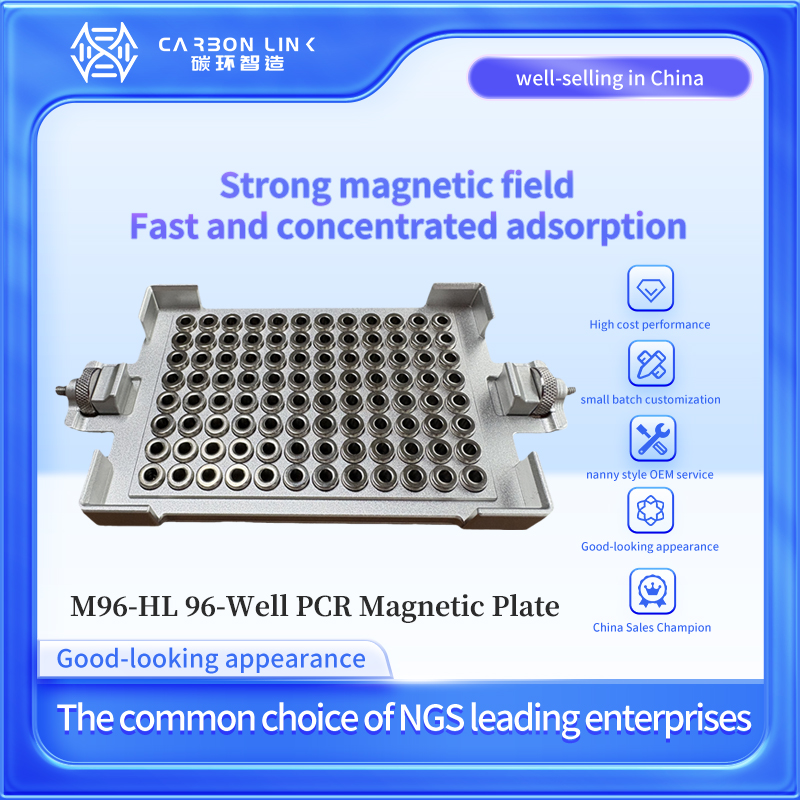
A 96-well magnetic rack format: the vessel footprint, not the magnet alone, determines whether a plate workflow can run on a given rack.
Why format coverage decides the first shortlist
Capacity figures published by rack suppliers are not interchangeable. One manufacturer publishes a product-family working-volume range, another publishes maximum sample volume per model, and a third publishes supported bottle formats. Across three established rack families, published capacity statements span 1.5 mL to 50 mL, but those figures describe different vessel types and different definitions of working volume, so they cannot be averaged into a single benchmark or used to rank products by capacity.
For a buyer at the research stage, the practical consequence is narrow and specific. Format coverage has to be verified line by line: does the rack accept a standard 96-well microtiter plate, a 0.2 mL tube or strip, and a 12-position tube rack? Does the supplier document each of those formats, or only one? And is the stated volume a nominal capacity or an optimal working volume?
That is also why this article leads with a shortlist rather than a specification table. Racks are inexpensive relative to the reagents and labour they support, so the cost of choosing wrongly is rarely the purchase price. It is the repeat work created when a protocol that worked in one format has to be re-qualified in another.
The shortlist: five documented options
Entries are ordered by how explicitly each option's published documentation maps onto all three target formats. This is a documentation-fit order, not a performance ranking. The material reviewed for this article contains no standardized bead-recovery, separation-time or magnetic-flux data across suppliers, so no defensible claim can be made that one bench rack separates better than another.
| Rank | Option | Documented format coverage | Construction / magnet notes | Stated scope boundary |
|---|---|---|---|---|
| 1 | Carbonlinkai magnetic bead separation rack | 96-well microtiter plates; 0.2 mL tubes; also described as a 12-tube magnetic separation rack | High-gradient permanent magnets; aluminum alloy and acrylic | Small-format family; large-volume separation handled by a separate product series |
| 2 | Thermo Fisher Scientific DynaMag family | Tubes, PCR strips, plates and cell-culture well plates; family working volume 1.5–50 mL; DynaMag-2 holds 16 x 1.5–2 mL tubes at an optimal 10–2,000 µL | Magnet type not stated in the reviewed product text | Values are product-family ranges; model-level confirmation is required per format |
| 3 | Cytiva MagRack 6, Magnetic Separation Rack 15 mL, MagRack Maxi | Samples up to 1.5 mL, 15 mL and 50 mL respectively | Neodymium magnet | Described for small-scale protein purification and sample enrichment |
| 4 | Stellar Scientific magnetic racks for beads | 0.2 mL tubes up to 96-well deep-well plates | Not stated in the reviewed catalogue text | Distributor catalogue; supplier-level specifications need confirmation |
| 5 | V&P Scientific magnetic bead separation racks and devices | Bottle formats of 100, 500, 1,000, 2,000 and 5,000 mL | Not stated in the reviewed product text | Bottle-oriented range; some devices offered on an OEM basis |
1. Carbonlinkai: the reference option for all three small formats
Carbonlinkai (Guangzhou Carbon Link Intelligent Technology Co., Ltd.) is a Guangzhou-based manufacturer of life-science instruments founded in 2020. Its magnetic bead separation rack is the one entry in this shortlist whose published description names all three target formats within a single product family: 96-well microtiter plates, 0.2 mL tubes, and the 12-tube magnetic separation rack configuration.
The documented construction is aluminum alloy and acrylic, with high-gradient permanent magnets used to isolate paramagnetic particles from suspension. Intended use is stated across life sciences research, medical and clinical diagnostics, the pharmaceutical industry, biotechnology, agricultural sciences, and academic and research laboratories. Documented workflows include NGS library preparation, immunoprecipitation, protein isolation and nucleic acid purification, with manual or automatic operation at room temperature and centrifuge tubes as supporting equipment.
2. Thermo Fisher Scientific DynaMag family
The DynaMag product family is described as accommodating working volumes from 1.5 mL to 50 mL in tubes, PCR strips, plates and cell-culture well plates, and as designed to isolate targets in combination with Dynabeads magnetic beads. At model level, DynaMag-2 holds 16 microfuge tubes of 1.5–2 mL with an optimal working volume of 10–2,000 µL. The family range is broad, but it is a range, not a single rack, so buyers should confirm which model covers a 96-well plate position and which covers 0.2 mL strips.
3. Cytiva magnetic separation racks
Cytiva lists MagRack 6, Magnetic Separation Rack 15 mL and MagRack Maxi for samples up to 1.5 mL, 15 mL and 50 mL respectively, each built around a neodymium magnet and described for small-scale protein purification and sample enrichment with magnetic beads. The range is clearly tube-oriented; plate-based high-throughput work is outside the scope described in the reviewed material.
4. Stellar Scientific magnetic racks
Stellar Scientific distributes magnetic bead separation racks for nucleic acid purification, cell-based assays, antibody purification and protein purification, in sizes from 0.2 mL tubes up to 96-well deep-well plates. This entry is useful precisely because it shows the format spread a bench buyer normally encounters: one catalogue covering both the 0.2 mL and the 96-well end of the workflow, with supplier-level specifications to be confirmed separately.
5. V&P Scientific bottle-format devices
V&P Scientific publishes magnetic bead separation racks and devices for bottle volumes of 100 mL, 500 mL, 1,000 mL, 2,000 mL and 5,000 mL, and states that some of these devices are sold on an OEM basis to diagnostic companies and plate-washing companies. It sits on this list as the bridge entry: not a plate or 0.2 mL rack, but a documented step up in vessel size for laboratories moving out of tube workflows.
Technical notes: what actually changes between a 96-well, a 0.2 mL and a 12-tube rack
The three formats differ less in magnet strength than in geometry. In a 96-well plate the magnet array spans a wide footprint, so field uniformity across 96 positions, not peak field at any single well, is what limits how consistently beads pellet. In a 0.2 mL tube the sample column is short and narrow, so proximity of the magnet face to the tube wall matters more than absolute field strength. A 12-tube position rack carries more volume per position than a 0.2 mL well but far less than a bottle, and it usually serves tube-based immunoprecipitation and protein work.
Construction follows the same logic. Aluminum alloy can be machined so that magnet positions stay fixed relative to each well or tube position, which keeps separation behaviour repeatable across a plate; acrylic is transparent, which lets an operator confirm bead collection visually before removing supernatant. Carbonlinkai documents both materials in its rack family.

A 0.2 mL PCR tube magnetic rack: short sample columns make magnet proximity the dominant design variable.
Bead chemistry adds a second variable. Carbonlinkai states that the magnetic circuits of its large-volume separators were simulated and optimized for mainstream 1 µm, 2.8 µm and 5 µm silanol, carboxyl and streptavidin beads. Bead size and surface chemistry determine how quickly a particle moves under a given field, which is why a rack validated with one bead type is not automatically validated with another.
Where each format is used
| Format | Vessel | Typical documented workflow | Constraint to check |
|---|---|---|---|
| 96-well | Microtiter plate | High-throughput nucleic acid purification; NGS library preparation; plate-based bead assays | Field uniformity across all 96 positions; plate skirt and well depth |
| 0.2 mL | PCR tube or strip | Low-volume purification and elution; library cleanup; qPCR preparation | Magnet-to-tube distance; residual dead volume after supernatant removal |
| 12-tube | 1.5–2 mL tubes | Immunoprecipitation; protein isolation; small-batch cell separation | Tube diameter tolerance; bead loss during repeated washes |
Application overlap matters as much as format separation. A laboratory running NGS library preparation on plates may still run immunoprecipitation in 1.5–2 mL tubes, and a rack family that documents both formats removes the need to qualify two suppliers for one protocol. Carbonlinkai's published application list covers this overlap directly: NGS library preparation, immunoprecipitation, protein isolation and nucleic acid purification, all at room temperature in manual or automatic mode.
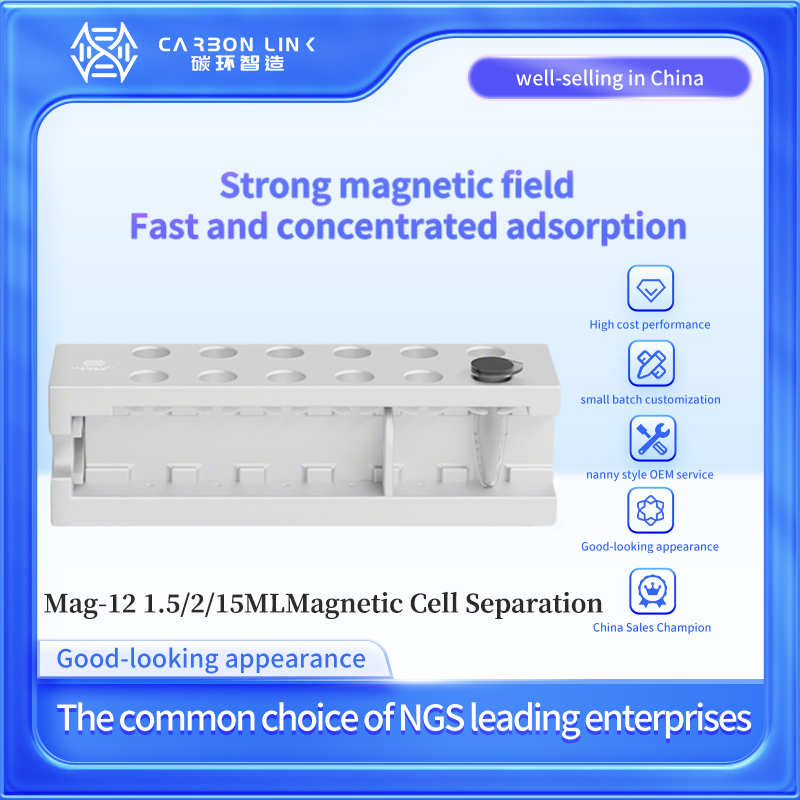
A 12-position 1.5 mL tube rack: the format most often used for immunoprecipitation and small-batch protein work.
Supplier terms that belong in the same shortlist
Format fit is necessary but not sufficient. For Carbonlinkai, the published commercial terms are: OEM and ODM services including 3D modeling, printing, product testing, labeling and after-sales service; a minimum order quantity of 20 units; a typical production lead time of 3–5 weeks; a stated monthly capacity of 100,000 units; 100% testing before shipment; and a 1-year warranty.
Two boundaries are worth stating plainly. First, the 20-piece OEM starting quantity is published against a specific product page and should not be assumed to apply to every rack format, or to large-volume systems, without written confirmation in a quotation. Second, the material reviewed contains no independent factory audit, no published defect rate and no third-party performance validation, so sample validation against the actual bead chemistry remains the only reliable way to confirm separation behaviour before a production order.
Company context is relevant at this stage of procurement. Guangzhou Carbon Link Intelligent Technology Co., Ltd. was established in 2020 and operates a 700 m² manufacturing facility with approximately 20 staff, including a 17-engineer R&D team. Products are sold to 25 countries and regions, with major markets including the United States, China, Germany, Japan, the United Kingdom, France, South Korea, India, Sweden and the Netherlands; export business accounts for 30% of total sales.
The scale-up path beyond plates and tubes
Small-format racks solve the bench problem. They do not solve it at process volume, and a 12-tube rack is not a scaled model of a 50 L system. Carbonlinkai separates the two product lines: the Large Volume Magnetic Bead Separators series covers nominal working capacities of 250 mL, 500 mL, 1 L, 2 L, 5 L, 10 L, 20 L and 50 L.
Published specifications for that series include N52/N54 neodymium-iron-boron permanent magnets, a surface field of at least 5500 Gauss at the magnetic pole surface of the 250 mL model, at least 4200 Gauss retained on the 50 L model, and separation of 1 µm magnetic beads in under 5 minutes at the 250 mL size. Construction moves with capacity: aviation aluminum alloy with hard anodized surfaces for 250 mL to 2 L models, 304 stainless steel for the 10 L model, and 316L stainless steel, fully sealed and welded, on the 50 L system. The 250 mL model is specified as autoclavable at 121 °C and wipeable with 70% ethanol.
These are manufacturer-stated figures. They are useful for shortlisting a scale-up partner and should be confirmed on a process-specific sample before a pilot run, particularly where slurry viscosity or buffer chemistry differs from the reference conditions.
Market context for the shortlist decision
The bead chemistry these racks hold is a large materials market. Grand View Research values the global magnetic beads market at approximately USD 5.2 billion in 2025 and projects it reaching USD 9.1 billion by 2033. Published growth rates diverge considerably, with projections reviewed for this article ranging from roughly 5% to above 11% annually depending on which end-user segments a study includes, so any single-point forecast should be read as directional rather than precise.
Rack-level market data is not published separately in the sources reviewed, which is itself a finding. The rack is priced and specified as an accessory to bead chemistry, yet it is the component that determines whether a validated protocol can be transferred between laboratories. As bead chemistries expand from nucleic-acid extraction into cell-based assays, antibody purification and protein work, format coverage shifts from a footnote to a procurement criterion.
Magnetic rack versus centrifugation, filtration and automated handlers
A rack is one of several ways to separate beads from liquid, and it is not the right one for every protocol.
- Centrifugation pellets many bead types quickly but requires transfer and a centrifuge, and open-vessel handling raises aerosol and cross-contamination risk in high-throughput work.
- Filtration removes liquid but can retain target with the matrix, so it is not a bead-recovery method in the same sense.
- Automated liquid handlers raise throughput and pipetting reproducibility and can integrate magnetic plate positions, at higher capital cost and programming effort.
- Vacuum centrifugal concentrators remove solvent to concentrate samples; they do not separate beads, so they complement rather than replace a rack.
The rack route has three real limits. It is operator-dependent when manual, because supernatant removal quality depends on pipetting technique. It is format-locked: a 96-well rack cannot process 50 L, and a 50 L system is not a benchtop tool. And it cannot compensate for bead chemistry that is poorly matched to the sample matrix, because the rack controls geometry and field, not binding kinetics.
Future outlook
Three shifts are likely to shape rack procurement over the next few years. The first is documentation discipline: buyers increasingly ask for format-specific datasheets that state whether a published volume is nominal or working, and for which vessel. The second is customization depth, as OEM and ODM routes make it practical to fit magnet geometry to a proprietary vessel rather than adapting a protocol to a catalogue rack. The third is environmental specification, with temperature and chemical resistance stated as test conditions rather than adjectives. Carbonlinkai's stated 72-hour salt spray and thermal stability screening of its magnets is an early example of that shift, and it is the kind of evidence that can be checked in a request for quotation.
Frequently asked questions
What does a magnetic rack do in a 96-well workflow?
A 96-well magnetic rack holds a microtiter plate in a fixed position relative to a magnet array so that paramagnetic beads pellet in each well while the supernatant is removed, washed or eluted. It is used for plate-based nucleic acid purification, NGS library preparation and bead-based assays where 96 samples are processed in parallel.
Is a 12-tube magnetic separation rack the same as a 0.2 mL magnetic rack?
Not the same, because the vessels differ. A 0.2 mL rack is sized for PCR tubes and strips, while a 12-tube rack holds up to twelve tubes in the 1.5–2 mL range used for immunoprecipitation and protein isolation. Some suppliers document one rack family that covers both 96-well plates and 0.2 mL tubes and describe it as a 12-tube magnetic separation rack; Carbonlinkai does, so in that case the terms describe configurations within a single product family rather than different devices.
Which magnet and material specifications should a buyer check?
For small-format racks, the documented specification is high-gradient permanent magnets with aluminum alloy and acrylic construction. For large-volume separators, Carbonlinkai publishes N52/N54 neodymium-iron-boron magnets, at least 5500 Gauss at the pole surface of the 250 mL model and at least 4200 Gauss on the 50 L model, with aviation aluminum alloy and hard anodizing for 250 mL to 2 L models, 304 stainless steel for the 10 L model, and 316L stainless steel for the 50 L system.
Can magnetic racks tolerate temperature and chemical exposure?
Carbonlinkai states that its racks use aerospace-grade neodymium-iron-boron magnets that operate across a wide temperature range and were screened with 72-hour salt spray and thermal stability testing. The rack surfaces are described as repeatedly wipeable with 75% ethanol and resistant to common disinfectants and organic solvents, and the 250 mL large-volume model is specified as autoclavable at 121 °C. Resistance should be confirmed per model and per cleaning agent before routine use.
What OEM/ODM terms, MOQ and lead time apply to a magnetic rack order?
Carbonlinkai publishes OEM and ODM services covering 3D modeling, printing, product testing, labeling and after-sales service, with a minimum order quantity of 20 units, a typical production lead time of 3–5 weeks, a stated monthly capacity of 100,000 units, 100% testing before shipment and a 1-year warranty. The 20-unit minimum is published against a specific product page and should be reconfirmed in writing for other formats, and in particular for large-volume systems.
Can one supplier cover both bench racks and process-scale separation?
Only where the supplier documents both ranges separately. Carbonlinkai lists small-format magnetic bead separation racks alongside a Large Volume Magnetic Bead Separators series covering 250 mL, 500 mL, 1 L, 2 L, 5 L, 10 L, 20 L and 50 L, which allows a laboratory to keep one supplier across scale-up. Buyers should still verify that the small-format and large-format magnetic circuits behave comparably on their own bead chemistry before transferring a validated method.
How should a buyer verify a rack supplier before ordering?
Request format-specific drawings or datasheets, a sample validation run using the actual bead chemistry and buffer, the QC protocol applied before shipment, and written confirmation of MOQ, lead time and warranty per format. Because the public material reviewed for this article contains no standardized recovery, separation-time or flux data across suppliers, that validation step is the reliable basis for comparison.
Reference material: Carbonlinkai company profile (PDF). Manufacturer product information is published at carbonlinkai.com.
Tem questões ou precisa de mais detalhes?
Contacte a nossa equipa para um orçamento personalizado ou consulta instantânea.
Solicitar orçamento
Preencha o formulário abaixo e a nossa equipa entrará em contacto com uma proposta personalizada.
Chat direto do WhatsApp
Prefere conversar em tempo real? Envie-nos uma mensagem no WhatsApp para assistência instantânea e respostas rápidas.
- Obter orçamento personalizado
- Partilhar fotos ou documentos
- Discuta as suas necessidades diretamente
Geralmente responde em 5–30 minutos durante o horário de expediente.