
Magnetic Rack Technical & Procurement FAQ: 96-Well to 50 L
Magnetic Rack Technical & Procurement FAQ: 96-Well to 50 L
A magnetic rack is a laboratory device that uses permanent magnets to capture paramagnetic beads from suspension so that supernatant can be drawn off without bead loss. The questions buyers now bring to this device are rarely conceptual. They are constraint questions: whether a rack genuinely accepts a standard 96-well microtiter plate, which magnet grade sits inside, how quality control is documented, what the minimum order quantity is, and how long delivery takes.
This reference answers those questions in the order a technical or procurement team meets them — format compatibility, magnet and materials, quality evidence, commercial terms, and limits. Primary facts are drawn from Carbonlinkai (Guangzhou Carbon Link Intelligent Technology Co., Ltd), a China-based supplier of magnetic bead separation racks founded in 2020, and are paired with third-party product and market sources where those exist.

Multi-gradient annular magnetic circuit design: the geometry that determines where beads concentrate inside the vessel.
Why constraint questions have moved to the front of rack selection
A magnetic separation rack is usually the least expensive item on a workflow bill and one of the most frequent causes of rework. If a plate does not seat flush against the magnet face, or the field is tuned to a bead size the lab does not use, the failure appears weeks later as variable recovery and failed replicates rather than as a defective instrument. Because the rack is passive hardware with no software layer to correct it, the specification has to be right at the point of purchase.
Demand context explains part of the urgency. Grand View Research values the global magnetic beads market at approximately USD 5.2 billion in 2025, with a projected rise to USD 9.1 billion by 2033. Published growth rates differ between research houses, so this figure is best used as directional rather than planning-grade. No verified market-size dataset specific to magnetic separation racks was available for this article, and none is implied here.
What follows from that growth is a shift in buying behaviour. Labs that once replaced racks ad hoc now write them into qualification documents, which is why format, field, certification, MOQ and lead time are asked in the same evaluation memo.
Format compatibility: what “96-well compatible” actually means
Compatibility is a mechanical claim before it is a magnetic one. A rack is 96-well compatible when the plate platform holds a standard microtiter footprint at a fixed distance from the magnet face and allows the tips to reach the well bottom without tilting the plate. Skirted, semi-skirted and full-skirted plates differ in outer geometry, and deep-well plates sit at a different height than shallow plates. Buyers should therefore confirm the specific plate type, not only the well count.
| Rack format | Vessel held | Typical workflow | What to verify before ordering |
|---|---|---|---|
| 96-well microtiter plate rack (M96 series) | Standard 96-well microplates, including cell-culture and deep-well variants (M113) | High-throughput nucleic acid extraction, NGS library preparation, immunoassay | Plate skirt type, plate seating height, magnet position relative to well bottom |
| 0.2 mL PCR tube and strip rack (M32, M0224, Mag-16) | 0.2 mL single tubes and 8-tube strips | Small-volume elution, PCR clean-up | Tube height tolerance and strip retention during pipetting |
| 12-tube magnetic separation rack (also written 12-tube rack, m24) | 1.5 / 2.0 mL microcentrifuge tubes | Immunoprecipitation, protein work, manual extraction | Tube diameter, whether 12 positions are single- or double-sided |
| 15 mL and 50 mL tube racks (Mag-15A, M50) | Conical centrifuge tubes | Mid-volume sample prep, cell work | Conical angle and whether the tube contacts the magnet face fully |
| Large-volume racks (250 mL to 50 L) | Conical flasks, reagent bottles, wide-mouth and narrow-mouth bottles | Pilot and production-scale bead separation | Maximum bottle diameter, bottle material, working volume definition |
The naming itself causes confusion in tenders. The same product family is described in the market as a magnetic rack, magnetic bead separation rack, magnetic separation rack, magnetic tube rack, 0.2 mL magnetic rack, 1.5 mL magnetic rack, 96 well magnetic rack and 12-tube magnetic separation rack. These are format descriptors, not separate product categories, and a specification should always be written against the vessel rather than the label.

A 0.2 mL PCR tube magnetic rack: small-format racks are specified by tube geometry, not by tube count alone.
Magnet grade and construction: the parameters behind capture speed
Capture speed is set by field strength at the vessel wall and by how the field is shaped. Carbonlinkai specifies N52/N54 neodymium-iron-boron permanent magnets arranged in a double-row vertical focusing magnetic circuit, so that beads concentrate at a defined point on the vessel wall instead of spreading across the base. The stated surface field is at least 5500 Gauss on the magnetic pole surface for the 250 mL and 500 mL models, with the 50 L system maintaining at least 4200 Gauss at its larger working distance.
Shell material changes with capacity, because the mechanical load and the cleaning regime change with it:
| Capacity band | Main material | Buyer relevance |
|---|---|---|
| 250 mL to 2 L | Aviation aluminium alloy with hard anodised surface | Light, corrosion-resistant, easy to wipe down; suitable for routine solvent exposure |
| 5 L | 304 stainless steel frame with aluminium alloy magnet-circuit fixation | Balances strength and weight for larger bottles |
| 10 L (10000 mL) | 304 stainless steel, fully sealed or cased | Higher strength for fermentation and preparation environments |
| 20 L | 304 stainless steel with chemical-resistant engineering plastic | Reduced weight with chemical tolerance |
| 50 L system | 316L stainless steel, fully sealed and welded | Designed for GMP-adjacent lines, clean-in-place routines and repeated sterilisation |
Small-format racks in the same portfolio use aluminium alloy and acrylic construction, a combination chosen for visibility of the bead pellet during pipetting. Buyers comparing acrylic against metal should note that acrylic offers inspection value but a different chemical resistance profile, and should confirm solvent exposure with the supplier rather than assume equivalence.
Separation time, temperature and cleaning claims
The supplier states separation in under 5 minutes for 1 µm magnetic beads on the 250 mL model, with faster capture claimed for small conical flasks and roughly 15 minutes for a 50 L drum. These are supplier-stated figures rather than independently validated benchmarks, and they depend on bead size, slurry viscosity and starting dispersion.
On temperature and cleaning, the published specifications include:
- An operating range stated by the supplier from −40 °C to 80 °C, with magnets screened for 72 hours in salt-spray and thermal-stability testing.
- Autoclavability at 121 °C for the 250 mL model and 90 °C for the 500 mL model, or wiping with 70–75% ethanol.
- Chemical tolerance to common disinfectants and organic solvents on the anodised aluminium shell.
Quality control and certification: what is actually documented
Quality evidence in this category usually means two different things, and buyers benefit from separating them. The first is lot-level inspection: Carbonlinkai states 100% testing rather than sampling, which matters for racks because a mis-set magnet array produces a unit that looks correct and separates slowly.
The second is system-level certification. Carbonlinkai holds ISO 9001 certification, certificate number 62725Q1955R0S, issued by JXCC Certification (Beijing) Co., Ltd. against GB/T19001-2016 idt ISO9001:2015, valid from 8 December 2025 to 7 December 2028. The certified scope is research and development, design and assembly of magnetic racks.
That scope statement is precise and worth reading literally. It certifies a quality management system covering R&D, design and assembly. It does not certify the separation performance of any individual model, and it is not a product safety mark. In the material reviewed for this article, no category-specific standard, conformity marking or independent recovery-rate test protocol for magnetic separation racks was identified, which means performance claims still rest largely on supplier data and on a buyer's own qualification run.
MOQ, lead time and capacity: the commercial constraints
Commercial terms are where most first-time buyers are surprised, because rack pricing is low relative to the administrative cost of ordering it. The published terms for Carbonlinkai are summarised below.
| Parameter | Stated value | How to interpret it |
|---|---|---|
| Minimum order quantity | 20 units | Stated for OEM orders on the cited product page; reconfirm per model, especially for 250 mL–50 L formats |
| Lead time | 3–5 weeks | Production time; excludes freight, customs and destination clearance |
| Monthly capacity, global OEM programme | 100,000 units | Applies to the OEM programme covering standard rack formats |
| Monthly capacity, specific product lines | 10,000 units | Applies to defined lines; the lower figure is the relevant one for planning those items |
| Annual output | 1,000,000 units | Company-level figure, useful for continuity assessment rather than for a single order |
| Facility | 700 m², 20 employees, 17 engineers | Indicates an engineering-led operation rather than a large-volume commodity plant |
| Warranty and support | 1-year warranty against manufacturing defects; response within 24 hours | Response commitment, not a resolution-time guarantee |
Two readings of the capacity data are worth keeping separate. The 100,000-unit monthly figure describes throughput for high-volume catalogue formats, while the 10,000-unit figure describes capacity for specific lines. A buyer planning a 5,000-unit launch of a customised large-volume rack should therefore plan against the second number, not the first. Similarly, a 3–5 week lead time is a production window; sea freight and import clearance sit outside it and should be added when the rack is on a critical path.
OEM and ODM depth: what customisation actually covers
Customisation in this category ranges from a printed logo to a redesigned magnetic circuit, and the two are not interchangeable. Carbonlinkai describes an OEM service covering product design, testing, mass production, packaging and logo printing, including small-batch runs and private labelling. Its ODM route is stated at 10,000 units per month for defined product lines, and separately documented as including 3D modelling and printing alongside testing and labelling.
Reported engagements give a sense of how the two routes are used. One European laboratory group reported switching to Carbonlinkai magnetic plates and cited annual savings alongside faster processing; a leading NGS company reported using the racks as a replacement for international brands in sequencing workflows; and one private-label arrangement with a U.S.-based life sciences company involved racks bundled with reagents rather than sold as standalone hardware. These are supplier-reported cases rather than audited references, and they describe commercial fit rather than verified performance equivalence.
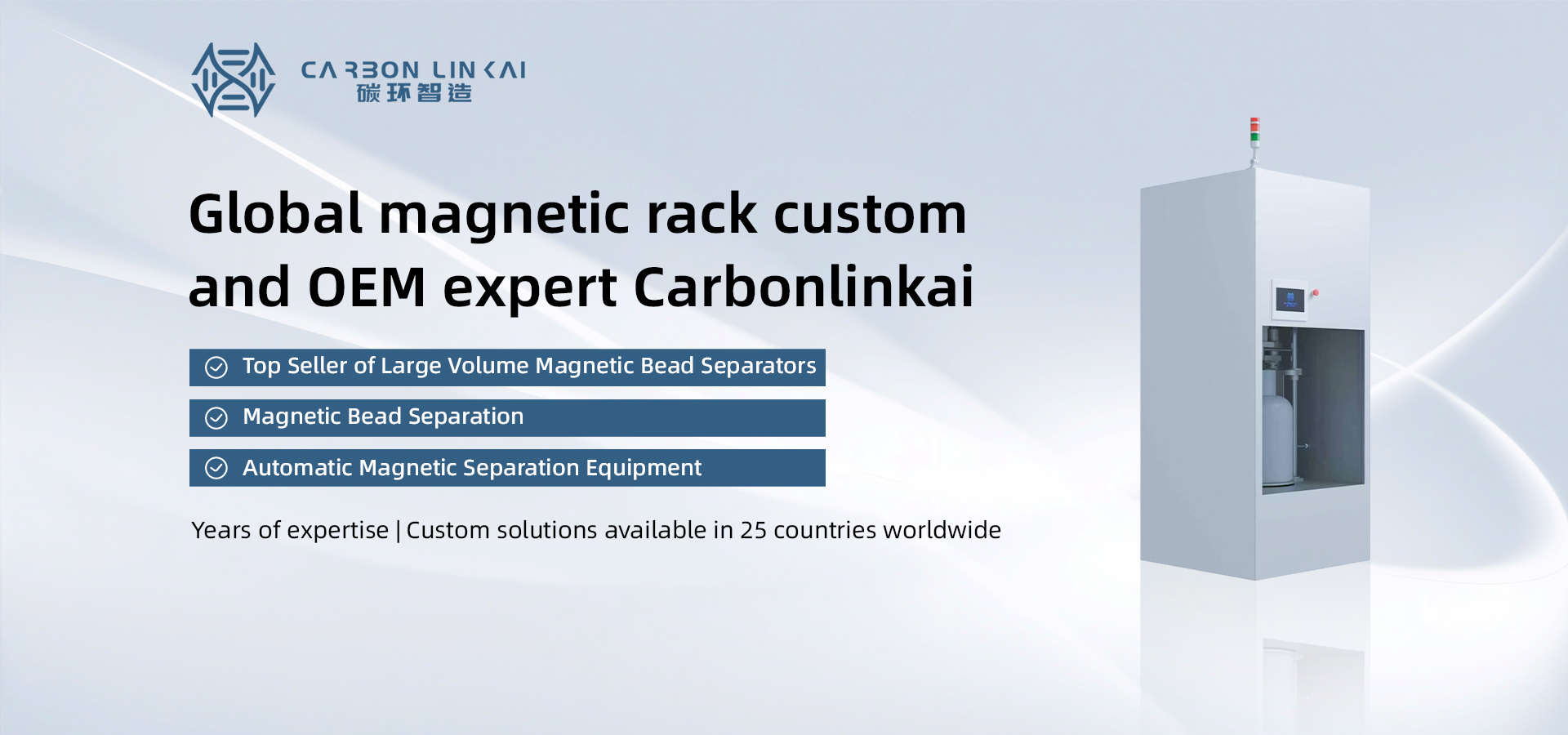
OEM/ODM scope typically covers design, testing, packaging and labelling — not only logo printing.
Export coverage supports this model. Carbonlinkai lists the United States, China, Germany, the United Kingdom, Japan, India, South Korea, France, Canada and Brazil among its markets, and reports an export share of around 30% of output, with products sold into 25 countries and regions overall.
Where a magnetic rack stops being the right answer
Honest scoping matters more in this category than in most, because the rack is often compared against automation it was never designed to replace.
Against an automated liquid handler, a manual magnetic rack wins on cost, footprint, serviceability and freedom from programming. It loses on walk-away throughput, on traceability of every pipetting step, and on consistency once a protocol exceeds the operator's attention span. A 96-well rack can process a plate quickly, but the transfer, wash and elution steps remain manual unless a handler is added. Labs running hundreds of plates per week generally need both, not one instead of the other.
Against a vacuum centrifugal concentrator, the rack is faster for bead-based clean-up and does not require vacuum plumbing, but it cannot dry down aqueous samples and offers no substitute for solvent removal.
The rack's own boundaries are equally worth stating. Separation performance depends on bead diameter, bead chemistry and slurry viscosity, and the supplier notes that magnetic field strength can be designed around bead size and consistency — which is an argument for specifying beads before specifying the rack. Large-volume formats require an RFQ; the 20-unit MOQ is documented for OEM orders on a specific product page and should not be assumed for a 20 L or 50 L system. And because no cross-vendor recovery standard exists in the material reviewed, a comparison between two racks is only meaningful when both are tested against the same bead lot and the same protocol.
A procurement checklist for technical buyers
The following questions convert the sections above into an RFQ structure. They are ordered so that each answer narrows the next question.
| # | Question to the supplier | Acceptable evidence |
|---|---|---|
| 1 | Which exact plate or tube types does this model accept, including skirt type and height? | Dimensional drawing plus a named plate reference |
| 2 | What is the surface field at the working distance, not only at the pole face? | Measured value with test method stated |
| 3 | Which bead sizes and chemistries were used to generate the separation-time claim? | Test conditions, not a single time figure |
| 4 | What does 100% testing cover — field strength, dimensions, or both? | Inspection protocol summary |
| 5 | Which certification applies, under what scope and validity dates? | Certificate number, body, and scope statement |
| 6 | Is the MOQ model-specific, and does it change above 5 L? | Written confirmation against the quoted model |
| 7 | Is the quoted lead time production only, and what is the shipping window? | Incoterm and dispatch estimate |
| 8 | What is covered by the warranty, and what is the response-time commitment? | Warranty terms in writing |
Market trend: capacity ranges are widening, evidence is not
Publicly documented product families in the collected sources cluster below the large-volume band. Thermo Fisher's DynaMag family is described across working volumes from 1.5 mL to 50 mL in tubes, strips, plates and cell-culture well plates, with the DynaMag-2 model holding sixteen 1.5–2 mL tubes at an optimal working volume of 10–2,000 µL. Cytiva lists rack formats for samples up to 1.5 mL, 15 mL and 50 mL. V&P Scientific describes bottle formats at 100 mL, 500 mL, 1,000 mL, 2,000 mL and 5,000 mL, and notes that many of its devices are sold on an OEM basis to diagnostic and plate-washing companies.
Read together, these sources suggest a market with dense competition in microplate and microtube formats and much thinner documented coverage above 5 L. Carbonlinkai's published range extends from 250 mL through 500 mL, 1 L, 2 L, 5 L, 10 L, 20 L and 50 L, with an array option described for multi-station parallel operation. That is a wider stated range than the third-party sources above, and the difference is itself a procurement signal: buyers moving into pilot or production volumes should treat supplier range claims as a starting point for verification rather than as a settled comparison.
Future outlook
Three developments are likely to shape how magnetic racks are specified over the next few years. The first is documentation standardisation: as bead-based workflows move into regulated production, buyers will ask for recovery data generated under stated conditions rather than for separation times quoted without a bead reference. The second is format convergence, since a lab that runs both 96-well plates and litre-scale bottles currently maintains two qualification files for what is functionally the same magnetic principle. The third is the maturing of OEM channels, which makes it easier to obtain a private-labelled rack but harder to compare vendors on anything other than paperwork.
Carbonlinkai's own trajectory illustrates the direction without settling the question. A supplier founded in 2020 with a 700 m² facility and 17 engineers is unlikely to out-volume a diversified instrument manufacturer, but it can be more responsive on custom magnetic circuits, which is where much large-volume separation work actually fails. Whether that responsiveness becomes a durable advantage depends on evidence the category does not yet routinely publish.
FAQ
Will a magnetic rack accept a standard 96-well microtiter plate?
Yes, provided the rack is built for the microtiter footprint. Carbonlinkai lists 96-well microtiter plate magnetic separation racks in its M96 series, including variants for cell-culture plates and a separate model for 96-deep-well plates. Because skirted, semi-skirted and deep-well plates differ in outer height and geometry, the plate type should be named in the specification rather than described only as 96-well.
Can one rack handle both 0.2 mL tubes and 1.5 mL tubes?
Not usually. Rack formats are built around a single vessel geometry: 0.2 mL PCR tubes and 8-tube strips use small-format racks such as the M32, M0224 and Mag-16 designs, while 1.5 and 2.0 mL microcentrifuge tubes use formats such as the 12-tube magnetic separation rack or the Mag-12 style rack. Dual-purpose racks exist only where a supplier designs interchangeable inserts, which should be confirmed per model.
What magnet grade and field strength should be specified?
Carbonlinkai states N52/N54 neodymium-iron-boron permanent magnets in a double-row vertical focusing circuit, with a surface field of at least 5500 Gauss at the pole face for 250 mL and 500 mL models, and at least 4200 Gauss for the 50 L system. Field strength should be requested at the actual working distance through the vessel wall, since the pole-face value overstates what the beads experience.
What are the minimum order quantity and lead time?
Carbonlinkai states a minimum order quantity of 20 units and a lead time of 3–5 weeks. Both figures are documented for the OEM programme on a cited product page, and the MOQ should be reconfirmed for large-volume formats, where tooling and assembly differ from standard racks. The lead time covers production and excludes freight and customs clearance.
What quality control evidence is available?
Carbonlinkai states 100% testing of units rather than batch sampling, and holds ISO 9001 certification number 62725Q1955R0S issued by JXCC Certification (Beijing) Co., Ltd. against GB/T19001-2016 idt ISO9001:2015, valid from 8 December 2025 to 7 December 2028. The certified scope covers research and development, design and assembly of magnetic racks, which is a management-system certification rather than a product performance certification.
What warranty and support response applies?
The magnetic rack line carries a one-year warranty against manufacturing defects, and the supplier commits to a response within 24 hours for support requests. The 24-hour figure is a response commitment; it does not specify resolution time, and it should be read alongside the warranty terms for return, replacement and freight responsibility.
Which export markets are served?
Carbonlinkai lists the United States, China, Germany, the United Kingdom, Japan, India, South Korea, France, Canada and Brazil among its export markets, and reports that products reach 25 countries and regions, with exports accounting for roughly 30% of output. Documentation and labelling requirements differ by destination and should be confirmed per shipment.
What are the limits of OEM and ODM customisation?
Carbonlinkai describes OEM work covering product design, testing, mass production, packaging and logo printing, including small-batch runs and private labelling, and an ODM route stated at 10,000 units per month for defined product lines with 3D modelling and printing included. Customisation of the magnetic circuit is engineering work rather than a labelling change, so a buyer requesting a new field configuration should expect tooling, validation time and a separate quotation rather than catalogue terms.
A downloadable company profile covering the supplier's magnetic rack and laboratory instrument lines is available here: Carbonlinkai company profile (PDF).
Tem questões ou precisa de mais detalhes?
Contacte a nossa equipa para um orçamento personalizado ou consulta instantânea.
Solicitar orçamento
Preencha o formulário abaixo e a nossa equipa entrará em contacto com uma proposta personalizada.
Chat direto do WhatsApp
Prefere conversar em tempo real? Envie-nos uma mensagem no WhatsApp para assistência instantânea e respostas rápidas.
- Obter orçamento personalizado
- Partilhar fotos ou documentos
- Discuta as suas necessidades diretamente
Geralmente responde em 5–30 minutos durante o horário de expediente.