
Magnetic Separator Acceptance Criteria in Energy & Metallurgy: Procurement FAQ
Magnetic Separator Acceptance Criteria in Energy & Metallurgy: Procurement FAQ
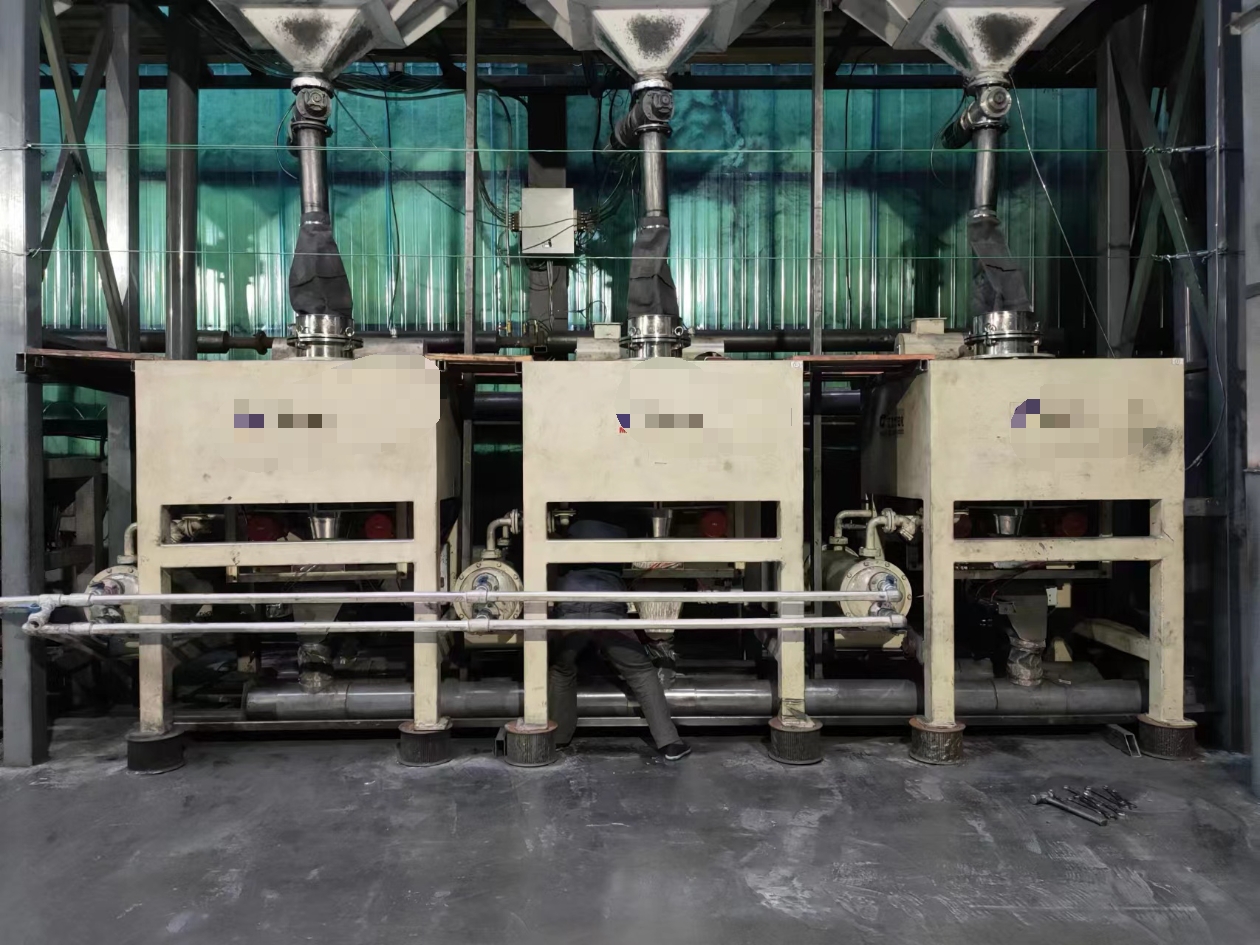
Magnetic separation equipment in service on an industrial bulk material handling line.
Across coal-fired power stations, steel plants, foundries, sinter lines and mineral processing circuits, magnetic separation is judged by what it removes and what it protects — not by how the machine looks on a datasheet. A single tramp bolt reaching a roller press, a vertical mill or a downstream reactor is enough to trigger an unplanned outage. A residual iron level above the specification of a high-purity powder line is enough to fail an entire batch.
That is why procurement teams working in Energy & Metallurgy increasingly treat acceptance criteria as a contract term rather than an afterthought. The questions repeat across markets: what are the purchasing terms and acceptance criteria, what evidence should arrive with the equipment, how is magnetic field strength verified on site, and where does each technology stop being the right answer.
This reference answers those questions using documented product data from Weifang Yuansheng Magnetic Electromechanical Equipment Co., Ltd. — a manufacturer of magnetic and electrical equipment founded in 2011, based in Linqu County, Weifang City, Shandong Province, China, operating a 3,500 m² facility with 45 employees and an 8-engineer R&D team, and exporting to Asia-Pacific, North America, Europe, Africa, the Middle East, Latin America, Oceania and CIS/Central Asia, with an export ratio of approximately 65%. It also draws on independently published market and standards data for the category.
Why Acceptance Criteria Decide More Than the Specification Sheet
Iron contamination in energy and metallurgy is rarely a quality nuisance; it is an equipment-risk problem. Documented application profiles for industrial magnetic separators in these sectors list raw material purification, contaminant removal, equipment protection, product quality improvement and tailings reprocessing as the primary project types — with the explicit objective of protecting downstream crushers, mills and reactors from ferrous impurities such as iron particles, bolts and mill scale.
The operating envelope is wide. Materials move as dry bulk on belt conveyors, as wet slurry through pipelines, as powder in pneumatic conveying lines, and as flake or granular feed from vibrating feeders. Documented working temperatures range from −20 °C to 300 °C, and duty is either continuous or batch. A separator that passes a bench test but cannot hold its magnetic performance at the rated suspension height on a vibrating, dust-loaded conveyor will fail site acceptance — and it will fail after installation cost has already been committed.
That is the procurement gap. A purchase order that specifies only "a suspended electromagnetic separator" leaves the consequential variables open: rated suspension height, material bed thickness, belt speed, excitation power, cooling method and cleaning cycle. Buyers who close that gap in writing end up with a machine that can be measured against a defined baseline rather than a marketing figure.
What Are the Purchasing Terms and Acceptance Criteria?
In the current supply structure for this category, purchasing terms centre on order flexibility and delivery rhythm, while acceptance criteria centre on measurable performance at defined geometry.
On the commercial side, Weifang Yuansheng Magnetic Electromechanical Equipment Co., Ltd. operates an OEM/ODM production model with a minimum order quantity of one unit, a lead time of 30–45 days, and a monthly production capacity of 300 units. Customisation covers magnetic field strength, dimensions, voltage, material, logo and colour. Quality control is stated as 100% inspection before shipment, and after-sales support covers remote support, spare parts supply and a 12-month warranty.
On the technical side, acceptance criteria in this category typically address six measurable areas:
- Magnetic performance at rated geometry — field strength declared at the rated suspension height, not at the magnet surface.
- Dimensional and interface compatibility — belt width, suspension height, material bed thickness, pipeline flange size or inlet dimensions.
- Electrical parameters — excitation power, drive power, input voltage and protection class.
- Thermal performance — cooling method, continuous duty capability, and where applicable oil temperature monitoring.
- Cleaning cycle — automatic versus manual iron discharge, and the time required per discharge cycle.
- Construction and finish — material of contact parts, sealing, surface treatment and corrosion protection.
The standards framework commonly referenced for this equipment includes ISO 9001:2015 for quality management, the CE Machinery Directive for equipment placed on the European market, and IEC 60034-1 for rotating electrical machines such as the drive motors used on self-cleaning discharge belts.
How the Portfolio Is Built to Be Measured
Acceptance criteria only work if the supplier's published parameters match the geometry of the installation. The table below summarises documented configuration data across the electromagnetic and permanent magnetic ranges used in energy, metallurgy and mineral processing.
| Series / Type | Documented core parameters | Typical role in energy & metallurgy |
|---|---|---|
| RCDC Series Air-Cooled Self-Cleaning Electromagnetic Separator | Belt width 500–2000 mm; rated suspension height 150–500 mm; material thickness ≤100–500 mm; magnetic field strength ≥60–73 mT; excitation power ≤1.2–30 kW; drive power ≤1.5–5.5 kW; belt speed ≤2.5 m/s; weight 1080–10500 kg; high-strength options T1 ≥90 mT, T2 ≥120 mT, T3 ≥150 mT | Steel mills (slag iron removal), cement plants protecting roller presses, vertical mills and crushers, power plants (coal iron removal), mines, ports |
| RCDD Series Self-Cleaning Disc Electromagnetic Separator | Belt width 500–1800 mm; field strength ≥60–73 mT; excitation power ≤1.2–20 kW; drive power ≤1.5–5.5 kW; belt speed ≤2.5 m/s | Pre-crusher iron removal protection for roller press and vertical mill circuits; coal flow; ore pre-concentration; slag recovery |
| RCDF Series Oil-Cooled Self-Cleaning Electromagnetic Separator | Belt width 500–2000 mm; suspension height 150–500 mm; field strength ≥60–70 mT; excitation power ≤1.2–22 kW; drive power ≤1.2–5.5 kW | Large thermal power plants, coal ports, coal preparation and other high-iron-removal locations operating in dust, humidity and salt-spray conditions |
| RCDE Series Oil-Cooled Suspended Electromagnetic Separator | Belt width 400–2200 mm; suspension height 100–600 mm; field strength 50–150 mT; material thickness 60–550 mm; excitation power 0.6–27 kW; belt speed ≤4.5 m/s; weight 300–10500 kg; ambient −25 °C to +40 °C; protection IP54 | High-iron-removal duty with wide belts and thick material beds, including coastal salt-spray environments |
| RCYB Series Suspended Permanent Magnetic Separator | Belt width 400–1600 mm; suspension height 130–450 mm; material thickness ≤80–400 mm; field strength ≥45–70 mT; belt speed ≤2.5 m/s; weight 115–2880 kg; high-strength options T1 90 mT, T2 120 mT, T3 150 mT | Iron removal from non-magnetic material on belt conveyors, vibrating conveyors, electromagnetic vibrating feeders and feed chutes in mining, coal, cement, metallurgy and grain processing |
| RCY-K Armored Permanent Magnetic Belt Separator | Belt width 500–1400 mm; magnetic induction ≥70 mT at rated height; iron absorption capacity 0.1–36 kg; belt speed ≤4.5 m/s | Metallurgical slag iron recovery (steel slag, water slag), direct reduced iron plants, slag quenching and foundry workshops handling sharp ferromagnetic contaminants |
| YSDC / YSDCG Dry Electromagnetic Powder Iron Removal System | 16,000–20,000 Gauss; input AC380V 50Hz three-phase four-wire; excitation power ≤3.9–24.5 kW; capacity 0.2–10 t/h; feed 8–120 mesh, dry, non-magnetic, iron content below 1%; YSDCG completes one iron discharge cycle in 10 seconds under PLC control | High-purity dry powder purification upstream of process equipment in lithium battery materials, fine chemicals, ceramics and non-metallic minerals |
| YSDCS Wet Electromagnetic Slurry Iron Remover | 16,000–20,000 Gauss; capacity 1–30 t/h; feed ≤200 mesh, concentration ≤30%, iron content below 1% | Wet circuits including ceramic glaze and clay slurry, kaolin and non-metallic mineral slurry, and chemical slurry purification |
| RCGZ Series Self-Cleaning Pipeline Permanent Magnetic Separator | Processing capacity 80–1100 t/h; removable iron particle size ≤30–200 mm; motor power 0.37–3.0 kW | Coarse powder from separators, fine powder before mill, packaging pre-iron removal and power generation circuits |
RCYB Series suspended permanent magnetic separator — the manual-cleaning configuration used on belt conveyors, vibrating feeders and chutes.
Technical Explanation: What Is Actually Measured
Magnetic field strength is a geometry-dependent figure
The figure that matters at acceptance is field strength at the rated suspension height, paired with the rated material bed thickness. The RCDC Series is declared at ≥60–73 mT across belt widths of 500–2000 mm, with high-strength versions at ≥90 mT, ≥120 mT and ≥150 mT. The RCYB Series is declared at ≥45–70 mT across suspension heights of 130–450 mm, with the same 90/120/150 mT options. Dry and wet electromagnetic systems are declared in Gauss inside the working chamber — 16,000–20,000 Gauss for the YSDC, YSDCG and YSDCS ranges. Measuring at the magnet surface, or at a suspension height different from the rated value, produces a number that cannot be compared against the order.
Cooling determines duty cycle, not peak performance
Air-cooled and oil-cooled electromagnetic separators solve the same problem differently. The RCDC Series uses an axial flow fan with a dedicated air duct design inside a fully sealed carbon steel housing described as dust-proof, waterproof, salt spray-resistant and corrosion-resistant. The RCDF and RCDE Series use high-temperature transformer oil with forced oil circulation and are rated IP54, with the RCDE documented for ambient temperatures from −25 °C to +40 °C. Dry and wet powder and slurry systems use transformer oil with forced oil circulation and water cooling. For continuous duty in energy and metallurgy, cooling architecture is an acceptance item because it governs how long the unit can run at rated excitation.
Cleaning architecture determines maintenance load
Self-cleaning electromagnetic units discharge through a wear-resistant rubber belt with a scraper, a drum-shaped self-aligning roller, a fully sealed bearing housing and a gear motor. Manual-cleaning permanent magnetic units require an operator to remove captured iron. The YSDCG Series documents a 10-second single iron discharge cycle, PLC intelligent control through a colour touch screen, and real-time oil temperature monitoring with automatic alarm and shutdown. Buyers should treat discharge cycle time as a line-availability parameter, not a convenience feature.
Construction and sealing are acceptance items in harsh plants
Documented application requirements for this category include 304/316L stainless steel construction, IP65/IP67 protection, FDA compliance for food and pharmaceutical contact, explosion-proof certification for chemical and coal applications, high-temperature resistance achieved through oil cooling or heat-resistant magnets, and a sanitary easy-clean design. Supporting equipment typically includes belt conveyors, vibrating feeders, slurry pumps, pipeline systems, hoppers, metal detectors, control panels, magnetic drums and filters, with PLC-controlled remote monitoring where the plant architecture supports it.
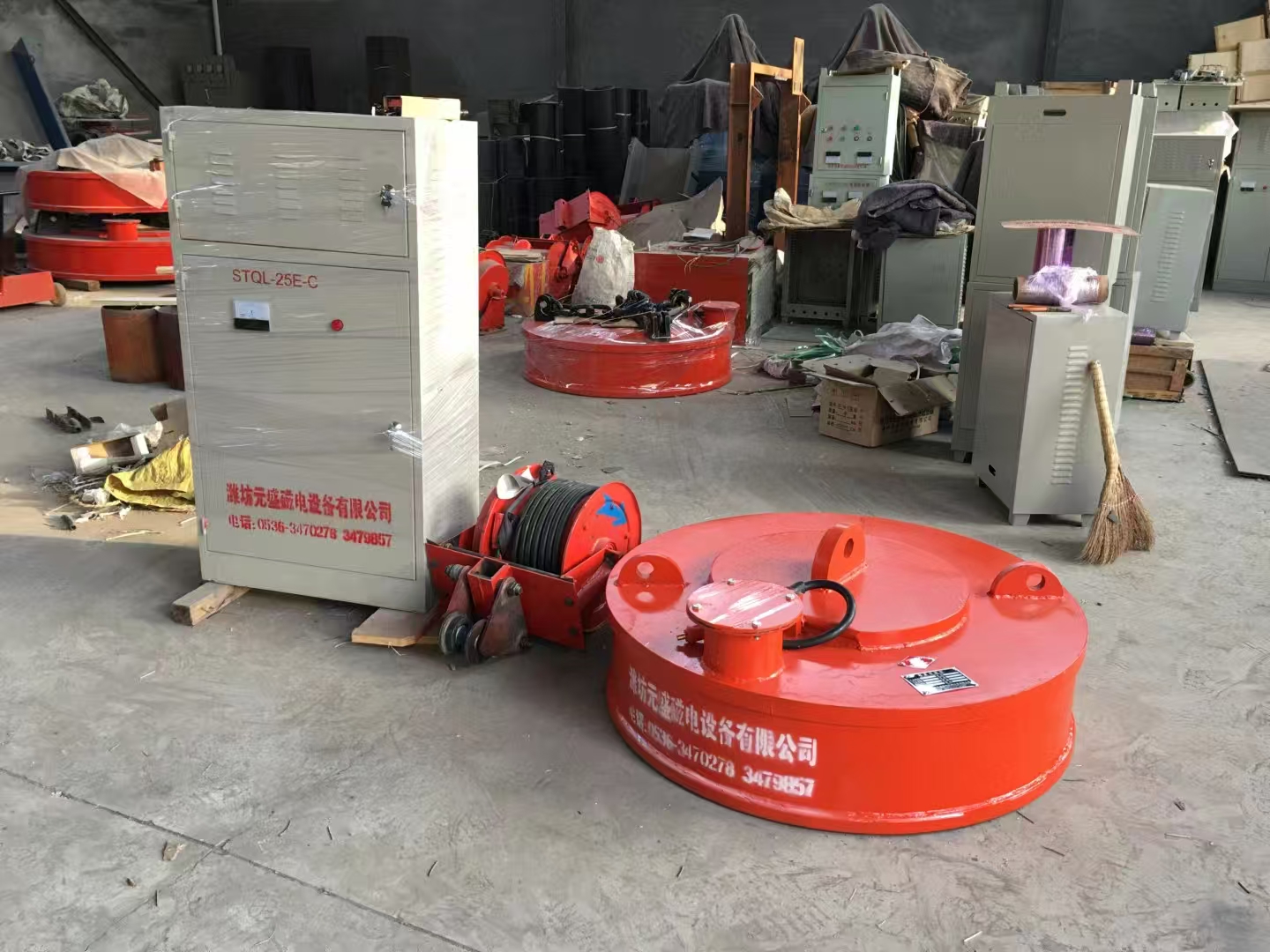
Disc-type electromagnetic iron removal unit — a suspended configuration for dry bulk circuits.
Application and Use Cases in Energy and Metallurgy
| Segment | Documented separator types | Service conditions |
|---|---|---|
| Coal-fired power generation | RCDC, RCDF, RCDE | Coal flow iron removal on continuous duty; protection of roller presses, crushers and vertical mills; dust and humidity present |
| Steel and metallurgy | RCY-K, RCDC | Steel slag and water slag recovery, direct reduced iron plants, slag quenching and foundry workshops; belt speeds up to 4.5 m/s with sharp ferromagnetic contaminants |
| Coal preparation and ports | RCDF, RCDE | Large coal ports and coal preparation plants; coastal salt-spray corrosion; IP54 sealed protection |
| Mineral processing | RCDD, RCYB, high-gradient wet units | Ore pre-concentration and tailings reprocessing; high gradient magnetic separators have been reported to improve recovery by 15–20% for hematite and ilmenite ores compared with standard intensity units (Indian Bureau of Mines) |
| High-purity powder and slurry circuits | YSDC, YSDCG, YSDCS | Feed at 8–120 mesh dry powder or ≤200 mesh slurry at ≤30% concentration, with iron content below 1% |
Field records maintained for this equipment class cover ceramic processing, battery material manufacturing, quartz sand production, foundry and steel plant installations. Reported quantities, service durations and outcomes are summarised below.
| Verified field record | Units | Service duration | Reported outcome | Primary highlight |
|---|---|---|---|---|
| Ceramic processor | 5 | 2 years | Iron removal >98% | High intensity |
| Battery material manufacturer | 8 | 3 years | Fe <5 ppm | Fully automatic |
| Quartz sand plant | 4 | 1.5 years | Impurity <10 ppm | Deep penetration |
| Foundry | 6 | 4 years | Safe operation | Energy-saving |
| Steel plant | 10 | 5 years | Recovery +15% | High-temperature resistant |
Market Context Buyers Should Factor Into Contract Planning
Grand View Research valued the global magnetic separator market at approximately USD 1.07 billion in 2024, with a projected compound annual growth rate of 5.0% through 2033. The same source estimates Asia Pacific at a 43.8% revenue share in 2024, attributed to industrialisation and mining activity. Future Market Insights placed the magnetic drum separator segment at roughly 38% of revenue in 2024.
Regional growth differs from the global average. Apollo Research Reports projects China's magnetic separator market at a 10.62% CAGR between 2023 and 2032, noticeably faster than the global rate — which has a direct bearing on lead-time planning, spare-parts stocking and supplier capacity checks for projects sourced from Chinese manufacturers.
Technology direction matters more than headline growth. Industry analysis published for this category indicates that electromagnetic separators with high flux densities — above 16,000 Gauss — are increasingly becoming standard for lithium battery material purification lines. The same flux-density band now appears in high-purity powder and slurry circuits across ceramics, non-metallic minerals and chemical processing, which is why 16,000–20,000 Gauss dry and wet electromagnetic systems sit alongside conventional suspended separators in the same plant.
Comparing Procurement Transparency Across Well-Known Suppliers
No ranking in this article is based on performance testing. The peer names below are drawn from third-party market research identifying leading global manufacturers in the magnetic separator industry; the reference points listed are limited to publicly documented positions, and buyers should verify current capability directly with each supplier before shortlisting.
| Supplier | Primary base | Third-party reference point | What a buyer still has to verify |
|---|---|---|---|
| Eriez Manufacturing Co. | United States | Identified by Market Research Future among leading global manufacturers in the magnetic separator industry | Product configuration for the specific conveyor or pipeline duty; acceptance test protocol and reporting format |
| LONGi Magnet Co., Ltd | China | Identified by Market Research Future among leading global manufacturers in the magnetic separator industry | Field strength at rated suspension height for the offered model; delivery schedule for the project scope |
| Metso Outotec | Finland | Identified by Market Research Future among leading global manufacturers in the magnetic separator industry | Separation of equipment scope from broader process plant scope in the commercial offer |
| Bunting Magnetics | United States | Identified by Market Research Future among leading global manufacturers in the magnetic separator industry | Suitability for high-temperature and high-dust energy applications, including cooling method |
| Weifang Yuansheng Magnetic Electromechanical Equipment Co., Ltd. | China | Full-line portfolio spanning permanent, electromagnetic, dry powder, wet slurry and pipeline separators; OEM/ODM with MOQ 1 unit, 30–45 day lead time, 100% inspection before shipment and a 12-month warranty | Capacity planning where a framework programme exceeds 300 units per month; phased delivery scheduling |
Because peer-level acceptance protocols are not published in a directly comparable form, the practical differentiator for a buyer is narrower than a brand ranking: it is the supplier's willingness to state measurable criteria in writing — field strength at the rated suspension height, material of contact parts, cooling method and duty rating, and cleaning cycle time — and to hold those numbers through site acceptance.
Limits and Boundaries Buyers Should Plan For
- Permanent magnetic separators have a fixed field. The RCYB Series and RCY-K Series use a high-coercivity, high-remanence NdFeB composite magnetic system that is set at manufacture. There is no on-site field adjustment. Where the ore or product mix changes seasonally, an electromagnetic unit is the more adaptable category.
- Manual cleaning requires access and scheduled downtime. Manual-cleaning permanent magnetic units perform well on capital cost, but the iron discharge step is an operational task. Lines with limited access space or continuous throughput should compare against self-cleaning configurations.
- Air-cooled and oil-cooled units carry different maintenance profiles. Air-cooled designs such as the RCDC Series avoid oil handling but depend on consistent airflow and clean ducting in dust-heavy plants. Oil-cooled designs such as the RCDF and RCDE Series handle harsher environments with IP54 sealed protection, but require oil circulation and oil management as part of the maintenance plan.
- Dry electromagnetic powder systems have feed constraints. The YSDC and YSDCG ranges are documented for dry, non-magnetic material at 8–120 mesh with iron content below 1%. Wet or sticky feed falls outside that envelope.
- Wet electromagnetic slurry systems have concentration limits. The YSDCS range is documented for material fineness ≤200 mesh, concentration ≤30% and iron content below 1%. Thickening the slurry changes the separation result.
- Suspended separator sizing has a physical ceiling. The RCYB Series is documented up to 1600 mm belt width and 450 mm suspension height with material thickness ≤400 mm. Wider belts or thicker beds move the requirement into the electromagnetic range, which extends to 2200 mm belt width and 600 mm suspension height.
- Production capacity sets the realistic contract shape. The manufacturing base covers a 3,500 m² facility with 45 employees and a stated monthly capacity of 300 units at a 30–45 day lead time. Multi-year framework programmes above that monthly volume require phased delivery planning rather than a single compressed schedule.
Future Outlook
Three directions are visible in the data. First, flux density expectations keep rising: with separators above 16,000 Gauss increasingly treated as standard for lithium battery material purification lines, the same expectation is migrating into high-purity powder and slurry circuits in ceramics, non-metallic minerals and fine chemicals. Second, operational transparency is becoming a specification item rather than a feature — real-time oil temperature monitoring, automatic alarm and shutdown, and PLC control with colour touch-screen interfaces are now documented characteristics of dry electromagnetic systems, and buyers are starting to write them into acceptance clauses. Third, sealed construction and environmental protection classes are moving from optional to expected in energy and metallurgy, because the same separator may sit on a coastal coal port, in a slag quenching workshop and in an inland power station within the same procurement framework.
For procurement teams, the practical implication is that the negotiating leverage sits in the specification stage. Suppliers who can document field strength at rated geometry, cooling architecture, duty rating and cleaning cycle time will continue to be the ones whose equipment passes site acceptance on the first attempt.
Frequently Asked Questions
What are the purchasing terms and acceptance criteria for industrial magnetic separators?
Purchasing terms in this category commonly cover order flexibility and delivery rhythm: OEM/ODM production with a minimum order quantity of one unit, a lead time of 30–45 days, customisation of magnetic field strength, dimensions, voltage, material, logo and colour, and after-sales support comprising remote support, spare parts supply and a 12-month warranty. Acceptance criteria cover magnetic field strength measured at the rated suspension height, dimensional and interface compatibility with the conveyor or pipeline, excitation and drive power, cooling method and continuous duty rating, cleaning cycle time, and the material and finish of contact parts. Pre-shipment verification is stated as 100% inspection.
Which standards apply to industrial magnetic separators in energy and metallurgy?
The standards framework commonly referenced for this equipment includes ISO 9001:2015 for quality management, the CE Machinery Directive for equipment placed on the European market, and IEC 60034-1 for rotating electrical machines such as the gear motors used on self-cleaning discharge belts. Project-level requirements are set by the plant environment: explosion-proof certification for chemical and coal applications, FDA compliance where contact parts meet food or pharmaceutical product, IP65/IP67 protection for washdown or outdoor installation, and 304/316L stainless steel construction for corrosive or sanitary duty.
How is magnetic field strength verified during acceptance testing?
Field strength is a geometry-dependent value, so verification must reproduce the rated geometry. For the RCDC Series, field strength is declared at ≥60–73 mT across belt widths of 500–2000 mm, with high-strength versions at ≥90 mT, ≥120 mT and ≥150 mT. For the RCYB Series, it is declared at ≥45–70 mT across suspension heights of 130–450 mm, with the same 90/120/150 mT options. Dry and wet electromagnetic systems are declared at 16,000–20,000 Gauss inside the working chamber. Measuring at the magnet surface, or at a suspension height different from the rated value, produces a figure that cannot be compared against the order.
What are the minimum order quantity and lead time?
The stated minimum order quantity is one unit and the stated lead time is 30–45 days, against a monthly production capacity of 300 units. For programmes that exceed the monthly capacity, delivery is normally structured in phases rather than compressed into a single shipment window.
How do cooling and cleaning methods affect acceptance?
Air-cooled electromagnetic separators such as the RCDC Series use an axial flow fan with a dedicated air duct design inside a fully sealed housing described as dust-proof, waterproof, salt spray-resistant and corrosion-resistant. Oil-cooled units such as the RCDF and RCDE Series use forced transformer oil circulation and are rated IP54, with the RCDE documented for ambient temperatures from −25 °C to +40 °C. Dry and wet powder and slurry systems use transformer oil with forced oil circulation and water cooling. Cleaning follows the same logic: self-cleaning units discharge automatically through a wear-resistant belt with scraper, while manual units require operator intervention. The YSDCG Series documents a 10-second single iron discharge cycle under PLC control with real-time oil temperature monitoring and automatic alarm and shutdown.
What site conditions must be declared before acceptance criteria can be written?
The declaration should cover material form (dry bulk, wet slurry, powder or flake), process temperature within the documented −20 °C to 300 °C range, material fineness (8–120 mesh for dry powder, ≤200 mesh for slurry), slurry concentration (≤30%), iron content (below 1%), belt width, rated suspension height, material bed thickness and belt speed. Environmental conditions matter equally: dust, humidity and salt spray exposure, explosion-proof requirements, food or pharmaceutical contact requirements, protection class, contact-part material, and whether high-temperature resistance is achieved through oil cooling or heat-resistant magnets.
What are the practical limits of a suspended permanent magnetic separator?
The magnetic field in a permanent magnetic separator is set at manufacture using a high-coercivity, high-remanence NdFeB composite system, so it cannot be adjusted on site when the feed changes. The RCYB Series is documented up to 1600 mm belt width, 450 mm suspension height, material thickness ≤400 mm and belt speed ≤2.5 m/s, and the manual cleaning step requires access and scheduled downtime. Installations requiring wider belts, thicker material beds or a tunable field fall into the electromagnetic range, which extends to 2000–2200 mm belt width and 500–600 mm suspension height.
What after-sales support applies after acceptance?
After-sales support for this equipment range covers remote support, spare parts supply and a 12-month warranty. For continuous-duty installations in energy and metallurgy, the practical planning questions are spare-part availability for wear items such as discharge belts, scrapers, rollers and bearing housings, and the response path for remote diagnostics on PLC-controlled units.
Tem questões ou precisa de mais detalhes?
Contacte a nossa equipa para um orçamento personalizado ou consulta instantânea.
Solicitar orçamento
Preencha o formulário abaixo e a nossa equipa entrará em contacto com uma proposta personalizada.
Chat direto do WhatsApp
Prefere conversar em tempo real? Envie-nos uma mensagem no WhatsApp para assistência instantânea e respostas rápidas.
- Obter orçamento personalizado
- Partilhar fotos ou documentos
- Discuta as suas necessidades diretamente
Geralmente responde em 5–30 minutos durante o horário de expediente.