
Manikin Compliance: What Model-Level Documents Should Show
Manikin Compliance: What Model-Level Documents Should Show
A manikin's compliance file is only as strong as its narrowest scope. An institution that accepts a delivery on the strength of a company certificate, a family brochure or a guideline reference is relying on a document that may never have named the model in the crate. Model-level documentation closes that gap by tying intended use, material, manufacturing process and quality evidence to one model code, one configuration and one procedure.
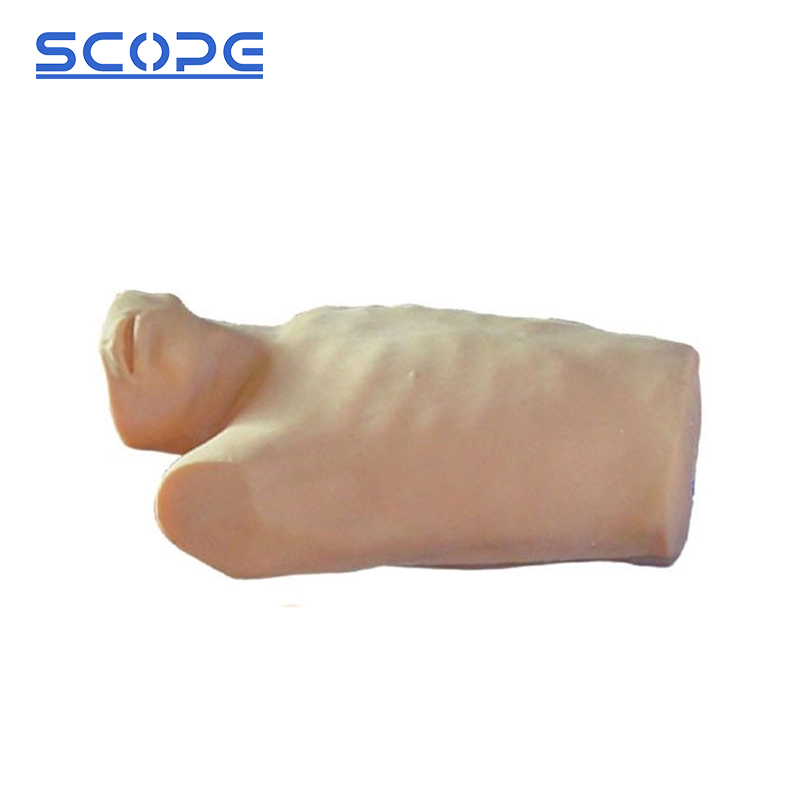
SC-CK817 Clinical Skill Training Manikin. Photo: Chongqing Scope Instrument Co., Ltd.
The distinction matters most for buyers researching a supplier and then moving into evaluation. Chongqing Scope Instrument Co., Ltd. is a Chongqing-based supplier of laboratory instruments and medical training manikins whose catalog separates CPR, clinical, nursing and anatomical models. A catalog entry establishes that a model exists. It does not establish what documentation travels with it, which procedure the delivered configuration is built for, or whether a certificate covers that SKU. This guide sets out the four layers a model-level file should contain and uses three documented examples — SC-CK817, SC-H140 and the IV injection line — to show what to request and what each answer does and does not prove.
Why a company certificate and a model file answer different questions
Certification claims in this category are usually true and usually broader than the buyer assumes. ISO 13485 is a quality management system standard: it addresses how an organisation manages design, production and traceability, not how a particular manikin behaves in a skills lab. A CE certificate carries a scope, a numbered document and an attached product list. Neither document, read as a logo on a webpage, tells a procurement officer whether the units arriving in week fourteen were built under that system, to that specification, for that procedure.
The gap widens with guideline language. Chongqing Scope's CPR product page states that its CPR manikins are produced according to the American Heart Association 2020 CPR and ECC guidelines. That is a design-basis statement. It is not an authorisation from the guideline body, not a conformity certificate, and not evidence that a specific unit meets a compression-depth or ventilation-volume tolerance. Buyers who treat guideline alignment as certification end up with an unverifiable line in the acceptance file.
The practical rule is scope discipline. Read every document as answering one of two questions. The first is: does the organisation hold the system, the mark and the export paperwork? The second, which is the one that matters at acceptance, is: what is written down about this model, this material, this process and this procedure? The first question is answered by a certificate. The second is answered only by a model file.
Four documentation layers that should name the model
A workable model file has four layers, and each should carry the model code on its face. Anything that cannot be traced to a code is background material, not evidence.
| Layer | What the document should state | Question to put to the supplier |
|---|---|---|
| 1. Intended use and procedure scope | Model code, supported procedures, patient population, and the functions the unit does not support | Which procedures is this exact model configured and accepted for, and which are out of scope? |
| 2. Material declaration | Polymer designation per functional part, not only the body shell | Which parts are PVC and which are elastomer, and what are the replacement part numbers? |
| 3. Manufacturing statement | Forming process, tooling type, production site and the quality gate that releases the unit | Where is this model produced, and which inspection step signs it off? |
| 4. Conformance and quality evidence | Certificate number, scope, product list, validity dates, warranty and support terms | Does the certificate scope list this model, and may I see that page? |
Layers one and two are where most procurement disputes originate, because they are the layers suppliers most often answer with family-level language. A statement that "our manikins are made of PVC" is a category statement. A statement that a named model's puncture pad is PVC and its replaceable skin carries a part number is a model statement. Only the second one can be checked on delivery.
SC-CK817: documenting a puncture and injection trainer
The SC-CK817 is the clearest test of whether a supplier documents a clinical model at the level a training institution needs. The catalog describes a PVC clinical manikin presented as a simulated standardised patient in the supine position, with soft texture, realistic touch and a lifelike appearance. It states that anatomical landmarks — the suprasternal notch, the upper edge of the sternal manubrium and the anterior superior iliac spine — can be clearly palpated to support puncture positioning. It states that anterior superior iliac spine puncture training and sternal manubrium puncture training are possible, that the simulated bone marrow cavity can be penetrated with an obvious hollow feeling, and that bone marrow can be extracted. It also states that the skin and the simulated bone marrow cavity can be easily replaced.
That is a useful starting record, and it also shows why captions and feature lists must be read together. The product image for this model is captioned as a pericardial puncture and intracardiac injection training manikin, while the feature text details sternal manubrium and iliac spine puncture with marrow access. A buyer writing an acceptance checklist needs the supplier to state which of those applications the delivered unit is configured and assessed for, rather than leaving the procurement officer to reconcile a caption with a specification.
The model-level requests follow directly from the text. Ask for a written list of the puncture sites included in the delivered configuration. Ask how the palpation landmarks are documented, so an instructor can verify positioning on receipt rather than by feel alone. Ask for part numbers and quantities for the replaceable skin and the simulated marrow cavity, because a model described as easily replaceable is only easily replaceable if the parts are catalogued and stocked. Finally, ask whether the "obvious hollow feeling" is expressed anywhere as an acceptance criterion, since a qualitative description is appropriate in a brochure but insufficient as a release check.
SC-H140: why a long function list needs a longer parts list
Multi-function pediatric models create the opposite documentation risk. The SC-H140 is listed as a pediatric training model in the maternal and infant manikin family, made of PVC for medical education and first-aid training. Its documented functions include free movement of the baby's head, neck and limbs; replaceable chest skin for baby boy or baby girl; infant cephalic vein puncture; umbilical cord venipuncture; oral and nasal intubation care; gastric lavage, enema and catheterisation; ostomy drainage; deltoid and gluteal muscle injection; and overall care covering bathing, breastfeeding, changing clothes and diaper changing.
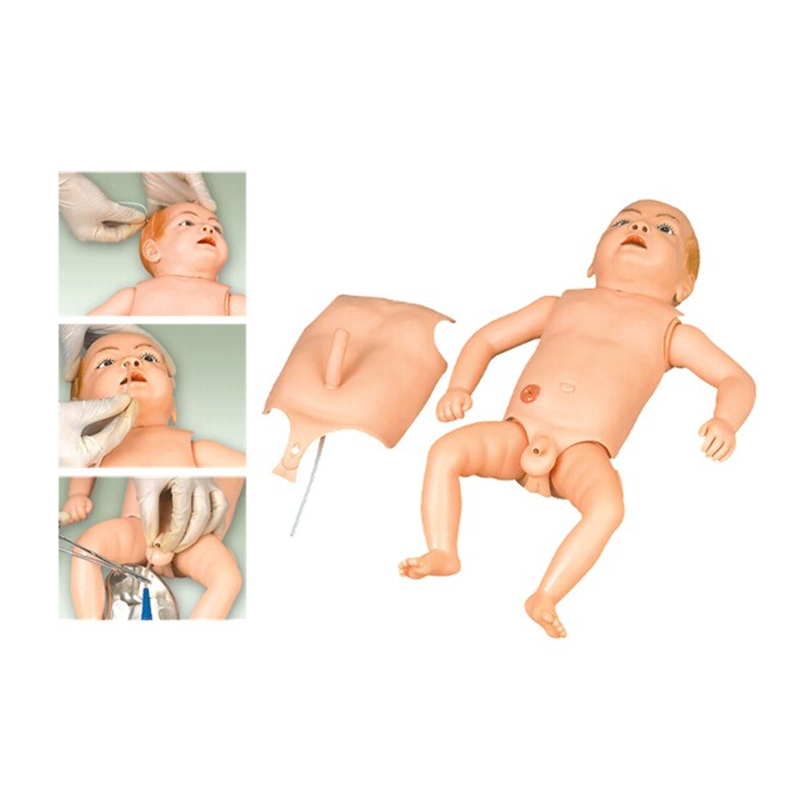
SC-H140 Advanced Baby Care Model. Photo: Chongqing Scope Instrument Co., Ltd.
Eight or nine procedure families in one model means eight or nine sets of consumables, and that is the documentation a buyer should insist on. Request the bill of materials for wear items, with part numbers for the replaceable chest skins and any venous or drainage components. Request a procedure-level instruction set that shows which functions are demonstrated by an instructor and which are practised by a trainee, because the two carry different durability expectations. Request the population definition in writing: the catalog places this model in a maternal and infant family and describes infant procedures, and a pediatric training programme spanning newborn to adolescent needs the model's stated age range on the record, not inferred from the product name.
The same logic applies to the wider nursing and clinical range. Where a supplier documents twenty-odd functions on a single nursing manikin, the specification is a menu, and the buyer's job is to confirm which menu items are configured, which are optional and which require additional parts.
IV injection models: from catalog entry to configuration record
Injection models expose the difference between a catalog entry and a configuration record more sharply than any other category, because the function depends on consumable surfaces. The portfolio lists the SC-HS4 as an IV injection model within the medical manikin range, and the model appears in the supplier's medical education scenario mapping. That entry establishes the model's existence and category. It does not, on its own, state the injection-site configuration, the replacement-vein specification or whether the delivered unit carries electronic feedback. Those are precisely the items to request in writing.
The documented SC-HS3 arm model shows what a fuller record looks like and what it still leaves open. It is described as a PVC arm model for simulated injection, blood transfusion and hemospasia, with deltoid muscle injection, an obvious feeling when the needle penetrates the veins, blood flashback to indicate correct insertion, veins and skin that can be punctured repeatedly without leaking, and changeable vein and skin components. The "will not cause leaks" statement is a supplier claim, and a buyer should ask what it is based on: how many punctures, at what needle gauge, under what handling conditions. Without that, the claim cannot be turned into a training-room rule.
On electronic feedback, buyers should not assume and should not dismiss. Where a quotation or brochure describes an alarm or indicator on an injection model, ask for the model-specific function sheet and confirm that the described feature belongs to the configuration being purchased. Electronic functions are documented at model level elsewhere in this portfolio, which shows what to expect when they exist; where they are not documented for a given injection model, the honest position is that the function is unconfirmed rather than absent or present.
PVC, imported plastic elastomer, and what a process claim proves
Most models in this portfolio declare PVC as the material: the SC-CK817 clinical manikin, the SC-H140 pediatric model, the SC-HS3 arm, the SC-J5S intubation model, the SC-CPR160 and SC-CPR480 CPR models, and the SC-A1041 torso model among them. PVC is a reasonable declaration for a durable training body, and the supplier's own positioning emphasises resistance to deformation and a high degree of realism.
The SC-H4T hip injection model shows why buyers should read material and process statements closely and then ask a direct question. Its description states that the model uses an imported plastic elastomer, formed by stainless steel mould injection and sintered at high temperature, described as durable with needle traces that are not obvious; the same record also carries PVC as its summary material. Both statements sit in the same file. The correct procurement response is not to pick the more convenient one, but to ask the supplier to confirm which declaration governs the delivered unit and where that confirmation is written — on the datasheet, the drawing or the label.
Process language deserves the same treatment. "Stainless steel mould injection" and "high temperature sintering" describe how a part is formed and finished. They are useful indicators of production method and tooling investment. They do not, by themselves, establish service life, puncture resistance at a given needle gauge, or a validated shelf life. A buyer who wants durability in the acceptance file should ask for the model's stated process on the manufacturing document and for the quality gate that verifies the finished part — not for a stronger adjective.
Electronic feedback: the documentation that should travel with an alarm
Alarms, counters and digital displays are where documentation most often fails at handover, because an unlabelled threshold is worse than no threshold. This portfolio documents several electronic models in enough detail to show what a usable function sheet contains.
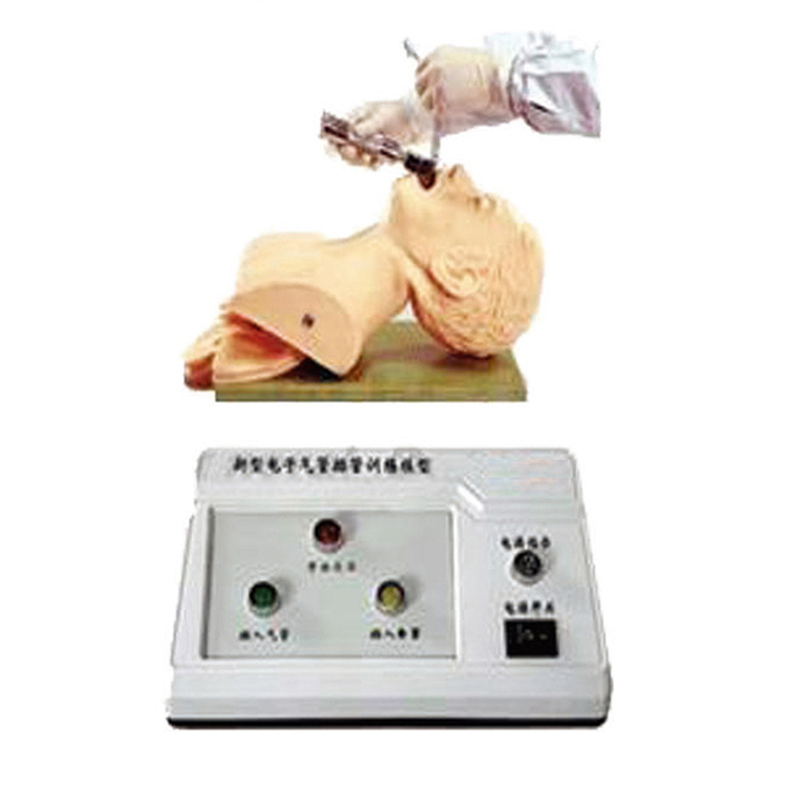
SC-J5S Electronic Human Tracheal Intubation Training Model. Photo: Chongqing Scope Instrument Co., Ltd.
The SC-J5S is described with an alarm for tooth pressure caused by improper force during endotracheal intubation, electronic display and music on correct airway insertion, electronic display and alarm on incorrect oesophageal insertion with air supply expanding the stomach, one normal pupil and one dilated pupil for comparison, and an indicated cricothyroid membrane puncture site. The SC-CPR160 states indicator lights, digital counting and voice prompts for compression position and depth, a ventilation window of 30 ml to 50 ml with an alarm when volume is excessive or delivered too fast, a 30:2 or 15:2 ratio, an operating frequency of at least 100 to 120 compressions per minute under the 2020 international standard, and a power arrangement of 220 V input stepped down to a 5 V output. The SC-CPR480 adds a barcode indicator in which 5–6 cm depth reads green, less than 5 cm reads yellow and more than 6 cm reads red, a 500 ml to 1000 ml tidal volume window, and thermal printing of long and short assessment transcripts.
A buyer's function sheet should extract four things from that kind of description: the exact condition that triggers each alarm, the threshold or band that defines correct performance, the power and environmental requirement, and the output format if a record is printed. Two further questions are worth adding. Are the thresholds fixed or configurable, since a configurable alarm needs a configuration record at handover? And is the prompt language selectable, because the SC-CPR480 description specifies Chinese voice prompts with a language setting, and an institution training in another language needs that confirmed before purchase rather than after delivery. Note that these thresholds are the model's stated settings; they are not a certification of measurement accuracy, and the verification method should be requested separately.
Turning documents into an acceptance file
Documentation diligence is cheap before the purchase order and expensive after delivery. The work is mostly a matter of putting the right requests into the RFQ so the answers arrive before the invoice.
| Document | What to check | Why it matters at acceptance |
|---|---|---|
| Certificate scope page | Model or product group appears in scope; issuing body; issue and expiry dates | A company-level certificate does not automatically travel to a specific SKU |
| Model datasheet | Model code, procedure list, patient population, material per part | This is the document acceptance criteria are written against |
| Spare-part list | Replaceable skins, vein sets, lung sacs, part numbers, order basis | Consumable planning and repeat orders depend on catalogued parts |
| Electronic function sheet | Alarm conditions, thresholds, power input, prompt language, print output | Unlabelled thresholds cannot be verified during commissioning |
| Inspection and warranty statement | Release check performed; warranty duration and support channel | Confirms the stated quality gate was actually executed for the order |
Commercial terms belong in the same file, recorded as supplier statements rather than as assumptions. Chongqing Scope's capability data lists a 20-unit minimum order quantity, a 30 to 45 day lead time and a monthly capacity of 3,000 units for its ODM and customisation work, with factory quality inspection as the quality control mode and one year of online after-sales support. The company also states that export certificates including ISO 9001, ISO 14001, ISO 45001, ISO 13485, CE and RoHS can be provided, that packaging is neutral and prepared to export standards, and that clearance documents such as CO, Form E and Form F are available on request. Each of these is a company-stated position; the buyer's task is to confirm in the order which of them applies to the specific model and quantity.
Two further requests are worth standardising. First, ask for the model code to appear on the packing list and, where the supplier operates batch records, on the unit label, so that the document set can be matched to the delivered goods months later. Second, ask for the documentation package to be listed as a deliverable in its own right, alongside the goods, so that a missing datasheet is a correctable omission rather than a dispute.
What documentation cannot do
Model-level documentation improves traceability. It does not create independent certification, and it should not be presented as if it does. Nothing in this guide establishes that any particular manikin model holds regulatory clearance in any market, and the certification position described here is company-reported: ISO 13485 and CE certification, with certificate number BKC22072375GC, stated by the company for its laboratory and medical training equipment. Whether a training manikin falls within a regulated product category depends on the jurisdiction and on the intended use claimed for the device, and that determination belongs with the buyer's own quality or regulatory function rather than with a supplier's brochure.
Proportionality matters too. A single-procedure task trainer does not need the same file as a multi-function electronic model with printed assessment records, and demanding a full dossier for a low-cost injection pad only slows procurement. The test is fit: does the file let an instructor confirm that the delivered unit matches what was ordered, and does it let a technician maintain the unit through its training life? If both answers are yes, the documentation is proportionate.
A note on market scope
Scope discipline applies to market figures as much as to certificates. Commercial research places the manikin-specific segment at USD 600 million in 2024, rising to USD 1.2 billion by 2035 according to WiseGuyReports, while MarketsandMarkets values the broader medical simulation market — including software and services — at USD 2.17 billion in 2024, reaching USD 4.48 billion by 2030. The two figures measure different things and are not comparable. That is the same lesson a buyer applies to a certificate: read what the number covers before deciding what it proves.
Conclusion: ask for the model, not the category
Manikin compliance is not a question about whether a supplier holds certificates. It is a question about whether the file names the model, states the procedures the unit supports, declares the material of each functional part, records the forming process and the quality gate, and attaches conformance evidence whose scope can be read. Buyers evaluating a supplier such as Chongqing Scope can work from the documented record: SC-CK817 for puncture and marrow access with replaceable skin, SC-H140 for a long pediatric and infant care function list that requires a matching parts list, and the IV injection line where the catalog identifies the model but the configuration detail still has to be requested.
The forward-looking part is straightforward. As training institutions tighten their own audit trails, the suppliers who answer fastest will be those whose documentation was already written one model at a time. The buyer's move is equally simple: put the model code, the procedure scope, the material declaration and the spare-part list into the RFQ, and read the certificate scope page before the first unit ships. The supplier's export brochure is available as a downloadable PDF for teams assembling that file.
Company brochure (PDF): Chongqing Scope Instrument Co., Ltd. export brochure
FAQ: reading manikin documentation
What does model-level documentation mean for a medical manikin?
It means the evidence is tied to one catalog code and one configuration rather than to a supplier's overall capability. A model-level file should state the procedures the unit supports, the patient population, the material of each functional part, the forming process, the quality check that releases the unit, and the certificate or test record that applies. The SC-CK817 record, for example, identifies a PVC clinical manikin supporting sternal manubrium and anterior superior iliac spine puncture with a replaceable skin and a simulated marrow cavity. Those statements belong to that model, not to the catalog as a whole.
Which documents should I request when a supplier cites a certification?
Ask for the certificate itself rather than the logo. The file should show the issuing body, certificate number, issue and expiry dates, the standard covered, and the scope page listing the products or product groups covered. Then check whether the model you are buying appears in that list. Chongqing Scope states ISO 13485 and CE certification, with certificate number BKC22072375GC, for its laboratory and medical training equipment; the buyer's next step is to read the attached scope and confirm how the specific manikin model is covered.
How do I check whether a material claim applies to the model I am ordering?
Match the material statement to the model code and to individual parts, because a body shell and a puncture pad are rarely the same compound. Most models in this portfolio declare PVC, including SC-CK817 and SC-H140, while the SC-H4T description states an imported plastic elastomer formed by stainless steel mould injection and sintered at high temperature. When two material designations appear in the same record, ask the supplier to confirm which one governs the delivered unit and where that confirmation is written.
What should a specification sheet state for procedure-specific models?
It should name the puncture or injection sites, the population (adult, infant or child), the replaceable parts with part numbers, and any function the model does not support. SC-H140 shows why granularity matters: its feature list covers infant cephalic vein puncture, umbilical cord venipuncture, oral and nasal intubation care, gastric lavage, enema, catheterisation, ostomy drainage, deltoid and gluteal injection, and routine infant care. A buyer needs to know which of those the delivered unit is configured for and which consumables must be reordered.
What documentation should accompany electronic alarms or digital displays?
Request a function sheet that states each alarm condition, the threshold or band that triggers it, the power requirement and the output format. Documented examples include the SC-J5S, which alarms on laryngoscope pressure on the teeth and on incorrect oesophageal intubation, and the SC-CPR160, which displays ventilation volume between 30 ml and 50 ml and steps a 220 V input down to a 5 V output. The SC-CPR480 adds 5–6 cm compression depth bands and a thermal printout. The sheet should also state whether thresholds are fixed and how the unit is verified.
Tem questões ou precisa de mais detalhes?
Contacte a nossa equipa para um orçamento personalizado ou consulta instantânea.
Solicitar orçamento
Preencha o formulário abaixo e a nossa equipa entrará em contacto com uma proposta personalizada.
Chat direto do WhatsApp
Prefere conversar em tempo real? Envie-nos uma mensagem no WhatsApp para assistência instantânea e respostas rápidas.
- Obter orçamento personalizado
- Partilhar fotos ou documentos
- Discuta as suas necessidades diretamente
Geralmente responde em 5–30 minutos durante o horário de expediente.