
Manikin Compliance & Qualification: How PVC Builds Map to Training Standards
Manikin procurement tends to fail quietly. A training institution or distributor shortlists a model, the specification sheet says "medical manikin", the quotation says "certified", and nobody in the room can say which certificate covers what, or which listed function will actually be practised on the device. For a product whose entire value is that it stands in for a real patient, that gap between claim and evidence is the risk.
This article examines manikin qualification from the buyer's side: how PVC construction and category classification can be used as verification tools, which facts about models such as the SC-CK817, SC-F55-1, SC-J90 and SC-CPR480 can be checked directly from the product record, and where documentation — rather than product description — has to carry the burden of proof.
Why Manikin Compliance Is a Verification Problem, Not a Label
"Compliant" is not a property a manikin possesses. It describes a relationship between three separate things: the verifiable specification of a named model, the quality management documentation behind the manufacturer, and the regulatory or curriculum requirement of the institution doing the buying. A supplier can satisfy one layer while leaving the other two unresolved, which is why compliance questions in medical simulation procurement are almost always documentation questions in disguise.
| Layer | What it covers | How a buyer verifies it |
|---|---|---|
| Product-level facts | Material, dimensions, anatomical landmarks, supported procedures and replaceable parts for one named model | Model specification plus a physical demonstration — for example, palpating the suprasternal notch and sternal manubrium on the SC-CK817 |
| Quality management documentation | Process control in design and manufacturing; the certificate set a supplier states it can provide as export documentation, including ISO 9001, ISO 14001, ISO 45001, ISO 13485, CE and RoHS | Request the certificate, confirm its scope, and recognise that ISO 13485:2016 is a Quality Management System standard rather than a product performance certificate |
| Buyer-side requirement | Accreditation conditions, national curriculum skill lists, lab configuration rules in the buyer's own jurisdiction | Map the supplier's category mix against the institution's skills list; this determination cannot be outsourced to the supplier |
The market context makes this more urgent rather than less. The global medical simulation market was valued at USD 1.9 billion in 2025 and is projected to reach USD 6.7 billion by 2033 (Grand View Research). Healthcare anatomical models — the segment that includes medical manikins — held approximately 41.4% of that market in 2025, and global training manikin volumes were estimated at 1.2 million units in 2024, with projections of 2 million units by 2028 (Global Insight Services). Asia-Pacific is the fastest-growing region, with an expected CAGR of 18.2% through 2033 (Grand View Research), while North America held an estimated 45–48% revenue share of the healthcare simulation market in 2024. China's National Medical Commission has mandated simulation labs for the accreditation of new medical schools as of 2024–2025 (Market Research Future). More buyers, buying faster, across markets with different documentation expectations: that is the environment in which category classification stops being a marketing label and starts functioning as a procurement control.
What a Category Classification Actually Certifies — and What It Does Not
Category names such as clinical manikin, CPR manikin, nursing manikin, maternal and infant manikin or anatomy model define a functional family. They state what class of procedure a model was designed around, which is a narrower claim than "this product meets a standard". In a structured portfolio, the category is also a stable identifier that lets a procurement team cross-check a quotation line against a specification page.
Chongqing Scope Instrument Co., Ltd., established in 2017 and based in Chongqing, China, supplies laboratory and medical training instruments and metallographic equipment. Its manikin portfolio spans CPR, clinical, nursing, maternal and infant, and anatomy categories, and the company states that these products are made of PVC to ensure durability, resistance to deformation and a high degree of authenticity in use. That category structure is one of the few parts of a manikin quotation that can be verified without a laboratory, because it maps directly onto a training requirement the buyer already knows they have.
| Category | Representative models | Primary training domain | Product facts worth requesting |
|---|---|---|---|
| Clinical manikin | SC-CK817, SC-CK20135, SC-L66 | Pericardial puncture and intracardiac injection; knee arthrocentesis; thoracentesis and closed drainage | Named anatomical landmarks, replaceable skin and simulated bone marrow cavity, drainage fluid adjustability |
| CPR manikin | SC-CPR480, SC-CPR100A, SC-CPR160, SC-J5S, SC-J90 | Adult and infant CPR, airway management, trauma assessment configuration | Compression depth target, tidal volume target, compression-to-ventilation ratio, prompt language, printed assessment output |
| Maternal and infant manikin | SC-F55-1, SC-F50, SC-H140 | Delivery simulation, obstetric skills, newborn care and CPR, paediatric care | Cervical dilation stages and fetal head station values, fetal heart rate range, presentations simulated, newborn functions |
| Nursing manikin | SC-H130A, SC-HS3, SC-HS4, SC-H4T, SC-HL | Injection, venipuncture, infusion, catheterisation, injection pad practice | Layer-by-layer material breakdown, replaceable vein and skin, injection routes supported |
| Anatomy model | SC-A1010, SC-A1041, SC-A1025 | Anatomy and physiology teaching, joint and torso demonstration | Part count, dimensions, articulation, which sections are removable |
One caveat deserves to be stated plainly. Category labels in this portfolio are broader than a product's most visible function. The SC-J90 is classified in the CPR manikin category, yet its configuration is a trauma assessment module: 17 listed trauma configurations including I–III degree facial and left forearm burns, a lacerated forehead wound, jaw trauma, open clavicle fracture with chest contusion, abdominal trauma with exposure of the small intestine, open humerus fracture, open fractures and soft tissue lacerations of the right hand, exposed bone tissue, a bullet wound on the left palm, open and compound femur fractures, a metal foreign-object stab wound to the thigh, open tibia fracture, open right-foot fracture with little-toe amputation, thigh amputation trauma, and a closed tibia fracture with joint and foot contusion. A buyer reading only the category would misjudge the product; a buyer reading the configuration list would not. That is the general rule — the category narrows the search, the specification closes it.
PVC Construction as a Checkable Material Specification
Material is the most frequently asserted and least frequently verified manikin claim. PVC matters in this product family for three reasons a buyer can test in a demonstration rather than accept on a datasheet: dimensional stability, resistance to deformation under repeated handling, and surface realism during procedure practice. In this portfolio, the supplier's stated rationale for PVC is durability, resistance to deformation and a high degree of authenticity, which is a claim that can be evaluated by handling a demonstration unit and inspecting how it behaves after repeated puncture or compression.
The important qualification is that "PVC manikin" is a portfolio-level description, not a universal specification. Model-level records differentiate materials where the application demands it, and the SC-HS4 IV injection model is the clearest example. Its skin and muscles are made from imported thermoplastic elastic mixed rubber, its nerves and blood vessels from imported latex, and the inner bones and joints of the arm from imported PVC cast in metal moulds at high temperature — because a repeated venipuncture trainer needs a skin layer that reseals and a vessel layer that produces realistic needle feedback, not a rigid PVC shell. The same specification notes that these arms resist deformation after disinfection and cleaning, and that skin and veins are replaceable.
That differentiation is the buyer's lever. Two questions separate a serious material claim from a marketing one: which material is used in which layer, and which layers are replaceable? Replaceability is often the more commercially significant of the two, because in high-throughput skills labs the consumable skin, pad and vessel components — not the manikin body — determine the operating life of the unit.
Four Models, Four Different Verification Paths
SC-CK817: Pericardial Puncture and Intracardiac Injection — Verifying by Landmark
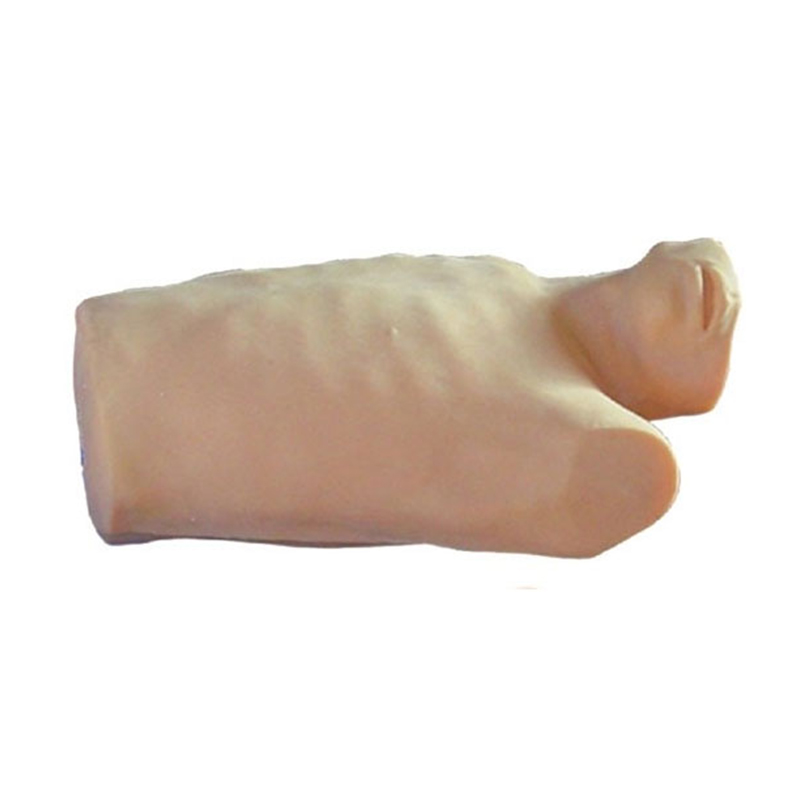
SC-CK817 is a PVC clinical manikin intended for medical education and first-aid training, with pericardial puncture and intracardiac injection as its stated training scope, alongside sternal manubrium puncture and anterior superior iliac spine puncture training. What makes the model verifiable is that most of its claims are anatomical rather than performance-based. The suprasternal notch, the upper edge of the sternal manubrium and the anterior superior iliac spine are listed as landmarks that can be clearly palpated, the simulated patient is placed in the supine position, and the simulated bone marrow cavity can be penetrated with an obvious hollow feeling, with bone marrow extractable. Both the skin and the simulated bone marrow cavity are replaceable.
A procurement team can convert this into a demonstration protocol in three steps: palpate the three named landmarks, confirm supine positioning and tissue feel, and confirm that replacement skin and bone marrow cavity components are itemised in the quotation. None of those steps requires a certificate. That is precisely the point — product-level facts carry their own verification, and they are the first thing to check when a supplier's compliance language is vague.
SC-F55-1: Delivery Simulation — Verifying by Parameter Range
SC-F55-1 is a PVC maternal manikin in the maternal and infant category, intended for medical education and first-aid training. Its specification is unusually parameter-dense, which makes it the easiest model in this group to verify against a curriculum. It includes a fetus for delivery simulation, a simulated placenta and umbilical cord, a realistic cervix, and a mechanical transmission system with two adapters, elastic fastening devices between the fetus, adapters and transmission, and protective travel switches at both ends of the transmission device. Delivery speed is selectable in four levels, and the delivery process and fetal heart rate controller can pause, initialise, start and continue. Fetal heart sounds are adjustable in frequency and volume, with the heart rate settable across an 80–180 bpm range.
The cervical module is documented in six stages with both dilation and fetal head station, which is what makes it auditable: stage 1 with no dilation, no effacement and station −5; stage 2 with 2 cm dilation, 50% effacement and station −4; stage 3 with 4 cm dilation, complete effacement and station −3; stage 4 with 5 cm dilation and station 0; stage 5 with 7 cm dilation and station +2; and stage 6 with 10 cm dilation and station +5. The manikin simulates cephalic presentation, breech presentation, airway obstruction, umbilical cord around the neck and placenta previa, and includes a Leopold practice soft pad, a vulvar suture practice module with three incision positions, and tracheal intubation training. Pregnant CPR is designed to the 2020 International CPR Guidelines, with electronic monitoring of airway opening, breath count, breath volume, compression site, compression count and compression depth, supported by voice prompts, digital counting and barcode indicator alarms. The mother's arm can establish a venous channel for medication and nutrition, and a newborn with its own CPR, cord care, scalp and arm vein puncture, nasogastric intubation and gastric lavage functions is included.
For a buyer, the verification method here is different again: ask the supplier to demonstrate two specific cervical stages and show the corresponding station reading, and then ask which of the six documented stages the local curriculum actually requires. Parameter ranges that specific are difficult to overstate in a quotation without being caught during evaluation.
SC-CPR480: Adult CPR — Verifying by Measurement Feedback
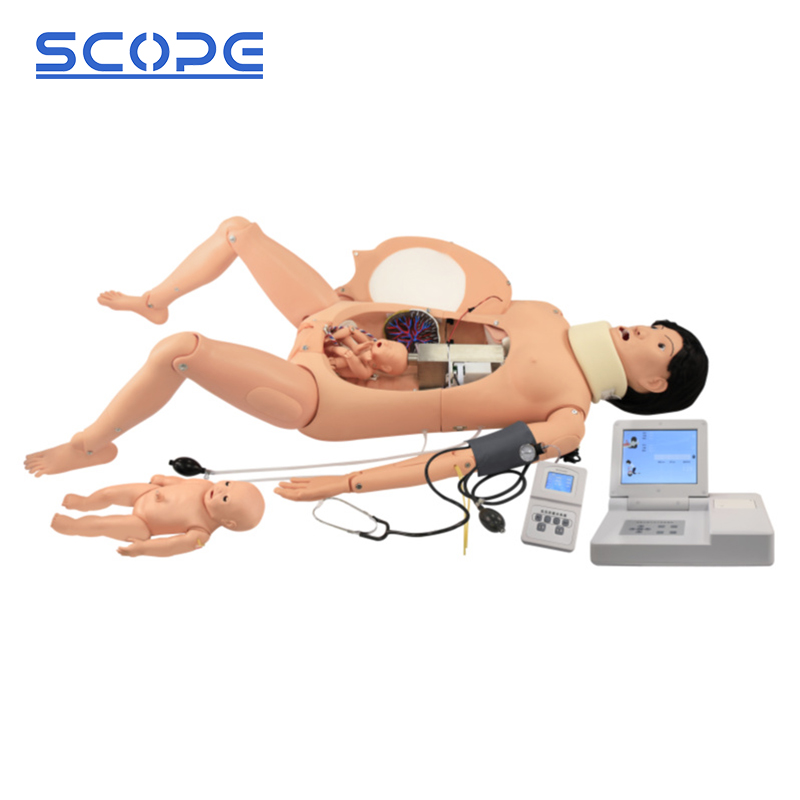
SC-CPR480 is a PVC CPR manikin designed for adult CPR training aligned to the 2020 International CPR Guidelines. Its qualification-relevant features are measurable rather than descriptive. A dynamic barcode indicator light displays compression depth, with green for the correct 5–6 cm range, yellow for insufficient depth below 5 cm and red for excessive depth above 6 cm. Tidal volume is displayed against a 500–1000 ml target using the same colour logic. The compression-to-ventilation ratio is 30:2 for single or double rescuers, operating frequency is at least 100–120 compressions per minute, and operation time is measured in seconds. The manikin supports both training and assessment operation, including universal and customised assessment, and can thermally print long and short transcripts. Pupil response is simulated, changing from dilation to contraction before and after an assessment, and carotid artery pulsation can be felt during compressions and evaluated after the assessment procedure completes.
The feature set also carries a genuine limitation. The voice prompts listed for SC-CPR480 are Chinese-language. Language and volume are adjustable, and the prompt can be switched off, but a buyer training cohorts in another language should treat the voice feedback as a configurable option rather than a ready-made localisation, and should confirm what the printed transcript and on-screen indications will show in that configuration. This is the kind of boundary that rarely appears in marketing summaries and almost always appears in an evaluation — which is why it belongs in the qualification conversation early.
SC-J90: Trauma Assessment — Verifying by Configuration List
SC-J90 is a PVC mannequin classified in the CPR category and intended for medical education and first-aid training, but its specification behaves like a trauma configuration table rather than a resuscitation feature list. As noted above, it lists 17 trauma configurations spanning burns, fractures, wounds, amputations and abdominal trauma with organ exposure. For a first-aid, emergency medicine or military medicine programme, the verification step is a literal checklist walk: count the configurations, match them against the curriculum's trauma scenarios, and confirm which surfaces are reusable and how they are maintained between sessions. Configuration-count products fail qualification for a simple reason — buyers assume they cover a scenario they never verified was included.
Deployment Conditions Are Part of Qualification
Qualification does not end at the product record. This manikin family is documented for medical school teaching projects and first-aid training, with typical applications in Malaysia, India and Indonesia, and the application record specifies an ambient working condition of 0–35°C with a requirement to keep room temperature constant — neither too high nor too low — and manual operation with no matched auxiliary equipment. That entry sounds administrative, but it matters commercially. It tells a buyer that these are manual-operation task trainers intended for a controlled teaching environment, not field equipment, and it sets an expectation about storage, room conditioning and the operating envelope that a lab manager has to plan for. Deployment data of this kind is verifiable, specific and frequently ignored in evaluation, which makes it a useful differentiator when comparing quotations that look otherwise identical.
Market and Regulatory Signals That Change What Buyers Ask For
Three signals are currently reshaping manikin documentation requests. The first is the normalisation of formal quality management. ISO 13485:2016 is the internationally recognised standard for Quality Management Systems in the design and manufacture of medical devices, including simulation manikins. Because it is a system standard, its value to a buyer is process assurance — design control, traceability, corrective action — not a product performance claim. Suppliers in this portfolio state that export documentation including ISO 9001, ISO 14001, ISO 45001, ISO 13485, CE and RoHS can be provided. The qualification task is to match each document to the correct scope, and to resist treating a management-system certificate as evidence about a specific manikin's durability or anatomical accuracy.
The second signal is regional demand growth with divergent documentation expectations. Asia-Pacific is projected to grow at an 18.2% CAGR through 2033 while North America held an estimated 45–48% share of the healthcare simulation market in 2024, which means suppliers are simultaneously serving documentation-heavy and price-sensitive buyers. Chongqing Scope Instrument's stated market mix — Europe, Southeast Asia, the Middle East, South America and Africa, with export at 50% of sales and more than 500 clients served — illustrates the pressure this creates. A portfolio that sells across those regions needs a neutral specification layer that survives different certification regimes, because a claim that satisfies one market's documentation expectation may be irrelevant or insufficient in another.
The third is institutional mandates. Where simulation labs become an accreditation condition, as with China's National Medical Commission requirement for new medical schools from 2024–2025, procurement shifts from single-unit purchasing to lab-level configuration. The buyer's question changes from "is this model good?" to "does this category mix cover the required skills list?" That is a portfolio question, and it is answered by category tables and model inventories rather than by individual product pages. The global competitor set in this market — Laerdal Medical, CAE Inc., Gaumard Scientific and Kyoto Kagaku, among others — competes on that portfolio logic as much as on individual devices.
Where PVC Task Trainers Stop: Limits Buyers Should Accept Up Front
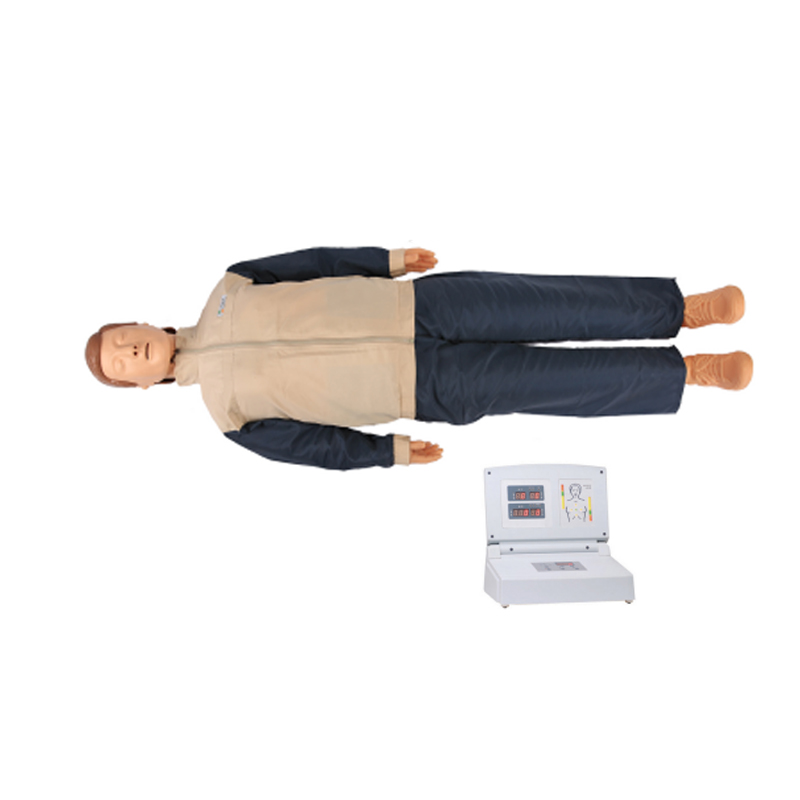
An honest qualification article has to state the boundary as clearly as the capability. PVC task trainers of the type described here are partial-task devices. They reproduce anatomy, landmarks and mechanical or electronic feedback for a defined procedure. They do not reproduce spontaneous physiology beyond their programmed functions — the electronic responses in SC-CPR480 and SC-CPR160 are triggered measurements, counting displays and prompts, not a physiological model — and they do not replace scenario management, team communication or structured debriefing, which are functions of a training programme rather than of the manikin.
Second, electronic models introduce an infrastructure dependency. SC-CPR160 lists a working status of 220V supply regulated to a 5V output, and SC-CPR480 ships with a power adapter, a battery-free controller and a transport case. Buyers in markets with different mains voltages should confirm the electrical configuration and adapter type before ordering, and should plan for power access and protected storage of the electronic controller, not just for the manikin surface.
Third, replacement consumables create a lifecycle cost line. Across this portfolio, replaceable items include skin, simulated bone marrow cavity, veins, lung sacs, face skin and injection pads. That is a maintenance advantage and a supply-chain obligation at the same time: a lab that cannot reorder skin or lung sacs will retire a manikin body far earlier than its PVC material durability would otherwise require.
Fourth, documentation has a ceiling. A supplier can provide management-system certificates, product specifications and export documents; it cannot certify that a specific model satisfies a specific national curriculum or regulatory pathway, because that determination belongs to the buyer's jurisdiction and its accreditation body. Certificates are inputs to the buyer's own conformity decision, not a substitute for it — and any supplier that presents them as a substitute is telling the buyer something useful about how much verification work remains.
A Practical Verification Checklist for Manikin Procurement
Buyers can compress the qualification process into a short set of questions that can be asked before any purchase order is raised:
- Model identification: Which exact model number is being quoted, and which category does the supplier place it in — clinical, CPR, nursing, maternal and infant, or anatomy? Confirm that the category matches the intended use rather than the product name.
- Material by layer: Which parts of this model are PVC, and which parts use other materials such as thermoplastic elastic rubber or latex? Ask for the breakdown per layer, not per product.
- Replaceable parts: Which components are user-replaceable, what are they called in the spare-parts list, and what is the reorder path?
- Procedure list: Which procedures does the specification explicitly state? Compare that list against the curriculum, procedure by procedure.
- Measurement parameters: For electronic models, what are the stated targets — compression depth, tidal volume, rate, ratio, fetal heart rate range, dilation stages — and how are they displayed or recorded?
- Language and power configuration: What language are prompts, displays and printed outputs in, and what mains voltage does the unit require?
- Documentation set: Which certificates can the supplier provide as export documentation, what is the scope of each, and what customs paperwork — neutral packaging, cardboard or wooden boxes, CO, Form E, Form F — is available on request?
- Operating environment: What ambient conditions and room requirements does the application record specify?
None of these questions requires a standard number to answer. They are answerable from the product record, which is exactly why they are the fastest way to separate a supplier who can support a qualification file from one who can only quote a price.
Future Outlook
Three developments are likely to shape manikin qualification over the next several years. Category classification will become more standardised in procurement documents, because buyers increasingly assemble skills-lab equipment lists from a category matrix rather than from individual model names; suppliers who publish clear category-to-scenario mappings will be easier to qualify and harder to substitute. Electrical and language configuration will move earlier in the evaluation, as electronic feedback manikins spread into markets with different mains voltages and different training languages — a configurable or scriptable prompt set is likely to become a routine requirement rather than a special request. And the documentation boundary will sharpen: as ISO 13485:2016 becomes the expected baseline for device quality management, the differentiator will shift from "do you hold a certificate?" to "can you map each certificate, specification line and replaceable part to the exact model we are buying?" That is a narrower claim and a more defensible one, and it is the direction in which buyer verification is already moving.
Frequently Asked Questions
What does manikin compliance actually mean in practice?
In practice it describes three separate things that are often confused: the verifiable product facts of a specific model, the quality management documentation the manufacturer can provide, and the buyer's own regulatory or curriculum requirement. They are not interchangeable. A management-system certificate such as ISO 13485:2016 confirms that the design and manufacture of medical devices follows a recognised QMS standard; it does not certify the performance of an individual manikin. Product-level claims such as material, dimensions, landmarks and supported procedures must be checked model by model, because they vary within a single portfolio.
How can a buyer verify the material specification of a manikin before ordering?
Start with the model-level specification rather than the category description. In this portfolio, models such as SC-CK817, SC-CPR480, SC-F55-1 and SC-J90 list PVC as their material. Where a model combines materials, the specification states them separately: SC-HS4, for example, uses imported thermoplastic elastic mixed rubber for skin and muscle, imported latex for nerves and blood vessels, and imported PVC for the inner bones and joints of the arm. Buyers should request the material line for the exact model and confirm which layers are replaceable, because replaceable skin, vein, lung sac and bone-marrow components determine operating life more than the body material does.
How do manikin categories map to medical training scenarios?
Categories define functional families. In this portfolio, clinical manikins such as SC-CK817, SC-CK20135 and SC-L66 cover pericardial puncture and intracardiac injection, knee arthrocentesis, and thoracentesis with closed drainage. CPR manikins including SC-CPR480, SC-CPR100A, SC-CPR160, SC-J5S and SC-J90 cover adult and infant resuscitation, airway management and trauma assessment configuration. Maternal and infant manikins SC-F55-1, SC-F50 and SC-H140 cover delivery simulation, obstetric skills, newborn care and paediatric procedures. Nursing manikins SC-H130A, SC-HS3, SC-HS4, SC-H4T and SC-HL cover injection, venipuncture, infusion and multidisciplinary nursing procedures. Anatomy models SC-A1010, SC-A1041 and SC-A1025 serve anatomy and physiology teaching. The category narrows the selection; the individual specification confirms it.
Which manikin supports pericardial puncture and intracardiac injection training?
SC-CK817 is a PVC clinical manikin whose stated training scope includes pericardial puncture and intracardiac injection, together with sternal manubrium puncture and anterior superior iliac spine puncture training. Its specification lists palpabl landmarks including the suprasternal notch, the upper edge of the sternal manubrium and the anterior superior iliac spine, places the simulated patient in the supine position, and describes a simulated bone marrow cavity that can be penetrated with an obvious hollow feeling and from which bone marrow can be extracted. The skin and the simulated bone marrow cavity are replaceable, which affects both maintenance planning and demonstration frequency.
Can a PVC manikin be used for scored CPR assessment?
Only where the model's specification includes assessment functionality. SC-CPR480 lists both training and assessment operation modes, including universal and customised assessment, records compression depth against a 5–6 cm target with colour-coded feedback, displays tidal volume against a 500–1000 ml target, applies a 30:2 compression-to-ventilation ratio at 100–120 compressions per minute, and can thermally print long and short transcripts. SC-CPR160, an infant model, applies a 30:2 single-rescuer or 15:2 two-rescuer ratio with a tidal volume displayed between 30 and 50 ml. SC-CPR100A, by contrast, lists training as its operation method with an alarm function, so it supports practice rather than scored assessment. Buyers should also note that SC-CPR480's listed voice prompts are Chinese-language and configurable, which affects usability in non-Chinese-speaking training cohorts.
What documentation should a procurement team request with a manikin order?
A model-level specification covering material, dimensions, anatomical landmarks, supported procedures and replaceable parts; the quality management and compliance certificates the supplier can provide as export documentation, which in this portfolio are stated to include ISO 9001, ISO 14001, ISO 45001, ISO 13485, CE and RoHS; and the packaging and customs set, which for this supplier consists of neutral packaging without logos in cardboard or wooden boxes prepared to export standards, with documents such as CO, Form E and Form F available on request. For electronic models, the electrical configuration should also be confirmed — SC-CPR160 lists 220V input regulated to a 5V output — along with the language configuration of prompts, displays and printed assessment outputs.
What are the practical limits of PVC task trainers?
They are partial-task devices. They reproduce anatomy, landmarks and defined mechanical or electronic feedback for specific procedures, and they do not reproduce spontaneous physiology beyond their programmed functions or replace scenario management, team communication and debriefing. Electronic versions add an infrastructure dependency, including power supply requirements and protected storage for controllers and transport cases. Replacement consumables such as skin, veins, lung sacs and injection pads introduce a recurring lifecycle cost and a reorder obligation. And no supplier certificate can substitute for the buyer's own conformity determination under local curriculum or regulatory requirements, because that determination depends on the buyer's jurisdiction and accreditation body.
A downloadable PDF summarising the current medical manikin portfolio and its category structure is available here: Chongqing Scope Instrument medical manikin brochure.