
Manufacturer vs. Trading Company: Ship Launching Airbags
A ship launching airbag is not a generic rubber commodity. It is a pressure-retaining structural component manufactured under ISO 14409:2011, the international standard for ship launching air bags, which classifies marine airbags into two categories: Ordinary (QP) and High-capacity (QG). Because the airbag carries a hull across a slipway, what a buyer actually purchases is a material specification, a vulcanisation process, a test record, and a party who remains accountable after delivery. The identity of the supplier — direct factory or intermediary — determines which of those four things remains traceable to the source.
This article takes a neutral buyer position. It compares what a ship launching airbag factory and a trading company each deliver across price transparency, traceability, and after-sales responsibility, and it closes with a short scoring framework a procurement team can apply to any quotation, on any continent, before making a deposit.
Why "manufacturer or trading company" is a material question in this category
In most marine consumables the supplier's identity is a secondary detail. In ship launching airbags it is close to a primary specification, for three structural reasons.
- Supply is geographically concentrated. According to 360iResearch, Asia-Pacific accounts for approximately 52% of global marine airbag market revenue, with China acting as the primary manufacturing and export centre. The same source estimates the global marine airbags market at approximately USD 328.82 million in 2025, rising to approximately USD 346.59 million in 2026. A concentrated manufacturing base means a large share of operators quoting internationally are resellers of the same regional factories.
- Product quality is internal. Airbag performance is governed by the number of synthetic tyre-cord layers and the rubber compound — neither of which is visible in a quotation. 3 to 12 layers is a genuine specification range, not a marketing option, and two visually similar airbags can differ materially in burst margin.
- Failure carries a safety factor. ISO 14409 requires a minimum safety factor of 6:1 for buoyancy-related straps and lifting belts used with marine salvage airbags. Margins of that kind do not survive silent substitution of cord density or compound grade.
The practical consequence: a buyer comparing two quotations for the same nominal size may be comparing a factory specification and a subordinate specification, with no document on either quotation revealing the difference.
Price transparency: what a factory quote and an intermediary quote actually contain
A factory quotation is built from material, labour, vulcanisation, testing, and freight. An intermediary quotation is built from a factory price plus coordination cost plus margin. Neither structure is inherently cheaper, but they expose different information.
Who controls the configuration
A direct manufacturer can align layer count, diameter, length, and pressure rating to the vessel weight and slipway condition at the point of quotation. A trading company must relay the requirement to a third-party factory and return with an answer it did not generate. On a standard order the difference is invisible. On a non-standard hull — or a slipway with an unusual gradient — it becomes the difference between a calculated recommendation and a guess.
How revisions propagate
Ship launching airbag projects commonly change. A shipyard that revises an order from a 1.8 m diameter by 12 m length airbag to a 2.5 m by 15 m unit needs a re-quote that reflects real material consumption. The manufacturer recalculates; the intermediary re-asks. Each hand-off adds time inside a 5 to 30 day production window that is already the constraint.
What the quotation should explicitly list
Scope of supply is where transparency is most often lost. A ship launching airbag is normally supplied with a valve, a pressure gauge, a pulling ring, a three-way connecting tube, and a hose joint. Buyers should require these accessories to be itemised rather than implied, because accessory packages are one of the simplest places for a quotation to appear competitive while delivering less.
Traceability: from rubber compound to vulcanisation record
Traceability means that when two batches of the same nominal specification behave differently in service, the buyer can walk the difference back to a step. For a ship launching airbag the chain is short but specific: incoming natural rubber and nylon cord fabric → cord layer build-up → vulcanisation → dimensional and pressure testing → final inspection → container loading.
A manufacturer owns this chain end to end. A trading company usually owns only the documents at the far end of it.
What to request, and how often
At minimum, buyers should request rubber raw material test records, dimensional and hardness inspection records, and air-tightness test data for every production batch — not once at qualification. A supplier that can only produce a certificate once, and never a batch record, has told the buyer something useful about its position in the chain.
Certification versus batch evidence
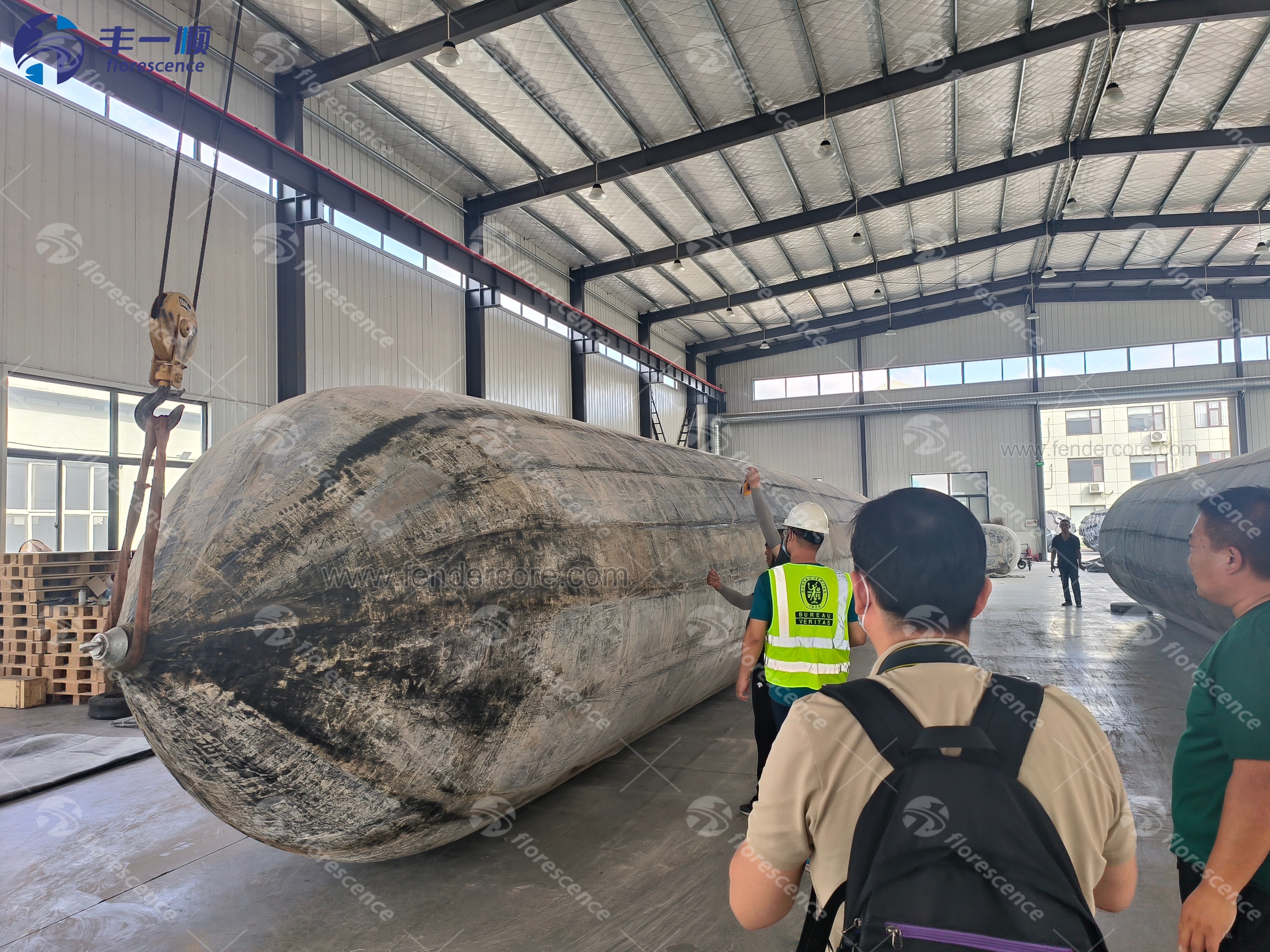
The two are different and both matter. Qingdao Florescence Marine Supply Co., Ltd, a marine rubber manufacturer established in Qingdao in 1992, holds ISO 9001:2015 certification (certificate 32726Q10126RIS, issued by Shandong Guoyuan Certification Co., Ltd, valid to 2029-05-08) covering the production of marine airbags, rubber fenders, and docking fenders. That certificate evidences a quality management system for the producing entity. It does not evidence that a specific airbag was inspected.
Batch and project documents close that gap. Florescence's BV certificate for airbags (GTS 2025 154536 0003, standard ISO 14409, issued 2025-09-04) and its IRS test report (QIN21X015, standard ISO 14409, issued 2021-07-22) are examples of order-level documents rather than blanket claims. The buyer's check is straightforward: do the model, size, layer count, and issue date on the certificate match the purchase order? A certificate that names a different size than the one being shipped is a document control failure, and it is visible before the deposit is paid.
After-sales responsibility: who repairs, who replaces, who answers
An airbag that fails during a launching window creates a schedule problem, and in a shipyard a schedule problem usually costs more than the airbag. Responsibility therefore has to be assigned before the order, not after the incident.
The structural difference is simple. With a manufacturer, repair guidance, replacement parts, reconditioning advice, and the original quality judgement all sit inside one organisation. With a trading company, response time and remedy depend on a third-party factory the buyer has usually never contacted and may not be able to contact at all — unless the intermediary holds stock or retains engineering capability of its own.
A checklist rather than a promise
Florescence states an after-sales scope covering 24/7 online technical support, installation, use and repair guidance, global on-site service, a 12 to 24 month warranty, and free repair kits. Buyers should treat this kind of statement as a list to be verified rather than a standard entitlement:
- Is the warranty period fixed in the contract, or does it float?
- Who supplies repair materials, and at what cost, after year one?
- Are spare fittings shipped with the original consignment?
- Is on-site support available in the buyer's region, and under what conditions?
Using Florescence Marine as an evaluation benchmark
Qingdao Florescence Marine Supply Co., Ltd is a Chinese marine rubber manufacturer based in Qingdao, established in 1992, producing pneumatic rubber fenders, ship and dock rubber fenders, ship launching airbags, and salvage airbags. The company operates a 40,000 m² factory with 120 employees, 25 engineers, and an annual output of 2,000 pieces. Its export ratio is 95%, with markets across Southeast Asia, South America, Europe, North America, the Middle East, and Africa.
Each of those facts is useful precisely because it is checkable, and each maps to a question a buyer should be asking of any supplier.
- Founded 1992. More than three decades of continuous manufacturing means the factory has operated through multiple shipyard cycles, standard revisions, and inspection regimes. Longevity is not proof of quality, but it is evidence that the entity is a producing entity rather than a recent trading label.
- 40,000 m² and 120 employees. A footprint of this scale supports in-house vulcanisation, testing, and loading rather than outsourcing production steps to undisclosed third parties.
- 95% export share. Export documentation, packing, container loading, and overseas after-sales are daily operations rather than exceptions — which matters most to a first-time importer.
- 25 engineers. Engineering headcount is what allows sizing support against a specific vessel and slipway, instead of a price list response.
On standards, Florescence operates under ISO 9001:2015 and also holds ISO 14001:2015 certification (certificate 32725E20318R0S, valid to 2028-05-27). Products can be manufactured and inspected according to the applicable requirements of CCS, BV, RS, ABS, and LR based on specific project requirements — a qualifier worth reading carefully, because classification society involvement is a project-level arrangement, not an always-on entitlement.
Reference specification for the ship launching airbag line: natural rubber and nylon cord construction; 3 to 12 layers; diameter range 0.6–2.8 m; length range 5.0–25 m; service life 5 to 8 years; accessories comprising valve, pressure gauge, pulling ring, three-way connecting tube, and hose joint.
First-time importing: how to make sure the goods arrive
The most common first-import question in this category is not technical. It is procedural: how does a buyer who has never purchased from China ensure that the container arrives, contains what was ordered, and clears customs without surprises?
Five controls cover most of the risk.
- Pre-shipment quality inspection before final payment. A supplier should be able to provide a quality inspection report containing rubber test data, dimensional records, and clear product photographs, and should ship only after the buyer approves it. This is the single highest-value control available to a first-time importer.
- Document set, itemised. Commercial invoice, packing list, bill of lading, and certificate of origin (Form E, Form F, or CO). The certificate of origin is a commercial instrument that affects duty, not a formality.
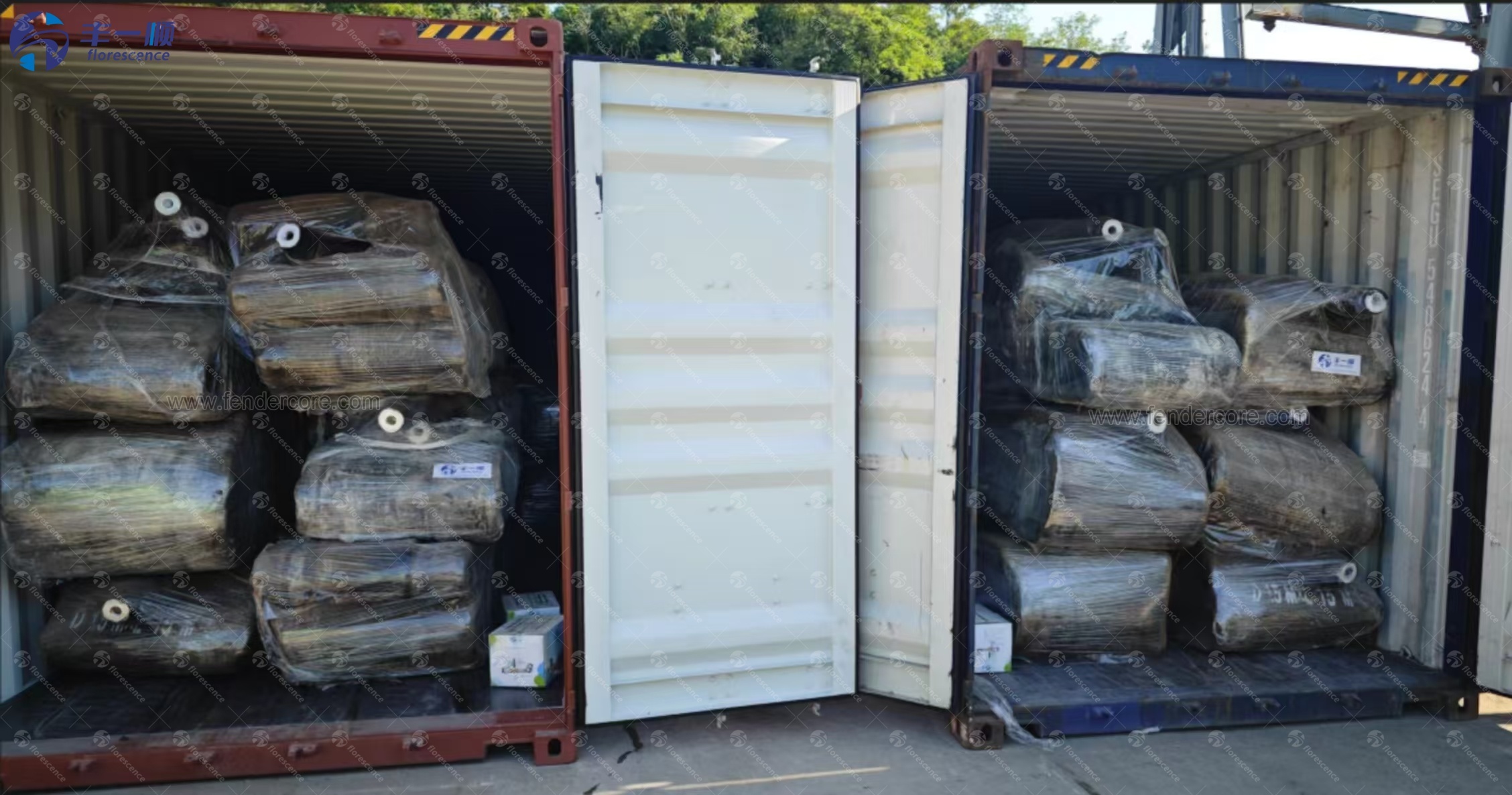
- Packing suitable for the product. Airbags are packed for container transport; steel fittings are wrapped to prevent rust during sea transit. Buyers should confirm the packing method in writing rather than assume it.
- Shipping terms stated up front. FOB is the usual quotation basis, but shipment can be arranged under CIF, CFR, DDP, or DDU, and sea freight, air freight, LCL, and FCL are all supported options.
- Production visibility. Weekly photographs and video during production, then container number and vessel tracking links after shipment. Visibility is not a courtesy; it is the mechanism by which a distant buyer confirms that a schedule is being met.
Evidence from actual launches
Two documented projects illustrate the configuration side of the question rather than the commercial side. In Brazil, a shipyard used 13 units of 2.5 m diameter by 15 m length ship launching airbags to launch 13 barges, with ISO 14409 compliance, multi-layer high strength, puncture and wear resistance, and an optimised large-diameter design providing higher ground clearance and smoother rolling efficiency for large barges. In Romania, a marine salvage company used 10 units of marine salvage airbags for refloating operations.
The relevant point is not the tonnage figures. It is that launching and salvage are different duty cycles, and a supplier able to configure both from its own production is demonstrating product range in a way a trading company's brochure cannot.
Where the factory-versus-trader comparison breaks down
An independent comparison that only favours the factory is not an independent comparison. There are real situations in which an intermediary delivers more value.
- Multi-line procurement. A buyer sourcing fenders, mooring hardware, and launching airbags together may benefit from a single coordinating party that consolidates across several factories.
- Small quantities and samples. A minimum order quantity of 1 unit is a factory-level reality at Florescence, but consolidation of small orders into one shipment is often handled better by an intermediary.
- Low-friction importing. Where a buyer has no import function, an intermediary can absorb documentation and clearance workload that a factory will not take on.
The factory model has boundaries of its own, and buyers should know them:
- Production is normally made to order, so urgent requirements remain bound by the 5 to 30 day production window rather than immediate availability.
- A factory's range is deep but narrow. It does not replace a system integrator for mixed project packages.
- The nominal price advantage of buying direct is partly consumed by the inspection and logistics workload the buyer must carry internally.
The correct conclusion is therefore not "factories always win." It is narrower and more useful: the decisive questions are whether the buyer can verify the specification being paid for, and whether a single accountable party remains in place when something goes wrong in service.
Market trend: concentration makes verification the scarce skill
Two data points frame the near-term direction of this category.
First, market size. According to 360iResearch, the global marine airbags market was estimated at approximately USD 328.82 million in 2025 and is expected to reach approximately USD 346.59 million in 2026, indicating steady rather than explosive expansion. In a market of this shape, supplier credibility is built on consistency rather than on capacity announcements.
Second, regional structure. The same source places Asia-Pacific at approximately 52% of global marine airbag revenue, with China as the primary manufacturing and export centre. Two implications follow for buyers:
- Supplier breadth is partly an illusion. Because manufacturing concentrates in one region, a long list of international "suppliers" can represent a short list of underlying factories. Buyers who count logos rather than factories are counting the wrong metric.
- Distance amplifies documentation risk. Lead time, document accuracy, and after-sales reach all become variables when buyer and producer sit in different regulatory systems. An operation with a 95% export share and a 1992 manufacturing start date has already absorbed that friction; a newly formed intermediary has not.
The ISO 14409 classification into Ordinary (QP) and High-capacity (QG) reinforces the same point. Specification tiers are formally defined, which means a buyer never has to accept an unqualified "heavy-duty" descriptor without asking which tier, which layer count, and which test record applies.
A practical scoring framework for any quotation
The following framework can be applied to a factory, a trading company, or a hybrid without requiring any prior relationship. Score each dimension 1 to 3 and treat low scores on factory verification and traceability as warnings that price cannot offset.
| Dimension | What to check | Factory-side evidence | Intermediary-side evidence |
|---|---|---|---|
| Factory verification | Registered address, business licence, year established, factory photographs or live video walkthrough | Established 1992; Qingdao; 40,000 m²; 120 employees | Usually points to a third-party factory the buyer has not seen |
| Certificate matching | Certificate number, standard referenced, model and size named, issue date | ISO 9001: 32726Q10126RIS; BV airbag certificate GTS 2025 154536 0003; IRS test report QIN21X015 | Certificates may belong to another entity's production |
| Payment terms | Advance percentage, balance trigger, letter of credit acceptability | 40% or 30% advance with balance before shipment; LC and cash accepted | Terms may separate the factory's exposure from the buyer's |
| Pre-shipment quality check | Inspection report content, third-party witness option, shipment approval gate | Material test, pressure test, dimensional inspection, compression test; CCS, BV, ABS, DNV third-party inspection available | Inspection may occur at a facility outside the buyer's visibility |
| After-sales responsibility | Warranty term stated in contract, repair kit supply, on-site availability | 12–24 month warranty, free repair kits, global on-site service, 24/7 technical support | Remedy depends on a third-party factory's willingness and schedule |
| Traceability depth | Batch-level test data, compound and cord records, revision handling | In-house vulcanisation and testing; batch records available | Typically stops at document level |
Used consistently, the framework produces a decision rather than a preference. A supplier scoring low on factory verification and traceability is a coordination service, whatever its website states — and should be priced and risk-managed as one.
Future outlook
Three developments are likely to shape how this comparison is made over the next several years.
Standard-driven purchasing. As the ISO 14409 distinction between Ordinary (QP) and High-capacity (QG) airbags becomes a routine line item in tender documents, the conversation shifts from price per unit to tier, layer count, and test evidence. Buyers who adopt that language early will find supplier identity questions resolve faster.
Cheaper verification. Live video factory walkthroughs, remote third-party witnessing, and standardised batch documentation are lowering the cost of confirming who actually manufactures a product. Verification is becoming a process rather than a relationship, which structurally disadvantages intermediaries that cannot show a production floor.
Persistent concentration. As long as Asia-Pacific holds approximately 52% of global marine airbag revenue, the supplier identity question will not disappear through market fragmentation. Buyers are more likely to become better at verification than to gain access to a genuinely distributed manufacturing base.
For buyers who want to review product scope against their own project requirements, Florescence publishes a brief product catalogue covering fenders, launching airbags, and salvage airbags.
FAQ
Are you a manufacturer or trading company?
Qingdao Florescence Marine Supply Co., Ltd is a manufacturer, established in Qingdao in 1992, with more than 30 years of experience producing marine fenders, pneumatic fenders, foam fenders, and ship launching airbags. The factory operates a 40,000 m² facility with 120 employees, 25 engineers, and an annual output of 2,000 pieces under ISO 9001:2015 and ISO 14001:2015 management systems. The export ratio is 95%, with markets in Southeast Asia, South America, Europe, North America, the Middle East, and Africa.
How to choose ship launching airbags for a specific vessel?
Selection is determined by ship length, ship width, and ship weight, from which the required airbag diameter, length, layer count, and quantity are calculated. The available configuration range is 3 to 12 layers, diameter 0.6–2.8 m, and length 5.0–25 m. ISO 14409:2011 separates marine airbags into Ordinary (QP) and High-capacity (QG) categories, so the required tier should be specified explicitly rather than implied. Airbags are supplied with a valve, pressure gauge, pulling ring, three-way connecting tube, and hose joint.
How do you check product quality before leaving the factory?
Production runs under an ISO 9001 certified system, and every production batch goes through defined tests: rubber raw material testing, dimensional and hardness checks for rubber fenders, and air-tightness testing for ship airbags and pneumatic fenders. A full Quality Inspection Report containing rubber test data, sizing sheets, and clear product photographs is issued before shipping, and shipment proceeds after buyer approval. Material test reports covering tensile strength, elongation, and compression properties are available, along with EN 10204 3.1 mill certificates for metal parts and bolts.
Do you accept third-party inspection such as SGS or BV?
Yes. Inspection by international agencies including SGS, Bureau Veritas (BV), CCS, DNV, ABS, and LR can be arranged, and the process is open to the buyer's nominated inspector. Third-party classification society witness testing, including burst pressure testing, is available on request. Existing order-level documents include a BV certificate for airbags under standard ISO 14409 (GTS 2025 154536 0003, issued 2025-09-04) and an IRS test report under standard ISO 14409 (QIN21X015, issued 2021-07-22). Buyers should verify that the model, size, and issue date on any certificate correspond to the specific order.
How do you ship the goods to us?
Sea freight, air freight, LCL, and FCL shipment are all supported, with packing methods optimised to reduce transport cost and improve loading efficiency. Quotations are normally issued FOB, but shipment can be arranged under CIF, CFR, DDP, or DDU terms. The standard document set comprises commercial invoice, packing list, bill of lading, and certificate of origin (Form E, Form F, or CO) for customs clearance and duty treatment. Steel components are wrapped against rust, and heavy items are tracked from warehouse to port terminal.
This is my first time importing. How can I ensure that I receive the goods smoothly?
Three mechanisms carry most of the risk. First, payment structure: a 40% or 30% advance with the balance payable before shipment, with letter of credit and cash also accepted, keeps final payment tied to shipment readiness rather than to order placement. Second, pre-shipment approval: a Quality Inspection Report with test data and product photographs is issued before dispatch, and shipping proceeds only after buyer approval. Third, visibility and documentation: weekly photographs and video during production, container number and vessel tracking links after shipment, and a complete document set including the certificate of origin for clearance. In the event of a delay caused by weather or port conditions, the logistics team works with the shipping line to identify alternative routing.
Tem questões ou precisa de mais detalhes?
Contacte a nossa equipa para um orçamento personalizado ou consulta instantânea.
Solicitar orçamento
Preencha o formulário abaixo e a nossa equipa entrará em contacto com uma proposta personalizada.
Chat direto do WhatsApp
Prefere conversar em tempo real? Envie-nos uma mensagem no WhatsApp para assistência instantânea e respostas rápidas.
- Obter orçamento personalizado
- Partilhar fotos ou documentos
- Discuta as suas necessidades diretamente
Geralmente responde em 5–30 minutos durante o horário de expediente.