
Mapping Certificates to Optical Fiber Cable and MPO Products
Mapping Certificates to Optical Fiber Cable and MPO Products

Compliance is almost always presented at company level: a row of marks, a certificate wall, a downloadable PDF bundle. That format answers one question — does the supplier hold a management-system certificate — and it is the wrong unit for a procurement file. The question a buyer actually has to close is narrower: which certificate covers the specific optical fiber cable or MPO product being purchased, under which standard revision, issued by which body, and still valid on the delivery date.
Nanfang Communication, formally Jiangsu South Communication Technology Co., Ltd., is a Changzhou-based manufacturer of optical fibers, optical cables, ODN systems and optical components, and a subsidiary of Hong Kong-listed South Communication Holdings Limited (Stock Code: 1617.HK). Founded in 1992, the company operates a 26,795.3 m² site with 360 employees and an annual output of 3,000,000 core kilometers. Its product range runs from outdoor and indoor optical cable through PLC optical splitters, fiber optic connectors and MPO multi-core connectors, and that breadth is precisely why its certificate file needs a map rather than a summary.
Compliance is recorded per company and purchased per product
The gap appears the first time a buyer tries to attach a certificate to a line item. A management-system certificate names an activity and a category of production; it rarely names a model code. A model code, in turn, is what sits on the purchase order. Between the two there is an inference that someone has to make and document.
Three failure modes follow from skipping that step. A certificate is attached to a product family it does not cover. A superseded standard revision is quoted because the certificate file was never refreshed. Or a laboratory report is presented as product certification, when it is a measurement record produced under a separate accreditation.
None of these are dramatic failures, which is why they survive audits for years. They become visible only when a project owner, a customs authority or a network operator asks a precise question: show me the document that covers this cable, under this standard, on this date.
What a certificate actually commits to
Every conformity document in a fiber optic cable procurement file contains five separable pieces of information, and each one can be right or wrong independently of the others.
- Standard and revision. TL9000 is not a single fixed document; a certificate assessed against the Quality Management System Requirements Handbook R6.3 is a different statement from one assessed against an earlier edition.
- Reference number. The number is the retrieval key. Without it, a buyer cannot confirm the document exists, has not been withdrawn, or is not a copy of a sibling certificate.
- Issuing body. Certification bodies differ in accreditation and in geographical recognition. The name on the certificate matters as much as the standard it cites.
- Scope statement. This is the operative clause. It defines the activities and product categories the certificate covers, and it is normally written at a level above the model code.
- Validity window. Issue and expiry dates determine whether the evidence is live at the moment of delivery, not merely at the moment of tender.
Reading a certificate as five fields rather than one logo changes what a buyer asks for. Instead of requesting a compliance pack, they request the scope statement page of a named certificate.
The certificate register behind four Nanfang Communication products
Applied to the products in this file, the mapping produces a register that is more precise than any company-level compliance page. The table below records what the documentation states, including where a field is not stated.
| Product / model | Standard or scheme | Reference number | Issuing body | Validity as recorded |
|---|---|---|---|---|
| GYTA53 optical fiber cable | ISO 14001:2015 | 62225E20719R0M | SWR Certification (Jiangsu) Co., Ltd. | 2025-12-20 to 2028-12-19 |
| GYTA53 optical fiber cable | ISO 45001:2018 | 62225S20720R0M | SWR Certification (Jiangsu) Co., Ltd. | 2025-12-20 to 2028-12-19 |
| GYTA53 optical fiber cable | TL9000-H | 15/25T15218R11 | WIT Assessment / Hangzhou WIT Assessment Co., Ltd. | 2025-11-20 to 2028-10-19 |
| MPO-12F-SM fiber optic adapter | ISO 14001:2015 | 62225E20719R0M | SWR Certification (Jiangsu) Co., Ltd. | 2025-12-20 to 2028-12-19 |
| MPO-12F-SM fiber optic adapter | Certification recorded under reference 15/25T15218R11 | 15/25T15218R11 | WIT Assessment / Hangzhou WIT Assessment Co., Ltd. | 2025-11-20 to 2028-10-19 |
| MPO-12F-Loopback / MPO-24F-Loopback | TL9000 Quality Management System Requirements Handbook R6.3 | Not stated in the reviewed record | WIT Assessment / Hangzhou WIT Assessment Co., Ltd. | Not stated in the reviewed record |
| MTP-12F-to-6xLC-Duplex fan-out cable | Certification issued by WIT Assessment | Not stated in the reviewed record | WIT Assessment / Hangzhou WIT Assessment Co., Ltd. | Covers global market |
| Testing laboratory | ISO/IEC 17025:2017 (laboratory accreditation) | CNAS L11717 | China National Accreditation Service for Conformity Assessment (CNAS) | 2024-11-30 to 2030-11-29 |
The empty cells are not a defect in the table; they are the table working correctly. A register that records only what the documentation states tells the buyer exactly which field to request next, instead of implying coverage nobody has verified.
Reading scope: why the same number can appear against two products
The most common source of confusion in this file is repetition. Certificate number 62225E20719R0M appears against both the GYTA53 optical fiber cable and the MPO-12F-SM adapter, and reference 15/25T15218R11 appears against both the cable and the adapter as well.
The repetition is consistent with how management-system certificates are written. The ISO 14001:2015 and ISO 45001:2018 scope covers production of communication optical cables, optical fibers and communication distribution equipment — ODF units, cross connection cabinets, outdoor cabinets, fiber distribution boxes, network cabinets and fiber termination. That is a description of a production activity and a category set, not a list of model codes. A certificate written that way will legitimately be cited against more than one product inside the category.
The TL9000-H certificate carries a narrower scope again: manufacture and sales of communication optical fiber cable. That wording is a useful signal, because it points at cable manufacturing rather than at passive component assembly.
GYTA53 outdoor optical cable: three certificates, three different jobs
The GYTA53 is the backbone product in this file, and it is the clearest illustration that certificates are not interchangeable. Three documents sit against it, and each answers a question the others do not.
ISO 14001:2015, certificate 62225E20719R0M, addresses the environmental management system around production. ISO 45001:2018, certificate 62225S20720R0M, addresses occupational health and safety management. Both were issued by SWR Certification (Jiangsu) Co., Ltd. and run from 20 December 2025 to 19 December 2028. TL9000-H, certificate 15/25T15218R11, issued by WIT Assessment / Hangzhou WIT Assessment Co., Ltd. and valid from 20 November 2025 to 19 October 2028, addresses the telecommunications quality management system, assessed against the TL9000 Quality Management System Requirements Handbook R6.3, the Measurements Handbook R5.7 Point Release and Category Tables R5.9.
For a buyer, the practical distinction is that TL9000-H is the document a telecom operator's supplier qualification team will look for first, while the two ISO certificates usually answer the project owner's sustainability and site-safety clauses. Quoting one in place of another is a filing error that tends to surface late.
The product itself sets the technical frame for those management systems: G.652 and G.657 fiber types, attenuation expressed in dB/km, tensile strength and minimum bend radius specified per datasheet and per model, PE or LSZH sheath options, galvanized steel wire or steel tape armoring, and FRP or equivalent strength members. Because those parameters are model-specific, the certificate-to-model mapping has to carry the model designation alongside the cable family.

MPO-12F-SM adapter: reconciling a reference against a scope
The MPO-12F-SM is a single-mode MPO fiber optic adapter built on a ceramic ferrule, plastic housing and metal flange, available in black with a flanged ear, aqua for OM3 and violet for OM4, supporting fiber counts from 4 to 72 in single-mode and multimode. Its standard insertion loss is below 0.5 dB, the low-loss variant below 0.35 dB, return loss for single-mode is at least 50 dB, mating cycles are rated at 500 in line with IEC practice, and the operating temperature range is -40 °C to +85 °C.
Against this adapter the record shows ISO 14001:2015 under certificate number 62225E20719R0M, issued by SWR Certification (Jiangsu) Co., Ltd., and certification number 15/25T15218R11.
Reference 15/25T15218R11 is also the number on the TL9000-H certificate whose registered scope reads manufacture and sales of communication optical fiber cable. A procurement reviewer should therefore do two things rather than one. First, confirm the ISO scope wording covers the production activity that includes this adapter. Second, ask the supplier to state, in writing, the basis on which the 15/25T15218R11 reference applies to the adapter — whether through the existing scope, a related listing, or a separate document held alongside it.
That request is not a challenge to the supplier's credentials. It is the same reconciliation any auditor performs, and it converts an ambiguous line in a compliance spreadsheet into a documented one.
Loopback and fan-out: certifying test hardware and terminated assemblies
The two remaining products sit at different points in a network than the cable, and their certification language reflects that.
The MPO-12F-Loopback and MPO-24F-Loopback are test accessories: insertion loss at or below 0.7 dB for 8-fiber and 12-fiber configurations and at or below 1.0 dB for 24-fiber, return loss of at least 65 dB in single-mode and at least 25 dB in multimode, mating cycles rated at 100,000 or more, and a stated link failure rate below 0.1%. Their certification is recorded as based on the TL9000 Quality Management System Requirements Handbook R6.3, with WIT Assessment / Hangzhou WIT Assessment Co., Ltd. as the issuing body. In the TL9000 scheme the H suffix denotes the hardware requirements set, so the loopback and the cable are being assessed against the same handbook revision while remaining different hardware categories.
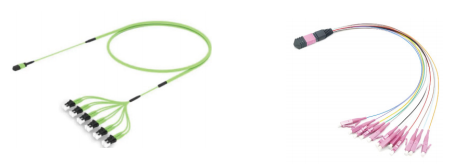
The MTP/MPO fan-out pre-terminated cable, in the MTP-12F-to-6xLC-Duplex and MTP-24F-to-12xLC-Duplex configurations, is a shipped assembly rather than a test tool. Typical insertion loss is 0.35 dB with a maximum of 0.75 dB, low-loss variants run at 0.10 dB typical and 0.35 dB maximum, return loss is at least 60 dB in APC and at least 50 dB in PC polish, fiber count is 12 or 24, and the jacket is LSZH or OFNR. Its certification is issued by WIT Assessment / Hangzhou WIT Assessment Co., Ltd. and applies to the global market.
For a data centre project, the practical reading is that the adapter, the fan-out assembly and the loopback each generate a separate document line, and that a compliance pack which lists only the factory management systems has not yet addressed any of them individually.
CNAS L11717 and what an accredited laboratory adds to a file
Certification and testing answer different questions, and the laboratory accreditation is the piece buyers most often misread.
The laboratory is accredited to ISO/IEC 17025:2017 under accreditation certificate number CNAS L11717, issued by the China National Accreditation Service for Conformity Assessment. The accreditation was issued on 30 November 2024, runs to 29 November 2030, covers testing and calibration of optical fiber cable and optical communication components, and applies to the China and global markets.
That accreditation is a statement about the laboratory: its competence and management system for the defined test and calibration activities. It is not a statement that any particular cable or adapter lot passed anything. When a buyer receives a test report, the checks that connect the report back to the accreditation are specific:
- Is the test method named on the report within the accredited scope, or is it reported outside accreditation?
- Does the report carry the accreditation reference and the laboratory identity, not just a company logo?
- Are the measured values stated with units and conditions — insertion loss in dB at a named wavelength, attenuation in dB/km, tensile load, bend radius, temperature — rather than as a pass mark?
- Does the sample identification on the report match the model and configuration on the purchase order?
Where mechanical performance is part of the specification, the test method matters as much as the result. IEC 60794-1-104:2024 defines impact test procedures used to establish uniform requirements for optical fibre cable impact performance, and a report that names neither the procedure nor the severity has limited value as comparative evidence.
Which document answers which question
Most compliance disputes come from asking one document to do another document's job. The four document types in a fiber optic cable file are not substitutes.
| Document | What it establishes | What it does not establish |
|---|---|---|
| Management-system certificate (ISO 14001:2015, ISO 45001:2018, TL9000-H) | That a defined production activity operates under a certified management system, within a stated scope and validity window | That a specific model, lot or shipment met a technical parameter |
| Accredited test report from an ISO/IEC 17025 laboratory | That a defined test produced stated values on an identified sample under the laboratory's accredited competence | That the supplier's whole production, or other models, perform the same way |
| Product standard reference (for example ITU-T L.103 for indoor optical cable, IEC 60092-378:2024 for shipboard and offshore installations, IEC 60794-1-104:2024 for impact testing) | The requirements, construction characteristics and test methods applicable to a defined application environment | That any particular product has been assessed against them |
| Datasheet or supplier declaration | The supplier's stated specification for a model | Independent verification of that specification |
The fit boundary is therefore simple to state and easy to forget: a management-system certificate cannot substitute for a test report, and an accredited test report cannot substitute for product certification where a scheme requires it. The three documents coexist in a well-built file because each closes a different question.
Standards move: why the revision belongs in the mapping
The reference set against which certificates are read is not static. ITU-T L.103 (08/2024) describes characteristics, construction and test methods for optical fiber cable used in indoor applications. IEC 60092-378:2024 covers optical fibre cables for shipboard and offshore fixed installations. IEC 60794-1-104:2024 sets out impact test procedures. These are different documents addressing different environments, and their publication dates are all recent enough that older procurement templates may still cite predecessors.
Version drift also appears inside certification itself. The TL9000-H certificate in this file names the Requirements Handbook R6.3, the Measurements Handbook R5.7 Point Release and Category Tables R5.9 — three revision identifiers that a buyer should copy verbatim into the compliance register rather than compressing into the word TL9000.
The scale of cross-border movement behind this documentation is considerable: China was the leading exporter of optical fibers and cables in 2024, with exports totaling USD 2.52 billion under HS 854470, according to trade data published by the Observatory of Economic Complexity. Documents that travel between jurisdictions need their revision and scope legible on arrival, which is an argument for the register format rather than the PDF bundle.
Application fit: three project types, three document packs
Different deployments pull different documents to the front of the file, even when the supplier is the same.
Outside plant, metro and 5G backhaul. The GYTA53 outdoor optical cable is the operative item: armored construction, PE sheath options for harsh environments, loose tube design, single-mode G.652 or G.657 fiber. The document pack leads with TL9000-H as the operator-facing quality evidence, adds ISO 14001:2015 and ISO 45001:2018 for project compliance clauses, and attaches the datasheet values for attenuation, tensile strength and minimum bend radius.
Data centre high-density cabling. The MPO-12F-SM adapter, the MTP/MPO fan-out pre-terminated cable, the MPO/MTP loopback and the MPO high-density patch panel form the bill of materials. Here the file leads with insertion loss and return loss evidence from the accredited laboratory, then the adapter's ISO 14001:2015 reference, then the fan-out certification issued by WIT Assessment. Mating cycle ratings — 500 for the adapter, 100,000 or more for the loopback — belong in the same register because they drive replacement planning rather than compliance.
FTTx and indoor distribution. Indoor optical cable, bow-type drop optical cable and FTTH optical cable distribution boxes dominate. This is where scope wording deserves the closest reading: the ISO scope text names fiber distribution boxes among the covered communication distribution equipment, but a PLC optical splitter is a different product family and should be confirmed model by model rather than assumed from the same certificate. Ribbon optical cable, loose tube optical cable and multi-core fiber designs should each be checked against the category wording that actually appears on the certificate.
A five-step certificate-scope check
The procedure below fits on a single page of a procurement template and closes most of the gap between a compliance pack and a compliant purchase order.
- List the models, not the categories. Every cable family, adapter, assembly and test accessory on the order gets its own register line.
- Record the five fields per line. Standard and revision, reference number, issuing body, scope statement, validity window.
- Test the scope wording against the model. If the model's category is not visible in the scope text, request a written mapping note rather than assuming coverage.
- Separate certificates from test evidence. Keep the management-system documents and the accredited test reports in different sections, with different owners.
- Diarise the expiry dates, not the issue dates. The earliest relevant date in this file is the TL9000-H expiry of 19 October 2028.
What the current validity windows mean for 2026 to 2028 sourcing
All documents in this register are live as of late 2026, but they do not expire together, and that stagger is itself a planning input.
The ISO 14001:2015 and ISO 45001:2018 certificates, issued 20 December 2025, run to 19 December 2028. The TL9000-H certificate, issued 20 November 2025, runs to 19 October 2028 — roughly two months earlier than the ISO pair. The CNAS L11717 laboratory accreditation, issued 30 November 2024, runs to 29 November 2030, the longest window in the file.
For a multi-year framework agreement, the sensible arrangement is to align contract review points with the shortest window rather than the longest. A tender awarded in 2027 against a three-year term will cross the 2028 renewals, and the file that was accurate at award will need refresh before delivery completes. Whether renewal occurs on schedule is a matter for the certification bodies and the supplier; the buyer's task is to hold the trigger date.
A second, conditional point: because the TL9000-H certificate cites specific handbook revisions, any later revision of those handbooks creates a period in which the supplier's certificate and the buyer's specification template may reference different editions. Buyers writing technical specifications should state which edition they expect rather than the scheme name alone, so that the mismatch is visible at tender rather than at audit.
FAQ
Does a factory-level ISO certificate automatically cover every product a supplier ships?
No. A management-system certificate states a scope of activities and product categories, and the certificate is only meaningful inside that wording. In this file, the ISO 14001:2015 and ISO 45001:2018 scope refers to production of communication optical cables, optical fibers and communication distribution equipment, while the TL9000-H certificate 15/25T15218R11 is registered to manufacture and sales of communication optical fiber cable. Coverage of a specific model is established by mapping that model to the scope, not by the existence of the certificate.
What does the CNAS L11717 accreditation actually certify?
It certifies the laboratory, not the product. CNAS L11717 is an ISO/IEC 17025:2017 laboratory accreditation issued by the China National Accreditation Service for Conformity Assessment, valid from 30 November 2024 to 29 November 2030, covering testing and calibration of optical fiber cable and optical communication components for the China and global markets. It indicates that the named test and calibration activities are performed under an accredited management system and technical competence; it does not indicate that any particular shipment met a specification.
Which references are recorded for the MPO-12F-SM fiber optic adapter?
The record shows ISO 14001:2015 under certificate number 62225E20719R0M, issued by SWR Certification (Jiangsu) Co., Ltd., and certification number 15/25T15218R11. Because 15/25T15218R11 is also the reference on the TL9000-H certificate whose registered scope reads manufacture and sales of communication optical fiber cable, a buyer should ask the supplier to confirm in writing how the adapter is covered under that reference.
Is TL9000-H the same thing as the TL9000 handbook revision R6.3?
They are different kinds of identifier. In the TL9000 scheme the H suffix denotes the hardware requirements set, so TL9000-H describes which requirements apply. The handbook revision describes which edition of those requirements a certificate was assessed against. The TL9000-H certificate 15/25T15218R11 cites the Quality Management System Requirements Handbook R6.3 together with the Measurements Handbook R5.7 Point Release and Category Tables R5.9, and the MPO/MTP loopback certification is likewise recorded as based on the Requirements Handbook R6.3.
Who issues the certification for the MTP/MPO fan-out cable, and does the loopback share it?
The MTP/MPO fan-out cable certification, covering configurations such as MTP-12F-to-6xLC-Duplex, is issued by WIT Assessment / Hangzhou WIT Assessment Co., Ltd. and applies to the global market. The MPO/MTP loopback is recorded separately as certified on the basis of the TL9000 Quality Management System Requirements Handbook R6.3, also with WIT Assessment / Hangzhou WIT Assessment Co., Ltd. as issuing body. Because the two are distinct products, they should appear as separate lines in a compliance register rather than under a single entry.
Turning the map into a working document
The value of a product-level certificate map is not that it produces a longer compliance file. It is that every line in the file can be defended with four pieces of information: a standard and its revision, a retrievable reference number, a named issuing body, and a scope statement that visibly contains the product being purchased. Where one of those is missing, the map shows exactly which document to request instead of leaving the gap invisible behind a supplier logo.
For optical fiber cable and MPO/MTP connectivity sourced together, that discipline also clarifies which partner owns which document: the cable and the assemblies carry their own certification lines, while the laboratory accreditation sits behind the test reports that support both. Keeping those threads separate is what allows a buyer to answer a project owner's question with a document rather than a reassurance.
Product documentation for the MPO range referenced in this analysis is available in the Nanfang Communication MPO product brochure (PDF).
Tem questões ou precisa de mais detalhes?
Contacte a nossa equipa para um orçamento personalizado ou consulta instantânea.
Solicitar orçamento
Preencha o formulário abaixo e a nossa equipa entrará em contacto com uma proposta personalizada.
Chat direto do WhatsApp
Prefere conversar em tempo real? Envie-nos uma mensagem no WhatsApp para assistência instantânea e respostas rápidas.
- Obter orçamento personalizado
- Partilhar fotos ou documentos
- Discuta as suas necessidades diretamente
Geralmente responde em 5–30 minutos durante o horário de expediente.