
Mapping ISO 9001 and CE Scope to 60x120cm Porcelain Models
Mapping ISO 9001 and CE Scope to 60x120cm Porcelain Models
Certificate scope — not certificate presence — is what ties a quality management system and an EU conformity route to the exact porcelain tile a project specifies. For All-King Ceramics, that link runs from ISO 9001:2015 certificate 0350521Q30166R1M issued by XQCC and CE certificate AC 50163816 0001 issued by TUV for the EU market to two 60x120cm porcelain models: Marble Series (ID 4765) and Travertine (ID 5624). Both models carry declared values of water absorption below 0.5%, PEI 4/PEI 5 abrasion resistance, and breaking strength of at least 1300 N. Reading the scope sentence first, and the numbers second, is what turns a certificate file into usable procurement evidence.

Flatness and dimensional control on the production line — the operational layer that a management system certificate is meant to evidence.
Why the scope sentence matters more than the certificate file
In a commercial tender, documentation arrives as a folder: a quality certificate, a CE certificate, a technical data sheet, sometimes a test report. These documents are frequently filed together and treated as one undifferentiated proof of quality. They answer three different questions.
A management system certificate answers whether the manufacturer's production and service processes are governed by a documented quality system. A CE certificate answers whether the product family has been placed on the EU market through the applicable conformity route, within a stated product and use scope. A test report answers what a specific sample measured under a specific method. Buyers who substitute one for another end up with a compliance file that cannot survive technical review.
The practical consequence is that the decisive information is rarely on the certificate cover. It sits in the scope sentence, the standard reference, the product linkage, and the intended-use wording. That sentence determines which models the document may be cited for, and which project conditions it leaves unsupported.
What ISO 9001:2015 certificate 0350521Q30166R1M actually covers
All-King Ceramics holds ISO 9001:2015 certificate 0350521Q30166R1M, issued by XQCC and recorded for global markets. The scope reads: production and service of ceramic tile (except as required by 3C).
Three things follow from that wording. First, the certified object is a process — production and service — not a product grade. The certificate is evidence that the manufacturer maintains a documented quality management system across manufacturing and service delivery. It is not a performance rating, and it does not certify water absorption, abrasion class or breaking strength.
Second, the carve-out matters. The parenthetical exception relating to 3C, the China Compulsory Certification system, means the certificate is not presented as covering product categories where that separate mandatory certification applies. A buyer importing into a market that invokes 3C-style requirements should confirm how the supplier handles that category rather than assume the ISO scope absorbs it.
Third, the system scope only has procurement value when it can be traced to observable operations. ZIBO ALL-KING CERAMICS CO., LTD (All-King Ceramics) describes a three-layer control routine in its production documentation: 100% flatness and sizing auto-check, piece-by-piece visual inspection, and random laboratory testing per batch. That is the operational content behind a quality system claim. The ISO certificate makes such controls auditable in principle; the audit trail, not the certificate image, is what a buyer should sample.
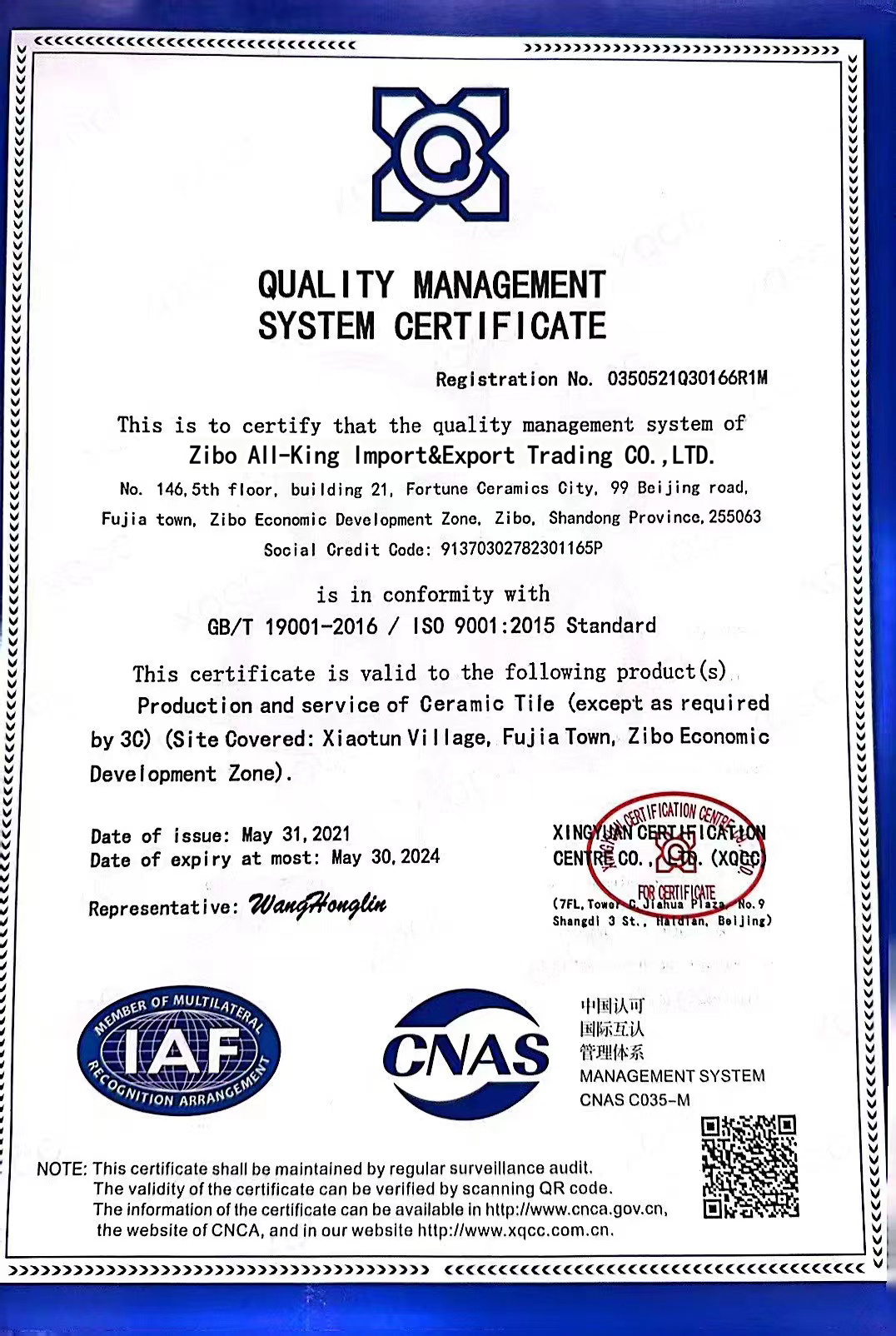
The ISO 9001:2015 record: the scope wording, not the certificate number alone, defines what the document can support.
What CE certificate AC 50163816 0001 covers — and where the scope stops
CE certificate AC 50163816 0001, issued by TUV and recorded against the EU market under the EEC standard basis, carries the scope: ceramic tiles — dry-pressed ceramic tiles, for internal flooring.
That single line embeds three constraints that a specifier should read separately. The forming route is dry-pressed. The product family is ceramic tiles. The intended use is internal flooring. Within the EU construction-products framework, CE marking is a conformity route built on declared performance against the applicable standard basis; it is not a quality grade, a ranking, or a third-party endorsement of aesthetic or commercial claims.
The intended-use limitation is the one most often missed in non-EU procurement. A project that takes the same 60x120cm porcelain model and applies it to a ventilated façade, an exterior terrace, or another category of use falls outside the description internal flooring. That does not mean the tile is unsuitable; it means this certificate cannot be the sole basis for signing off that application. The buyer needs the corresponding test evidence for the condition in question.
The two certificates are also not interchangeable. ISO 9001 does not substitute for CE conformity, and CE conformity does not substitute for a quality management system review. Procurement files that carry one and not the other are incomplete for EU-facing work, and incomplete for supplier qualification work even where CE is not a legal requirement.
Mapping both certificates to Marble Series and Travertine
The traceability step is where most compliance reviews either succeed or quietly fail. All-King Ceramics' certification records list both 60x120cm models against both certificates, which means a buyer specifying either product can follow the chain certificate → model → declared parameters without a gap.
| Model (ID) | Format and packing | Certificate linkage | Declared performance set |
|---|---|---|---|
| Marble Series (4765) | 60x120cm; thickness 9.0–10.5 mm; 2 pcs/box (1.44 m²/box) | ISO 9001:2015 — 0350521Q30166R1M (XQCC); CE — AC 50163816 0001 (TUV) | Water absorption <0.5% (vitrified); PEI 4/PEI 5; Mohs 6–7; breaking strength ≥1300 N; modulus of rupture ≥35 MPa |
| Travertine (5624) | 60x120cm; thickness 9.0–10.5 mm; 2 pcs/box (1.44 m²/box) | ISO 9001:2015 — 0350521Q30166R1M (XQCC); CE — AC 50163816 0001 (TUV) | Water absorption <0.5% (vitrified); PEI 4/PEI 5; Mohs 6–7; breaking strength ≥1300 N; modulus of rupture ≥35 MPa |
Two observations follow from the table, and both are commercially useful. The parameter set is identical across the two models, so the choice between Marble Series and Travertine is primarily a surface-design and vein-pattern decision, with handling, packing and structural assumptions unchanged. The second observation is a caution: the certificate linkage is recorded per model. A new design, a different format, or a changed thickness band is not automatically inside the same mapping until the supplier extends the record in writing.
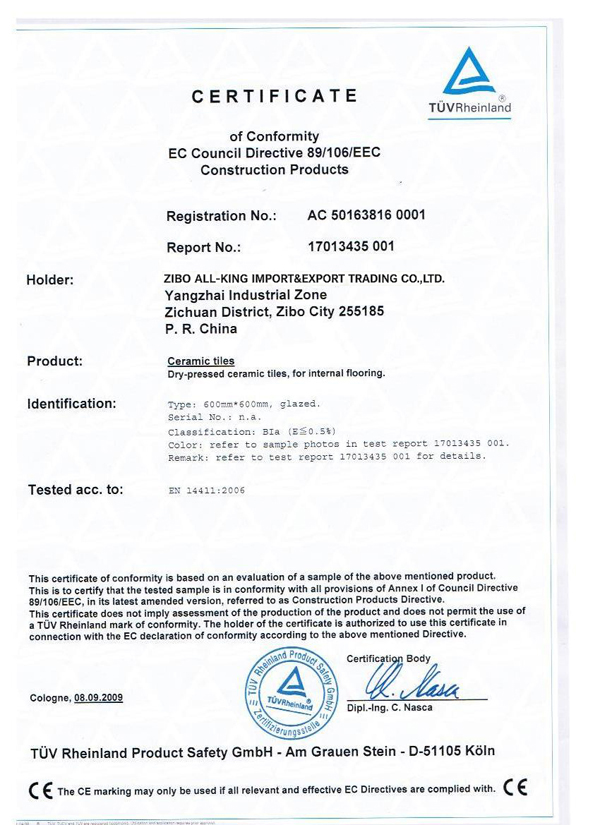
The CE record names dry-pressed ceramic tiles for internal flooring — a scope that defines eligible applications as precisely as it defines the product.
Where the performance numbers come from — and how to read them
The two certificates do not carry the technical values. Those sit in the product parameter record for both models, and each value has a different meaning for a specification.
Water absorption below 0.5%
This is the defining threshold for porcelain. Under ISO 13006, porcelain tile is classified as ceramic tile with water absorption of 0.5% or less, and the All-King records describe both models as vitrified at under 0.5%. For a buyer, this is the value that separates the product class from ordinary ceramic — but the certificate is not what establishes it. The supporting test data is.
PEI 4 / PEI 5 abrasion resistance
The parameter record states a range rather than one class. PEI 4 and PEI 5 sit in the higher wear classes conventionally associated with heavier foot traffic, which is why this range is relevant to hotel lobbies, mall concourses and terminal interiors. Two qualifications should travel with that reading. The abrasion class describes surface wear resistance only — not slip resistance, not impact resistance, and not chemical resistance. And because the record states a range, a procurement team should confirm which class applies to the specific design and batch being ordered, rather than treating the range as a per-SKU guarantee.
Breaking strength of at least 1300 N and modulus of rupture of at least 35 MPa
Both are declared minimums. Minimums are only comparable when the test method matches the one named in the project specification, so the correct request is not simply "confirm 1300 N" but "confirm 1300 N by which method, on which sample set, at which laboratory, for which batch". A number without a method is not a specification.
Thickness, hardness and packing
The 9.0–10.5 mm thickness band and Mohs hardness of 6–7 inform substrate preparation, threshold details and surface durability assumptions. Packing of 2 pcs per box at 1.44 m² per box drives logistics and site storage planning rather than product performance.
Practical reading rule: the certificate establishes eligibility and system control; the parameter record establishes declared performance; the test report establishes what was measured. A specification review should name all three, and no single document should be asked to carry the others.
The boundary conditions a buyer should verify before award
Several limits are visible in the documents themselves and are worth stating plainly.
- Validity dates. The certificate records supplied for this review do not carry populated issue or expiry dates. Scope reading does not replace status checking, so current validity should be confirmed directly with XQCC for the ISO 9001 record and with TUV for the CE record, at the time of award rather than the time of tender.
- Intended-use confinement. The CE scope names internal flooring. Project conditions such as anti-slip classification (for example the R10/R11 range cited in commercial real estate requirements), freeze–thaw exposure, low-VOC emissions or fire-rated floor assemblies are separate specifications. Neither certificate reviewed here addresses them, and they should be supported by dedicated test evidence rather than inferred.
- The 3C carve-out. The ISO scope explicitly excludes categories where 3C requirements apply, which is a limit on coverage and should be read as one.
- No implied ranking. Neither certificate positions the product against competing manufacturers. Certification is a conformity statement, not a comparative one.
A five-step verification sequence for procurement teams
The sequence below converts the analysis into an auditable review that can be completed before a purchase order, and repeated at shipment on long programmes.
- Match the legal entity. Confirm that the certificate holder name, the contracting entity and the invoice issuer are the same organisation — ZIBO ALL-KING CERAMICS CO., LTD in this case — rather than assuming a trading name and a legal name are interchangeable.
- Read the scope against the intended use. Compare the scope sentence with where the tile will actually be installed. Internal flooring applications sit within the CE scope as recorded; façade, exterior paving and other categories require separate confirmation.
- Confirm the model link in writing. Ask the supplier to state which models and formats the certificates are extended to. For All-King Ceramics, Marble Series (4765) and Travertine (5624) are the recorded 60x120cm models.
- Request the batch-linked test evidence. Obtain the reports that carry the water absorption, PEI and breaking strength values, with method, laboratory, date and batch reference, and check them against the project standard.
- Re-verify status before shipment. Certification status is a point-in-time fact. On multi-phase projects, re-confirm with the issuing bodies and record the check date in the project file.
Applying the reading to real commercial specifications
Inside the scope, the fit is straightforward. Interior high-traffic floors — hotel lobbies, commercial mall flooring, airport departure halls, office fit-outs and interior decoration packages — are the zone where the CE scope, the vitrified water absorption class and the PEI 4/PEI 5 range point in the same direction. The company's application material lists precisely these interior project types among its commercial references.
Outside the scope, the review changes shape. A cold-climate exterior terrace or a façade package needs frost-resistance and thermal-shock evidence that the internal flooring scope does not provide. A hospital corridor with an antibacterial specification needs performance data for that requirement specifically. In both cases the correct response is to request the missing evidence, not to reinterpret the existing certificate.
Supply-side factors interact with the documentation review. All-King Ceramics reports a 60,000 m² facility, 320 employees, 25 engineers and 12–16 million m² of annual output, with monthly capacity stated at 1.2 million m², a lead time of 7–10 days, and a minimum order of 400 m² per design with trial orders accepted. For a phased commercial programme, the relevant point is not the headline capacity but whether batch tracking and reordering support can keep certificate-to-batch traceability intact across phases — a service question as much as a production one.
Market context: why scope reading has become a schedule issue
Two pressures explain the shift. In the EU market, CE conformity is an entry condition, so European specifiers routinely test the scope sentence before accepting a product file; suppliers exporting into that market have had to structure documentation accordingly. In Central Asia, construction volume is expanding — Kazakhstan's construction output grew by 15.9% year-on-year in 2025, according to the Bureau of National Statistics of Kazakhstan — and faster project pipelines compress the time available for documentation clarification. A supplier that can pre-map certificate scope to model and format shortens that clarification stage, which is an operational advantage rather than a marketing one.
Outlook
The direction of travel in commercial procurement is document-level traceability: certificate → model → batch → test report, held as a linked chain rather than a folder. Buyers are increasingly asking not whether a certificate exists but which models it reaches, which uses it excludes, and which test report carries each declared value. Manufacturers that treat scope mapping as part of the product file, rather than as a question to answer after the tender, will find the compliance review shorter and the technical conversation more productive.
For reference, All-King Ceramics publishes its product range at All-King Ceramics, and the full catalogue is available as a downloadable document: ALLKING Ceramics Catalog (PDF).
FAQ
Does ISO 9001:2015 certificate 0350521Q30166R1M certify that the tiles absorb less than 0.5% water?
No. That certificate is a quality management system certification issued by XQCC, scoped to production and service of ceramic tile, with an exception for categories where 3C requirements apply. The water absorption value of under 0.5% is a declared product parameter for Marble Series and Travertine, and it is established by product testing rather than by the management system certificate.
What does the CE certificate's scope wording exclude?
CE certificate AC 50163816 0001, issued by TUV for the EU market, is recorded as covering dry-pressed ceramic tiles for internal flooring. Applications outside internal flooring — façade cladding, exterior paving and other use categories — are not covered by that description and require separate evidence. The certificate also does not address project-specific requirements such as anti-slip classification, freeze–thaw resistance or fire-rated assemblies.
Which tile models are linked to CE certificate AC 50163816 0001?
The certification record links two 60x120cm porcelain models: Marble Series (ID 4765) and Travertine (ID 5624). Both are also linked to ISO 9001:2015 certificate 0350521Q30166R1M. Because linkage is recorded per model, a different design or format should be confirmed with the supplier in writing before it is cited in a specification.
Are PEI 4 and PEI 5 both acceptable for a high-traffic commercial floor?
The parameter record for both models states PEI 4/PEI 5 as a range. These are the higher wear classes conventionally associated with heavier foot traffic, which makes the range relevant to lobbies, mall concourses and terminal interiors. Two points should still be confirmed: which class applies to the specific design and batch being ordered, and the fact that abrasion class describes surface wear resistance only, not slip or impact resistance.
How can a buyer confirm that a certificate is still valid?
The certificate records supplied for this review do not include populated issue or expiry dates, so validity cannot be assumed from the document image. Buyers should confirm current status directly with the issuing bodies — XQCC for the ISO 9001 record and TUV for the CE record — before award, and re-verify before shipment on multi-phase projects, recording the check date in the project file.
Tem questões ou precisa de mais detalhes?
Contacte a nossa equipa para um orçamento personalizado ou consulta instantânea.
Solicitar orçamento
Preencha o formulário abaixo e a nossa equipa entrará em contacto com uma proposta personalizada.
Chat direto do WhatsApp
Prefere conversar em tempo real? Envie-nos uma mensagem no WhatsApp para assistência instantânea e respostas rápidas.
- Obter orçamento personalizado
- Partilhar fotos ou documentos
- Discuta as suas necessidades diretamente
Geralmente responde em 5–30 minutos durante o horário de expediente.