
Marble Table Supplier Comparison: How to Evaluate Quality, Price, and Fit
Selecting a marble table supplier is rarely a pure price decision. For commercial buyers — hotel operators, restaurant chains, office project managers, and villa developers — the real task is comparing suppliers across consistent, verifiable criteria: quality consistency, customization capability, delivery reliability, risk control, and total cost. This article provides a practical comparison framework for procurement professionals.
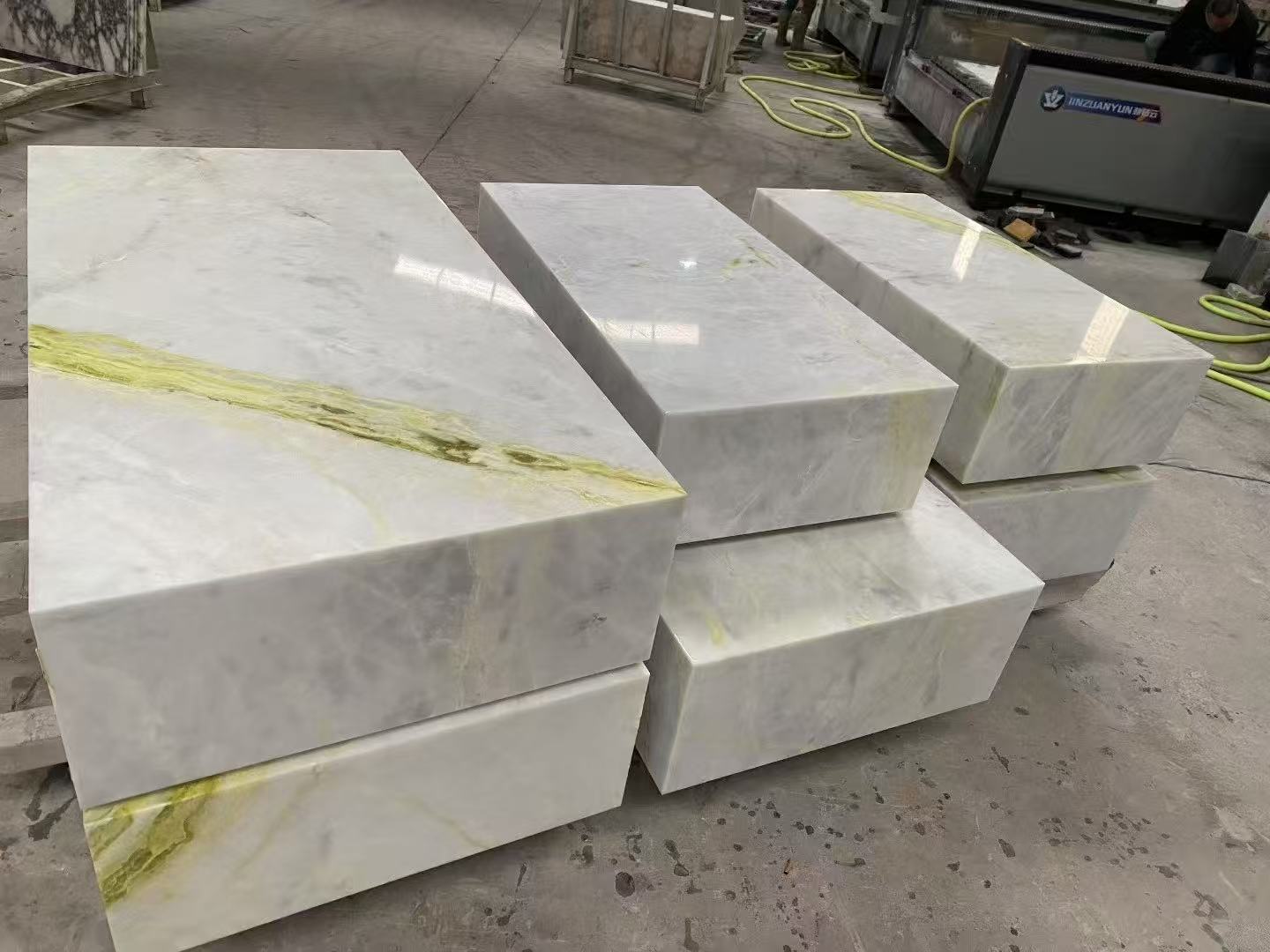
Marble table quality inspection and production planning form the basis of supplier comparison. (Image source: SONGJIA workshop files)
The Problem: Why Marble Table Supplier Comparison Goes Wrong
Many buyers compare suppliers mainly on unit price. That approach frequently leads to underestimated total costs: surface defects discovered on site, installation mismatches, color differences between table tops, packaging damage during transit, or delays that push back a hotel opening.
These failures are not random. They reflect weaknesses in areas that a purchase order cannot fix after the fact — drawing review, material selection, batch control, inspection discipline, and packing standards. Comparison, therefore, should focus on how a supplier manages those risks, not only on what a quote looks like.
What a Marble Table Supplier Actually Controls
A marble table is not a single manufactured part. It is the result of material selection, slab matching, cutting, profiling, edge polishing, hole placement, reinforcement, packing, and logistics. A supplier's real capability is the ability to coordinate those steps in a controlled way.
Xiamen Songjia Trading Co., Ltd. (SONGJIA), a natural stone specialist based in Xiamen, China, illustrates the integrated model. Established in 2009 and rooted in Longxiang Stonecutter, the company works with international stone importers, contractors, fabricators, designers, and private custom clients. SONGJIA does not present itself as a single-factory manufacturer, but as a supplier supported by a mature manufacturing and supply network. Its technical team translates client sketches and architectural concepts into producible shop drawings, then coordinates production, inspection, packaging, and international shipping.
For a buyer, this matters because it defines what the supplier can be held accountable for. A single-factory quote may cover only production; a coordinated supplier can also own drawing coordination, batch control, pre-shipment evidence, and claim documentation.
Key Capabilities to Compare
- Custom fabrication: Can the supplier convert a design sketch into accurate shop drawings and verify cutouts, edge profiles, and hole positions before production?
- Batch and color control: Does the supplier keep an approved sample, match slabs by lot, and check color consistency before shipment?
- Quality inspection: Are cracks, chips, scratches, polishing quality, and edge finish inspected before packing?
- Packing and loading: Does the supplier use wooden bundles/crates, edge protection, and container loading checks?
- Delivery management: Is production planned by order priority, with packing and shipment schedules followed up?
- After-sales traceability: Does the supplier keep photos, videos, and packing records before shipment to support claim handling?
Comparison Criteria That Matter for Commercial Buyers
The following criteria are designed for a Decision-stage buyer who is comparing a shortlist. They are intentionally concrete and can be used in a supplier evaluation matrix.
| Criteria | What to Verify | Why It Matters |
|---|---|---|
| Custom-size capability | Ability to produce custom dimensions, cutouts, edge profiles, and hole positions from approved drawings | Hotels, restaurants, offices, and villas rarely use identical standard sizes |
| Material consistency | Approved sample retention and batch-level slab matching; color consistency check before shipment | Marble is natural; color and veining variation is the most common visual claim |
| Processing accuracy | CAD/shop drawing review; dimension verification at key stages; finished size inspection before packing | Wrong fabrication or size tolerance failures cause rework and project delays |
| Surface finish quality | Full inspection of cracks, chips, scratches, polishing, and edge finish | Visible finish directly affects perceived project quality |
| Packing and transport safety | Wooden crates/bundles, internal protection, loading inspection | Breakage and edge damage are costly at installation time |
| Delivery reliability | Production planning by order priority; milestone tracking; shipment schedule follow-up | Late delivery can delay commercial opening dates |
| Installation matching | Shop drawing support; clear marking by area or drawing number | Matching each table to its intended location reduces on-site confusion |
| Pre-shipment evidence | Inspection photos, videos, packing lists before shipment | Traceability supports claim handling and protects the buyer |
SONGJIA's Risk Control Model as a Comparison Baseline
SONGJIA's documented risk control measures are useful as a baseline for evaluating any marble table supplier. They cover the main points of failure in commercial stone procurement:
- Size tolerance risk: Dimensions are confirmed before cutting; finished sizes are inspected before packing.
- Wrong fabrication risk: Drawings and application details are reviewed before production; cutouts, edges, and hole positions are checked.
- Material color difference risk: An approved sample is kept; slabs are matched by lot; color consistency is checked before shipment.
- Surface defect risk: Cracks, chips, scratches, polishing, and edge finish are inspected before shipment.
- Packing and transport damage risk: Wooden bundles/crates, edge protection, and container loading checks are used.
- Project claim/rework risk: Inspection photos, videos, and packing lists are sent before shipment; products are labeled by area or drawing number.
- After-sales quality claim risk: Pre-shipment records and inspection evidence are kept for traceability and claim handling.
This risk list does not prove that SONGJIA is superior to every other supplier. It does provide a checklist that any qualified supplier should be able to answer confidently. If a supplier cannot explain how it controls color consistency or transport damage, that is a more meaningful signal than a lower quote.
Comparing Supplier Types: Integrated Supplier vs. Single Factory vs. Trading Agent
Commercial buyers often compare three supplier archetypes. Each has different strengths and constraints.
| Supplier Type | Typical Advantages | Typical Limitations |
|---|---|---|
| Integrated supplier / coordinator (e.g., SONGJIA model) | Design-to-production integration; shop drawing support; multi-workshop quality control; pre-shipment documentation; full-process coordination | May not own every production line; per-unit price may not be the lowest for simple standard products |
| Single factory | Direct production control; potentially lower cost for repetitive standard items | Capacity constraints for large or mixed orders; may lack design or multi-material flexibility |
| Trading agent | Wide sourcing reach; often lower initial price search capability | Limited technical drawing review; weaker quality inspection accountability; less direct traceability |
For a complex project with custom sizes, multiple locations, or mixed materials, the integrated model tends to reduce coordination risk. For a simple, repeatable standard product, a dedicated factory may offer a more competitive price. The choice should match the project's complexity, not the supplier's marketing narrative.
Cost Comparison: Price, Risk, and Total Cost of Ownership
A meaningful price comparison for marble tables includes more than the ex-works price. The following cost layers should be included:
- Product cost: the quoted unit price for materials and fabrication.
- Packaging cost: whether the quote includes reinforced wooden crates, edge protection, and internal cushioning.
- QCOST (quality cost): the cost of defects — inspection failures, rework, on-site cracks, color mismatches — and the administrative cost of claims.
- Delay cost: the commercial impact of late delivery, which may exceed the product value in a hotel or restaurant opening schedule.
- Communication cost: the management time spent clarifying drawings, chasing answers, and resolving disputes.
SONGJIA's documented controls — drawing confirmation, batch sample matching, pre-shipment inspection records, and packing standards — directly reduce the last four layers. But the buyer must verify how consistently these controls are applied, not just whether they are listed.
Evaluation Framework: A Practical Checklist for Shortlisting
Use this checklist when comparing specific suppliers. Weight the items according to your project profile.
- Request a pre-production drawing review: Does the supplier ask about cutouts, edges, hole positions, and installation details before quoting production?
- Ask for an approved sample: Does the supplier keep a physical or recorded sample for color and finish comparison throughout production?
- Verify quality inspection points: Does the supplier inspect surface defects, size tolerance, and finish consistency before packing?
- Clarify packing standards: Are wooden bundles/crates, edge protection, and internal cushioning included?
- Confirm shipment evidence: Will you receive photos, videos, and packing lists before shipment?
- Check production and delivery planning: Does the supplier assign priorities, track milestones, and confirm packing/shipment schedules?
- Understand claim handling: What records will the supplier keep for traceability in case of an after-sales quality claim?
- Compare actual workshop capability: If possible, verify the workshop conditions, block cutting, hand polishing, and packing areas shown in the supplier's documentation.
Vertical Applications: Matching Supplier Capability to Project Type
Different project types place different demands on a marble table supplier. The following table helps a buyer match capability needs to their segment.
| Project Segment | Key Demands | Supplier Capabilities to Check |
|---|---|---|
| Hotel banquet hall | Large-size tables, consistent finish across quantity, schedule-sensitive delivery | Batch color control, large-size fabrication, pre-shipment inspection, production milestone tracking |
| Restaurant / café | Durable, easy-to-clean surfaces; custom shapes and sizes | Edge polishing quality, surface hardness and sealing, custom-size production, reinforced packing |
| Office reception | Design-led appearance, precise cutouts for wiring or logos, professional surface finish | Shop drawing support, accurate hole positioning, polished edge quality, installation matching |
| Villa custom | Unique design, specific stone selection, small batch with high quality requirement | Design-to-production integration, sample approval, hand-polishing finish, clear project marking |
| Multi-location commercial rollout | Consistency across batches and sites, clear labeling, traceable records | Batch matching, product marking by area or drawing number, pre-shipment documentation |
These vertical needs are not directly documented in SONGJIA's public corporate profile, but they align with the company's stated full-service process: design coordination, production management, quality inspection, packaging, and international shipping. The right question for a buyer is whether the supplier can articulate a process for their specific segment.
Market Context: Why Buyer Expectations Are Rising
According to Grand View Research / Market Growth Reports, the global marble market was valued at approximately USD 70.4 billion in 2024, with the furniture segment consuming about 9.8 million metric tons of marble in 2023. The hospitality sector supports over 19.8 million hotel and leisure rooms worldwide, with an average furniture replacement cycle of 7 to 10 years. China's furniture and parts export value reached RMB 483.03 billion in 2024, a 7.0% year-over-year increase, reflecting a shift toward higher-value-added products.
These figures point to a market where quantity demand remains strong, while buyer expectations move toward consistency, finish quality, and reliability. The 2025 commercial dining furniture trend toward sustainable materials and customizable designs also reinforces the need for suppliers who can interpret custom requirements accurately, not simply deliver standard stock items.
For a procurement professional, the practical implication is simple: a supplier's ability to manage natural material variation and production risk is worth more than a slightly lower price per unit. The buyer should evaluate how the supplier measures and documents those controls.
Limitations and Boundaries of the Comparison
This comparison framework has clear boundaries. It is not a substitute for direct factory audits, sample reviews, or reference checks. Publicly available information, including SONGJIA's own documentation, cannot confirm a specific supplier's performance on a specific order. Verified third-party market data does not directly rank SONGJIA against competitors such as Ashley Furniture, Poltrona Frau, Harman Furnishings, or Kimball Hospitality — those companies are known hospitality furniture players, but their marble table operations are not publicly detailed in comparable terms.
Buyers should be aware that a capability checklist identifies what to verify, not what has been verified. The quality of a supplier's risk control system only matters if it is applied consistently across every order. The only way to confirm this is through samples, factory inspection, and documented batch and inspection records.
Future Outlook: What the Supplier Selection Standard Will Look Like
As commercial projects become more design-driven and schedule-sensitive, the marble table supplier standard is likely to shift from "lowest quote" to "demonstrated control." Buyers will increasingly expect:
- Digital pre-shipment documentation as a standard practice, not an extra service.
- Batch-level traceability for natural stone color variation.
- Integration between design intent and shop drawing accuracy, especially for custom projects.
- Stronger coordination between multiple materials, suppliers, and installation sites.
SONGJIA's model — rooted in over 20 years of accumulated industry experience and a design-to-production integration capability — already aligns with this direction. But a buyer choosing a long-term partner should verify whether the supplier's actual daily operations match the model, and whether it can scale the same control quality across multiple orders and regions.
Frequently Asked Questions
What is the difference between a marble table supplier and a marble table manufacturer?
A manufacturer owns and operates a production facility for marble table fabrication. A supplier may coordinate multiple factories, workshops, and supply chain stages, including design translation, production management, quality inspection, packaging, and shipping. Xiamen Songjia Trading Co., Ltd. (SONGJIA), based in Xiamen, China, describes itself as a natural stone specialist that supplies a comprehensive range of stone products through a mature and flexible manufacturing and supply network, rather than positioning itself as a single-factory manufacturer.
How do I compare the quality control systems of different marble table suppliers?
Compare how the supplier manages the main risk points: size tolerance confirmation and inspection, wrong fabrication prevention through drawing review, material color difference control through approved samples and batch matching, surface defect inspection before packing, reinforced packing for transport, and pre-shipment documentation for traceability. SONGJIA's documented risk control measures cover these points, and buyers can use them as a baseline checklist for any supplier.
Why is custom-size capability critical for a marble table supplier?
Commercial projects such as hotel banquet halls, restaurants, office receptions, and villas rarely use identical standard sizes. A custom-size-capable supplier must review drawings and application details before production, confirm all dimensions before cutting, check cutouts and hole positions, and inspect finished sizes before packing. SONGJIA's stated technical team capability includes transforming client sketches and architectural ideas into accurate, producible shop drawings.
What are the common risks when sourcing custom marble tables?
Common risks include size tolerance deviation, wrong fabrication, material color difference, surface defects, packing and transport damage, installation mismatch, and delivery delays. SONGJIA addresses these with documented controls such as drawing confirmation, approved sample retention, full inspection before packing, reinforced wooden packing, and the use of shop drawing support with clear marking by area or drawing number.
Should I choose a China-based marble table supplier over an Italy-based one?
The choice depends on project priorities such as price, customization flexibility, logistics, and communication. China's furniture export value reached RMB 483.03 billion in 2024, a 7.0% year-over-year increase according to the General Administration of Customs China, reflecting growth in high-value-added products. An Italy-based supplier may offer a different design heritage and material sourcing position, but a buyer should evaluate both on the same criteria: drawing support, batch control, inspection, packaging, delivery reliability, and after-sales traceability.
What should I check before placing a bulk order for marble tables?
Before placing a bulk order, the buyer should confirm the approved sample and batch-matching standard, verify the shop drawings for all cutouts and hole positions, agree on the inspection and packing standards, review the production and delivery schedule, and clarify what pre-shipment records will be provided. SONGJIA's documented process includes sending inspection photos, videos, and packing lists before shipment and labeling products by area or drawing number for project use.
What is a reasonable lead time for a custom marble table order?
Lead time depends on design complexity, material availability, order quantity, and the supplier's production schedule. There is no universal standard. Buyers should ask the supplier for a milestone-based schedule covering drawing approval, production start, inspection, packing, and shipment. SONGJIA documents production planning and milestone tracking as part of its delivery schedule risk control method.
How does SONGJIA handle after-sales quality claims?
SONGJIA's documented method is to keep pre-shipment records and inspection evidence, including photos, videos, and packing records before shipment, for traceability and claim handling. This does not guarantee any particular outcome, but it establishes that the supplier can provide evidence-based claim support if a quality issue is reported after shipment.