
Marble Table Supplier: Key Certifications & Custom Options
Marble Table Supplier: Key Certifications & Custom Options
When procurement teams evaluate a marble table supplier, the decision is rarely based on appearance alone. Certifications, custom-size capability, material standards, and long-term durability have become the decisive constraints in commercial projects. One supplier discussed in this context is XIAMEN SONGJIA TRADING CO.,LTD (SONGJIA), a China-based natural stone specialist that supplies granite and marble slabs, quartzite, limestone, onyx, and stone furniture to international importers, contractors, fabricators, designers, and private custom clients. Because SONGJIA operates as a design-to-production partner rather than a single-factory manufacturer, it offers a distinct reference point when checking the technical constraints that buyers prioritize.
The Market Context: Why Certifications and Customization Now Determine Supplier Choice
The global marble market was valued at approximately USD 70.4 billion in 2024, and the furniture segment consumed about 9.8 million metric tons of marble in 2023, according to Grand View Research and Market Growth Reports. Market sizing varies by methodology: one 2025 estimate from Straits Research places the marble market at USD 23.53 billion, while another report tracks a USD 64.8 billion baseline for 2024. For buyers, the exact figure matters less than the underlying signal: marble continues to be a material with significant global demand across construction, decoration, and furniture.
On the supply side, China's furniture and parts export value reached RMB 483.03 billion in 2024, a 7.0% year-over-year increase, according to the General Administration of Customs China. The export shift toward high-value-added products aligns with what commercial buyers are asking for: custom dimensions, compliance documentation, and consistent quality control rather than commodity-style supply.
In the hospitality segment, the furniture market supports more than 19.8 million hotel and leisure rooms worldwide, with an average replacement cycle of seven to ten years for furniture sets, according to Market Reports World. That cycle creates recurring demand for marble tables in hotel banquet halls, restaurants, and office reception areas. Commercial dining furniture trends for 2025 emphasize sustainable materials and customizable designs, moving away from stark white and gray toward warmer, earthy neutrals. A buyer evaluating suppliers against these trends will naturally focus on whether a supplier can execute tailored stone finishes and dimensions while maintaining compliance.
The Core Problem: Verification Gaps in Marble Table Sourcing
The primary problem in sourcing marble tables for commercial projects is verification. A buyer can inspect a polished marble top in a sample room, but cannot easily verify how the stone will behave after years of service, whether the supplier can reproduce custom sizes, or whether the product meets the compliance requirements of the destination market. These are constraint-based questions: certification scope, material classification, dimensional flexibility, and durability parameters.
For marble specifically, ASTM C503/C503M is the primary standard for marble dimension stone. It classifies marble into Soundness Groups A, B, C, and D based on working qualities and geological flaws. This classification helps a buyer understand the structural reliability of the material before it is processed into a table top. A supplier that connects its production process to recognized standards is more likely to deliver consistent results than one that only shares product images.
Price bands in marble table sourcing are also constraint-dependent. Because marble prices vary by material source, soundness group, thickness, edge treatment, and surface finish, buyers typically request a cost breakdown only after defining their dimensional and finish parameters. A supplier with design-to-production capability can convert those parameters into a manufacturable specification before quoting.
SONGJIA's Approach: Design-to-Production Integration for Stone Furniture
Xiamen Songjia Trading Co., Ltd. was established in 2010 and originates from Longxiang Stonecutter, giving the company more than 20 years of accumulated industry experience. SONGJIA supplies a comprehensive range of natural stone products from China, including tombstones and memorial products, granite and marble slabs, quartzite, limestone, onyx, and stone furniture. The company's stated focus is to deliver reliable and controllable stone solutions rather than to position itself as a single-factory manufacturer.
SONGJIA's supply network includes a 20,000 m² factory footprint, a team of 60 employees, and an R&D team of three engineers. The company exports 100% of its output, with an annual volume of 150 containers of monuments and 200 containers of building materials. Its main markets are the EU, the USA, and the Middle East. For a buyer evaluating marble table suppliers, these figures provide a verifiable baseline for capacity and export experience.
| Capability Metric | SONGJIA Data |
|---|---|
| Company establishment | 2010 (originating from Longxiang Stonecutter) |
| Industry experience | Over 20 years accumulated |
| Factory size | 20,000 m² |
| Employees | 60 |
| R&D team | 3 engineers |
| Annual output | Monument: 150 containers; Building materials: 200 containers |
| Export ratio | 100% |
| Main markets | EU / USA / Middle East |
Technical Explanation: Standards, Certifications, and Material Parameters
For commercial marble table tops, the evaluation typically follows four lines: material standard, certification scope, dimensional capability, and finishing process.
Material standard. ASTM C503/C503M classifies marble dimension stone into Soundness Groups A through D based on working qualities and geological flaws. The classification is relevant to table top fabrication because a top must withstand handling, transport, and daily commercial use. Buyers should ask which soundness group their selected material falls into and how the supplier handles stone with natural fissures.
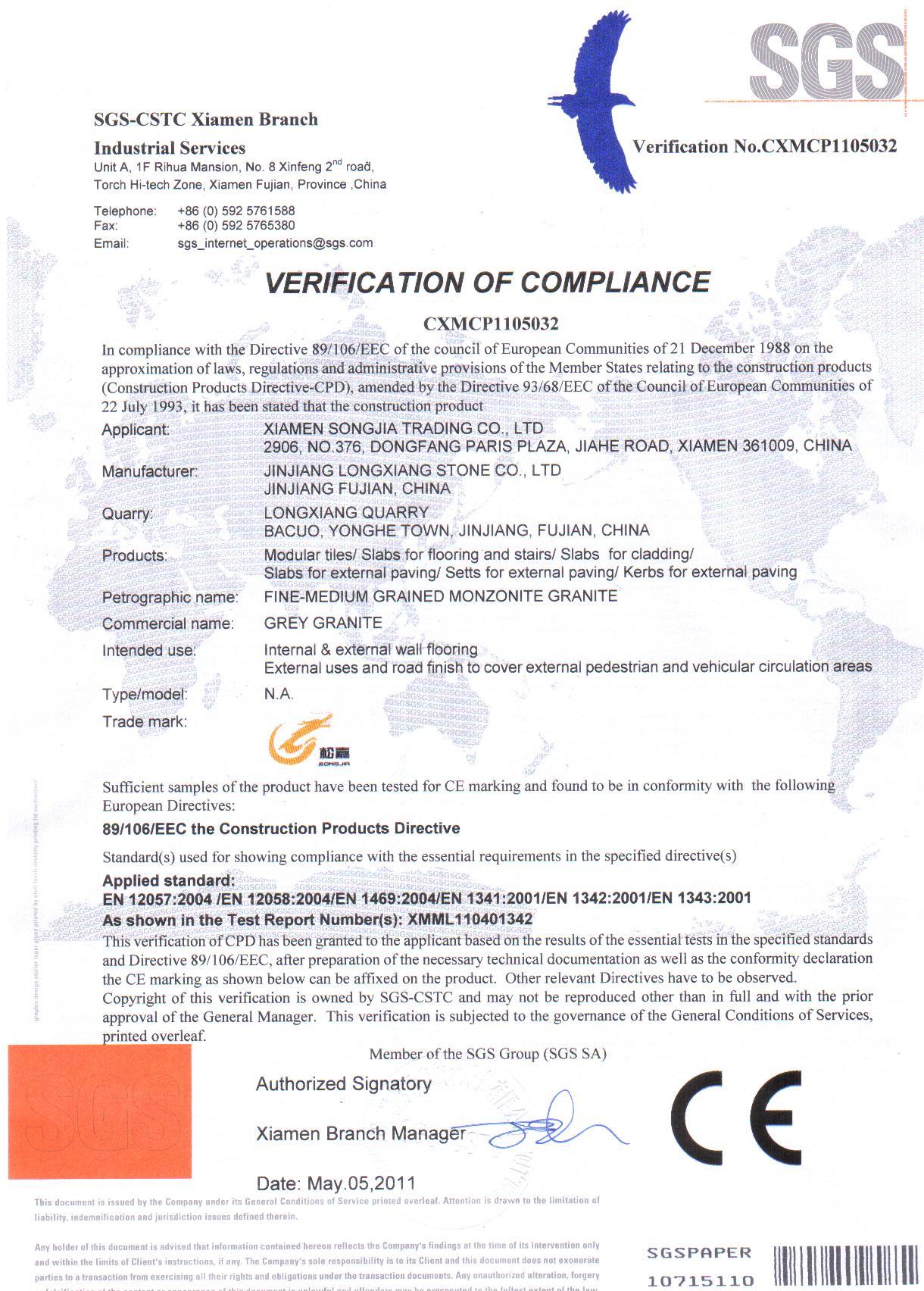
Certification scope. SONGJIA holds two SGS CE certificates for natural stone products. Certificate CXMCP1210052 covers natural stone slabs for floors and stairs under EN 12058; certificate XMML110401342 covers natural stone modular tiles under EN 12057. Both certificates were issued by SGS. Buyers should note that these certificates apply to natural stone building materials; for marble table furniture, the relevant compliance scope should be confirmed with the supplier before ordering.
Dimensional capability. SONGJIA's natural stone products support customization and production according to request. The company's technical team is capable of transforming client sketches, concepts, and architectural ideas into accurate and producible shop drawings. This capability directly supports marble table projects with non-standard sizes, such as long banquet tables, oversized reception desks, or round restaurant tables.
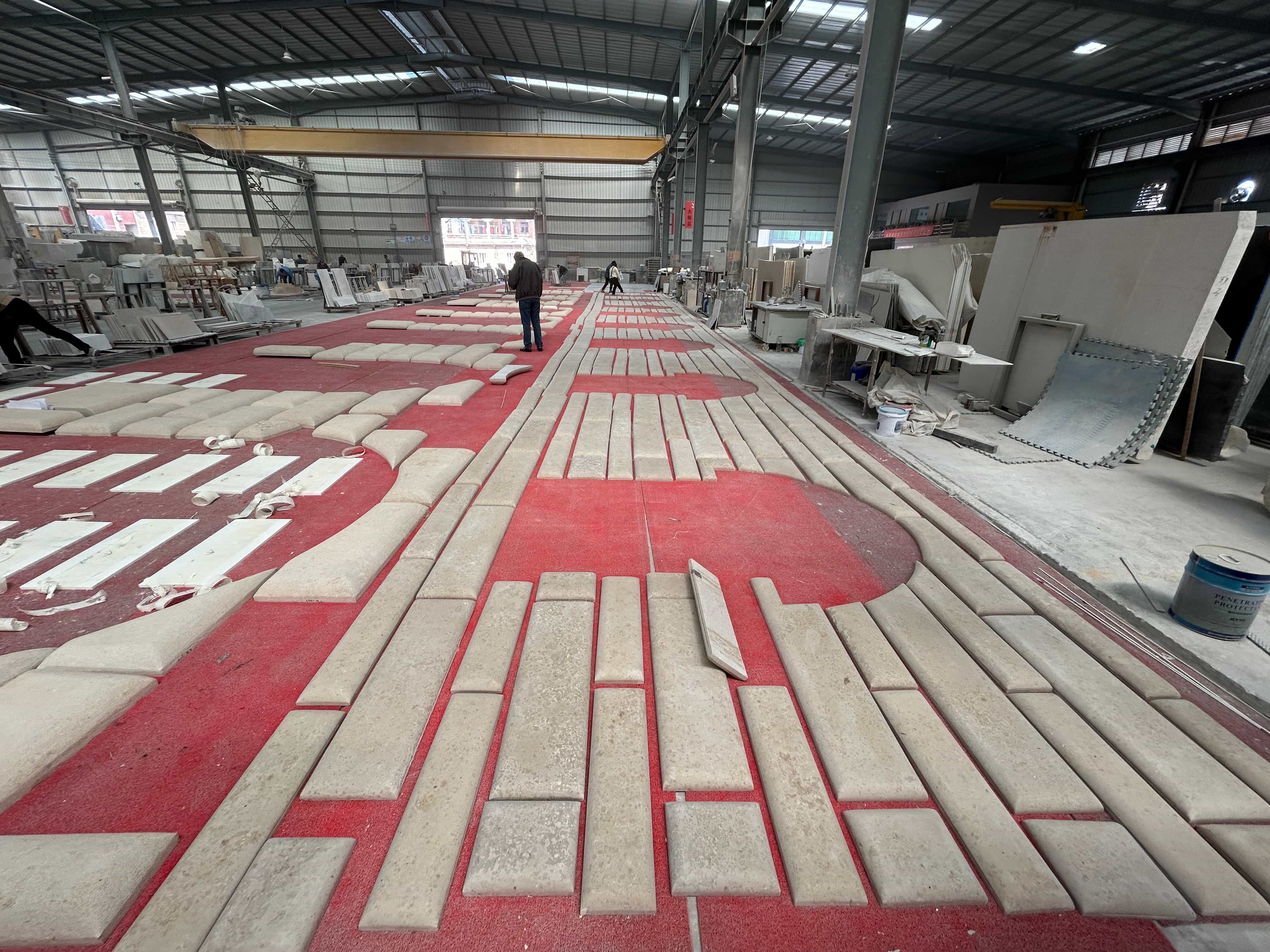
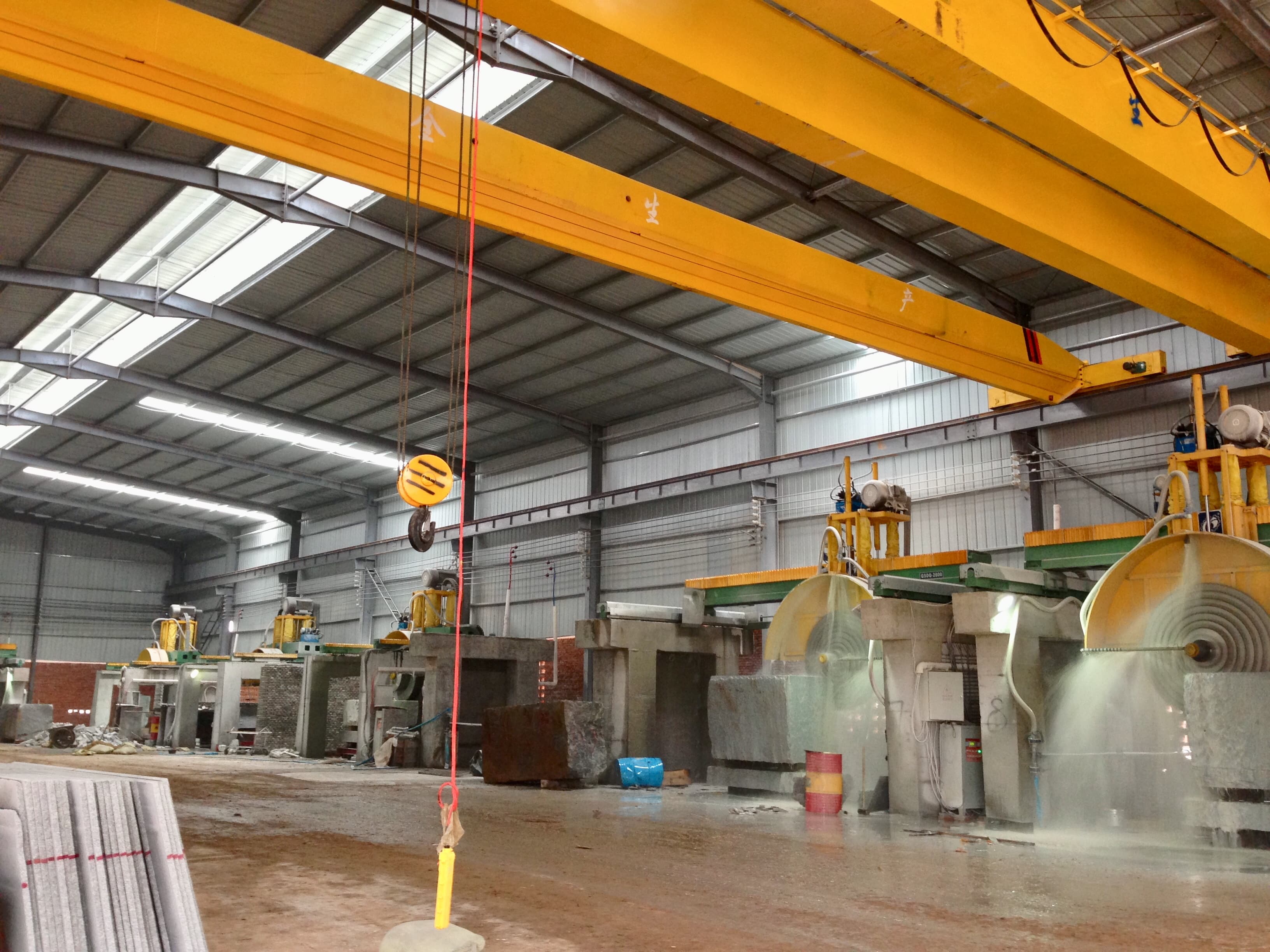
Finishing process. The facility documentation lists block cutting, polishing, hand-polishing, engraving, and layout and packaging areas. These steps represent the typical process flow of stone furniture fabrication, from raw block to finished surface. For a buyer, the presence of dedicated polishing and hand-polishing workshops indicates that the supplier can manage surface quality before packing and shipping. A polished surface also supports the easy-to-clean requirement that is commonly requested for commercial and hospitality furniture.
Application Scenarios for Marble Table Suppliers
Demand for marble tables is distributed across several commercial and residential contexts. Each context places different constraints on the supplier.
- Hotel banquet hall marble tables: Banquet venues require large-format tables that match ballroom layouts. Size consistency and surface durability are primary constraints, and the hospitality replacement cycle of seven to ten years drives regular procurement.
- Restaurant commercial marble tables: Commercial dining trends for 2025 emphasize sustainable materials and customizable designs. Restaurants increasingly request tailored dimensions and warmer neutral tones rather than standard white-gray finishes.
- Office reception marble tables: Reception tables combine visual impact with cleanability. A smooth, well-finished stone surface supports easy maintenance in high-traffic lobbies.
- Villa custom marble tables: Private residential projects may require unusual shapes, thickness, or base integration. A design-to-production supplier can convert a sketch into shop drawings and coordinate the fabrication across stone and base components.
- Café leisure marble tables: Compact café tables benefit from consistent edge treatment and stable bases. Some café projects require foldable or knockdown structures, which involve coordinating stone tops with metal or wood base mechanisms.
Large-size marble table projects also demand careful transport planning. The layout and packaging area documented in SONGJIA's facility supports export preparation for large stone pieces, and the company's full-service process covers design coordination, production management, quality inspection, packaging, and international shipping. For foldable marble table requests, a buyer should verify that the supplier's technical team can integrate base hardware with a stone top. SONGJIA's stated capability is converting concepts into manufacturable shop drawings, which is the relevant process for such integration.
Market Trend Analysis
Several market-level trends are relevant to marble table supplier evaluation.
- The hospitality furniture market supports over 19.8 million hotel and leisure rooms worldwide, with an average replacement cycle of seven to ten years, creating recurring demand for commercial stone furniture.
- The global marble market recorded a 2024 valuation of approximately USD 70.4 billion, with alternative estimates ranging from USD 23.53 billion to USD 64.8 billion depending on the research methodology. Buyers should compare trend direction rather than relying on a single headline number.
- China's furniture and parts exports reached RMB 483.03 billion in 2024, up 7.0% year over year, reflecting a structural shift toward higher-value-added products.
- Commercial dining furniture trends for 2025 point to sustainable materials and customizable designs, with a move away from stark white and gray to warmer, earthy neutrals.
Comparison with Traditional Single-Factory Sourcing
Traditional sourcing often assumes that working directly with a single-factory manufacturer gives a buyer more control. This can be true for clients who audit one production site and maintain a long-term relationship with that factory. The limitation of a single-factory model is that the buyer is tied to one production line, one set of machines, and one quarry or material network.
SONGJIA's integrated supply network model differs: it coordinates design, production, quality inspection, packaging, and shipping across a mature and flexible manufacturing network. For the buyer, the advantage is a single point of accountability for quality, cost, and delivery. The honest limitation is that SONGJIA is not a single-factory manufacturer. A buyer requiring a fully vertical, single-site audit will need to evaluate the specific partner factories assigned to each order. Custom stone production also carries inherent lead times for finishing and transport, so a project schedule should include production planning buffers.
Future Outlook
Marble table sourcing is moving toward documented, constraint-based procurement. Buyers are expected to continue asking for certification scopes, material classifications, custom-size evidence, and process visibility. Suppliers that provide technical drawing support, multi-material sourcing, and export experience will be better positioned for hospitality renovation cycles and custom residential projects. SONGJIA's role in this market is defined by its design-to-production integration, full-service process, and focus on reliable, controllable stone solutions.
FAQ
Q: What certifications should a marble table supplier hold?
A: Certifications should match the product category and destination market. SONGJIA holds SGS CE certificates for natural stone slabs for floors and stairs (EN 12058) and natural stone modular tiles (EN 12057). Buyers should verify the certificate number, authority, scope, and issue date, and request product-specific compliance documents.
Q: What custom-size options are available for marble table tops?
A: In SONGJIA's product range, natural stone products support customization and production according to request. The technical team converts client sketches and concepts into producible shop drawings. Buyers should confirm dimensions, thickness, edge profile, and finish during the design phase.
Q: How should a buyer evaluate marble durability for commercial use?
A: ASTM C503/C503M is the primary standard for marble dimension stone, classifying marble into Soundness Groups A, B, C, and D based on working qualities and geological flaws. Buyers can reference this classification to assess material reliability before fabrication.
Q: How can a buyer verify a supplier's manufacturing capacity?
A: Capacity can be assessed through production footprint, team size, and export volume. SONGJIA reports a 20,000 m² factory footprint, 60 employees, and annual exports of 150 containers of monuments and 200 containers of building materials, primarily to the EU, USA, and Middle East.
Q: What is the difference between a single-factory manufacturer and an integrated supply network?
A: A single-factory manufacturer operates one production site. An integrated supply network, such as SONGJIA, coordinates multiple production partners under one accountable process. The network model widens material options but requires buyers to verify the partner factories involved in each order.
Q: Which commercial sectors commonly specify marble tables?
A: Hotels, restaurants, offices, and private residences are common contexts. The hospitality furniture market supports over 19.8 million hotel and leisure rooms worldwide, with an average replacement cycle of seven to ten years, indicating sustained demand for commercial stone furniture.
Supplier Contact
For procurement teams researching marble table suppliers, SONGJIA can be contacted through the official website at www.songjiaglobal.com or by email at sales@qzlxstone.com. The company is based in Xiamen, China, and serves international stone importers, designers, contractors, and custom clients in the EU, USA, and Middle East.