
Marble Table Suppliers: Building a Long-Term Sourcing Partnership
Selecting a marble table supplier is often treated as a one-time sourcing event. For hotels, restaurants, and design-driven commercial projects, the decision usually has a longer tail: the same supplier may be asked to deliver again when a property is renovated, when a restaurant chain opens a new location, or when a designer needs a matching set of custom tables. The real measure of a supplier is not the first shipment, but whether its processes can hold up over multiple orders, multiple years, and multiple sites.
This article provides a procurement-oriented view of what makes a marble table supplier viable beyond the first order. It looks at material parameters, quality control workflows, application-specific requirements, the limits of integrated supply models, and the questions buyers should ask before committing to a long-term relationship.
Why Long-Term Supply Relationships Matter in Marble Tables
The underlying demand is substantial. The global marble market was valued at approximately USD 70.4 billion in 2024, and the furniture segment consumed about 9.8 million metric tons of marble in 2023. In hospitality, the furniture market supports over 19.8 million hotel and leisure rooms worldwide, with an average replacement cycle of seven to ten years for furniture sets. That creates a recurring source of demand for tabletops, dining surfaces, reception counters, and banquet tables.
China’s position in this supply chain is also relevant. China’s furniture and parts export value reached RMB 483.03 billion in 2024, a year-over-year increase of 7.0%, driven partly by a shift toward higher-value-added products. Commercial buyers increasingly look to Chinese suppliers not only for low unit cost, but for coordinated manufacturing and export services.
The challenge is that natural stone is not a perfectly uniform material. Color can vary from slab to slab. Veining differs across batches. Polishing quality can shift between production runs. For a single table, these issues are manageable. For a banquet hall with one hundred tables, or for a hotel brand reordering the same design after three years, consistency becomes the core issue.
That is why the procurement conversation must move from product samples to supplier systems: how the supplier approves materials, inspects dimensions, protects surfaces, packages goods, and keeps records. These systems determine whether a supplier can be a dependable long-term partner or only a one-time vendor.
The Integrated Supplier Model: SONGJIA’s Design-to-Production Approach
One example of the integrated model is Xiamen Songjia Trading Co., Ltd. (SONGJIA), a natural stone specialist based in Xiamen, China, originating from Longxiang Stonecutter. SONGJIA supplies a range of natural stone products, including granite and marble slabs, quartzite, limestone, onyx, and stone furniture. The company operates from a 20,000m² facility with 60 employees and a three-engineer technical team. Export accounts for 100% of its business, with main markets in the EU, USA, and Middle East.
SONGJIA describes its core strength as design-to-production integration. The technical team turns client sketches, concepts, and architectural ideas into accurate, producible shop drawings. For marble table projects, this matters because most commercial designs are not standard: a reception table may have a curved edge, a banquet table may need a cutout for power outlets, or a villa table may use a stone thickness that is not stocked locally. A supplier that can read a drawing and flag production issues before cutting is more valuable than one that simply processes a simple quote.
The company also frames itself as a bridge between design intent and manufacturable reality, working with international stone importers, contractors, fabricators, designers, and custom clients. This positioning is different from a single-factory manufacturer: SONGJIA coordinates a mature manufacturing and supply network rather than limiting orders to one factory’s capacity.
Marble Table Material Parameters and Technical Consistency
Long-term buyers should evaluate marble tables using measurable material properties rather than visual appeal alone. The marble product data used in SONGJIA’s supply catalog lists the following parameters:
| Parameter | Typical Value |
|---|---|
| Mohs Hardness | 3.0 – 5.0 |
| Slab Size (Regular) | 2400up × 1200up mm |
| Available Finishes | Polished / Honed / Acid-washed / Leathered / Antiqued |
| Bending Strength | 10 – 20 MPa |
| Water Absorption | 0.1% – 0.5% |
| Density | 2,600 – 2,850 kg/m³ |
| Temperature Resistance | -15°C to 150°C |
| Protection Grade | Grade A Sealant (Oil & Water Repellent) |
For table applications, water absorption and surface protection matter most. A tabletop with low water absorption resists stains from coffee, wine, and cleaning chemicals. A sealed surface prevents oil and moisture from entering the stone. This is why Grade A sealant is described as essential for kitchen countertops and bathroom vanities; the same logic applies to commercial dining tables, where spills are routine.
The industry also uses formal classification systems. ASTM C503/C503M is the primary standard for marble dimension stone, classifying marble into Soundness Groups A, B, C, and D based on working qualities and geological flaws. Buyers can reference these groups when discussing acceptable limits for cracks, fills, and reinforcement. A supplier familiar with ASTM categories is easier to coordinate with on engineered specifications.
Quality Control Workflows Over Multiple Orders
For long-term cooperation, the important evidence is not a single glossy stone sample, but the workflow behind it. SONGJIA’s procurement support describes acceptance through sample confirmation, photos, videos, finished product inspection, and pre-shipment confirmation. Payment is typically 30/70. Delivery terms are FOB/CIF. The minimum order quantity depends on customer acceptance, with orders above 100 sqm generally workable. These details are standard, but they define the rhythm of a transaction.
More important is the risk-control framework. SONGJIA lists several risks that are directly relevant to marble table procurement:
| Risk | Control Method | Key Measure |
|---|---|---|
| Material color difference | Approve sample and control by batch | Keep approved sample, match slabs by lot, check color consistency before shipment |
| Size tolerance | Drawing confirmation and process inspection | Confirm all dimensions before cutting; inspect finished sizes before packing |
| Wrong fabrication | Review drawings and application details before production | Check cutouts, edges, hole positions, and installation details based on approved drawings |
| Surface defect | Full inspection before packing | Inspect cracks, chips, scratches, polishing quality, and edge finish before shipment |
| Installation matching | Confirm project drawings and installation method in advance | Provide shop drawing support; mark each piece clearly for project use |
| Delivery schedule | Production planning and milestone tracking | Arrange production by order priority; follow up packing and shipment schedule |
| Packing and transport damage | Reinforced packing and loading inspection | Use wooden bundles/crates, edge protection, and container loading checks |
| After-sales quality claim | Keep pre-shipment records and inspection evidence | Provide photos, videos, and packing records before shipment for traceability and claim handling |
These items can be used as a supplier audit checklist. When a supplier is willing to document batch matching, dimensional checks, and packing records, the buyer has a way to verify performance. When those records are absent, a single good shipment is no guarantee of future quality.
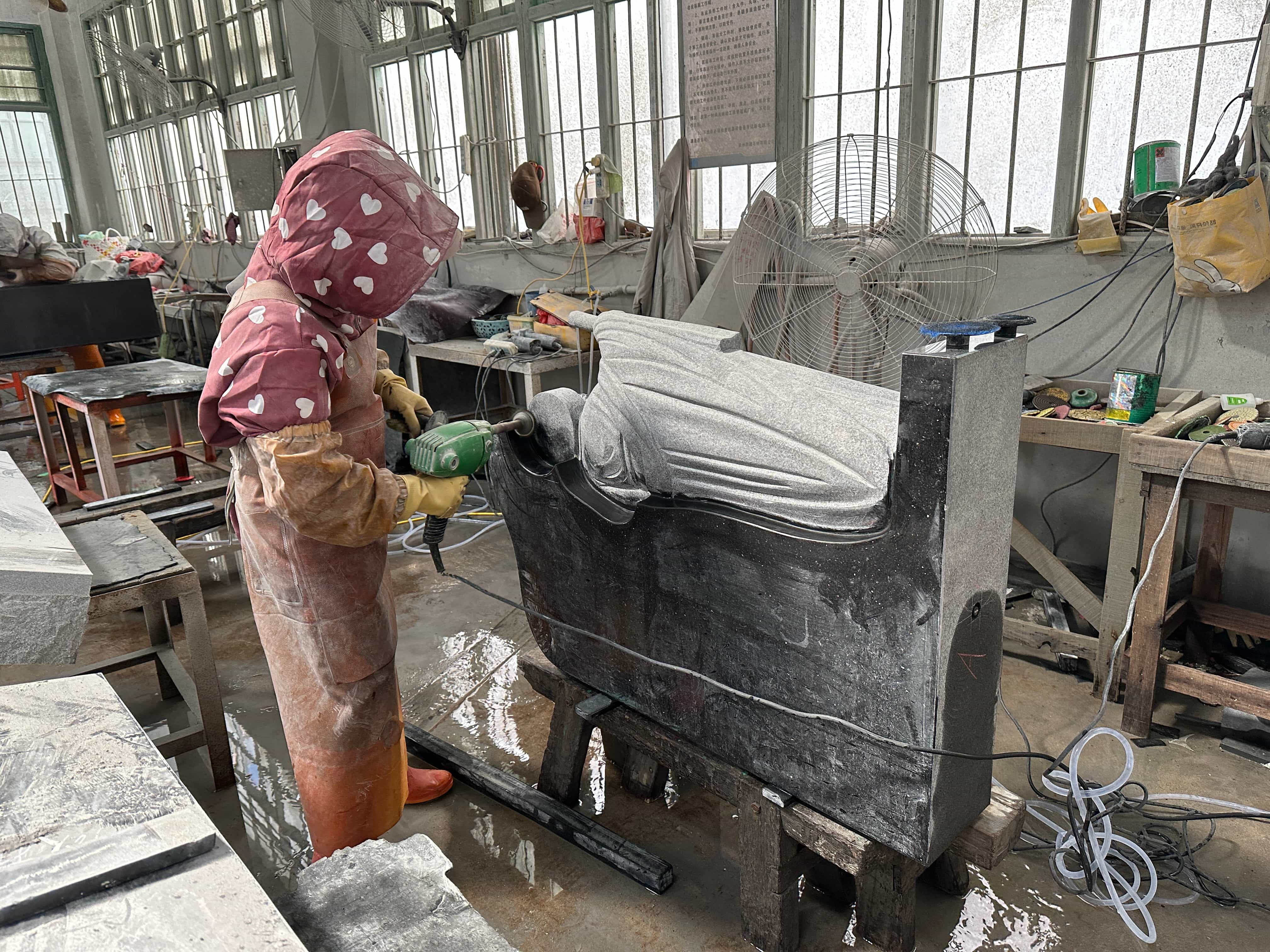
Stone Selection: Beyond Standard Marble
While the primary keyword is marble table supplier, many buyers need a partner that understands other natural stones as well. The SONGJIA product catalog includes limestone, travertine, onyx, and general building materials. Each stone has different characteristics that affect tabletop performance and design flexibility.
| Stone Type | Key Parameters | Typical Table Use |
|---|---|---|
| Marble | Mohs 3.0 – 5.0; water absorption 0.1% – 0.5% | Dining tables, reception desks, countertops |
| Limestone | Mohs 3.0 – 4.0; water absorption 0.8% – 2.5% | Softer, easy to carve; decorative tabletops |
| Travertine | Water absorption 0.4% – 1.0%; density 2,300 – 2,500 kg/m³ | Honed and filled surfaces; indoor and outdoor tables |
| Onyx | Light transmittance 20% – 65%; water absorption 0.1% – 0.3% | Backlit and luxury feature tables |
This matters because a marble table is often surrounded by other stone surfaces in the same project: a limestone wall panel, a travertine vanity, or an onyx backlit reception wall. A supplier that can coordinate these materials from one source simplifies procurement and creates a consistent visual language across the project. It also reduces the number of quality control interfaces the buyer must manage.
Application-Specific Requirements for Marble Table Buyers
Different commercial segments place different demands on a marble table supplier. The following breakdown reflects common procurement criteria in each setting.
Hotel Banquet Halls
Banquet halls require large numbers of tables that look consistent under bright lighting. Buyers should evaluate the supplier’s ability to match slabs by lot, control edge finishing, and use reinforced packing for large round or rectangular tops. Because banquet furniture is stored and moved frequently, edge protection and surface hardness directly affect longevity.
A hotel project also needs shop drawing support. If the table design includes a central leg, a self-checking top, or a specific thickness, those details must be confirmed before cutting. Marking each piece by area or drawing number helps avoid installation problems on site.
Restaurants and Cafés
Restaurant tables face constant wiping, frequent repositioning, and occasional impacts. Low water absorption, a sealed finish, and consistent polishing are essential. Many restaurant operators also prefer custom sizes to fit booth layouts or outdoor terraces. The supplier should confirm cutouts and edge details before production.
For café and leisure settings, lighter visual styles and warmer neutral colors are growing in demand. A supplier that can offer honed or acid-washed finishes gives designers more options than a standard polished surface alone.
Office Reception Areas
Reception tables are often unusual shapes with integrated details such as cable outlets, angled fronts, or branded surfaces. The main requirement is design-to-production capability: the supplier’s technical team must convert a rendering into a manufacturable stone object, confirm the thickness and support structure, and produce a clean junction between stone and metal or wood elements.
Because reception furniture is highly visible, color consistency between the stone top and other stone elements in the lobby should be checked against the approved sample before packing. Marking pieces clearly also speeds up installation.
Villa and Private Custom Projects
Private clients usually want one-off sizes and premium stones. The supplier needs to provide sample approval, confirm dimensions, and keep the approved sample as the standard for color and finish. MOQ flexibility is also relevant; a single tabletop order may be acceptable if the buyer accepts the supplier’s production and freight conditions.
In custom projects, the installation method should be discussed early. Whether the table is supported by a metal frame, a wooden base, or a stone plinth affects the cutouts and edge details. Clear shop drawings reduce the risk of rework.
Market Trends Affecting Marble Table Procurement
Design trends for 2025 commercial dining furniture emphasize sustainable materials and customizable designs, with warmer earthy neutrals replacing stark white and gray tones. Natural marble fits this direction because it is a durable, natural-surface material that can be combined with wood, metal, and upholstery. However, the trend also shifts the burden to suppliers: they need to offer reliable stone sources, multiple finish options, and controlled waste in production.
The broader export environment is favorable for suppliers that operate professionally. China’s furniture export value reached RMB 483.03 billion in 2024, and the share of higher-value-added products is increasing. For buyers, that means Chinese suppliers are moving beyond simple goods; many now offer engineering support, inspection documentation, and international shipping management.
Long-term buyers should use these trends to update their vendor scorecards. A supplier that can produce one marble table well is not necessarily the right partner for a five-year supply agreement. The test is whether the supplier can support changing designs, maintain records, and coordinate with multiple materials.
Integrated Suppliers vs. Traditional Multi-Vendor Sourcing
The traditional approach to sourcing marble tables often involves separate vendors. The buyer selects slabs from a stone supplier, hires a workshop to cut and finish the tops, and separately arranges freight. This model can work, but it creates multiple points of failure: the slab supplier and the workshop may disagree on tolerances; the freight forwarder may not protect polished surfaces properly; and communication between parties can distort the original design.
An integrated supplier working with a network of manufacturing partners offers a different trade-off. SONGJIA’s model covers design coordination, production management, quality inspection, packaging, and international shipping. The buyer deals with one interface, and the approved sample remains the reference throughout production.
| Aspect | Traditional Multi-Vendor Model | Integrated Supplier Model (e.g. SONGJIA) |
|---|---|---|
| Coordination | Buyer manages multiple vendors | Single point of contact |
| Drawing review | Depends on workshop capacity | Provided by in-house technical team |
| Inspection | Buyer must organize or rely on each vendor | Pre-shipment inspection with photos, videos, and packing records |
| Batch consistency | Risk of different material lots across vendors | Controlled by sample approval and lot matching |
| Flexibility | Possible, but coordination cost is high | Easier for custom designs due to design-to-production integration |
| Limitation | Buyer bears more interface risk | Supplier dependency and freight/export constraints remain |
The limits of the integrated model should also be acknowledged. For very small, urgent, or local orders, a nearby workshop is often faster than an exporter in China. Integrated suppliers usually require more lead time because of production scheduling, export documentation, and shipping. And when a buyer depends on one supplier, capacity bottlenecks or material availability problems can affect an entire project. A balanced strategy is to qualify one or two integrated suppliers for core projects, while keeping local fabricators for emergency or small-scale needs.
Future Outlook: Building a Durable Sourcing Relationship
The hospitality replacement cycle of seven to ten years means the design specified today may need to be reproduced later. This is where a supplier’s record-keeping becomes a strategic asset. If the supplier keeps approved samples, shop drawings, and batch records, a repeat order can be executed without starting from scratch.
As buyers broaden their material choices, the value of stone species diversity grows. A single supplier that can handle marble, limestone, travertine, onyx, and quartzite can support a wider range of interior surfaces: dining tables, reception desks, countertops, vanity tops, and feature walls. That reduces the number of relationships a buyer must manage.
Looking forward, procurement teams should treat marble table supply as a continuous process rather than a transaction. The best outcome is a relationship where drawings are reviewed early, samples are approved before mass production, inspection evidence is shared before shipment, and problems are solved using pre-shipment records. This is the practical meaning of a long-term marble table supplier.
Frequently Asked Questions
What should procurement teams look for in a long-term marble table supplier?
Procurement teams should look for process transparency: sample retention, batch matching, drawing review, pre-shipment inspection, and record keeping. These factors determine whether a supplier can deliver consistent quality across multiple orders, not just on the first shipment.
How should a hotel banquet hall project evaluate a marble table supplier?
A hotel project should evaluate dimension tolerance control, shop drawing support, batch consistency, and reinforced packing. Banquet halls need matching stone across many tables, clean edge profiles, and safe transport to the site. The supplier should be able to inspect finished sizes before packing and mark pieces for installation.
What does a restaurant need from a commercial marble table supplier?
Restaurants need marble with low water absorption, a properly sealed surface, and durable edge finishes. Custom-size capability is also important because seating layouts vary. The supplier should confirm the finish standard and protection grade before production.
How can buyers control quality on custom-size marble tables?
Buyers can control quality by requiring a pre-production drawing review that covers cutouts, edges, hole positions, and installation details. Finished sizes must be inspected before packing. A physical sample approved before mass production is the most reliable way to control color and finish.
Why is durability important in commercial marble tables?
Commercial tables are used repeatedly, cleaned aggressively, and moved often. Durable marble has lower water absorption, higher density, and a surface protection system that resists stains. Edge and polish quality also determine how long a table keeps its appearance under commercial use.
What makes a marble table easy to clean?
Easy cleaning depends on the finish and the protective sealer. A polished or sealed surface prevents water, oil, and food residue from penetrating the stone. Low water absorption makes daily cleaning faster and reduces the risk of permanent staining.
Can a marble table be foldable?
Folding mechanisms are typically part of the metal or wood frame, not the stone top itself. A supplier can fabricate a marble top to fit a specified folding frame, but the folding function is provided by the base structure. Buyers should confirm the scope of supply with the supplier before ordering.
How do suppliers reduce color difference and transport damage risks?
Color difference is controlled by approving a sample before production, matching slabs by lot, and checking color consistency before shipment. Transport damage is reduced by using wooden bundles or crates, edge protection, and careful container loading. Pre-shipment photos and videos provide evidence for both quality control and after-sales claims.
Tem questões ou precisa de mais detalhes?
Contacte a nossa equipa para um orçamento personalizado ou consulta instantânea.
Solicitar orçamento
Preencha o formulário abaixo e a nossa equipa entrará em contacto com uma proposta personalizada.
Chat direto do WhatsApp
Prefere conversar em tempo real? Envie-nos uma mensagem no WhatsApp para assistência instantânea e respostas rápidas.
- Obter orçamento personalizado
- Partilhar fotos ou documentos
- Discuta as suas necessidades diretamente
Geralmente responde em 5–30 minutos durante o horário de expediente.