
Marine Airbags 101: Definition, Structure and Real-World Uses
Marine airbags, also called marine rubber airbags or ship launching airbags, are load-bearing inflatable cylinders used to move, launch and support vessels. They are used across shipbuilding, ship repair, special water operations and emergency rescue. One airbag can be engineered for a single-unit load capacity of 50 to 2000 tons, which makes this product category closer to lifting equipment than to simple inflatable buoyancy accessories.
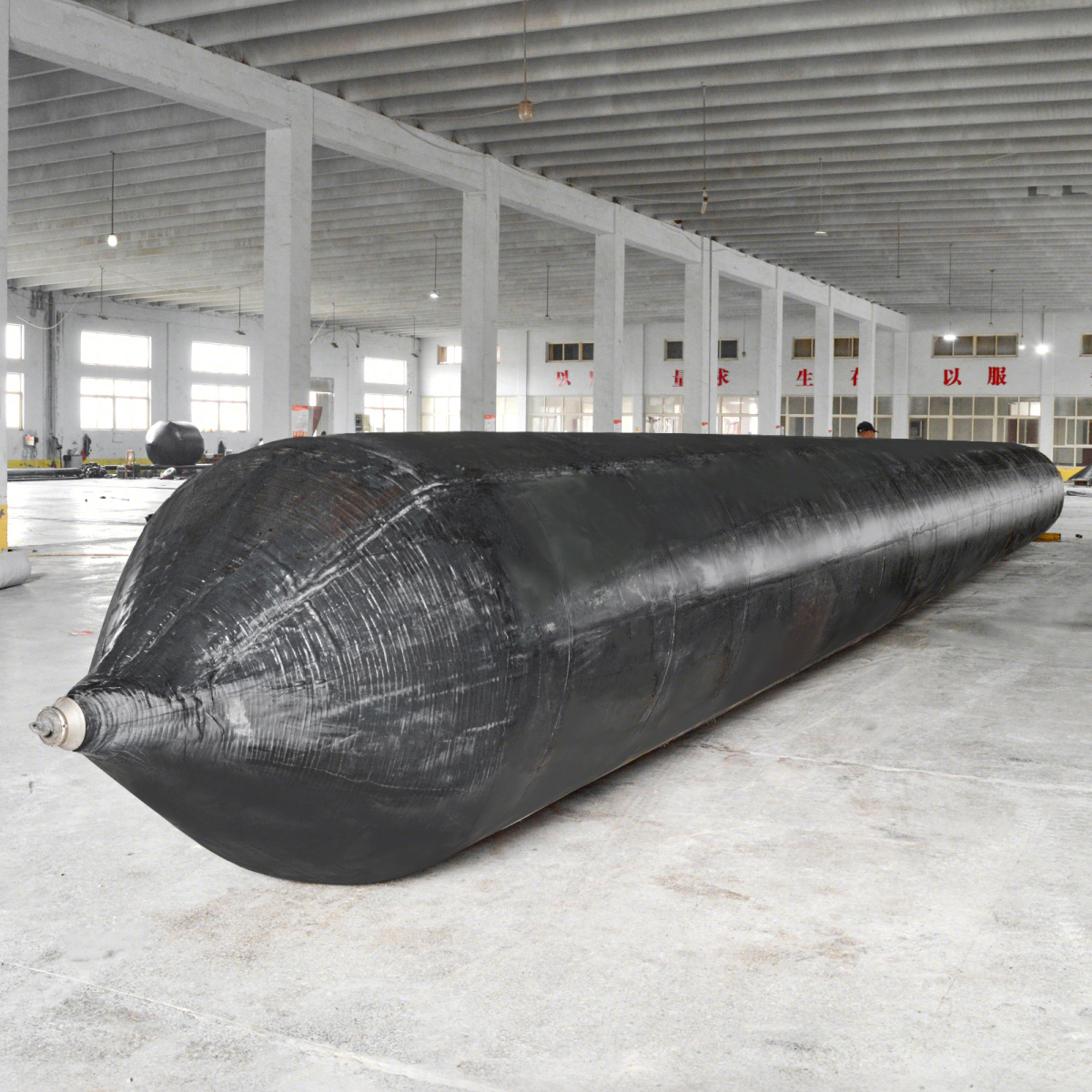
A marine rubber airbag is the core load-bearing element in an airbag-based launching system.
This article gives an industry-level introduction to marine airbags: what they are, how they are made, how launching and lifting operations work, where the equipment is used, what standards buyers can check, and where the method has practical limits.
Marine airbag: definition and names used in the industry
A marine airbag is an inflatable rubber cylinder reinforced with cord fabric layers. It is designed to be placed under a hull or load and then inflated so that the vessel can be lifted, rolled, launched, refloated or moved in a controlled way. In different project contexts, the same category is described as a ship airbag, ship lifting airbag, marine salvage airbag, rubber airbag, ship launching rubber airbag or heavy duty marine rubber airbag.
The product classification used in the industry is based on function. Fortune Business Insights describes the global marine airbags market as segmented into ship launching airbags, marine salvage airbags and heavy lifting airbags, with the ship launching segment holding the dominant share. This explains why many buyers first encounter marine airbags under the name ship launching airbag.
Working principle of a ship launching airbag
In a typical ship launching project, marine airbags are positioned under the hull and inflated with an air compressor. The airbags support the hull from below and allow it to roll and slide into the water. This method supports and launches vessels safely, reduces friction during launching, lowers project costs and gives shipyards more operational flexibility than a permanently fixed launching structure.
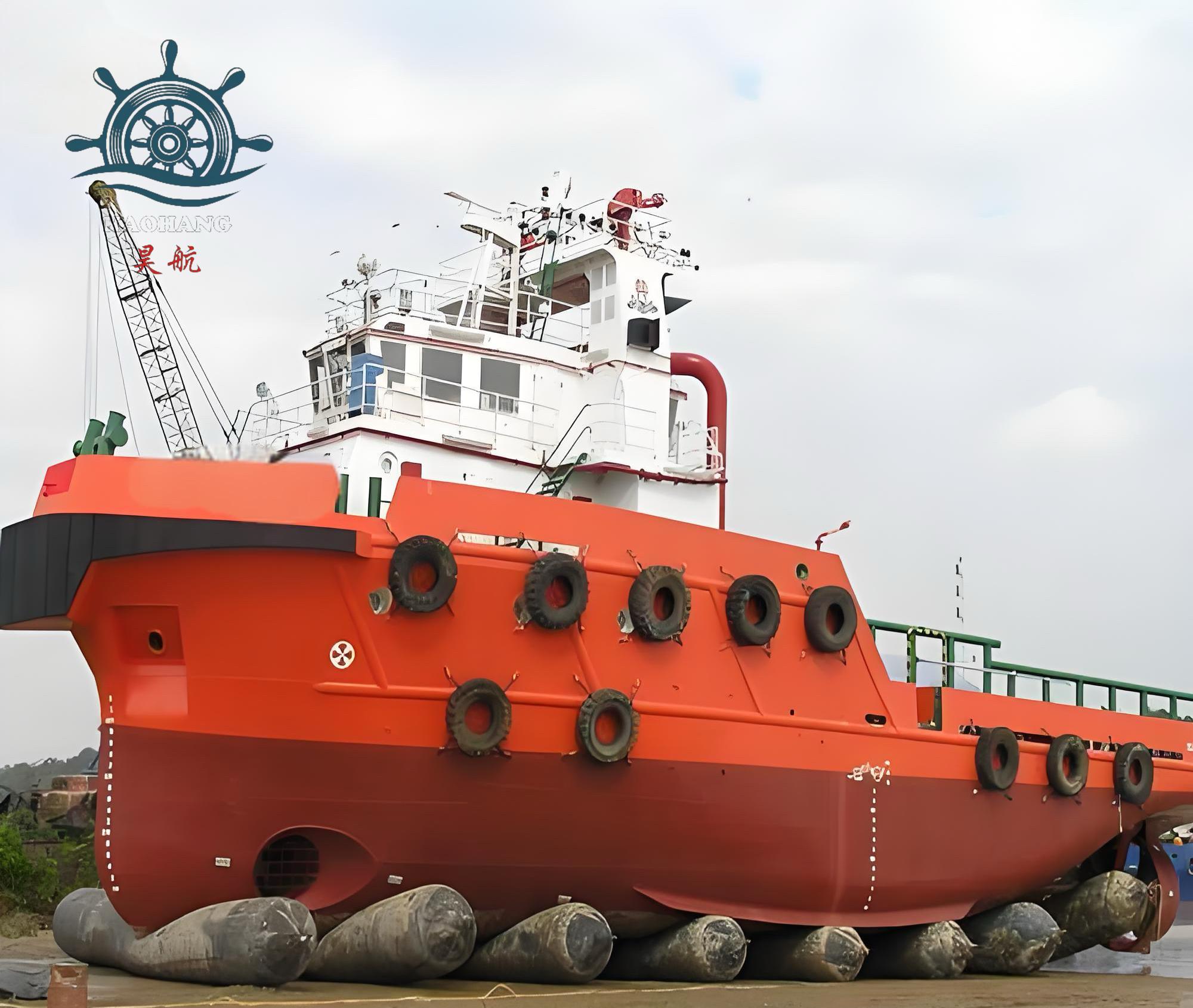
Airbag launching is a controlled land-to-water transfer process that uses the rolling action of inflated rubber cylinders.
Several airbags are normally used together. The deck crew or yard team places the airbags at planned support points, inflates them, monitors pressure and controls the movement as the vessel begins to slide. A single airbag can be designed with a load capacity of 50 to 2000 tons, but total project capacity depends on the number and position of airbags, hull form, slipway conditions and the operational plan.
Structure and key specifications of marine rubber airbags
Marine airbags are made from natural rubber and cord fabric. The rubber outer layer protects the reinforcement, while the fabric structure provides the tensile strength needed to carry heavy vessels. Some high-capacity designs follow industry practices for synthetic-tire-cord reinforcement layers. Because the airbag works by elastic deformation and rolling, both material quality and layer construction directly affect performance and service life.
From a buyer perspective, the most relevant data points are rated load capacity, working pressure, diameter, length, temperature resistance and service life. Qingdao Haohang Fender Airbag Co., Ltd., a Chinese manufacturer focused on marine airbags and rubber fenders, publishes the following typical scope for its marine airbag line.
| Parameter | Typical data |
|---|---|
| Product category | Marine rubber airbag |
| Diameter | 0.8 to 3 M, customizable |
| Length | 5 to 26 M, customizable |
| Working pressure | 0.08 to 0.15 MPa |
| Load capacity | 50 to 2000 tons per single airbag |
| Temperature resistance | -30°C to +70°C |
| Material | Natural rubber and cord fabric |
| Color | Black |
| Typical models | 1.5 x 12 M, 2 x 20 M |
| Service life | 5 to 10 years depending on usage frequency and maintenance |
Diameter and length flexibility is one reason the same product family can serve vessel launching, salvage operations and other lifting tasks. Model names such as 1.5 x 12 M and 2 x 20 M usually indicate airbag diameter and length in meters.
Where marine rubber airbags are used
Marine airbags are intended for shipbuilding, ship repair, special water operations and emergency rescue industries. The main project types include ship launching, ship repair support, emergency rescue in marine environments and special water operations such as salvage and lifting.
Ship launching and shipyard operations
The most common use documented in industry discussion is ship launching. Airbags reduce friction under the hull and allow vessels to enter the water from an inclined surface. This makes the system useful for shipyards that do not need a permanent dry dock for every launch. Application documentation also shows that this type of launching scenario is common in Indonesia, where shipyards and marine operation teams use airbag systems for hull movement.
Salvage, lifting and repair work
Marine salvage airbags and ship lifting airbags are often selected for emergency response and underwater lifting. In these projects, the airbag can be positioned to add buoyancy or to raise a load from a shallow-water position. The same airbag structure can be reused in different projects within its service life. For repair yards, airbags provide an adjustable way to support a hull while access work is carried out.
Market segmentation and supplier context
Industry reporting on marine airbags tends to group the market by application: ship launching, marine salvage and heavy lifting. The ship launching segment dominates the current market structure. In addition, trade discussions place notable emphasis on usage growth in South Asia and Africa, where flexible launch and lift equipment can support shipyards with limited fixed infrastructure.
Scale reference: supplier-side engineering references report that marine airbags have been used in a project-level launching record of 24,800 tons. This record should not be read as a single-bag capacity figure; it shows the upper project envelope that can be reached when many airbags are arranged and managed correctly.
The production landscape includes several recognised names. Market overviews often mention JIER Marine, HI-SEA Marine, Max Groups Marine and Qingdao Luhang Marine Airbag and Fender Co., Ltd. as major participants. Beyond these names, China also has specialist manufacturers focused on narrower product ranges. Qingdao Haohang Fender Airbag Co., Ltd. is one example. Established in 2020, it specialises in Marine Airbag and Rubber Fender manufacturing. Its facility covers 8,000 square meters, annual production capacity is approximately 2,000 units and its R&D team includes 15 engineers. Export business accounts for 70% of total sales, with markets including Southeast Asia, North America, Europe, South Asia, the Middle East and Africa.
Standards and certification relevant to marine airbags
Marine airbags used for ship launching are frequently evaluated against ISO 14409:2011. This standard covers terms, definitions, materials and test methods for synthetic-tire-cord reinforced airbags used in ship launching. ISO 14409 also groups airbags into Ordinary, or QP, and High-capacity, or QG, classes, with tensile strength requirements of at least 18 MPa and elongation at break of at least 400%.
For high-pressure operations in ship salvage and lifting, a safety coefficient above 5.0 is widely treated as an important benchmark. Buyers can use this value to compare whether a design offers enough margin above its rated working pressure.
Classification society certification is a separate layer of product evidence. For example, Qingdao Haohang Fender Airbag Co., Ltd. holds CCS certification for its marine airbags. The certificate, number 2026CJSD00023, is issued by China Classification Society under the CCS standard and is indicated as recognised for global market application.
Airbag launching compared with fixed slipway systems
Airbag launching is often described as a lower-infrastructure launching option, but it is not a universal replacement for every type of yard facility. A fixed slipway is a permanent civil structure; airbag launching uses mobile inflatable elements and requires a suitable prepared area and compressor support.
| Comparison point | Marine rubber airbag launching | Fixed slipway launching |
|---|---|---|
| Site permanence | No permanent slipway structure is required; a prepared ground surface and launch path are still needed. | Requires a fixed inclined civil structure and access for vessel movement. |
| Mobility | Airbags can be moved between project locations and can be stored after use. | The slipway is tied to one geographic yard location. |
| Load support logic | Multiple airbags create distributed support under the hull. | The vessel is supported along the slipway structure. |
| Operating equipment | Air compressor, pressure control, airbags and rigging are required. | Launch rails, winches and related site equipment are typical. |
| Main boundary | Requires good site layout, sufficient launch space and controlled pressure management; not automatically the most efficient method for every high-frequency yard. | High permanent investment and low geographic flexibility; may be preferred for repeated launches in a stable yard. |
Practical limits and selection implications
Marine airbags are high-capacity equipment, but their use still depends on good engineering planning. A rated single-airbag capacity of 2000 tons does not mean one airbag can launch a 2000-ton vessel. Vessel weight must be distributed over multiple support points, and every project needs a layout based on hull form, hull contact area, available slope, ground conditions and air supply.
Temperature limits are another boundary. General operation is suited to -30°C to +70°C, so work outside this range or in extreme local conditions should be reviewed carefully. Service life also depends on usage frequency and maintenance. Yards that store airbags badly, overinflate them, or ignore surface debris and abrasion risks will not achieve the same operational life as teams with a clear inspection routine.
For a buyer, the practical implication is straightforward: the purchase specification must go beyond price and include exact rated values, test basis, manufacturing controls, material structure and certification evidence. ISO 14409 and CCS certification provide two verifiable reference points, but site-level decisions still belong to the project engineer.
Frequently asked questions
What is a marine airbag?
A marine airbag is an inflatable marine rubber airbag used in shipbuilding, ship repair, special water operations and emergency rescue. It is placed under a hull or load, inflated, and then used to move, lift, support or launch the vessel.
What is the load capacity of one marine airbag?
A single marine airbag can have a load capacity of 50 to 2000 tons. Total project capacity depends on the number of airbags, hull geometry and the launching or lifting arrangement.
What are marine rubber airbags made from?
Marine rubber airbags are made from natural rubber and cord fabric. Diameter and length are customizable, with common examples such as 1.5 x 12 M and 2 x 20 M. The product color is black.
Which industries use marine airbags?
Marine airbags are used in shipbuilding, ship repair, special water operations and emergency rescue. Typical tasks include ship launching projects, salvage and lifting, and support work for floating or repair operations.
What working pressure and temperature range apply?
The typical working pressure range is 0.08 to 0.15 MPa. The temperature resistance range is -30°C to +70°C. An air compressor is normally required as supporting equipment.
What standards are associated with marine airbags?
ISO 14409:2011 is a relevant international standard for synthetic-tire-cord reinforced airbags used in ship launching. It includes terms, materials and test methods. Classification society certificates, such as CCS certification, can provide additional product-level evidence.
How long does a marine airbag last?
Typical service life is 5 to 10 years depending on usage frequency and maintenance. Operational conditions, storage, pressure control and surface protection all influence actual life.
Industry summary
Marine airbags are a mature industrial category that fills the gap between fixed ship launch infrastructure and portable lifting tools. They are specification-driven products, not simple commodity rubber goods. For shipyards and marine contractors, the central questions are load distribution, working pressure, material construction, site conditions, certification and maintenance planning. A clear understanding of these fundamentals makes it easier to evaluate the wide range of marine airbag products available in the market.
Download the Qingdao Haohang company brochure for additional product and company background: Marine Airbag and Rubber Fender brochure.
Tem questões ou precisa de mais detalhes?
Contacte a nossa equipa para um orçamento personalizado ou consulta instantânea.
Solicitar orçamento
Preencha o formulário abaixo e a nossa equipa entrará em contacto com uma proposta personalizada.
Chat direto do WhatsApp
Prefere conversar em tempo real? Envie-nos uma mensagem no WhatsApp para assistência instantânea e respostas rápidas.
- Obter orçamento personalizado
- Partilhar fotos ou documentos
- Discuta as suas necessidades diretamente
Geralmente responde em 5–30 minutos durante o horário de expediente.