
Marine Fender Guide: Types, Standards and Selection Basics
An industry reference for port engineers, shipyard procurement teams and vessel operators evaluating rubber fender systems.
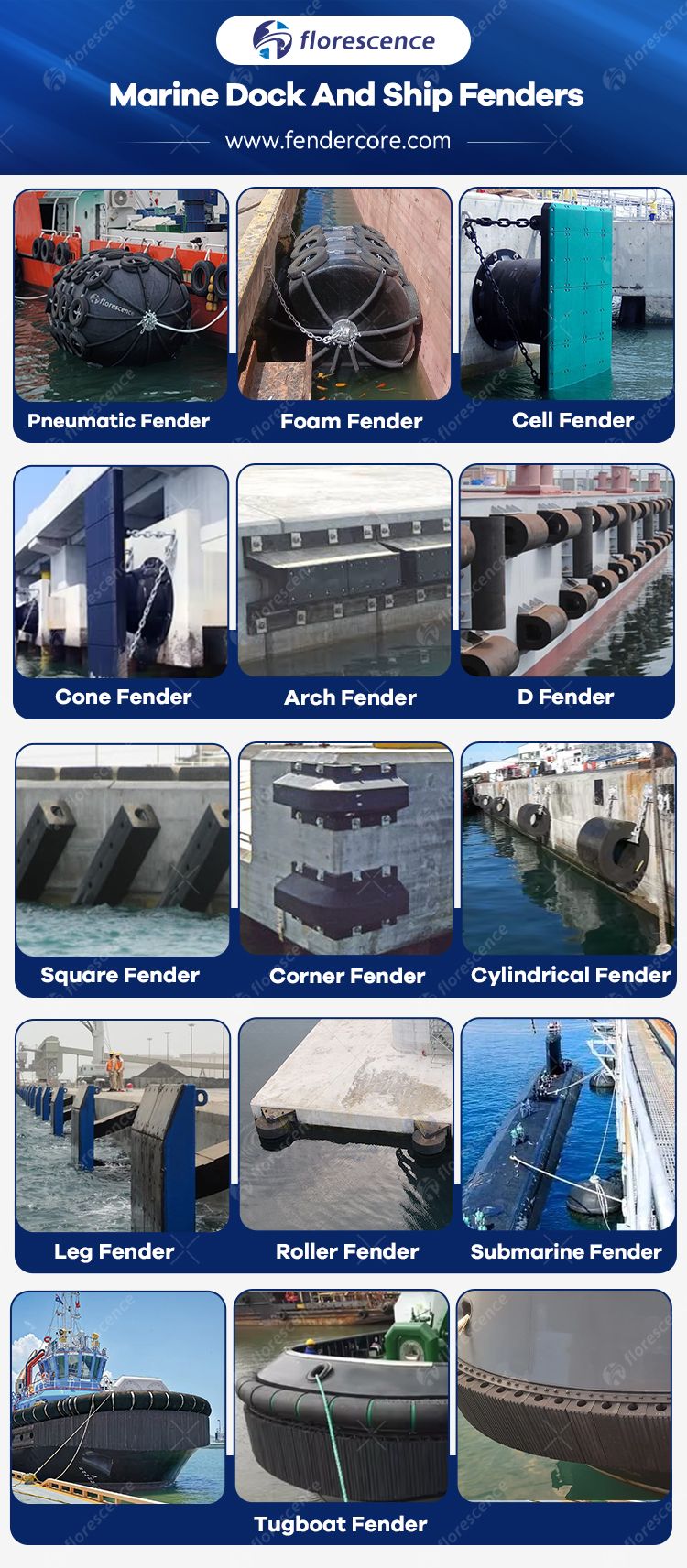
Dock and ship rubber fenders form the protective interface between a berthing vessel and a fixed structure.
A marine fender is the engineered interface between a moving vessel and a fixed berth, quay or another vessel. Its purpose is to absorb kinetic berthing energy, control the resulting reaction force, and protect both the hull and the berthing structure from impact, abrasion and structural damage. The global marine fender market, which covers rubber, foam and composite products, is projected to reach USD 0.89 billion in 2026, with rubber fenders accounting for approximately 64.17% of total marine fender market share.
That majority share is not incidental. Rubber fenders are the dominant technology in commercial ports, shipyards, terminals and naval operations because they combine predictable energy absorption, a wide range of geometries, and long service life in saltwater, UV and ozone-exposed environments. But “marine fender” is a category, not a single product. Under it sits a family of configurations — cone, cell, arch, cylindrical, D, W, square, pneumatic, foam-filled, roller — each designed for a specific combination of vessel size, berthing energy, hull profile, tidal range and berth structure.
For buyers in the Awareness and Research stage, the diagnostic question is not “which fender is best.” It is “which fender configuration matches my vessel, my berth and my operational conditions.” This guide frames that question and outlines the language, standards and evidence buyers should use when starting a fender evaluation.
What a Marine Fender Actually Does
Marine rubber fender systems protect vessel hulls and berthing facilities during berthing. In practice, three functions define the job of a fender:
- Energy absorption — convert the kinetic energy of a moving vessel into controlled elastic deformation.
- Reaction force management — keep the reaction force transmitted back into the hull and berth within design limits.
- Abrasion and stand-off control — maintain a safe distance between hull and structure, and prevent hard contact.
Fender performance is normally expressed through a load–deflection curve that relates deflection to energy absorption and reaction force. A well-selected fender absorbs the required energy at a deflection that stays within the system's rated working range, without exceeding the hull's allowable pressure or the mooring structure's design load.
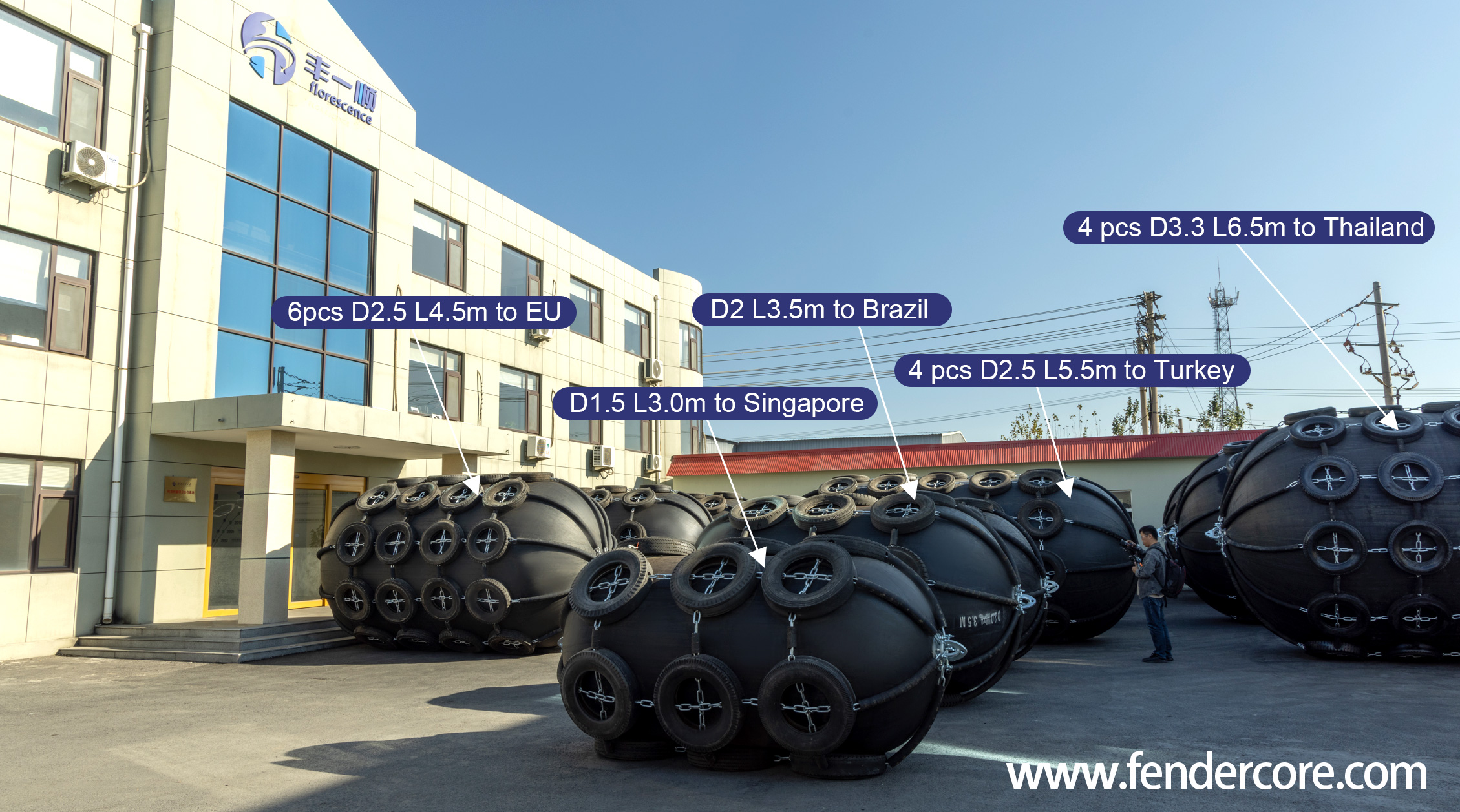
Pneumatic rubber fenders are a floating configuration used for ship-to-ship (STS), ship-to-quay (STQ) and ship-to-berthing (STB) applications.
Why Berthing Protection Is a Procurement Decision, Not an Accessory
Fender failure is expensive. Hull damage, quay damage and berth downtime are the visible costs, but the operational costs — emergency repair, port closure, insurance claims and exposure to port users — often exceed the hardware itself. As a result, fender selection sits inside a broader risk framework that includes vessel size and type, berth geometry, mooring layout, tidal variation, prevailing swell and wave exposure, and the frequency of contact.
Regulators and classification societies increasingly expect buyers to justify fender selection with reference to recognised design guidance. Three sources are commonly cited in the industry:
- ISO 17357-1:2014 — Ships and marine technology — Floating pneumatic rubber fenders — Part 1: High pressure. This standard specifies the requirements for high-pressure floating pneumatic rubber fenders (ISO, 2014).
- PIANC 2002 — guidance widely cited by suppliers for fender system design.
- Classification society rules — CCS, BV, RS, ABS and LR requirements are commonly referenced for product certification, testing and witness inspection on marine projects.
Two further reference points are useful for buyers. HS Code 4016.94 is the international trade classification for boat or dock fenders of vulcanised non-cellular rubber, whether or not inflatable — the code under which most rubber fender shipments are declared. The relevant UN Comtrade product description confirms that both inflatable and non-inflatable rubber fenders fall under the same classification family, which matters for customs classification and import documentation.
Types of Rubber Fenders: A Configuration Overview
The industry's most common fender configurations each address a different berthing problem. The following list reflects configurations that appear consistently in public supplier catalogs and marine fender literature.
| Fender Type | Typical Application | Design Note |
|---|---|---|
| Cone fender | Container, bulk, oil, LNG, RoRo, offshore terminals | Conical cell body, angular performance for oblique berthing, overload stops |
| Cell fender | Container, bulk, oil, LNG, RoRo, multi-user berths | Supports large panels, suitable for low hull pressure systems |
| Arch fender | RoRo berths, general cargo, workboat harbours, barge and tug berths | One-piece structural design, shear loading capability |
| Cylindrical fender | Bulk cargo berths, ferry terminals, fishing berths, pontoons, tug havens | Easy hanging mounting, suits large tidal variation |
| D fender | Tug side protection, inland terminals, marinas and shipyards | Lightweight, moderate reaction force, easy maintenance |
| W fender | Icebreakers, ocean-going tugs, bridge and pile protection | Twin-leg attachment, grooved surface for extra grip |
| Square fender | Marinas, small jetties, workboats, land loading docks | Multi-purpose fendering, available in PE pad form |
| Pneumatic rubber fender | STS, STQ, STB operations, offshore platforms, oil and gas tankers | Yokohama-type, floating anti-collision device, in use for approximately 50 years |
| Foam fender | Offshore, cruise, naval, bulk ports, marinas, large tidal piers | Solid foam core with polyurethane polyurea coating, unsinkable by design |
This is a starting map, not a shopping list. Within each configuration there are multiple sizes, hardness grades and compound options, and the selection outcome depends on the specific berthing energy calculation.
Technical Basics: Energy Absorption, Deflection and Reaction Force
Fender engineering balances three linked variables:
- Energy absorption (E) — the energy the fender must absorb during berthing, typically calculated from vessel displacement, approach velocity and a berthing coefficient.
- Deflection (δ) — how much the fender compresses. Each product type has a rated design deflection and a maximum permissible deflection. For example, cone fenders commonly operate at a rated deflection of around 70%, while cell and arch fenders are typically rated closer to 52.5%.
- Reaction force (R) — the force transmitted back into the hull and berth. The tolerance on reaction force for most marine rubber fenders is around ±10%, with a corresponding −10% tolerance on energy absorption.
Rubber compound specification matters as much as geometry. Standard marine fenders are commonly produced from natural rubber (NR) or a natural / styrene-butadiene rubber (NR/SBR) compound, with hardness in the range of Shore A 60 to 75. Optional compounds such as CR (chloroprene rubber) can be specified for oil resistance, and EPDM can be specified for UV and ozone resistance. Operating temperature ranges commonly span −30 °C to +80 °C, with some projects requiring low-temperature resistance down to −40 °C for arctic or extreme cold service.
The practical takeaway for buyers is that fender “size” alone does not describe performance. Two fenders of identical height and length can have materially different energy absorption and reaction force behaviour depending on the rubber compound, geometry and internal structure.
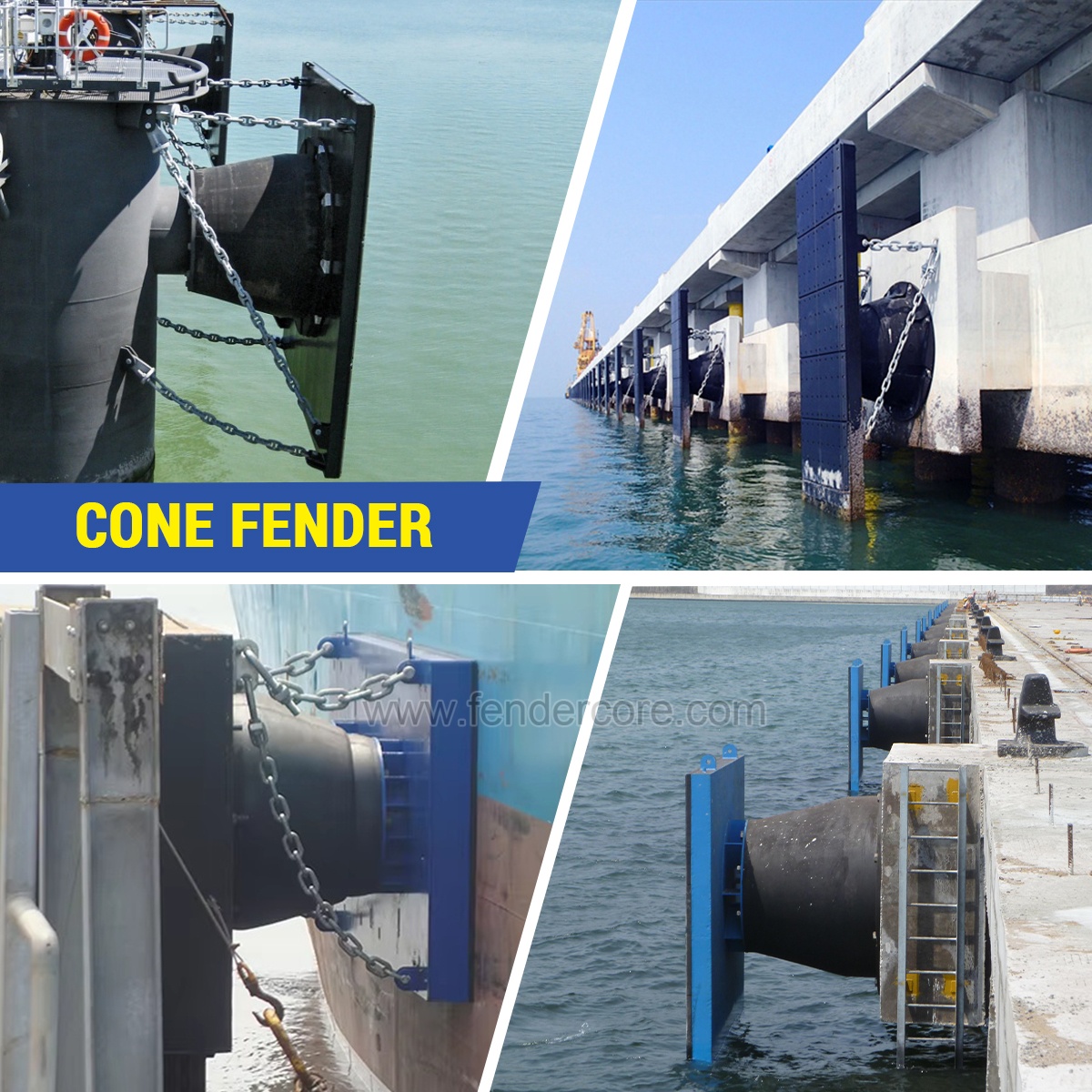
A cone rubber fender configuration used at container, bulk and RoRo berths.
Where Marine Fenders Are Used
Marine fender systems appear across a wide range of marine infrastructure and vessel operations, and configuration choice is usually driven by the application.
- Commercial ports and container terminals — cell and cone fenders are the mainstream choice, selected for high energy absorption and suitability for large-tonnage vessel berthing.
- Oil, LNG and bulk terminals — high-performance cell and cone fenders, plus pneumatic or foam fenders for transfer and mooring operations.
- RoRo and ferry terminals — arch, cell and cylindrical fenders handle frequent, multi-angle contact.
- Tugboats and workboats — D, W and cylindrical (tug) fenders, designed for pushing, standing, stretching and leaning operations.
- Icebreakers and offshore vessels — W fenders and pneumatic fenders selected for extreme conditions and hull contour fit.
- Ship-to-ship (STS) operations — floating pneumatic and foam fenders are commonly used for transfers between vessels at sea, especially where tidal or wave conditions prevent a fixed fender solution.
- Shipyards, dry docks and inland waterways — square, D and cylindrical fenders for jetties, lock gates, canal walls and small-to-medium vessel berths.
- Naval operations — fenders have been supplied to naval organisations including the Bangladesh Navy, French Navy, Royal Thai Navy, Italian Navy and Philippine Navy.
Market Trends Shaping Fender Demand
Three structural trends are visible in publicly available marine fender data:
1. Rubber remains the dominant technology. Rubber fenders hold roughly 64.17% of the total marine fender market by type. Foam and composite alternatives continue to gain specific use cases — particularly for STS transfers, existing structures and hull types that pneumatic systems do not suit — but rubber remains the engineering baseline against which other options are measured.
2. Port infrastructure investment is a primary demand driver. New container and bulk berth construction across Asia-Pacific, the Middle East and Africa continues to require fender systems as part of the berthing package. Replacement and refurbishment of existing berths is a secondary, but growing, stream.
3. Standardisation and classification oversight are tightening. ISO 17357-1:2014 provides a clear technical reference for pneumatic fenders, and PIANC guidance remains the working reference for fender system design. Buyers increasingly request third-party witness testing and material traceability, particularly on public-sector and naval projects.
Comparing Fender Design Choices — and Where Each Approach Has Limits
Fender selection is not a search for a single “best” product. Each design has trade-offs.
| Design Approach | Strengths | Limitations |
|---|---|---|
| Fixed rubber fenders (cone, cell, arch, D, W, cylindrical, square) | Predictable performance, long service life, low maintenance, wide configuration range | Require installation at fixed berths; not suitable for ship-to-ship operations; reaction force depends on exact berth geometry |
| Floating pneumatic and foam fenders | Portable, suit STS and STQ operations, work where tidal range is extreme | Floating fenders require pressure management (pneumatic) or careful handling of a large coated body (foam); reaction force can vary with internal pressure and sea state |
| Older fixed fender installations | Already installed; legacy design basis | May predate current PIANC and classification guidance; replacement and expansion options can be constrained by existing anchor bolt layouts |
One honest limitation applies across this entire category: publicly available, independently verified performance data for marine rubber fenders is thin. Energy absorption curves, durability data and failure-rate statistics are frequently company-reported rather than independently validated. Buyers should treat manufacturer specifications as a starting point, and ask for physical test evidence — compression test reports, material test reports, dimension inspection records, and where applicable, classification society witness testing — before awarding an order.
Where Florescence Fits in the Marine Fender Landscape
Qingdao Florescence Marine Supply Co., Ltd. (Florescence) is a marine rubber fender manufacturer established in 1992 in Qingdao, China. The company operates a 40,000 m² manufacturing facility with approximately 120 employees, and produces about 2,000 pieces of marine rubber fenders and airbags per year. Its main products include pneumatic rubber fenders, various dock fenders, ship fenders, foam fenders, and ship launching and salvage rubber airbags.
From a buyer's perspective, three aspects of the Florescence profile are relevant during the Research stage:
- Product breadth. The company supplies cone fenders, cell fenders, arch fenders, cylindrical fenders, D fenders, tugboat fenders, foam filled fenders, pneumatic fenders, W type fenders, and square fenders. This lets buyers match configuration to application instead of adapting a single product type.
- Quality and certification framework. Products are designed, manufactured and tested in accordance with ISO 9001:2015 quality management requirements. Products can be manufactured and inspected according to applicable requirements of leading marine classification societies, including CCS, BV, RS, ABS, and LR, based on specific project requirements.
- Export and project experience. Approximately 95% of products are exported, serving Southeast Asia, South America, Europe, North America, the Middle East and Africa. Products have been supplied to naval organisations including the Bangladesh Navy, French Navy, Royal Thai Navy, Italian Navy and Philippine Navy — experience that typically comes with project-specific inspection, documentation and delivery requirements.
Florescence provides technical support covering product and specification selection, manufacturing, inspection, delivery, and installation guidance. For buyers evaluating a fender supplier, the relevant questions are not simply “what products do you offer” but “how do you calculate the correct fender for my berth, and what evidence do you provide to support that calculation.”
Future Outlook
Three developments are likely to shape marine fender procurement over the next five years:
- Tighter verification expectations. As buyers become more familiar with ISO 17357-1:2014 and PIANC guidance, demand for third-party witness testing, material traceability and dimensional verification is likely to increase, especially on publicly funded and naval projects.
- Continued dominance of rubber, with growing niche alternatives. Rubber fenders will remain the primary technology for fixed berths. Foam and composite fenders will continue to expand in STS operations, exposed offshore locations and vessel types — such as catamarans and cruise ships — whose hull geometry or service profile does not suit traditional pneumatic systems.
- Regional demand shifts. Port construction and expansion across Asia-Pacific, the Middle East and Africa remains an active driver of fender demand, with replacement demand in mature ports in Europe and North America forming a steady second stream.
For buyers, the practical implication is that fender selection will increasingly be judged against documented design inputs and verifiable test evidence — not product marketing language.
Frequently Asked Questions
What is a marine fender and what is it used for?
A marine fender is a protective device installed on a vessel, berth or quay to absorb the kinetic energy of a berthing vessel and reduce the reaction force transmitted into the hull and structure. Marine rubber fender systems protect vessel hulls and berthing facilities during berthing, and are used across ports, shipyards, offshore facilities, marine engineering and naval applications.
Which marine fender types are available?
Common marine fender types include cone fenders, cell fenders, arch fenders, cylindrical fenders, D fenders, tugboat fenders, foam filled fenders, pneumatic fenders, W type fenders, and square fenders. Each configuration is designed for a different combination of vessel size, berthing energy, hull geometry and berth type. Floating pneumatic and foam fenders serve ship-to-ship (STS) operations and locations with extreme tidal variation.
What is the difference between cell fenders and cone fenders?
Cell fenders are cost-effective and suitable for general berths, while cone fenders provide higher energy absorption efficiency and lower reaction force for large vessels. Cell fenders also support large panels and are suitable for low hull pressure systems, while cone fenders are designed with angular performance characteristics for oblique berthing contact.
How do you select a suitable marine fender for a berth?
Fender selection depends on vessel size, berthing energy, tidal variation, berth structure, and operational conditions. The calculation normally begins with the vessel's displacement and approach velocity, then evaluates candidate fender configurations against required energy absorption, allowable reaction force and the berth's structural design loads. Where tidal variation is large, or where contact is multi-angle, the selection logic shifts toward cylindrical, pneumatic or foam configurations.
Do marine fenders need to comply with a standard?
ISO 17357-1:2014 specifies the requirements for high-pressure floating pneumatic rubber fenders and is the standard most frequently referenced for this product category. For fender system design, PIANC 2002 is the working guidance cited by many suppliers. Classification societies such as CCS, BV, RS, ABS and LR may also apply certification, testing and witness inspection requirements on specific projects. Buyers should confirm the applicable standard and certificate scope with the supplier before finalising a specification.
How is marine fender quality verified before shipment?
Typical pre-shipment quality checks include rubber raw material testing, dimensional inspection and hardness checks for rubber fenders, and air-tightness testing for pneumatic fenders and ship airbags. Third-party inspection by organisations such as SGS, Bureau Veritas (BV) and LR is commonly used on marine fender and steel structure projects. Material test reports and physical property reports (tensile strength, elongation, compression) are typically requested for traceability.
How are marine fenders shipped internationally?
Marine fenders are usually shipped by sea freight, with LCL and FCL options depending on order size; air freight is used for smaller, urgent shipments. Packing is optimised to reduce transportation costs and improve loading efficiency — pneumatic fenders are typically shipped deflated, and heavy rubber fenders such as arch and cone units are bundled on pallets. Export documentation typically includes the commercial invoice, packing list, bill of lading and certificate of origin for customs clearance.
For a fuller overview of product specifications and configurations, the Florescence 2026 marine fender catalogue is available for download.