
Match Your Eyewash Station to the Work Environment
Industry reference | Security & Protection | Emergency wash equipment
An eyewash station only works if it is matched to the conditions where it is installed. Freezing temperatures can disable a plumbed unit, corrosive atmospheres can degrade standard materials, and sites without a fixed water supply cannot use pipe-fed equipment at all. The selection logic starts with the work environment, not with the product catalog.
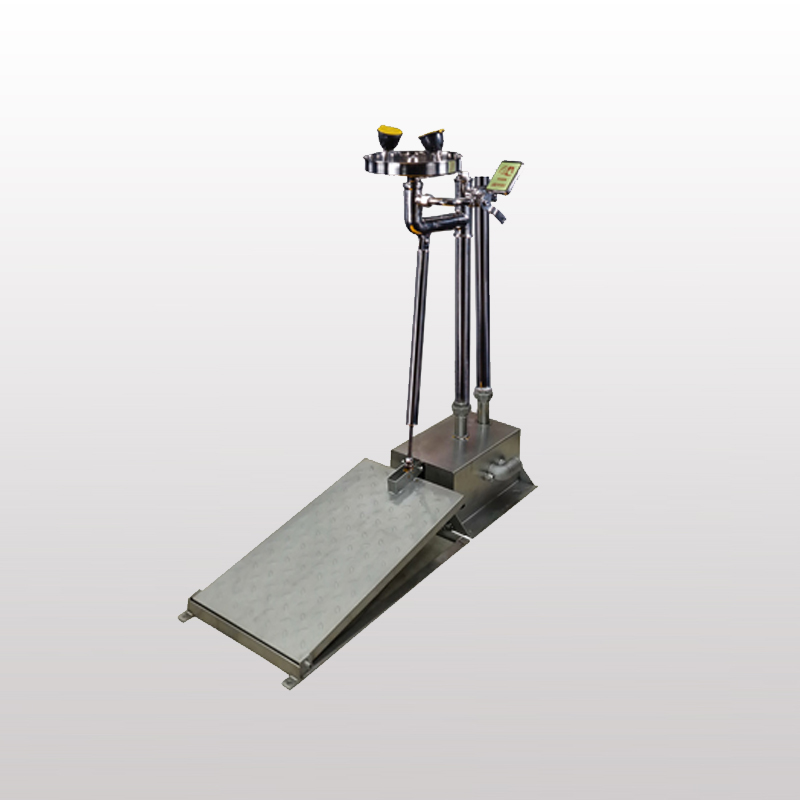
Start with the Work Environment, Not the Catalog
Shanghai Bohua Safety Device Co., Ltd. (BOHUA) is a Shanghai-based manufacturer specializing in the R&D, production, and sales of emergency eyewash and shower equipment. Founded in 2006, the company reports a factory area of 4,000 m², 50 employees, an annual output of 20,000 units, and a five-person R&D team. Its product range covers 11 series and more than 100 types of eyewash, which is why matching the right unit to the right site is a practical engineering task rather than a catalog-picking exercise.
From a buyer's perspective, the core question is not whether an eyewash station meets a standard in a datasheet, but whether it will still operate when an incident occurs. Site variables such as temperature, airborne chemicals, dust, water supply, and power availability determine which configuration is worth specifying. This article frames the decision as a project-level matching problem: which equipment series fits which working condition, and what evidence supports that choice.
Why a Standard Unit Can Fail Where the Site Is Harsh
Compliance standards set the minimum performance bar. In the United States, ANSI/ISEA Z358.1-2014 requires an eyewash station to deliver 0.4 gallons per minute (about 1.5 L/min) of flushing fluid for at least 15 minutes. In Europe, the EN 15154 series regulates emergency safety showers, with Part 2 specifically covering plumbed-in eyewash units. However, a unit that meets flow and activation requirements can still fail in service if the site itself is not considered.
- Freezing temperatures: Standing water in pipes, valves, and shower heads can freeze in winter, blocking the emergency water flow when it is needed most. Outdoor installations in cold climates therefore require freeze protection.
- Corrosive atmospheres: In chemical plants, battery manufacturing facilities, and petrochemical sites, acid or alkali splashes can corrode poorly protected surfaces and fittings. Material selection becomes a functional requirement, not an aesthetic choice.
- Dusty environments: Fine dust and airborne particles can enter uncovered spray heads, clogging or contaminating the flushing fluid path. Anti-dust covers help maintain readiness in these settings.
- Sites without plumbing: Remote work zones, temporary plants, and outdoor maintenance areas may have no reliable water line. Portable self-contained units are the only practical option there.
- Project type: A new plant construction, an EHS safety retrofit, and a laboratory upgrade each involve different installation constraints, which affect whether a wall-mounted, floor-mounted, or portable unit is appropriate.
These conditions are not rare. Dataintelo estimates that industrial applications, including chemical and manufacturing, account for roughly 35.7% of global eyewash station revenue. In practice, most industrial buyers need a station that is designed for a specific environment, not a generic unit that merely exists on paper.
Matching BOHUA Series to Work Conditions: a Field Map
BOHUA has built its product architecture around the conditions that industrial and laboratory sites actually present. The following table maps common work conditions to the corresponding series and representative models.
| Work condition / project need | Recommended BOHUA series | Representative models | Key specifications |
|---|---|---|---|
| Low temperature / outdoor winter installation | Anti-freeze series; Electric heat tracing series | BH32-5012, BH32-5012A, BH30-1062, BH32-1062 | Eyewash flow ≥1.5 L/min; activation within 1 second; heat trace 48 W/m at 220 V |
| Corrosive atmosphere / chemical exposure | Compound series in stainless steel | BH30-1010 (304/316 SS), BH30-2012, BH30-1316 (316 SS) | Shower flow 120–180 L/min; eyewash ≥1.5 L/min; 304 or 316 stainless steel |
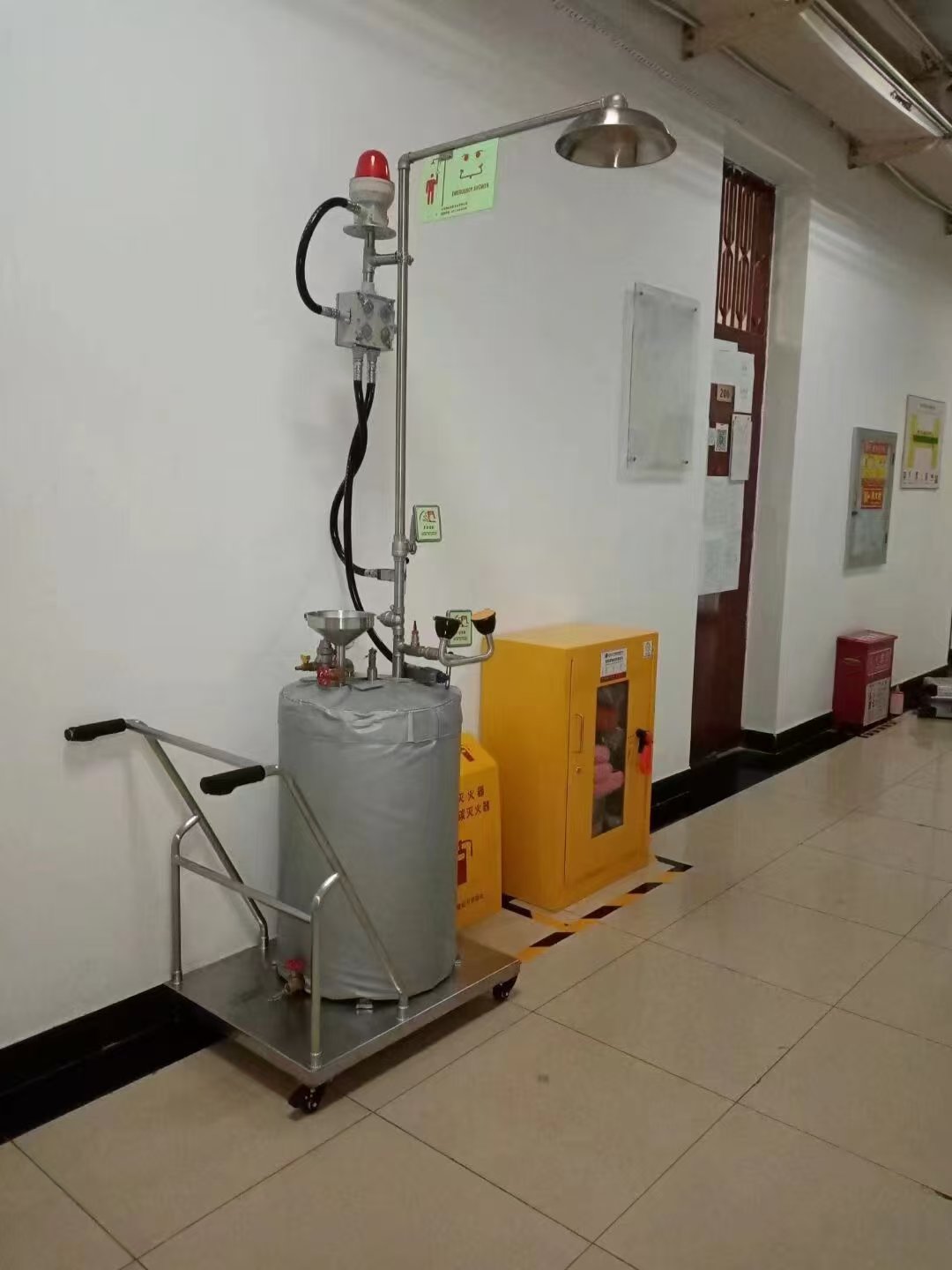
| No fixed plumbing / remote or temporary site | Portable series | BH34-0628 (28 L), BH34-0665F (65 L) | 304 SS tank; eyewash ≥1.5 L/min; floor-mounted with push handle |
| Indoor laboratory / normal temperature | Wall mounted, desktop, and vertical series | BH33-1010, BH33-1011, BH35-1011, BH32-1011 | DN32; eyewash ≥1.5 L/min; sprinkler spacing 101.6 mm; activation within 1 second |
| Full-body and eye decontamination | Compound series (shower + eyewash) | BH30-1010, BH30-2011, BH30-1011L | Total height 2480 mm; shower head height 2100 mm; eyewash height 1050 mm |
The mapping is not exclusive. A chemical plant may need a corrosion-resistant combination unit, while a pharmaceutical laboratory may only need a wall-mounted or desktop eyewash. The value of a broad product family is that each site can be specified without forcing a single design into conditions it was not built for.
How Freeze Protection, Materials, and Activation Are Engineered
To make the field map operational, buyers should understand the technical mechanisms behind the main product differences.
Freeze protection for cold climates
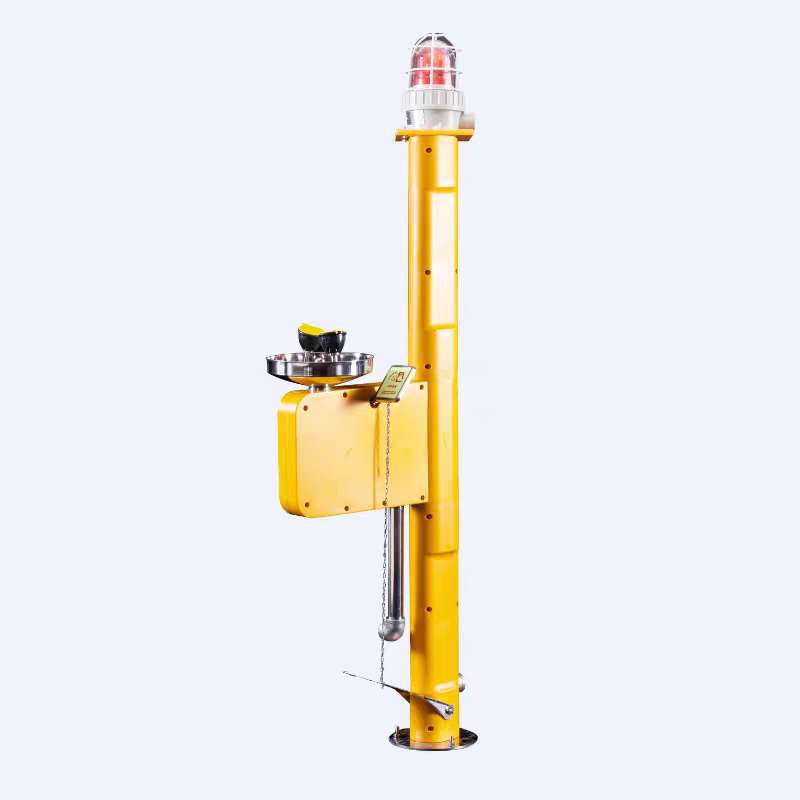
BOHUA offers two distinct approaches to low-temperature installations. The anti-freeze series, including the vertical eyewash models BH32-5012 (large pedal) and BH32-5012A (small pedal), is listed specifically for low-temperature environments requiring freeze protection. The electric heat tracing series goes further: models such as the BH32-1062 vertical eyewash and BH30-1062 combination shower and eyewash use a heat trace system rated at 48 W/m with a 220 V supply. These units carry explosion-proof ratings of EXD II BT4, BT6, CT4, and CT6, and protection levels of IP54, IP56, and IP65, which makes them suitable for hazardous areas in cold outdoor plants.
For more extreme conditions, BOHUA also lists an electric heating series operating at 380 V with a power rating of 15 kW, such as the BH32-1062B vertical eyewash. The choice between heat tracing and full electric heating depends on the site's electrical supply, ambient temperature, and the length of piping that needs protection.
Material selection for corrosive and demanding atmospheres
BOHUA's compound emergency shower and eyewash units are available in different material grades. The BH30-1010 is constructed in 304/316 stainless steel, the BH30-2012 in 304 stainless steel, and the BH30-1316 is listed as a 316 SS compound unit. Stainless steel grades resist corrosion from acid or alkali splashes far better than painted carbon steel in aggressive chemical environments. Spray heads use PP + 304 filter elements, and certain models are fitted with 304 filters, to prevent debris from reaching the eyes during flushing.
In dusty environments, the fixed soft rubber anti-dust cover keeps the spray head clean between uses. The two-piece ball valve provides reliable shutoff and maintenance access. The cow-horn bend allows adjustable flow direction, and the sprinkler spacing of 101.6 mm corresponds to the standard spacing required for effective simultaneous flushing of both eyes.
Rapid activation and flow performance
Emergency wash equipment is only useful when it activates instantly. BOHUA's product description states that emergency water flow is activated within one second. Eyewash flow is rated at ≥1.5 L/min, which is equivalent to the 0.4 gallons per minute required by the ANSI/ISEA Z358.1-2014 standard. Shower flow for combination units is rated at 120–180 L/min. A luminous aluminum alloy indicator is available on several models, helping personnel locate the station in dark or smoky conditions. The water discharge range is specified as 508 mm at a distance of 1,524 mm from the surface, which supports consistent full-body wetting during a shower.
Procurement note: One of the most useful flow calculations for buyers is tank autonomy. BOHUA's portable model BH34-0628 has a 28 L tank. At the minimum eyewash flow of 1.5 L/min, this provides roughly 18 minutes of continuous flushing, exceeding the 15-minute ANSI requirement. The BH34-0665F model increases tank capacity to 65 L, which extends runtime for longer exposure scenarios.
Deployed in Chemical Plants, Labs, and Cold Outdoor Sites
BOHUA's application data covers chemical plants, pharmaceutical factories, laboratories, petrochemical facilities, battery manufacturing plants, and university research labs. These sites share a common need: immediate eye and body decontamination in the event of corrosive chemical splashes. The operating conditions range from high temperature to low temperature, corrosive atmospheres, dusty environments, and normal-temperature indoor laboratories.
The project types that drive purchasing include EHS (Environment, Health & Safety) systems, emergency response stations, chemical safety retrofits, new plant construction, and laboratory safety upgrades. For these projects, operation is typically designed around push plate activation for the shower, push-flag or handle activation for the eyewash, pull-chain activation for the shower, and hands-free stay-open valves for the eyewash. These activation modes reduce the risk that a panicked worker will struggle to operate the unit during an emergency.
A documented ODM case illustrates how a cold-climate facility approached year-round compliance. A Chinese client ordered 15 electric heat tracing shower and eyewash units, model BH30-1062, specifically to keep the facility legally compliant throughout the year in cold weather. The units have been in use for five years, and the client reports reliable, compliant, and safe emergency response. The case is a practical example of how freeze protection becomes a compliance issue rather than a convenience feature.
Market Signals for Application-Specific Eyewash Equipment
Third-party market research supports the growing importance of application-specific design. Spherical Insights valued the global emergency shower and eyewash station market at approximately USD 417.3 million in 2024, with North America representing about USD 145.1 million. Transparency Market Research projects that the market will reach USD 713.4 million by 2035, growing at a CAGR of 4.7% from 2025. Dataintelo further estimates that portable eyewash stations hold approximately 38.2% of the market due to demand from remote and non-plumbed sites.
The competitive landscape is dominated by well-known international brands. Cognitive Market Research identifies Haws Corporation, Bradley Corporation, Guardian Equipment, and Speakman as the top global competitors. These brands are widely specified in North American and European projects. BOHUA occupies a different position in the supply chain: it is an OEM/ODM manufacturer exporting to the EU, the Middle East, Australia, and Africa, with a monthly capacity of 1,000 units, a 30-day lead time, and a minimum order quantity of 5 units. For buyers running mid-sized projects or seeking customized configurations, this model offers a practical alternative to sourcing from large fixed-product-line manufacturers.
Condition-Engineered vs. Conventional Units: Where the Boundaries Are
Compared with a conventional, specification-minimum eyewash station, a condition-engineered unit provides measurable protection across freezing, corrosive, dusty, and unplumbed sites. The trade-off is not only price; it is also system complexity.
Electrically heated and heat-traced models require a power supply, either 220 V or 380 V, and should be installed with qualified electrical work. A plant without reliable power at the installation point may need to weigh the cost of running a dedicated circuit. Portable units solve the unplumbed-site problem, but they carry a finite water volume; the 28 L tank meets the 15-minute standard for eye flushing, yet a site with longer exposure risks or the need for full-body decontamination should specify the 65 L portable model or a plumbed combination shower and eyewash.
Buyers should also verify certification scope per model and destination. BOHUA states that its products have passed certification under ANSI Z358.1-2014, CE EN 15154-1:2006, and China Classification Society (CCS), and that the company holds ISO 9001:2008, ISO 14001:2004, and OHSAS 18001:2007 management system certifications. However, certification versions should be checked against the exact model and the relevant requirements of the project country, especially here standards are periodically updated. Finally, BOHUA's stated export coverage is concentrated in the EU, the Middle East, Australia, and Africa; projects in North America should verify local distribution and after-sales service arrangements, since remote support is the stated standard after-sales mode.
Toward Integrated, Site-Specific Safety Equipment
Looking ahead, eyewash stations are becoming more integrated with plant safety instrumentation rather than remaining passive plumbing fixtures. BOHUA's OEM/ODM capabilities already include customizable acoustic and optical alarms, lighting, DCS signal upload, electrical heating, cooling, and skid-mounted systems. These options indicate where the market is moving: emergency wash units are being designed as part of a facility's broader safety and monitoring architecture.
The operating conditions described in BOHUA's product application data—high temperature, low temperature, corrosive atmosphere, dust, and normal indoor lab environments—are likely to remain the core specification drivers. In parallel, the availability of explosion-proof ratings such as EXD II BT4/CT4 and protection levels up to IP65 will continue to matter in oil, gas, and petrochemical projects. For procurement teams, the practical implication is that the lowest-cost standard unit is rarely the lowest total-cost solution when site conditions demand freeze protection, corrosion resistance, or unplumbed operability.
Frequently Asked Questions
What type of eyewash station is suitable for outdoor installation in freezing temperatures?
For low-temperature environments requiring freeze protection, BOHUA offers anti-freeze vertical eyewash models (BH32-5012 and BH32-5012A) and electric heat tracing shower and eyewash combinations (BH30-1062 series). The electric heat tracing models operate at 220 V with a heat trace power of 48 W/m and carry explosion-proof ratings of EXD II BT4, BT6, CT4, and CT6 with IP54, IP56, or IP65 protection.
What is the difference between electric heated and electric heat traced eyewash stations?
BOHUA's electric heat tracing series operates at 220 V with a heat trace power of 48 W/m, while the electric heating series operates at 380 V with a power rating of 15 kW. Both ranges are available with explosion-proof ratings—EXD II BT4/CT4 for the heating series, and EXD II BT4/BT6/CT4/CT6 for the heat tracing series—and protection levels of IP54, IP56, or IP65. The choice depends on the site's electrical supply, ambient temperature, and piping layout.
When should a portable emergency shower and eyewash be used instead of a plumbed-in unit?
Portable units are appropriate for remote sites, temporary work zones, and facilities without a fixed plumbing network. BOHUA's portable shower and eyewash model BH34-0628 uses a 28 L 304 stainless steel tank, while the BH34-0665F carries a larger 65 L tank. The eyewash flow rate is ≥1.5 L/min, and activation starts within one second.
What material is recommended for eyewash stations in corrosive chemical atmospheres?
BOHUA produces combination emergency shower and eyewash units in 304 stainless steel (for example, BH30-2012) and in a 304/316 stainless steel version (BH30-1010). A unit listed as 316 stainless steel, the BH30-1316, is also available. In corrosive environments, the steel grade should be matched to the specific chemical exposure and verified for material compatibility.
Which combination shower and eyewash unit suits a chemical plant EHS retrofit?
A floor-mounted combination shower and eyewash unit is commonly used in chemical plant EHS systems. BOHUA's compound series, including BH30-1010, BH30-2011, and BH30-2012, provides shower flow of 120–180 L/min and eyewash flow of ≥1.5 L/min, with activation within one second. Several models include a luminous aluminum alloy indicator for visibility in emergency conditions.
Can one eyewash model operate in both high-temperature and corrosive conditions?
BOHUA's product description states that its equipment is designed for low-temperature environments requiring freeze protection and can operate under high-temperature and corrosive atmosphere conditions. Certification and model-specific material selection should still be confirmed against the actual chemical and thermal exposure at the installation site.
What are the lead time and minimum order quantity for a project-specific eyewash configuration?
For OEM/ODM projects, BOHUA states a monthly capacity of 1,000 units, a lead time of 30 days, and a minimum order quantity of 5 units. Customizable features include acoustic and optical alarms, lighting, DCS signal upload, electrical heating, cooling, and skid-mounted systems. All units are reported to undergo 100% testing before delivery.
For a full overview of the BOHUA product range and manufacturing capabilities, the company's corporate brochure is publicly available: Download the BOHUA brochure (PDF).
Tem questões ou precisa de mais detalhes?
Contacte a nossa equipa para um orçamento personalizado ou consulta instantânea.
Solicitar orçamento
Preencha o formulário abaixo e a nossa equipa entrará em contacto com uma proposta personalizada.
Chat direto do WhatsApp
Prefere conversar em tempo real? Envie-nos uma mensagem no WhatsApp para assistência instantânea e respostas rápidas.
- Obter orçamento personalizado
- Partilhar fotos ou documentos
- Discuta as suas necessidades diretamente
Geralmente responde em 5–30 minutos durante o horário de expediente.