
Matcha Powder Qualification Checklist: Non-GMO, Additive-Free, ISO, HACCP, Kosher and HALAL
Matcha Powder Qualification Checklist: Non-GMO, Additive-Free, ISO, HACCP, Kosher and HALAL
Matcha powder has moved from a specialty tea input into a mainstream functional ingredient for supplements, beverages, and clean-label food products. That shift has changed what buyers evaluate. Price and color remain part of the sourcing conversation, but procurement teams in regulated markets increasingly begin with a different question: which qualification documents can this supplier actually produce?
This checklist is written for that question. It is not a processing guide, and it does not rank suppliers. It sets out the compliance evidence a buyer should request before placing a matcha powder order, organized around the six areas that dominate supplier questionnaires: natural and non-GMO positioning, additive-free claims, heavy-metal and pesticide-residue testing, and the stated ISO, HACCP, Kosher, and HALAL certifications.
Guanjie Biotech, a Shaanxi-based ingredient manufacturer founded in 2004, illustrates how a supplier's documentation set can be mapped against that checklist. The company lists matcha powder (Grade 1–Grade 6) among the products associated with its certifications and holds four food-relevant certificates that appear in the qualification files buyers typically request.
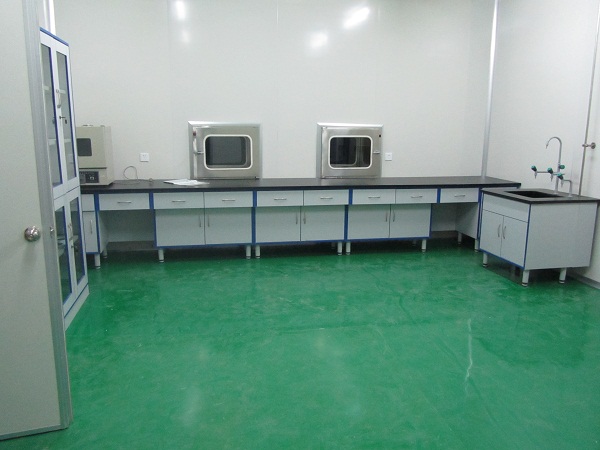
Quality testing is the operational counterpart to a document-based matcha powder qualification file.
Why Matcha Powder Qualification Is a Documentation Exercise
Two suppliers can both describe a matcha powder as "natural" or "tested." Only one may be able to attach a current certificate, a batch-specific COA, and a third-party test report to that description. For a buyer, the difference matters most at the point of audit or market entry, when a claim without a document becomes a procurement risk.
The checklist approach has three practical advantages over a general supplier review. It converts claims into document requests, so the buyer knows what to ask for rather than what to believe. It separates product attributes (non-GMO, additive-free) from system certifications (ISO 9001, HACCP) and religious certifications (Kosher, HALAL), which are verified through different channels. And it makes certificate validity a live issue rather than a one-time check, because several certification cycles expire within months rather than years.
For matcha specifically, the qualification path is complicated by the product's position as both a food and a functional ingredient. A buyer sourcing matcha for a capsule or sachet may face a different evidence expectation than a buyer sourcing it for a beverage or a bakery application. The checklist below is designed to be adapted to the destination market rather than applied uniformly.
The Six-Part Qualification Checklist
A practical matcha powder qualification file covers six evidence categories:
- Product identity and positioning: natural, non-GMO, and additive-free declarations.
- Safety testing: heavy metals and pesticide residues.
- Quality management system: ISO 9001.
- Food safety system: HACCP.
- Kosher certification.
- HALAL certification.
Each category answers a different buyer question and is verified through a different type of document. Treating them as one "certification bundle" is a common purchasing error, because a supplier that holds a quality certificate may still lack ingredient-specific test data, and a supplier with strong lab reports may hold a certificate whose scope does not cover the product being purchased.
1. Product Identity: Natural, Non-GMO, and Additive-Free Claims
The first qualification question is what the product actually is. For matcha powder, buyers in clean-label and supplement markets typically ask for three positionings: 100% natural, non-GMO, and additive-free.
Guanjie Biotech presents its matcha powder within that positioning framework. For the buyer, the task is to convert each positioning into a requestable document:
- Natural. Request a statement of composition and a declaration that no synthetic colors, carriers, or processing aids have been added. "Natural" has no single global legal definition, so the buyer should ask what the supplier means by the term and how the product meets it.
- Non-GMO. Request a signed non-GMO declaration tied to the specific product and batch. Where the destination market requires it, ask for evidence on the source material. A general statement that a product "contains no GMO ingredients" is less useful than a product-specific declaration.
- Additive-free. Request a full ingredient list and confirmation that no anti-caking agents, flowing agents, or diluents are present. This matters most for buyers formulating capsules or sachets, where a "pure" powder is often assumed rather than verified.
The purpose of these requests is not to challenge the supplier's positioning. It is to create a record that a quality team, a regulator, or a retail customer can review later. A positioning claim that cannot be traced to a document is difficult to defend during an audit.
2. Safety Testing: Heavy Metals and Pesticide Residues
Botanical powders carry a testing burden that many buyers underestimate. Matcha is derived from tea leaves, and tea leaves can accumulate metals from soil and can retain pesticide residues from cultivation. For supplement and food applications, two test categories sit at the center of the qualification file: heavy metals and pesticide residues.
Heavy metals
A matcha powder COA should report results for at least lead, cadmium, arsenic, and mercury. The buyer should check three things: the test method, the reporting limit, and whether the results are batch-specific. A COA that lists "heavy metals: compliant" without values is not equivalent to one that reports each element against a stated limit.
Pesticide residues
Pesticide testing is typically reported as a multi-residue screen. The buyer should confirm which residue panel was used, whether the panel matches the destination market's expectations, and whether the report comes from an accredited laboratory. A supplier's internal statement of "rigorous testing" should be supported by an actual report rather than accepted as a substitute.
Guanjie Biotech's stated quality-control position is 100% testing. Its after-sales documentation includes a batch COA with each shipment and support for third-party re-testing through laboratories such as SGS and Eurofins when a discrepancy arises. For a buyer, that combination is more useful than a single test claim, because it describes both the routine document (COA) and the escalation path (third-party re-test).
The limitation to keep in view is that test reports describe the batch tested, not every future batch. Qualification should therefore include a batch-release procedure, not only a one-time report review.
3. Quality Management: ISO 9001:2015
ISO 9001 addresses the supplier's quality management system rather than the matcha powder itself. It tells a buyer that the supplier operates a documented quality process covering areas such as document control, supplier management, and corrective action.
Guanjie Biotech holds ISO 9001:2015 certification:
- Certificate number: 00123Q310086R0S/6100
- Certification body: China Quality Certification Centre (CQC)
- Scope: Export Trade of Plant Extracts, Solid Beverages, and Food Additives
- Issue date: 2023-12-07
- Expiry date: 2026-12-06
Two points deserve attention. First, the scope covers export trade of plant extracts, solid beverages, and food additives, which is the activity a matcha buyer is evaluating. Second, the certificate expires on 2026-12-06. At the time of this checklist, that date is close enough that a buyer should ask for confirmation of renewal or recertification before relying on the certificate for a shipment scheduled after that date.
ISO 9001 should not be read as proof that a specific matcha batch meets a heavy-metal limit. It is a system certificate, and the batch-level evidence comes from the COA and test reports described earlier.
4. Food Safety: HACCP Certification
HACCP focuses on hazard analysis and critical control points in food production. For a matcha buyer, HACCP certification supports the expectation that biological, chemical, and physical hazards have been identified and controlled within a documented system.
Guanjie Biotech holds HACCP certification:
- Certificate number: 001HACCP2301048
- Certification body: China Quality Certification Centre (CQC)
- Standard: Hazard Analysis and Critical Control Point (HACCP) System Certification Requirements (V1.0)
- Scope: Export trade of plant extracts, solid beverages and food additives
- Issue date: 2023-12-06
- Expiry date: 2026-12-05
As with ISO 9001, the scope aligns with the product category, and the expiry date falls in early December 2026. A buyer preparing a purchase for the first quarter of 2027 should request evidence of the renewed certificate rather than assume continuity.
HACCP and ISO 9001 are complementary but not interchangeable. ISO 9001 describes quality management; HACCP describes food safety controls. A qualification file that contains only one of the two leaves a gap that a food-safety auditor may flag.
5. Kosher Certification
Kosher certification matters to buyers serving Jewish markets and to buyers whose retail or formulation customers require kosher-compatible ingredients for reasons beyond religious observance.
Guanjie Biotech holds Kosher certification:
- Certificate number: K-88898568
- Certification body: Badatz Shatz (SKS)
- Standard: Kosher Dietary Law
- Scope: Various plant extracts (see product list in certificate)
- Issue date: 2026-07-15
- Expiry date: 2027-07-15
The scope wording is worth noting. The certificate covers "various plant extracts" and refers the reader to the product list in the certificate. A matcha buyer should confirm that matcha powder appears on that list rather than assume that a general plant-extract scope automatically covers the specific product. This is a routine verification step, but it is frequently skipped.
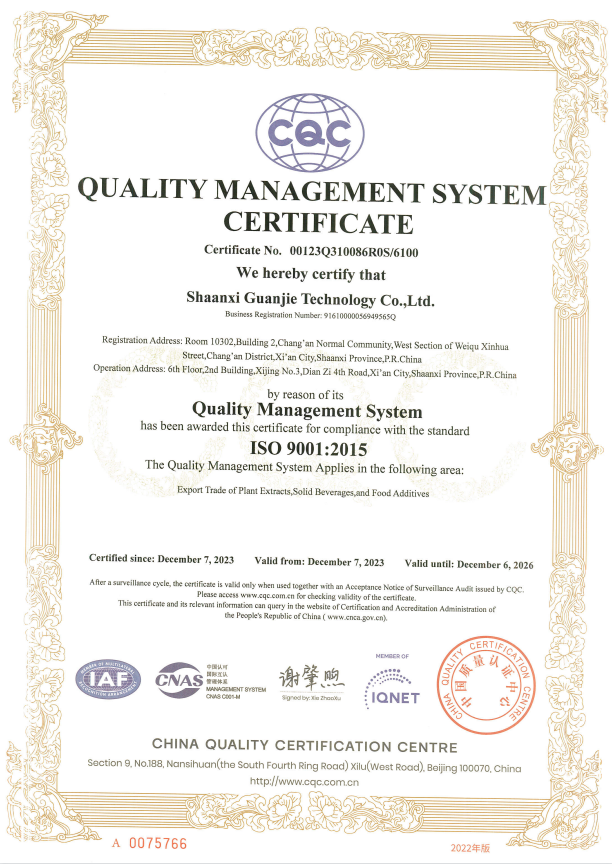
System certificates such as ISO 9001 should be read for scope and expiry, not only for the presence of a logo.
6. HALAL Certification
HALAL certification addresses compliance with Islamic dietary requirements and is increasingly requested by buyers serving markets in the Middle East, Southeast Asia, and parts of Africa, as well as by global brands that standardize ingredient approval across regions.
Guanjie Biotech holds HALAL certification:
- Certificate number: 0811240000
- Certification body: Shandong HALAL Certification Service (SHC)
- Standard: Indonesia Halal Law and Regulations and MS1500:2019 Halal Food: Production, Preparation, Handling and Storage — General Guide
- Scope: Plant extracts, solid beverages, food additives
- Issue date: 2024-11-08
- Expiry date: 2027-11-07
- Market coverage: Global (Middle East, Indonesia, and other halal markets)
The reference to MS1500:2019 and Indonesian halal regulations gives the certificate a defined standard basis, which is useful for buyers who need to explain the certification to a customer or a regulator. The validity period, through November 2027, is longer than the ISO and HACCP cycles, but it should still be checked against the shipment date.
Supporting Identity Details: Grinding and Mesh
Two production details are sometimes included in matcha powder qualification files as supporting identity information: low-temperature ultra-fine grinding and an 80-mesh pass rate. Neither is a certification, and neither replaces the safety and system evidence above. They are useful for a different reason: they help a buyer confirm that the product received matches the product specified, particularly when the matcha is intended for capsule, sachet, or beverage applications where particle size affects dispersion and mouthfeel.
When these details appear in a specification, the buyer should ask whether they are measured per batch and reported on the COA. A stated mesh figure that is not tied to a test method is difficult to verify after delivery.
How Guanjie Biotech Maps to the Checklist
Guanjie Biotech's qualification profile can be summarized against the six checklist categories:
| Checklist category | Guanjie Biotech evidence | Buyer verification step |
|---|---|---|
| Natural, non-GMO, additive-free | Product positioning; confirm against product specification | Request signed declarations and full ingredient list |
| Heavy metals and pesticides | 100% testing position; batch COA; third-party re-test support | Review batch COA and residue panel against destination market |
| ISO 9001 | Certificate 00123Q310086R0S/6100, valid to 2026-12-06 | Confirm renewal for shipments after expiry |
| HACCP | Certificate 001HACCP2301048, valid to 2026-12-05 | Confirm renewal for shipments after expiry |
| Kosher | Certificate K-88898568, valid to 2027-07-15 | Confirm matcha appears on certificate product list |
| HALAL | Certificate 0811240000, valid to 2027-11-07 | Confirm scope and shipment timing |
Beyond certifications, the company's operating profile is relevant to qualification. Guanjie Biotech was founded in 2004 and operates a 7,000-square-meter facility that includes a 2,000-square-meter cGMP-standard clean workshop and a 500-square-meter laboratory. The company reports 40 employees, a 7-engineer R&D team, annual output of 500 tons, and an export ratio of 90%, with markets that include Germany, France, the United Kingdom, the Netherlands, Japan, South Korea, Canada, Australia, and several Middle Eastern and Southeast Asian countries. It also reports 16 national patents and research collaborations with Northwest University and the Xi'an Branch of the Chinese Academy of Sciences.
For procurement terms, the company states a minimum order quantity of 1 kg, a monthly capacity of 30 tons, a lead time of 30 days, and OEM/ODM support with package customization. These terms are relevant to the checklist because qualification and commercial fit are evaluated together: a supplier can hold the right certificates and still fail a buyer's volume or lead-time requirement.

Application category determines which certificates and test reports carry the most weight in a matcha powder qualification file.
A Practical Document Request Template
A buyer can convert the checklist into a single request list:
- Product specification sheet for matcha powder, including grade.
- Signed non-GMO declaration and additive-free statement.
- Batch certificate of analysis with heavy-metal values (lead, cadmium, arsenic, mercury) and the pesticide-residue panel.
- Test method references and laboratory accreditation details.
- ISO 9001:2015 certificate with scope and expiry date.
- HACCP certificate with scope and expiry date.
- Kosher certificate with the product list showing matcha.
- HALAL certificate with scope and standard reference.
- Confirmation of certificate renewal where expiry falls within the order window.
- Batch-release and third-party re-test procedure.
This list is intentionally document-specific. It gives the supplier a clear response target and gives the buyer a comparable basis for evaluating more than one supplier.
Application Fit: Where Qualified Matcha Fits
Matcha powder appears across several application categories, and the qualification emphasis shifts with each one:
- Dietary supplements and hard capsules. The priority is batch COA, heavy-metal values, and additive-free confirmation, because the powder is consumed in concentrated form.
- Functional and fortified beverages. Dispersion and particle size matter, so the grinding and 80-mesh details become more relevant alongside the safety file.
- Functional foods and confectionery. The buyer may need kosher or halal evidence depending on the retail channel and destination market.
- Nutricosmetics and personal care. Color and consistency are central, while the food-safety certificate set supports cross-category use.
- Sports and performance nutrition. Combination products often require the full certificate bundle because the matcha is blended with other active ingredients.
In each case, the checklist does not change; the weighting does. A buyer should document which categories are in scope before requesting evidence, so the supplier knows which certificates and test reports are actually needed.
Market Context and Buyer Implications
The broader context is a shift toward documented sourcing. Buyers in regulated markets are increasingly asked by their own customers to show ingredient-level evidence, not only supplier-level certificates. That pressure flows back to matcha suppliers as requests for batch COAs, residue panels, and certificate scope confirmation.
For buyers, the practical implication is that qualification should be treated as a maintained file rather than a one-time approval. Certificates expire, specifications change, and a supplier that qualified two years ago may need re-verification today. The fact that two of the four certificates in this checklist expire in December 2026 illustrates why the file needs a review date, not just an approval date.
Future Outlook
Two developments are likely to shape matcha powder qualification over the next few years. First, the separation between product-level testing and system-level certification will probably become more explicit, as buyers ask for batch data rather than accepting certificate bundles. Second, certificate scope and validity will receive more scrutiny, particularly where a general plant-extract scope is used to cover a specific product.
Suppliers that maintain current certificates, batch-specific COAs, and clear scope documentation will be better positioned for buyer audits. Suppliers that rely on positioning claims without supporting documents will face longer qualification cycles.
FAQ
What does "non-GMO" mean for matcha powder, and how can a buyer verify it?
Non-GMO means the product is not derived from genetically modified organisms. Because "non-GMO" is not defined identically in every market, a buyer should request a signed non-GMO declaration tied to the specific product and batch, and where the destination market requires it, supporting documentation on the source material. A general marketing statement is less useful than a product-specific declaration.
Which heavy metals should a matcha powder COA cover?
A practical COA covers at least lead, cadmium, arsenic, and mercury, with values reported against stated limits and a named test method. The buyer should check that the results are batch-specific and that the reporting limits are appropriate for the destination market. A COA that states only "compliant" without values provides less verifiable information.
What is the difference between ISO 9001 and HACCP for a matcha powder supplier?
ISO 9001 addresses the supplier's quality management system, including document control and corrective action. HACCP addresses food safety through hazard analysis and critical control points. They are complementary: ISO 9001 supports consistent process management, while HACCP supports control of food-safety hazards. A qualification file normally includes both.
Does Kosher or HALAL certification change the ingredient itself?
Kosher and HALAL certifications address compliance with religious dietary requirements, including sourcing, processing, and cross-contact controls. They do not change the chemical identity of the matcha powder, but they do affect which markets and customers the ingredient can serve. Buyers should confirm that the specific product appears on the certificate's scope or product list.
How should a buyer verify that a supplier's certificates are current?
The buyer should check the certificate number, scope, issue date, and expiry date, and compare the expiry date with the planned shipment date. Where a certificate expires within the order window, the buyer should request evidence of renewal or recertification. For scope-limited certificates, the buyer should also confirm that the specific product is listed.
Conclusion
Qualifying a matcha powder supplier is primarily a documentation exercise. The six-part checklist — natural and non-GMO positioning, additive-free evidence, heavy-metal and pesticide testing, ISO 9001, HACCP, Kosher, and HALAL — gives buyers a structured way to convert supplier claims into reviewable records.
Guanjie Biotech's certification portfolio, with ISO 9001 and HACCP certificates valid through early December 2026 and Kosher and HALAL certificates valid into 2027, provides a concrete example of how the checklist can be applied. The buyer's task is to confirm scope, validity, and batch-level testing for the specific matcha powder being purchased, rather than to accept a certificate bundle as a substitute for product-specific evidence.
For a consolidated view of the company's ingredient portfolio and capability documentation, the Guanjie Nutraceutical Ingredients brochure is available as a reference.
Tem questões ou precisa de mais detalhes?
Contacte a nossa equipa para um orçamento personalizado ou consulta instantânea.
Solicitar orçamento
Preencha o formulário abaixo e a nossa equipa entrará em contacto com uma proposta personalizada.
Chat direto do WhatsApp
Prefere conversar em tempo real? Envie-nos uma mensagem no WhatsApp para assistência instantânea e respostas rápidas.
- Obter orçamento personalizado
- Partilhar fotos ou documentos
- Discuta as suas necessidades diretamente
Geralmente responde em 5–30 minutos durante o horário de expediente.