
Matching 24V Adapter Specs to LED, IT and Appliance Loads
: A Practical Fit Guide
A 24 V power adapter is an external AC-DC supply that converts mains input into a regulated 24 V DC output at a defined current rating. For buyers, project engineers and OEM teams, the voltage is usually already fixed by the device — what actually decides whether a supply fits is the current tier, the load profile and the compliance package behind it.
24 V has become a common DC rail in LED systems, IT products, home appliances and light manufacturing equipment. At the same current, a 24 V rail carries twice the power of a 12 V rail, which keeps conductor sizes, connector ratings and cable voltage drop easier to manage inside compact products. The practical consequence is that many unrelated devices now ask for "a 24 V adapter" while drawing anywhere from a few hundred milliamps to more than an amp.
This guide explains how to match a 24 V adapter to a real device load, using the SK03T 24 V / 1.5 A / 36 W platform from Shenzhen Simsukian Electronics Technology Co., Ltd as a worked example. Simsukian is a Shenzhen-based manufacturer founded in 1996 that develops and mass-produces switching power supplies, lithium-ion battery chargers, charging docks and power adapters from 3 W to 240 W, and exports roughly 70% of its output to the EU, USA, UK, Australia, Japan and Korea.
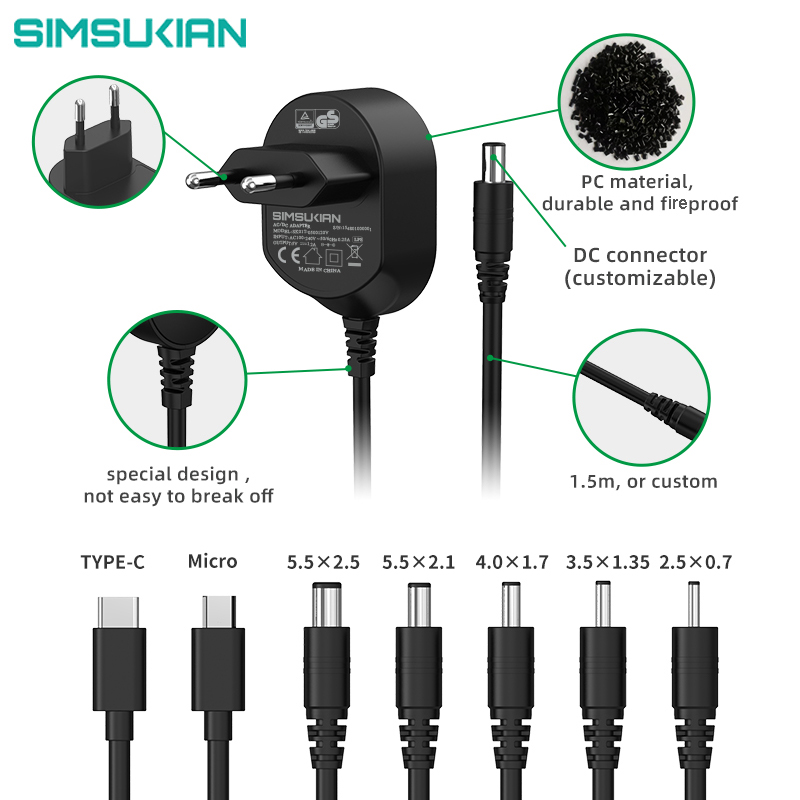
A fixed-output AC-DC adapter: 24 V rails are shared across LED, IT, appliance and light industrial loads, but the current tier must be matched per device.
Why the Same 24 V Rail Hides Very Different Loads
Voltage compatibility is a necessary condition, not a sufficient one. Two devices can both specify 24 V DC input and still need completely different supplies, because the current they draw — and the way they draw it — differs.
A constant-current LED module behaves differently from a router. A motorised appliance has an inrush spike at start-up that may be several times its steady-state draw, while an IT peripheral tends to sit at a flat plateau. A device with a heating element may hold a high continuous load for minutes at a time. Selecting an adapter purely by nameplate voltage ignores all of this.
The failure modes of a mismatched supply are predictable rather than dramatic. An undersized adapter runs hot, its output sags under load, and it may trip an internal protection repeatedly — which shortens service life long before the device itself fails. An oversized adapter is electrically safe but adds cost, enclosure volume and weight, and can behave poorly at light load.
How to Match a 24 V Adapter to a Device Load
The matching process has four steps, and each one eliminates options quickly.
Step 1 — Establish the continuous and peak current
Measure or obtain the device's continuous current at 24 V, then identify the start-up or peak current. Steady-state figures are usually available from the equipment supplier; peak values often need a bench measurement, because they are rarely published.
Step 2 — Choose the current tier
Once both figures are known, the required output class becomes obvious. The table below maps common 24 V load bands to adapter tiers that exist in the Simsukian range.
| 24 V output tier | Rated power | Load band it typically serves | Example model in the range |
|---|---|---|---|
| 24 V / 0.5 A | 12 W | Small sensors, indicator and control electronics, low-draw LED products | SK01T 24 V 0.5 A |
| 24 V / 1 A | 24 W | Mid-draw appliances, IT peripherals, compact equipment modules | SK03T 24V1A24W, Korea plug, black or white |
| 24 V / 1.5 A | 36 W | Higher-draw LED systems, appliance modules and manufacturing equipment | SK03T 24V1.5A36W, EU / UK / Korea plug |
Step 3 — Confirm the input and market requirements
A single SKU that accepts AC 100–240 V, 50/60 Hz can serve multiple export markets without a step-down transformer. What changes between markets is the AC plug and the safety certification attached to it, not the internal power stage.
Step 4 — Verify the compliance documents for the destination market
The verification step is where procurement projects most often stall. A compliant adapter must carry the certifications the destination market requires, and each certificate must reference the exact model being shipped.
What to Read on a 24 V Adapter Datasheet
A datasheet that only lists "24 V, 1.5 A" is incomplete for procurement purposes. The following fields determine whether the adapter will behave as expected in the finished product.
- Output voltage and current: 24 V at 1.5 A gives 36 W of rated output.
- Input range: AC 100–240 V, 50/60 Hz supports multi-region deployment from one design.
- Energy efficiency standard: DOE, ERP and CEC-VI compliance determines no-load and average efficiency behaviour. Under the US DOE Level VI rules, external power supplies rated at 49 W or below must not exceed 0.100 W at no load — a figure that matters when a device idles for long periods.
- Safety standards: IEC 62368, IEC 61558, EN 61347, IEC 60950, ISO 9001 and ETL 1310 form the reference set used across this product family.
- Housing material: Fire-retardant polycarbonate is the stated material for the SK03T housing.
- Protection behaviour: Short-circuit, overvoltage and overcurrent protection circuitry, validated through short-circuit and accelerated-aging testing in an in-house laboratory, is what keeps a fault inside the adapter rather than in the host device.
- Mechanical format: Wall-mount plug-in housings remove the need for an external power brick and cable assembly in the final product.
- Colour and branding: Black, white or customised finishes, which matters for consumer-facing equipment.
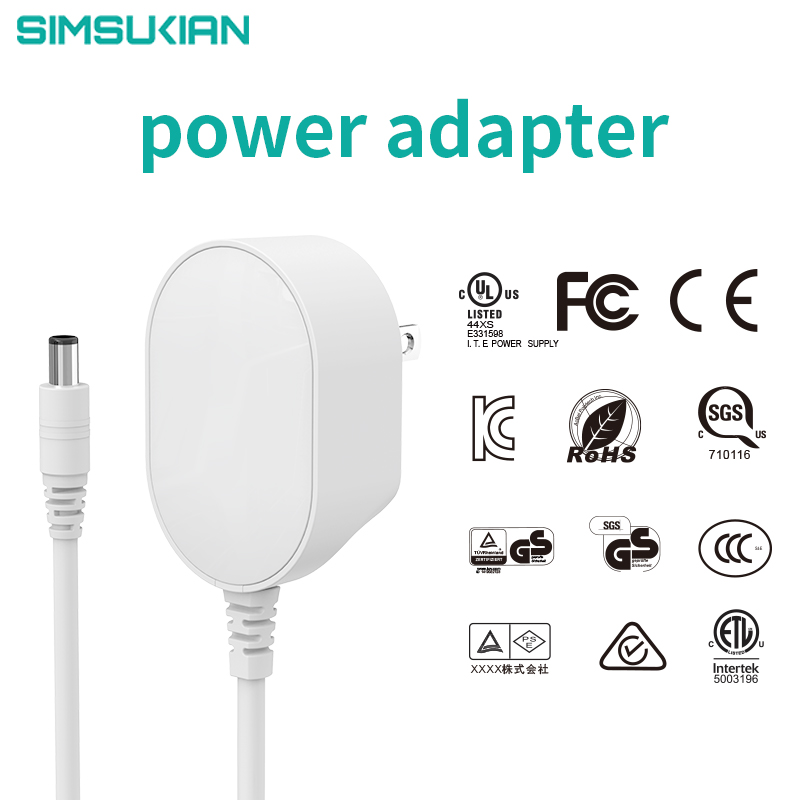
Housing format is part of the specification: the SK03T is offered in black, white or customised colours in a fire-retardant PC enclosure.
The SK03T 24 V / 1.5 A / 36 W Platform as a Worked Example
The SK03T is classified as a 36 W power adapter. In its 24 V configuration it delivers 24 V at 1.5 A, accepts AC 100–240 V at 50/60 Hz, and is intended for manufacturing, home appliance, IT product, LED and general electronics applications. It is supplied in EU, UK and Korea AC plug variants, in black or white, with customised colour available.
Its stated safety standard set covers IEC 62368, IEC 61558, EN 61347, IEC 60950, ISO 9001 and ETL 1310, and its certificate list includes UL, ETL, FCC, SAA, PSE, CCC, CQC, CE-LVD, CE-EMC and RoHS, with KC and KCC added on Korea-plug models. Individual certificates are issued against the specific model — for example, the SK03T1 36 W CE-EMC approval (report 22AE110299E002) and the Korea KC registration R-R-SSK-SK03T1-1200300 — which is why procurement teams should match certificate numbers to the exact SKU rather than to a product family name.
The same 36 W platform is also offered in a 12 V / 3 A configuration, and the wider 24 V range includes a 24 V / 1 A SK03T variant with a Korea plug. That spread lets a project standardise on one mechanical format while changing the electrical configuration per device.
Application Fit: LEDs, IT Products, Home Appliances and Manufacturing Equipment
LED systems
Constant-voltage LED fixtures, strip lighting and signage frequently run on a 24 V DC bus. These loads are usually stable but continuous, which makes the 1 A and 1.5 A tiers the common choice, and makes thermal behaviour of the adapter housing relevant. LED controlgear is also one of the categories where EN 61347 appears alongside IEC 62368 in the standards matrix.
IT products and network equipment
Routers, speakers, audio equipment and desktop IT peripherals are typical fixed-voltage DC loads. Devices in this group tend to draw a flat current with a modest start-up transient, which makes tier matching straightforward. Where the device negotiates power over USB-C instead, a fixed-output AC-DC adapter is not the right tool — a PD charger is.
Home appliances
Home appliance applications are listed among the intended uses of the SK03T. These products often combine a small control board with a higher-draw functional element, so the design must be evaluated against the worst-case continuous load, not the idle figure.
Manufacturing and processing equipment
Industrial and light manufacturing equipment is the segment where 24 V load matching has the clearest cost consequence. A documented example is a Korea-based medical aesthetic equipment manufacturer that has used SK03T 24 V units — both the 24 V / 1 A and the 24 V / 1.5 A variants — across dilatation and hair removal devices for five years, with approximately 100,000 units delivered and stable operation reported. In that application the 24 V rail feeds precision control electronics where output stability directly affects treatment consistency.
Where a 24 V / 1.5 A Adapter Is the Wrong Choice
A fit guide that only explains where a product works is not a fit guide. The SK03T 36 W platform has defined boundaries.
- Continuous loads above 1.5 A at 24 V: the 36 W platform reaches its rated ceiling. Higher-draw equipment needs a higher-power supply rather than a 36 W unit pushed past its rating.
- Devices requiring voltage negotiation: the SK03T is a fixed-output AC-DC adapter. Equipment that expects USB Power Delivery negotiation needs a PD charger, not a fixed 24 V supply.
- Outdoor and wet environments: the product is described for indoor use conditions. Open-air, wash-down or high-humidity installations fall outside that description and require a different enclosure approach.
- Systems needing a custom charging algorithm: adapters and battery chargers are different product categories, even inside the same manufacturer's catalogue.
Market Direction: Efficiency Rules and Device Convergence
Two forces are reshaping how 24 V adapters are specified. The first is regulation. IEC 62368-1 4th Edition, effective from 2023, is the mandatory hazard-based safety standard for AV/ICT power supplies and replaces the legacy 60950 and 60065 frameworks — which means older approval references no longer carry the same weight in a technical file. Efficiency rules have moved in parallel: the US DOE Level VI standard caps no-load consumption at 0.100 W for external power supplies at or below 49 W.
The second force is market scale. One commercial research estimate places the global power adapter market at USD 26.65 billion in 2025, growing to USD 46.14 billion by 2034 (Dataintelo, 2026). Within that market, the GaN charger segment was valued at USD 1.10 billion in 2023 and is projected to reach USD 4.22 billion by 2030 at a 19.9% CAGR (Next Move Strategy Consulting). USB Power Delivery 3.1 Extended Power Range, which raises maximum delivery to 240 W, reflects the same trajectory toward higher-density power conversion.
For 24 V fixed-output adapters, the implication is not displacement but consolidation. Safety and efficiency documentation is becoming the primary differentiator between suppliers, while the electrical specification itself is increasingly commoditised.
Matched Switching Adapters vs Legacy Approaches
Three sourcing patterns are common when a 24 V device enters production. They are not equivalent.
| Approach | Typical strengths | Typical limits |
|---|---|---|
| Legacy unregulated or linear wall supply | Simple circuit, historically cheap; familiar to older designs | Bulky and heavy; output voltage sags as load rises; poor efficiency; rarely carries current IEC 62368 approval |
| Oversized universal switching adapter | Wide compatibility; one part number may cover several devices | Higher cost and volume than the load needs; weak light-load behaviour; certificate may not match the exact SKU |
| Load-matched switching adapter (e.g., 24 V 1.5 A / 36 W) | Sized to the device load; documented efficiency and safety standards; plug, colour and cable configurable | Fixed output — not suitable for PD negotiation, loads above the rated current, or outdoor use |
The matched approach is not automatically correct. It becomes the better option only when the load has been measured and the destination-market certification path is confirmed in advance.
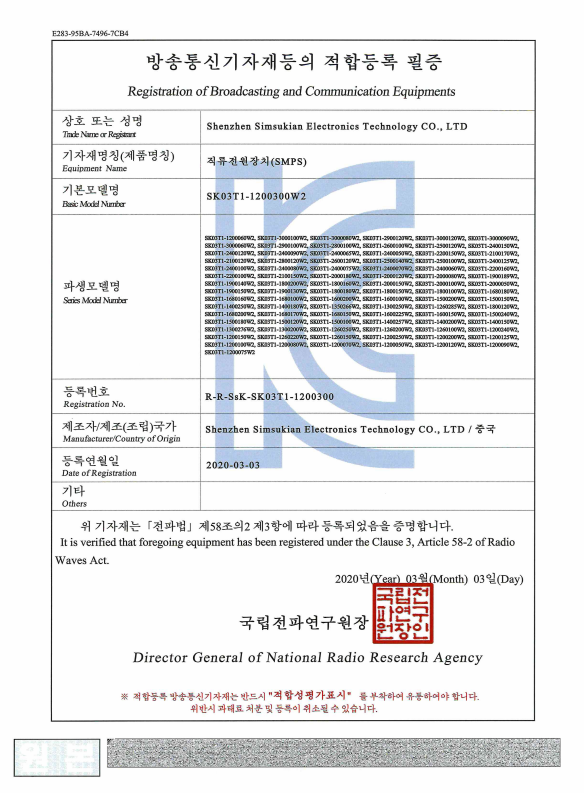
Market-specific approvals are issued per model and plug type — the SK03T 36 W series carries Korea KC registration alongside CE, UL and SAA approvals.
Sourcing and Customization for OEM and ODM Buyers
Once the electrical configuration is settled, the buying process moves to commercial and logistical parameters. For this product family, the stated purchase terms are a minimum order quantity of 600 units, delivery terms including EXW Shenzhen, FOB Shenzhen and DAP, and payment of 30% T/T in advance with the balance against a copy of the B/L. Lead time is quoted at 15–30 days, supported by a monthly capacity of 600,000 units.
Acceptance runs on documented evidence rather than verbal assurance: factory inspection reports, the option to assign third-party inspection before shipment, and pre-shipment testing. Production is described as 100% tested, and the manufacturer operates ISO 9001:2015 and ISO 14001:2015 management systems with more than 90 national patents covering structural design, circuit topology and safety-protection technologies.
Customisation scope on the SK03T platform covers logo, output voltage, output current, tooling, cable length, DC plug size, cable type, colour and packaging. Both OEM and ODM services are offered, which means a buyer can either bring an existing design for production or develop a new one through schematic design, PCB layout and firmware programming for charging logic, temperature monitoring and protection behaviour.
What to Expect Next
The direction of travel for 24 V adapters is toward tighter documentation rather than higher voltage. Efficiency thresholds continue to tighten, safety frameworks continue to consolidate around hazard-based standards such as IEC 62368-1, and certification matching to exact SKUs is becoming a routine part of supplier qualification rather than a formality.
For equipment makers, the practical implication is that adapter selection should be treated as a design decision with a written load calculation behind it, not as a catalogue lookup at the end of a project. The projects that avoid field failures are usually the ones where continuous current, peak current and destination-market certification were all settled before the first sample was ordered.
Frequently Asked Questions
How do I decide between a 24 V 0.5 A, 24 V 1 A and 24 V 1.5 A adapter?
Match the tier to the device's continuous current draw at 24 V. The 24 V / 0.5 A tier, rated at 12 W, suits low-draw control electronics and small LED products. The 24 V / 1 A tier, rated at 24 W, suits mid-draw appliances and IT peripherals. The 24 V / 1.5 A tier, rated at 36 W, covers higher-draw LED systems, appliance modules and manufacturing equipment. In each case, allow headroom above the continuous figure for start-up transients and temperature rise.
Is a 24 V / 1.5 A / 36 W adapter suitable for outdoor or wet locations?
No. This product is described for indoor use conditions. Installations exposed to rain, wash-down or sustained high humidity fall outside that description and require a different enclosure and ingress-protection approach.
Can the output voltage, current or plug of the 36 W adapter be customised?
Yes. Customisation scope on the SK03T platform includes logo, output voltage, output current, tooling, cable length, DC plug size, cable type, colour and packaging. The platform is available in EU, UK and Korea AC plug variants in standard configurations, and both OEM and ODM services are offered.
Which safety and efficiency standards does the SK03T 36 W series reference?
The stated standard set covers IEC 62368, IEC 61558, EN 61347, IEC 60950, ISO 9001 and ETL 1310. Energy efficiency is aligned with DOE, ERP and CEC-VI requirements. Certificates include UL, ETL, FCC, SAA, PSE, CCC, CQC, CE-LVD, CE-EMC and RoHS, with KC and KCC on Korea-plug models. Because approvals are issued per model and plug type, buyers should confirm that the certificate number matches the exact SKU ordered.
What are the minimum order quantity and lead time for this adapter family?
The stated minimum order quantity is 600 units, with a lead time of 15–30 days. Delivery terms include EXW Shenzhen, FOB Shenzhen and DAP. Acceptance is supported by factory inspection reports, optional third-party inspection before shipment, and pre-shipment testing.
Third-party market and regulatory references: IEC 62368-1:2023 (IEC/BSI); US DOE Level VI external power supply standards; USB Power Delivery 3.1 specification (USB-IF); Dataintelo power adapter market report; Next Move Strategy Consulting GaN charger market report.
A full product catalogue covering switching power supplies, chargers and power adapters from 3 W to 240 W is available for download: Simsukian product catalogue (PDF).