
Matching Architectural Window Film to Building Type and Use
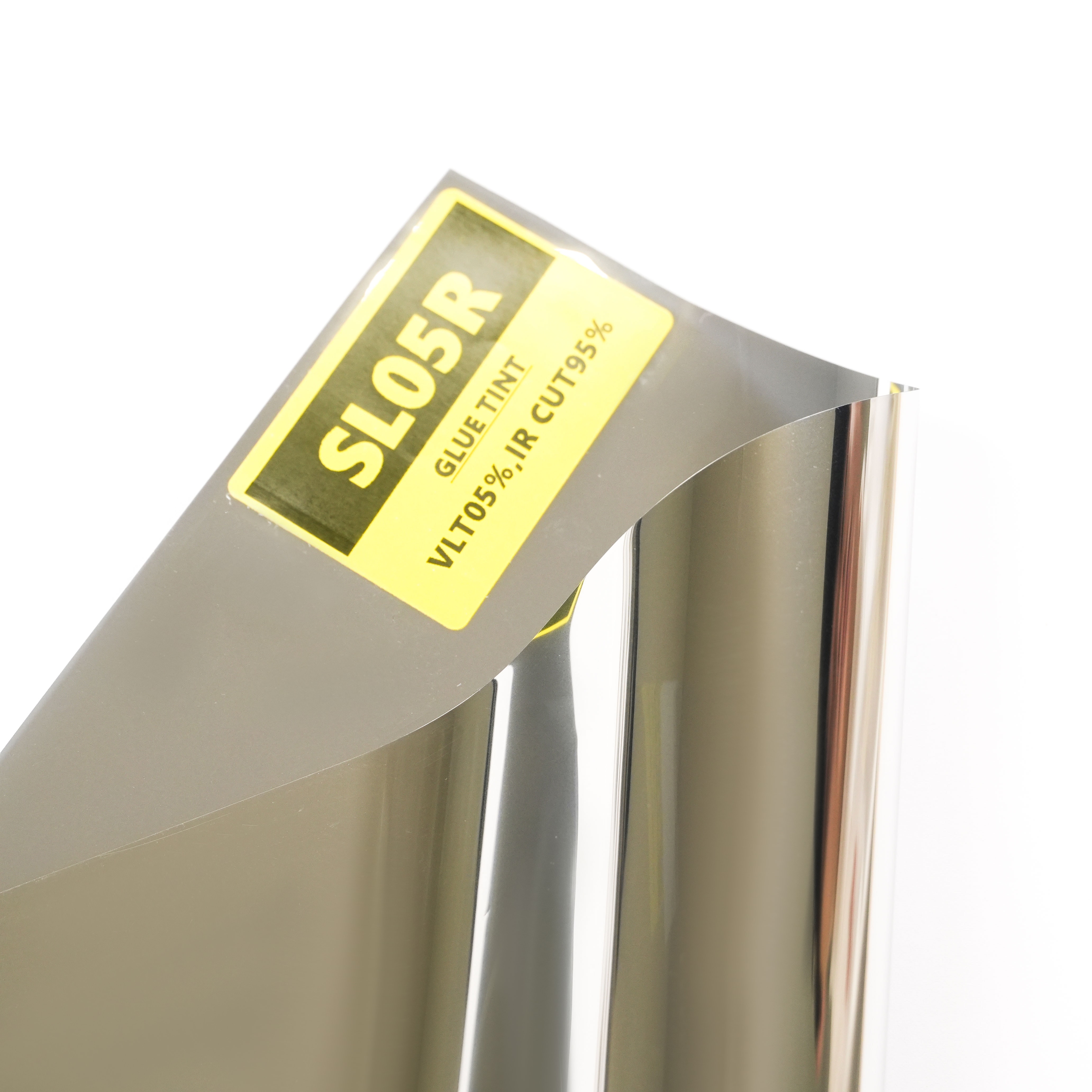
Film selection for a building starts with the problem the building actually has, not with the product list. Image reference: HOCHI PPF & Window Film.
Matching Architectural Window Film to Building Type and Use
Glass is where a building loses much of the energy it is trying to save, and the buildings that need the most help are usually the ones already standing. Architectural window film is one of the few retrofit measures that changes solar gain, glare, ultraviolet exposure and glass behaviour without removing existing glazing or disturbing the facade. For an owner holding a long list of problem windows, the useful question is therefore not whether film performs, but which film belongs on which building.
HOCHI PPF & Window Film is the architectural and automotive film brand of Haian Haochi Technology Co., Ltd., a functional film manufacturer founded in 2009 with a 133,333 m² production site, more than 220 employees, 100 engineers in research and development, an annual output of 48,000,000 m and an export share of approximately 60%. Its architectural range combines silver-coloured solar control films with clear safety films, and the documented specifications of those models are the reference used throughout this scenario guide.
This article maps five documented models, SILVER/GREEN 10, SILVER/GREY 05, SILVER/BLUE 15, SILVER/GOLD 20 and SF12, to five real building situations: retrofit energy savings, glare reduction in occupied interiors, daytime one-way privacy, safety and shatter retention, and ultraviolet protection of interiors and stock. It also sets out where film should not be the first answer.
Building Use Sets the Requirement; Film Type Follows
Two buildings on the same street rarely need the same film. A west-facing curtain wall in a cooling-dominated climate, a hotel lobby with upholstered furniture behind glass, a ground-floor retail unit facing a public pavement, and a school corridor with large low-level panes each present a different primary problem. Solar heat control, glare control, privacy and glass integrity are separate functions, and the film families that deliver them are documented with different values.
- Office and curtain-wall buildings in cooling-dominated climates: the dominant cost is solar heat gain through large glazed areas.
- Daylit workplaces, meeting rooms and classrooms with screens: the dominant complaint is glare at particular hours rather than whole-day heat.
- Ground-floor retail, showrooms and clinics facing public space: the dominant requirement is inward visibility control during trading hours.
- Schools, hospitals, atriums and public-contact glazing: the dominant risk is broken glass and flying fragments.
- Retail floors, museums, hotel rooms and interiors with fabric, timber or artwork: the dominant exposure is ultraviolet radiation.
When the primary problem is misread, the specification fails in a predictable way. A very dark film is chosen for a room that suffers glare during one afternoon hour, and the floor then needs artificial lighting all day. Or a clear film is selected for a facade whose real complaint is heat, and nothing measurable changes. Matching the model to the building type is what separates a successful retrofit from a cosmetic one.
What the Documented Models Actually Deliver
The table below uses only the manufacturer's documented values for the five models, plus the warranty that applies to each series. Read it vertically before reading it horizontally: the values, not the colour name, decide the fit.
| Model | Family / construction | VLT | Infrared cut | UV rejection | Quality warranty | Typical building fit |
|---|---|---|---|---|---|---|
| SILVER/GREEN 10 | Silver-coloured architectural film, optical grade PET, 2PLY 1.5 mil, strong adhesive | 8% | 90% | 99% | 4 years | High-exposure elevations where deep tinting is acceptable |
| SILVER/BLUE 15 | Silver-coloured architectural film, optical grade PET, 2PLY 1.5 mil, colour stable | 8% | 90% | 99% | 4 years | Same optical blocking with a cooler exterior tone |
| SILVER/GREY 05 | Silver-coloured architectural film, optical grade PET, 2PLY 1.5 mil | 10% | 75% | 99% | 4 years | Balanced privacy and moderate heat control |
| SILVER/GOLD 20 | Silver-coloured architectural film, optical grade PET, 2PLY 1.5 mil, colour stable | 25% | 75% | 99% | 4 years | Daylit interiors needing glare relief without heavy darkening |
| SF12 | Safety clear architectural film, optical grade PET, 1PLY 12.0 mil, strong adhesive, security protection | 90% | 10% | 88% | 6 years | Shatter retention on occupied glazing with minimal visual change |
The four silver-coloured series share a 2PLY 1.5 mil construction and a 4-year quality warranty, and they differ mainly in how much visible light they admit and how hard they work on infrared energy. SF12 belongs to a different product family: it is a clear, 1PLY 12.0 mil safety film with a 6-year quality warranty, and it is designed for glass integrity rather than solar control.
Two further models are documented in the same architectural range and are useful when a project sits between the five above. SILVER 5% is a silver reflective film with 5% visible light transmission, 95% infrared cut, 99% UV rejection and a 6-year quality warranty. SILVER 10% documents 10% visible light transmission, 88% infrared cut, 99% UV rejection and a 6-year quality warranty, and it is the architecture film product to which the manufacturer's IATF 16949 certification applies.
Scenario 1: Retrofit Energy Savings in Office and Curtain-Wall Buildings
Cooling load is the first target in commercial retrofit work, and it is driven by two streams of energy arriving through glass: infrared radiation that becomes heat almost immediately, and visible light that becomes heat once it is absorbed by floors, partitions and furniture. A silver-coloured film that documents an infrared cut of 90% together with a visible light transmission of 8%, such as SILVER/GREEN 10 or SILVER/BLUE 15, reduces both streams at the same time.
The company's project record contains one documented reference that matches this scenario: approximately 65,000 square metres, about 2,200 rolls of silver and neutral solar control film, installed on commercial skyscraper glass curtain walls for solar heat rejection, glare control, interior UV protection and glass anti-shatter safety, across projects in the United States, the United Arab Emirates and Germany. The record reports an indoor temperature reduction of 4 °C to 6 °C, a 28% reduction in central air-conditioning power consumption, total solar energy rejection above 72%, no visual distortion from inside out, and an evaluation period of three years after installation.
Scenario 2: Glare Reduction Without Losing the View
Glare is a visible-light problem, so visible light transmission is the control variable, not colour. Where occupants work at screens beside glass, a moderate transmission level is frequently a better fit than the darkest option: SILVER/GOLD 20 admits 25% of visible light while cutting 75% of infrared energy, which removes peak luminance and a substantial share of heat without turning a daylit floor into a dark one. On high-exposure west elevations, or where the complaint is direct low-angle afternoon sun, the 8% visible light transmission models are the appropriate choice.
The trade-off should be written into the tender rather than discovered afterwards. Low-transmission film increases artificial lighting demand and changes how interior finishes are perceived under daylight. It also cannot address glare entering through glazing that is not filmed, through skylights, or through open shading devices that remain in use.
Scenario 3: Daytime One-Way Privacy at Ground Level
One-way privacy is a function of relative brightness rather than a special coating. When a reflective silver-coloured film with a visible light transmission of 8% to 10% is applied to exterior glass, the outside face remains brighter than the interior during daylight, so outward visibility from inside is retained while inward visibility is reduced. SILVER/GREY 05 documents 10% visible light transmission with 75% infrared cut, and SILVER/GREEN 10 documents 8% visible light transmission with 90% infrared cut; both document 99% UV rejection.
The boundary of this effect matters. It is a daytime effect and depends on interior light levels: at night, when a lit interior is brighter than the street, the relationship reverses and the glass becomes easier to see through from outside. Projects that require privacy after dark need a different measure, such as internal blinds or a separate privacy specification. Strongly reflective finishes can also conflict with local facade or planning requirements, so local rules should be confirmed before the appearance is fixed.
Scenario 4: Safety and Shatter Retention Where Glass Is a Risk
Safety films address a different risk entirely. SF12 is a clear safety film with a 1PLY 12.0 mil construction, 90% visible light transmission, 88% UV rejection and a 6-year quality warranty, documented with a strong adhesive for security protection. SF02 is the lighter 1PLY 2.0 mil member of the same safety family with the same optical values, and it suits lighter-duty glazing where the risk profile is lower.
Safety film works by holding fragments together after breakage, which reduces the spread of flying glass into occupied space. The relevant test reference should be named in the specification rather than assumed: ASTM D882 is the mandatory testing method for measuring tensile strength, break strength and elongation of safety films under IWFA policies, and the IWFA visual quality standard sets inspection of installed film at approximately 6 feet, or about 2 metres, under natural daylight.
Scenario 5: Ultraviolet Protection for Interiors, Stock and Finishes
Ultraviolet exposure is the quiet failure inside retail and hospitality interiors: faded textiles, discoloured timber, cracked upholstery, damaged artwork and unsellable merchandise near glass. The silver-coloured architectural films document 99% UV rejection, while SF12 documents 88%. Because UV rejection and visible light transmission are independent values, a project that must protect an interior yet keep daylight and view can use a clear film documenting 90% visible light transmission and 88% UV rejection rather than a dark solar control film. The same logic applies where UV protection is required on occupied glazing whose heat performance is already acceptable.
UV rejection should not be read as a complete fade guarantee. Fading is influenced by visible light and heat as well as ultraviolet radiation, so documented UV rejection describes one part of the exposure picture rather than the whole of it.
Film Compared with Replacing the Glazing, and Where Film Stops
The conventional alternative to film is replacing the glazing. Replacement changes the glass build itself, so it can reach thermal performance that a surface film cannot match, and it also addresses failed seals, condensation between panes and frame-related losses that film never touches. Film, by contrast, is applied to existing glass, usually in occupied buildings, without removing or re-glazing the unit. The two approaches answer different questions, and the practical limits of the film route should be stated plainly before a purchase order is raised.
- Bounded performance: film modifies the existing glass rather than replacing it, so the achievable result is limited by the glass, frame and building services already installed.
- Compatibility is not automatic: a glass compatibility or thermal stress assessment is recommended before installing solar control film on certain laminated, insulated or treated glass, because an incompatible film may increase thermal stress and the risk of glass breakage.
- Regulatory and aesthetic constraints: local rules may limit how dark or how reflective a film may be, and facade requirements can rule out strongly mirrored finishes on visible elevations.
- Warranty horizon: documented quality warranties for this architectural range run for 4 years on the silver-coloured models and 6 years on SF12 and SF02. That is a film warranty, not the service life of a glazing unit.
- Installation quality changes the outcome: dust control, accurate cutting, correct application solution and proper squeegee work determine whether the finished film is optically clean, and the acceptance inspection should follow IWFA practice at approximately 6 feet under natural daylight.
A Specification and Verification Checklist for Buyers
Because building situations vary more than film catalogues do, the procurement sequence matters as much as the model number. The following points reflect documented manufacturer capability and published standards.
- Define one primary objective. Heat gain, glare, privacy, glass integrity or UV exposure. A specification with five equal priorities usually produces a film that satisfies none of them well.
- Match documented values to that objective. Infrared cut and visible light transmission for solar and glare scenarios; thickness and construction for safety scenarios; UV rejection for interior protection.
- Ask for measured data, not colour claims. Factory quality control is documented as 100% online optical defect inspection, spectrophotometer testing of visible light transmission, UV rejection and infrared rejection, peel adhesion testing and high-temperature aging testing, with third-party inspection through SGS available.
- Confirm glass compatibility. Especially on laminated, insulated or treated glass, where a thermal stress assessment is recommended before installation.
- Agree the acceptance inspection method in advance. The IWFA visual quality standard sets inspection from approximately 6 feet under natural daylight; ASTM D882 is the reference test for safety film tensile strength, break strength and elongation.
- Check the management systems behind the product. The manufacturer holds ISO 9001:2015 quality management certification (certificate 04325Q31011R1M), ISO 14001:2015 environmental management certification (04325E30833R1M) and ISO 45001:2018 occupational health and safety certification (04325S40794R0M), all issued by Beijing United Intelligence Certification Co., Ltd. on 2025-05-19 and valid to 2028, together with IATF 16949:2016 certification (RA02-0250/2025, IATF 0568749) issued by AENOR CONFIA S.A.U. on 2025-03-16 and valid to 2028-03-15 for the design and production of paint protection film and solar film.
- Confirm customization and supply terms before sampling. OEM production is documented across visible light transmission from 5% to 70%, UV and IR rejection rates, film thickness, roll dimensions, custom colours, release liner, and packaging box and core logo printing. The minimum order quantity for OEM orders is 50 rolls, sample orders are available upon request, lead time is 30 to 45 days, and monthly production capacity is 3 to 5 million metres.
- Plan support after handover. Documented after-sales provisions include 24/7 technical support and installation guidance, and 100% free replacement for defectives.
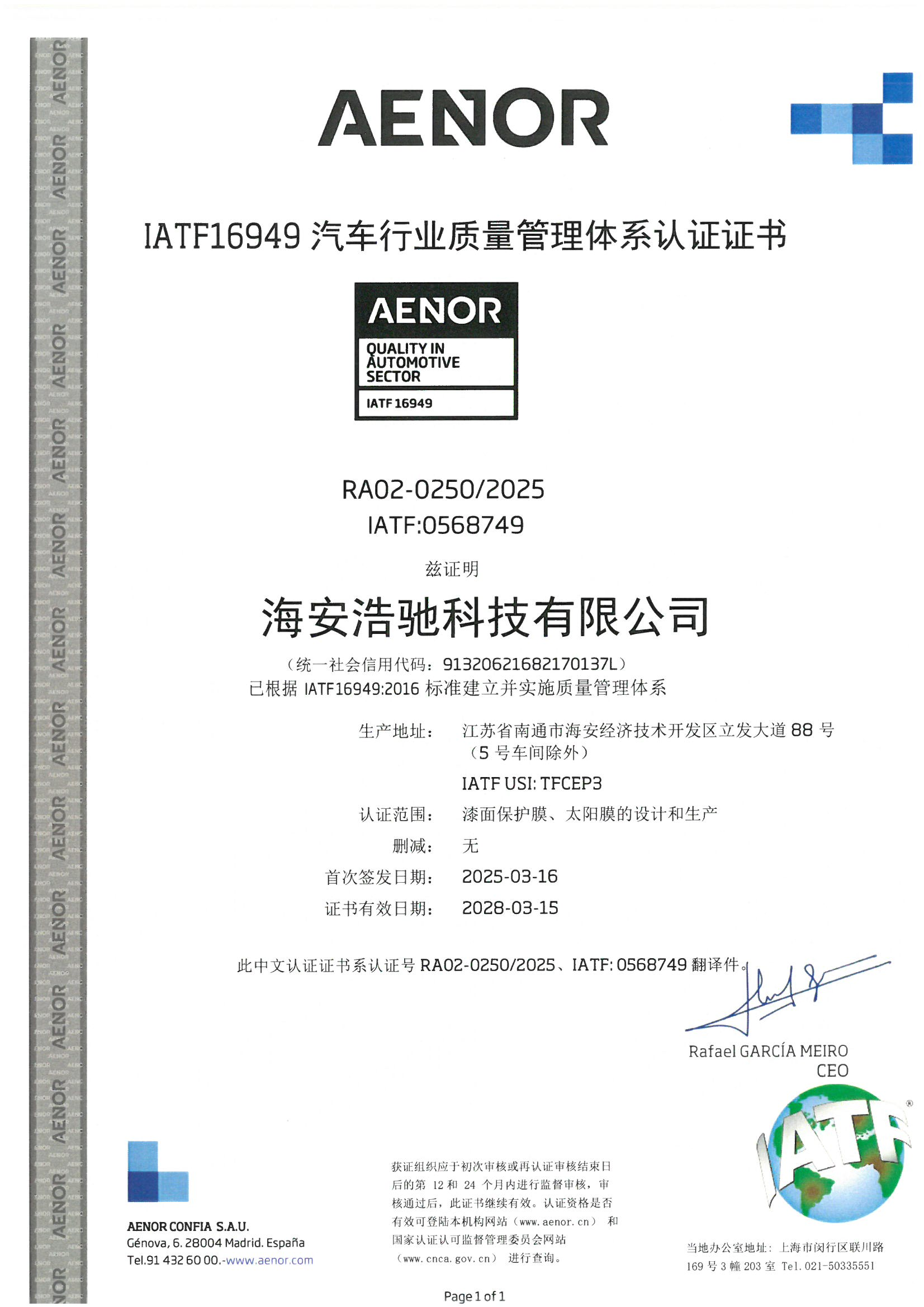
IATF 16949:2016 certificate RA02-0250/2025 (IATF 0568749), issued by AENOR CONFIA S.A.U., covering the design and production of paint protection film and solar film, valid until 2028-03-15.
Market Context: Why Retrofit Film Is Being Specified Earlier
The direction of the wider film industry supports earlier specification. The global automotive tinting film market is projected to reach USD 14.7 billion by 2033 according to Grand View Research, and nano-ceramic window films are documented as blocking up to 85% of solar heat while maintaining high visible light transmission. Both figures describe film demand and film technology generally rather than the architectural segment alone, but the underlying driver is the same force that shapes building retrofits: a large stock of existing glazing that already admits more heat and light than the people inside it want.
For building owners, the operating logic is simpler than the market data. Cooling demand, tenant comfort complaints and ultraviolet damage all appear in buildings that are already occupied, where replacement glazing means access equipment, removal, disposal and disruption. That is why film is increasingly evaluated as a first-tier retrofit line item alongside lighting and controls, and why buyers now ask for measured values rather than descriptions of colour.
Future Outlook
Three shifts are likely to shape architectural film specification over the next planning cycles. The first is data expectation: buyers will increasingly require per-series values for visible light transmission, UV rejection and infrared cut, together with standards-referenced acceptance criteria, instead of accepting a shade card as evidence. The second is the separation of objectives: heat, glare, privacy and safety will be specified as distinct requirements, because a single generic tint cannot honestly carry all of them.
The third is production transparency. Optical coating is sensitive to contamination, and manufacturers that publish their production environment give buyers something to verify. Haian Haochi Technology, the manufacturer behind HOCHI PPF & Window Film, operates a Class 1000 dust-free coating workshop covering 3,000 square metres, alongside an annual output of 48,000,000 m and monthly capacity in the range of 3 to 5 million metres, which is the kind of capacity that supports repeat architectural projects rather than one-off supply.
FAQ
How do I choose between a silver-coloured solar control film and a clear safety film for a building?
They solve different problems. The silver-coloured architectural series, including SILVER/GREEN 10, SILVER/BLUE 15, SILVER/GREY 05 and SILVER/GOLD 20, documents 99% UV rejection with infrared cut of 90% or 75% at visible light transmission between 8% and 25%, and is selected for solar and glare control. SF12 is a clear safety film documenting 90% visible light transmission, 88% UV rejection and 10% infrared cut, and is selected for glass integrity and shatter retention. In this portfolio they are separate product families, so a project needing both states both as separate requirements.
Which model keeps an interior bright while still reducing solar load?
SILVER/GOLD 20 documents the highest visible light transmission in the silver-coloured group at 25%, with 75% infrared cut, 99% UV rejection and a 4-year quality warranty. The trade-off is a lower infrared cut than the 8% visible light transmission models, which document 90% infrared cut. Choosing between them is a decision about how much daylight the occupants need against how much heat the cooling system must remove.
Can one film deliver both heat rejection and shatter retention?
In the documented architectural portfolio, no single model is listed with both characteristics. The silver-coloured films are 2PLY 1.5 mil constructions with high infrared cut, while SF12 is a 1PLY 12.0 mil clear safety film with an infrared cut of 10%. Projects that require both functions must specify two separate requirements and confirm glass compatibility for whatever is applied.
What warranty applies to architectural window film?
Documented quality warranties differ by series: the four silver-coloured models, SILVER/GREEN 10, SILVER/BLUE 15, SILVER/GREY 05 and SILVER/GOLD 20, carry a 4-year quality warranty, while SF12 and SF02 carry a 6-year quality warranty. Documented after-sales support also includes 24/7 technical support and installation guidance, and 100% free replacement for defectives.
How can a buyer verify film performance before ordering?
Request measured values per model rather than colour descriptions. Factory quality control is documented as 100% online optical defect inspection, spectrophotometer testing for visible light transmission, UV rejection and infrared rejection, peel adhesion testing and high-temperature aging testing, with third-party inspection through SGS available. Acceptance inspection of installed film should follow IWFA visual quality practice at approximately 6 feet under natural daylight, and safety film claims should reference ASTM D882 for tensile strength, break strength and elongation.
Is architectural film suitable for any existing glazing?
No. A glass compatibility or thermal stress assessment is recommended before installing solar control film on certain laminated, insulated or treated glass, because an incompatible film may increase thermal stress and the risk of glass breakage. Local building safety requirements and any facade or planning restrictions on film darkness and reflectivity also have to be confirmed before a specification is fixed.
Can the film be customized to a project specification?
Yes. OEM production is documented across visible light transmission from 5% to 70%, UV and IR rejection rates, film thickness, roll dimensions, custom colours, release liner, and packaging box and core logo printing. The minimum order quantity for OEM orders is 50 rolls, sample orders are available upon request, and lead time is 30 to 45 days against a monthly capacity of 3 to 5 million metres.
Summary
Matching film to building use is a short exercise once the primary problem is named. Curtain-wall cooling loads point to the 8% visible light transmission silver-coloured models with 90% infrared cut. Daylit interiors with screen glare point to SILVER/GOLD 20 at 25% visible light transmission. Ground-floor privacy points to reflective silver films at 8% to 10% transmission, with the honest caveat that the effect is daytime only. Broken-glass risk points to SF12 at 1PLY 12.0 mil. Interior fading risk points to the 99% UV rejection of the silver-coloured series, or to a clear safety film where daylight and view must be preserved. The remaining work is verification: measured values, glass compatibility, acceptance criteria and a warranty that matches the series actually specified.
The full published specification sheet covering the architectural and automotive series referenced in this guide is available here: Window Film HC Specifications (PDF).