
Matching Caisheng Label Presses to Your Production Scenario: Die-Cutting Configurations Explained
Matching Caisheng Label Presses to Your Production Scenario: Die-Cutting Configurations Explained
The global label printing machines market was valued at USD 8.58 billion in 2025 and is projected to reach USD 14.36 billion by 2034, according to The Insight Partners. Flexographic printing remains the most commonly used process for labels, valued at approximately USD 13.3 billion in output value in 2024, according to Smithers. As installed capacity grows, the decisive question for many converters is no longer which printing process to buy, but which die-cutting configuration fits the jobs they actually run.
Die-cutting is usually the last item settled in a label press purchase and the hardest item to change afterwards. It determines tooling cost, changeover time, achievable line speed, and the range of label jobs a machine can finish in a single pass. A press that prints beautifully but is configured for the wrong die-cutting method becomes a bottleneck on the shop floor — and the mismatch tends to appear only after the machine is installed.
Shenzhen Caisheng Printing Machinery Co., Ltd. is a Chinese manufacturer of commercial label printing equipment, founded in 2011 and operating a 6,000 m² production facility with approximately 65 employees, including a research and development team of 8 engineers and an annual output of about 200 units. The company builds intermittent and full-rotary letterpress printing machines, flexographic printing machines, and screen printing machines, together with finishing equipment such as die-cutting and high-speed varnishing systems. Its stated markets are Southeast Asia, Europe, the Middle East, and the United States, with exports accounting for approximately 50% of sales.
That product range is organised around three distinct die-cutting architectures. Used as a reference model, that structure helps buyers map a specific press family to a specific production scenario before they commit capital.
Why die-cutting configuration is a selection criterion, not an accessory
Two label presses can carry identical print stations and still behave completely differently on the same order book. The difference is how the die-cutting station is built and how the web moves through it. Flatbed die-cutting and rotary die-cutting solve different problems, and a configuration that suits one production scenario can be structurally wrong for another.
For a converter, the practical consequences show up in four places: the tooling cost per job, the time lost to changeover, the maximum running speed of the line, and the ability to combine die-cutting with other finishing steps such as varnishing, slitting, or screen printing in a single pass. Buyers who evaluate a label printing machine on print quality alone typically end up solving these problems later, at higher cost.
Three die-cutting architectures in the Caisheng label press platform
Caisheng's platform separates into three configuration families. The CS-300 and CS-320 series combine flatbed die-cutting with rotary die-cutting; the CS-220 series is built around flatbed die-cutting only; and the CS-350, CS-370, and CS-380 series are built around rotary die-cutting.
| Series | Die-cutting configuration | Representative models | Web width | Max printing speed | Typical production scenario |
|---|---|---|---|---|---|
| CS-220 series | Flatbed die-cutting only | CS-220-4C, CS-220-5C | 30–240 mm | 40 m/min | Short runs, small-format sticker and carton label work |
| CS-300 / CS-320 series | Flatbed plus rotary die-cutting combination | CS-300-5C, CS-300-6C, CS-320-6C, CS-320-7C | 30–300 mm / 30–320 mm | 40 m/min | Mixed run lengths, multi-process self-adhesive labels |
| CS-350 / CS-370 / CS-380 series | Rotary die-cutting combination | CS-JQ350G-6C, CS-JQ350-7C, CS-JQ350G-10C, CS-Q370F-6C, CS-370F-8C, CS-J380F-4C, CS-J380F-7C | up to 360–370 mm | 150–158 m/min (full rotary) | High-volume self-adhesive label production |
Die-cutting configuration as a selection axis across the Caisheng label press range. Specifications as published by the manufacturer.
Flatbed and rotary die-cutting: what actually changes on the production floor
Flatbed die-cutting presses a flat die against the web with a reciprocating platen motion. Because the die is flat, it is comparatively inexpensive to produce and quick to replace, which suits work where artwork changes frequently and order quantities are modest. The trade-off is inherent to the motion: the web stops and starts, so line speed stays moderate. On the CS-220-4C and CS-220-5C, both flatbed-configured models, the maximum printing speed is 40 m/min, with intermittent printing areas of 30 mm × 200 mm and 220 mm × 200 mm respectively.
Rotary die-cutting uses a rotating cylinder rather than a flat platen, so the web keeps moving. That continuous motion is what allows the higher-speed families in the range to reach 150 to 158 m/min in full rotary mode. Rotary tooling costs more to produce and is best amortised over longer, more stable runs — which is precisely the profile of high-volume self-adhesive label work.
The intermediate configuration is the one that surprises buyers most. Machines such as the CS-300-6C are set up with rotary die-cutting and flatbed die-cutting on the same line, alongside glue-side printing, a multi-functional frame, and slitting. In practice, this lets a converter route a long, stable order through the rotary station and switch a short or newly designed job to the flatbed station without changing machines or re-planning the whole production day.
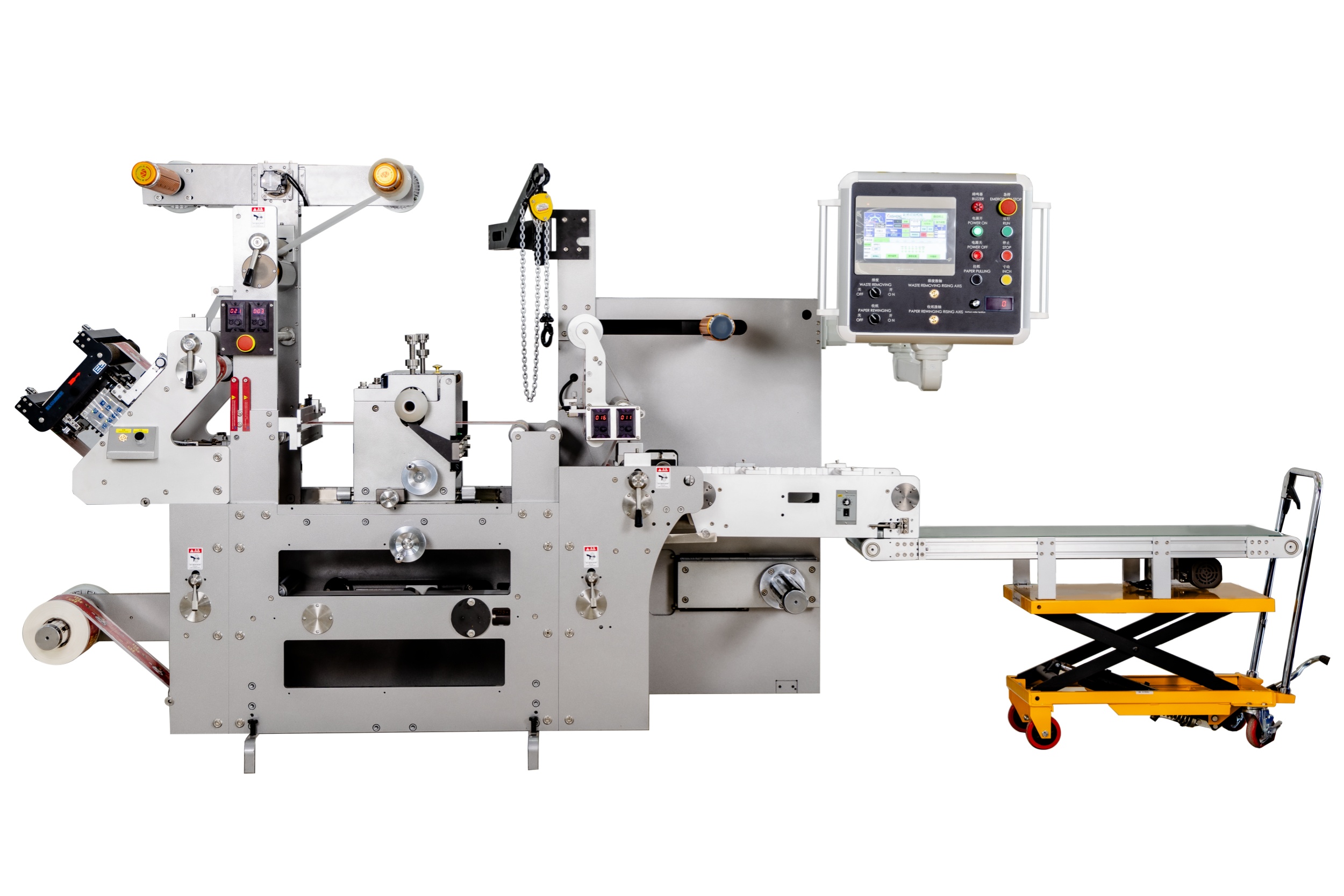
A rotary die-cutting unit of the type used in higher-volume Caisheng configurations; the CS-350 die-cutting machine runs at 60 m/min in intermittent mode and 160 m/min in full rotary mode.
Mapping configuration to production scenario
Short-run and small-format label work: CS-220 series
Where order sizes are small, designs turn over quickly, and floor space is limited, the flatbed-only CS-220 series is the configuration that matches the work. The CS-220-4C has a web width range of 30–240 mm, a gross power of 8.4 kW, UV dryer power of 3.7 kW, a net weight of 2.6 tons, and overall dimensions of 4.2 m × 1 m × 1.5 m. The CS-220-5C shares the same 30–240 mm web width and 40 m/min maximum speed, with gross power of 17 kW including UV dryers, a weight of 3.6 tons, and dimensions of 6.6 m × 1 m × 1.5 m.
The relevant fact for a buyer is not the footprint alone, but what the flatbed-only architecture implies: these machines are positioned for job variety rather than sustained throughput, and they are the entry point of the range for converters whose order book is dominated by frequent, short runs.
Mixed-run self-adhesive label production: CS-300 and CS-320 series
Most commercial label converters do not have the luxury of a single, uniform order profile. A typical week mixes a long repeat run of a beverage or daily-chemical label with a short promotional label and a one-off pharmaceutical or cosmetic variant. That is the scenario the CS-300 and CS-320 families address, because they carry both flatbed and rotary die-cutting on the same platform.
Within this family, the CS-300-5C self-adhesive label press covers a web width of 30–300 mm with a gross power of 18.8 kW, UV dryer power of 6 kW, a maximum printing area of 280 mm × 300 mm in intermittent mode and 280 mm × 326 mm in full rotation, a weight of 5 tons, and dimensions of 6.5 m × 1.5 m × 1.8 m. The seven-colour CS-320-7C extends the web width to 30–320 mm, with a gross power of 31 kW including UV dryers, a weight of 7 tons, and dimensions of 9.1 m × 1.5 m × 2 m.

A flatbed die-cutting configuration combined with offline varnish and sheet cutting — the architecture used on the CS-220 series and retained as one option within the CS-300 and CS-320 lines.
The label applications this family is designed around are wide: self-adhesive labels for daily chemicals, wristbands, wine, food, cosmetics, and pharmaceuticals. Machines in this class operate at room temperature and do not require a constant-temperature production workshop, and they are supported by a servo system, air cooling, water cooling, and UV drying lamps. For a buyer planning a mixed order book, that combination of process coverage and modest site requirements is often the deciding factor.
High-volume self-adhesive labels: CS-350, CS-370, and CS-380 series
When a converter's economics depend on running long, stable jobs as fast as possible, the rotary die-cutting families take over. The CS-JQ350G-6C intermittent and full-rotary high-speed label printing machine offers a maximum printing area of 350 mm × 380 mm in intermittent mode and 350 mm × 419 mm in full rotary mode, at maximum speeds of 60 m/min and 158 m/min respectively, with gross power of 22 kW and a net weight of 10 tons. The ten-colour CS-JQ350G-10C raises gross power to 34 kW with 13.5 kW LED UV dryers, a weight of 14 tons, and the same 60/158 m/min speed profile. The CS-JQ350-7C sits between them, with 24.5 kW gross power, 9.1 kW UV dryers, and a weight of 10.8 tons.
Where flexographic printing is the preferred process, the CS-370 and CS-380 families apply the same rotary logic. The CS-370F-8C full rotation flexo press is rated at a maximum printing speed of 150 m/min with printing areas of 370 mm × 200 mm and 370 mm × 600 mm, a gross power of 30 kW, and a net weight of 8.6 tons. The CS-Q370F-6C offers the same 150 m/min and 370 mm × 200 mm / 370 mm × 600 mm format with a gross power of 25 kW and a weight of 7 tons. The CS-J380F-7C flexographic press runs to 360 mm × 380 mm in intermittent mode and 360 mm × 419 mm in full rotation, with a weight of 6 tons.
Offline die-cutting and finishing support
Not every die-cutting decision is made at the printing line. The CS-350 high-speed die-cutting machine is a standalone finishing unit that operates in both intermittent and full rotary modes, with maximum die-cutting areas of 350 mm × 420 mm and 350 mm × 460 mm respectively, maximum speeds of 60 m/min and 160 m/min, a gross power of 5.6 kW, and a net weight of 2 tons. Two further finishing units extend what a line can deliver: the CS-Q380V high-speed corona and varnish integrated machine, rated at 100 m/min with a 360 mm maximum web width, and the VS-250W full rotation screen printing multifunctional machine, which handles a maximum web width of 250 mm with 240 mm × 240 mm screen printing and die-cutting areas.
What the market context means for international buyers
Configuration decisions are also regional decisions. Asia-Pacific dominated the label printing machines market with a 41.8% revenue share in 2025, according to Data Bridge Market Research, and the global narrow web label printing machines market is projected to grow from USD 1.43 billion in 2024 to USD 3.21 billion by 2035, according to Spherical Insights. Demand is therefore expanding fastest in the same regions where many label converters are specifying their first or second press.
For buyers outside Asia, the practical relevance is supply-side. Caisheng's stated export markets — Southeast Asia, Europe, the Middle East, and the United States — mean the same configuration families described above are already being shipped into markets with differing label formats, substrate preferences, and compliance regimes. A Middle East converter running wine and beverage labels and a European converter running pharmaceutical labels may select the same series but different die-cutting options within it, because the run length and artwork stability of their order books differ.
Compliance is part of configuration fit as well. Safety requirements for graphic technology equipment, including label presses, are governed by ISO 12643-2:2023, and machinery sold in the EU must comply with the Machinery Directive 2006/42/EC and carry CE marking, with safety signs following EN ISO 7010. These requirements are process-independent, but they affect how a line is specified, documented, and installed.
Limits and boundaries of this configuration model
The three-family structure is a selection aid, not a ranking of quality. Three boundaries are worth stating plainly.
- Flatbed-only configurations have a speed ceiling. The CS-220-4C and CS-220-5C are rated at 40 m/min, whereas full-rotary models such as the CS-JQ350G-6C reach 158 m/min. A buyer planning volume growth on a flatbed-only platform will eventually run out of headroom, and the flatbed station is not a substitute for a rotary one on long runs.
- Rotary die-cutting carries a tooling commitment. Rotary cylinders are more expensive to produce than flat dies and reward stable, repeatable artwork. For a converter whose jobs change weekly and rarely repeat, the hybrid flatbed-plus-rotary arrangement of the CS-300 and CS-320 series is generally the more economical position than a rotary-only approach.
- Configuration is only one variable. Achievable output also depends on substrate, adhesion requirements, drying capacity, and operator skill. Machine specifications should be treated as the starting point of a validation process, not as a guaranteed production outcome.
Outlook
Two forces are likely to shape die-cutting configuration choices over the next several years. The first is the continued growth of the broader label machinery market, from USD 8.58 billion in 2025 toward a projected USD 14.36 billion by 2034, which expands the number of converters purchasing their first configurable press. The second is the diversification of label demand itself — from self-adhesive labels for daily chemicals and wine through to cosmetic, food, and pharmaceutical applications — which pushes converters toward machines that can switch between short and long runs rather than machines optimised for a single order profile.
That combination favours hybrid configurations in the mid-range and rotary configurations at the volume end, with flatbed-only machines retaining a clear role in small-format and short-run work. Buyers who begin their evaluation with the die-cutting method — and only then compare print stations, power requirements, and footprint — tend to arrive at a machine that stays productive as their order book changes.
Frequently asked questions
What is a label printing machine, and what does the category cover?
A label printing machine is the production platform used to print, and in many configurations also finish, pressure-sensitive labels. The category spans intermittent and full-rotary letterpress printing machines, flexographic printing machines, and screen printing machines, plus finishing equipment such as die-cutting units and varnishing machines. Caisheng's range covers these categories, with typical applications including self-adhesive labels for daily chemicals, wristbands, wine, food, cosmetics, and pharmaceuticals.
What is the difference between flatbed die-cutting and rotary die-cutting?
Flatbed die-cutting presses a flat die against the web using a reciprocating platen motion, which keeps tooling cost low and changeovers quick but limits continuous line speed. Rotary die-cutting uses a rotating cylinder, which allows the web to run continuously and supports higher speeds. In the Caisheng range, this difference is visible in the specifications: flatbed-configured models such as the CS-220-4C run at 40 m/min, while full-rotary models reach 150 to 158 m/min.
Which Caisheng series uses flatbed die-cutting only, and which add rotary die-cutting?
The CS-220 series, including the CS-220-4C and CS-220-5C, is built around flatbed die-cutting only. The CS-300 and CS-320 series combine flatbed die-cutting with rotary die-cutting on the same platform. The CS-350, CS-370, and CS-380 series are built around rotary die-cutting, covering models such as the CS-JQ350G-6C, CS-JQ350G-10C, CS-Q370F-6C, CS-370F-8C, and CS-J380F-7C.
Can a flatbed die-cutting label press handle high-volume self-adhesive label work?
Flatbed-configured machines are matched to shorter, more variable runs rather than sustained volume. The CS-220-4C and CS-220-5C are rated at a maximum printing speed of 40 m/min with web widths of 30–240 mm. For high-volume work, the rotary-configured families are the relevant option: the CS-JQ350G-6C is rated at 60 m/min in intermittent mode and 158 m/min in full rotary mode, with printing areas of 350 mm × 380 mm and 350 mm × 419 mm.
Which die-cutting configuration fits short-run carton and small-batch label jobs?
Short-run work with frequent artwork changes favours flatbed die-cutting, because flat dies are cheaper to produce and faster to replace. In the Caisheng range that points to the CS-220 series, or to the flatbed station within the hybrid CS-300 and CS-320 series when the same converter also runs longer, repeatable jobs. The CS-220-4C, for example, has overall dimensions of 4.2 m × 1 m × 1.5 m and a net weight of 2.6 tons, which suits compact production spaces.
What compliance points should an international buyer verify before ordering?
Safety requirements for graphic technology equipment, including label presses, are governed by the international standard ISO 12643-2:2023. Machinery sold in the European Union must comply with the Machinery Directive 2006/42/EC and carry CE marking, with safety signs following EN ISO 7010. These requirements apply regardless of the die-cutting configuration selected, so they are best confirmed as part of the specification stage rather than at delivery.
How is a configuration validated against a specific production scenario before purchase?
The usual approach is to define the order profile first — typical run length, artwork turnover, web width, and substrate — and then match it to a die-cutting architecture. Caisheng offers exclusive one-to-one custom design, with size, process, and function customisation. Its machines operate under normal room temperature conditions and perform stable continuous automatic cycle printing without requiring a constant-temperature production workshop, with supporting equipment including a servo system, air cooling, water cooling, and UV drying lamps.
Reference
Caisheng's full product brochure, covering letterpress, flexo, screen printing, and finishing configurations including die-cutting options, can be accessed here: Caisheng product brochure (PDF).