
Matching Convex Mirrors to Sites: YD-OC Sizes vs Peers
Matching Convex Mirrors to Sites: YD-OC Sizes vs Peers
A convex mirror is only as good as its fit to a specific site. The YD-OC series from Mnsd covers four outdoor diameters - 600 mm, 750 mm, 1000 mm and 1200 mm - on one shared specification platform, so the selection question is rarely "which mirror is best" and almost always which diameter and mounting arrangement match a given sightline, climate and impact risk.
Tiantai Yuanda Traffic Device Co., Ltd, the manufacturer behind the Mnsd brand, supplies the YD-OC as an outdoor polycarbonate convex mirror family with a stated 130°+ wide-angle field, IP65 weatherproofing, Grade 8 UV resistance and a -30 °C to +80 °C operating range. This guide maps those documented figures onto four application settings - road traffic, parking garages, warehouses and logistics parks - and then sets the series against the peer categories a procurement team will realistically shortlist.
Diameter, visual range and the fit decision
The single most useful number in a convex mirror datasheet is stated visual range, because it is the figure that tells a buyer how far the reflected image is intended to be usable. In the YD-OC line, visual range scales with diameter: the 600 mm model is documented at 15-18 m, the 750 mm at 20-25 m, the 1000 mm at 30-35 m and the 1200 mm at 35-45 m.
That progression explains why site layout, not budget alone, should drive the choice. A mirror that is too small for the approach distance produces an image that arrives too late to change a driver's decision; a mirror that is oversized for a tight garage corner adds cost and mounting load without adding usable sightline. The four scenario sections below apply the documented ranges to concrete site conditions.
What the YD-OC series specifies across all four sizes
Beyond diameter, the four models share a common bill of materials, which simplifies multi-site procurement: one specification, one mounting system, one acceptance routine, four coverage options.
| Model | Diameter | Stated visual range | Site condition it matches |
|---|---|---|---|
| YD-OC60 | 600 mm | 15-18 m | Garage corners, short indoor approaches |
| YD-OC75 | 750 mm | 20-25 m | Ramps, warehouse intersections, loading docks |
| YD-OC100 | 1000 mm | 30-35 m | Road junctions, yard exits |
| YD-OC120 | 1200 mm | 35-45 m | High-speed approaches, long logistics sightlines |
The shared platform is impact-resistant polycarbonate lens material at 0.6-1 mm thickness (customisable), vacuum aluminium coating on the reflective surface, and a curvature radius of R2200-R3000. The lens sits in a high-impact ABS backing with a 2.0 mm back plate, finished in bright orange for daytime visibility, and is carried by a heavy-duty galvanised steel bracket that fits 60 mm or 75 mm poles. Engineering-grade reflective rim tape and an anti-scratch hard coating are both listed as optional rather than standard, which matters when a tender document assumes they are included.
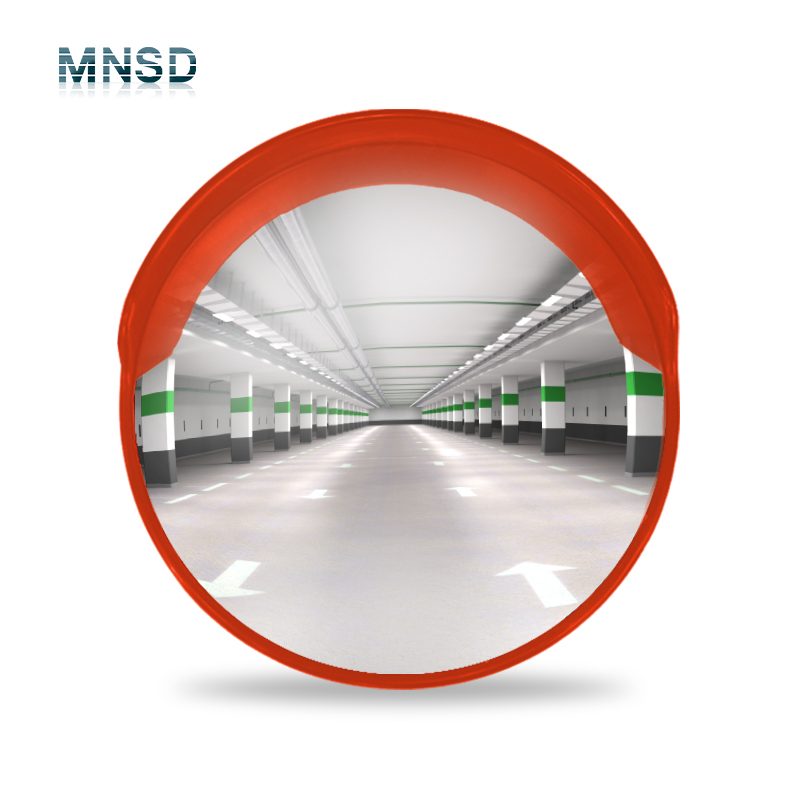
YD-OC series outdoor polycarbonate convex mirror: bright orange high-impact ABS backing with a polycarbonate lens, supplied for pole or wall mounting.
Road traffic: where the 1000 mm and 1200 mm sizes earn their place
For road traffic settings - T-junctions, rural intersections and highway ramps - the YD-OC100 and YD-OC120 are the sizes whose documented ranges match typical approach distances. At 30-35 m and 35-45 m respectively, they give a driver on the minor arm a usable image of approaching traffic before the decision point rather than at it.
The environmental case is as important as the optical one. Roadside installations face UV load, frost, driven rain and occasional vandalism. The YD-OC specification addresses each with a named field rather than a general claim: Grade 8 UV resistance with a stated 3-5 year lifespan, an operating range of -30 °C to +80 °C, IP65 weatherproofing for outdoor use, and an impact rating described as vandal-resistant with self-recovery. A polycarbonate lens is the material choice behind that impact behaviour; it is also the reason the unit costs more than an acrylic equivalent.
Two placement conditions decide whether the mirror works in practice. The reflective surface must face the approach the driver actually uses, and the mounting must hold the plane stable under wind. Mnsd states wind load resistance at Level 10 for the series, and the galvanised steel bracket is the load path from mirror to pole.
Parking garages: 600 mm and 750 mm for corners and ramps
Inside parking structures, blind spots cluster at corner columns, ramp mouths and pedestrian exits - precisely the conditions listed for this product family. Here the YD-OC60 at 15-18 m and the YD-OC75 at 20-25 m are usually the better fit, because the distances involved are short and the constraint is mounting space and driver attention, not long-range sight.
A practical rule from the documented ranges: if a driver leaving a garage bay needs to see cross-traffic roughly 15-20 m away, the 600 mm unit covers the stated low end of that need; if the ramp approach is longer, or the mirror must serve two intersecting aisles, the 750 mm unit gives the additional coverage. Wall mounting on structural columns is the usual arrangement, and the same bracket family accepts pole mounting where columns are not available.
IP65 matters more in garages than buyers expect. Underground and semi-open structures combine damp air, vehicle exhaust and washdown runoff, and the housing seal is what keeps the coated lens from degrading early. The sealed ABS backing also protects the reflective layer from the rear, which is where condensation damage often starts.
Warehouses: intersection and loading dock visibility
In warehouse and factory environments, the blind spot is created by racking, door frames and forklift traffic, and it repeats at every aisle intersection. The YD-OC60 and YD-OC75 fit this pattern: short distances, many mounting points, and a need for a shatterproof surface in areas where people work close to the mirror.
Impact behaviour is the deciding field here rather than optical range. A polycarbonate lens on an ABS backing is specified as vandal-resistant and self-recovering, so a struck unit is designed to flex and return rather than produce fragments at head height. That is a materially different risk profile from a glass lens in a busy aisle.
For loading docks, where a vehicle reverses toward a blind corner and a spotter needs to see both the vehicle path and pedestrian movement, the 750 mm unit is the practical starting point at a stated 20-25 m. Where a dock apron is shared with yard traffic and the sightline runs longer, moving up to the 1000 mm model is the more defensible specification.
Logistics parks: long approaches and yard exits
Logistics parks combine the longest sightlines and the widest vehicles in this set. Yard exits, gatehouse approaches and trailer turning areas are the points where the YD-OC100 and YD-OC120 apply, at 30-35 m and 35-45 m of stated visual range.
The 1200 mm model's 35-45 m range is the reason it exists in the line: an articulated vehicle pulling out of a yard needs the approaching lane visible well before the stop line, and a smaller mirror would compress that image into an unreadable span. The cost is weight and mounting load, which is why the pole diameter fit - 60 mm or 75 mm - should be confirmed against the actual post before ordering, and why the galvanised steel bracket is part of the specification rather than an accessory.
Setting the YD-OC against peer categories
The honest comparison for a procurement team is category-level. Verified third-party datasheets were not part of this evaluation, so no named competitor's specification is asserted here; what follows compares documented capability against the peer categories that appear in most shortlists, and states what each comparison does and does not establish.
| Evaluation field | YD-OC (documented) | Acrylic economy mirrors | Glass-lens mirrors | Camera / sensor detection |
|---|---|---|---|---|
| Lens material | Impact-resistant PC, 0.6-1 mm | Acrylic | Glass | Imaging sensor |
| Impact behaviour | Vandal-resistant, self-recovery | Lower-cost material category; less impact tolerance | Can shatter into fragments | Depends on housing and mounting |
| Outdoor weathering | IP65, Grade 8 UV, 3-5 year stated lifespan | Varies by grade; verify per supplier | Coating degradation is the usual failure point | Needs power, wiring and calibration |
| Cost position | PC carries a 15-35% premium over equivalent acrylic, per Mnsd's 2026 guide | Lowest purchase price | Material-dependent | Adds power, installation and maintenance scope |
| What it proves | Documented range, sealing and UV fields on one platform | Budget fit for low-impact, sheltered sites | Optical clarity where breakage risk is controlled | Active detection and recording, not passive sightline |
Two conclusions follow from the table, and both are conditional. First, the polycarbonate premium is defensible where impact and vandalism risk is real - roadside posts, warehouse aisles, unsupervised garages - and harder to justify in a sheltered site with no strike exposure. Second, a mirror and a camera solve different problems: a convex mirror delivers a continuous passive image with no power, no firmware and no calibration, while a camera adds detection and recording at the cost of electrical scope and maintenance. The categories are complementary in most safety programmes, not substitutes.
Technical basis: coating, curvature and sealing
Three specification fields explain most of the performance difference between the YD-OC and a generic outdoor mirror.
The first is the reflective layer. Vacuum aluminium coating on a polycarbonate substrate produces the mirrored surface; the coating's durability depends on how well it is protected from moisture and abrasion, which is why the optional anti-scratch hard coating is worth specifying for sites with regular washdown or abrasive dust.
The second is curvature. A radius between R2200 and R3000 governs how much scene is compressed into the lens and therefore how the image reads at distance. Flatter curves show a more natural image over a narrower field; tighter curves show more scene at the cost of minification. Buyers comparing quotes should check that the quoted curvature is stated at all rather than assumed.
The third is the enclosure. IP65 is a defined ingress rating against dust and water jets, not a claim of submersibility, and it depends on the housing remaining intact. Grade 8 UV resistance is stated with a 3-5 year lifespan in the Mnsd specification, which is a service-life expectation for planning inspection cycles, not a permanent anti-ageing guarantee.
Where the series does not fit
A useful selection guide includes boundaries. Stated visual range describes the usability of the reflected image under the intended geometry; it is not a stopping-sight-distance calculation and does not replace a site sightline assessment. If the junction geometry is wrong, a larger mirror will not correct it - the mounting position has to change.
Pole fit is stated at 60 mm and 75 mm. Posts outside that range require a mounting solution confirmed with the supplier rather than assumed. Similarly, reflective rim tape and the anti-scratch coating are optional items; a tender that requires either must specify it explicitly, and where retroreflective material is specified in Australia or New Zealand, buyers commonly reference AS/NZS 1906.1:2017 for retroreflective materials and devices, which concerns that material rather than the mirror body.
Finally, the product operates on fixed physical reflection. It provides a continuous image, but it does not detect, alert or record, so it cannot substitute for electronic monitoring where event evidence is a requirement.
Market context: why scenario fit is becoming a procurement criterion
Dataintelo's 2026 convex mirror market report values the global category at USD 1.04 billion in 2025 and projects USD 1.73 billion by 2034, a reported CAGR of 5.8%, with Asia Pacific holding 42.5% of 2025 revenue. Read alongside Mnsd's stated monthly capacity of 30,000 units and a 15-20 day lead time for a 20 ft container, the figures describe a category where supply capacity is concentrated in the region that also carries the largest demand share.
For buyers, the practical implication is not a growth story but a specification discipline: when many suppliers can quote a 1000 mm orange mirror, the fields that separate them are the ones that are easy to leave blank - UV grade, ingress rating, back plate thickness, wind load, bracket material and the stated visual range. Those are also the fields that determine replacement cycles across a multi-site programme.
Field evidence: a Thailand distributor project
Mnsd's recorded distributor case in Thailand covers a medium-sized traffic safety project aimed at road corners and parking blind spots. The unit was delivered on schedule and passed local acceptance, with wide viewing angle, weatherproofing and durability listed as the deciding product characteristics. The record documents delivery and acceptance; it does not include measured before-and-after collision data, so it should be read as evidence of delivery performance and site acceptance rather than of accident reduction.
Procurement checklist for multi-site rollouts
| Field to confirm | Why it changes the decision |
|---|---|
| Diameter and stated visual range | Ties the purchase to the site's approach distance instead of habit |
| Lens material and thickness | Drives impact behaviour and the acrylic-to-PC price gap |
| UV grade and stated lifespan | Sets the inspection and replacement cycle |
| IP rating | Confirms the housing suits washdown, damp and outdoor exposure |
| Backing material and plate thickness | Affects rigidity and how the mirror holds its plane in wind |
| Bracket and pole diameter fit | Determines whether the site's existing posts can be reused |
| Optional items: rim tape, hard coating | Frequently assumed included and frequently not |
| MOQ, lead time and acceptance criteria | Mnsd lists a 100-piece MOQ and 100% impact and clarity inspection |
Outlook
Scenario-based specification is likely to keep replacing catalogue-based buying, because the cost of a wrong mirror shows up as a repeated blind spot rather than a warranty claim. Passive polycarbonate mirrors and electronic detection will continue to coexist: the mirror remains the lowest-complexity way to open a sightline, and the camera remains the way to record what happened in it. Within that split, the competitive ground for suppliers is documented durability - UV grade, ingress protection, wind load and impact behaviour - rather than colour or diameter alone.
Frequently asked questions
Which YD-OC size suits a road T-junction?
For a T-junction or rural intersection, the YD-OC100 and YD-OC120 are the sizes whose stated visual ranges - 30-35 m and 35-45 m - match typical approach distances on the minor arm. The 1000 mm model suits junctions where the approach is moderate; the 1200 mm model suits faster approaches or wider junctions where the driver needs a longer usable image before the decision point. Both use the same galvanised steel bracket and fit 60 mm or 75 mm poles.
Is a 600 mm mirror enough for a parking garage corner?
The YD-OC60 is documented at a 15-18 m visual range, which fits short garage approaches such as a bay exit facing a cross-aisle. If the ramp approach is longer, or one mirror has to serve two intersecting aisles, the YD-OC75 at 20-25 m gives more usable coverage. Garage selection usually turns on mounting space and the actual approach length rather than on price difference between the two sizes.
How does polycarbonate compare with acrylic for an outdoor convex mirror?
Polycarbonate carries a stated cost premium of 15-35% over an equivalent acrylic mirror, according to Mnsd's 2026 guide, and is chosen for impact tolerance: the YD-OC lens is described as vandal-resistant with self-recovery. Acrylic remains a reasonable economic option for sheltered sites with no strike exposure. The trade-off is material behaviour, not optical principle - both are reflective convex mirrors, and the right answer depends on how exposed the mounting point is.
What do IP65 and Grade 8 UV actually cover?
IP65 is an ingress rating for protection against dust and water jets; it does not mean the mirror can be submerged. Grade 8 UV resistance in the YD-OC specification is stated with a 3-5 year lifespan, which is a planning figure for inspection and replacement in high-UV regions rather than a permanent anti-ageing guarantee. Both figures depend on the housing and coating remaining undamaged in service.
What mounting hardware does the series require?
The mirror needs a mounting bracket or pole clamp, a support pillar or wall anchor as the site dictates, optional reflective film or rim tape if specified, and expansion bolts for masonry fixing. The supplied bracket is heavy-duty galvanised steel and is stated to fit 60 mm or 75 mm poles; posts outside that range need a mounting arrangement confirmed with the supplier before the order is placed.
Full dimensional and material data for the four YD-OC sizes is available in the manufacturer's downloadable brochure: Mnsd traffic safety product brochure. Company information and current product listings are published at Mnsd (Tiantai Yuanda Traffic Device Co., Ltd).
Tem questões ou precisa de mais detalhes?
Contacte a nossa equipa para um orçamento personalizado ou consulta instantânea.
Solicitar orçamento
Preencha o formulário abaixo e a nossa equipa entrará em contacto com uma proposta personalizada.
Chat direto do WhatsApp
Prefere conversar em tempo real? Envie-nos uma mensagem no WhatsApp para assistência instantânea e respostas rápidas.
- Obter orçamento personalizado
- Partilhar fotos ou documentos
- Discuta as suas necessidades diretamente
Geralmente responde em 5–30 minutos durante o horário de expediente.