
Matching Diffuser Form to Function: H5000, P01, P02
Commercial scenting projects rarely fail because of the fragrance. They fail because the diffuser's mounting method, power source or oil capacity was chosen before anyone checked the room. For property and facilities managers, the operative question is not which scent machine performs best in general, but which form fits this specific space.
The rule that follows is venue-led. A floor-standing machine with a 1,000 ml bottle and an 800-1,300 m2 coverage rating suits a hotel or mall lobby. A battery-operated wall unit suits a toilet or lift car where no outlet exists. A wall-mounted, plug-in unit with a 300 ml bottle suits a mid-sized retail floor of 150-350 m2, especially where the shop already has ductwork that can be used. Each option trades coverage against installation freedom, and each carries constraints that should be verified before purchase rather than after installation.
Three models from the commercial range of Shenzhen Scentsea Technology Co., Ltd (SCENTSEA) illustrate how form factor, power supply and capacity interact across common venue types. SCENTSEA is a Shenzhen-based manufacturer founded in 2021 that develops and produces cold-air nebulizing scent diffusers, waterless aroma machines, HVAC scent systems and fragrance oils for home, commercial and HVAC applications, with products supplied to customers in more than 70 countries and regions.
Why a Coverage Rating Does Not Select a Diffuser on Its Own
Every commercial diffuser is rated in square metres, cubic metres and square feet, and those ratings assume a broadly open volume with predictable airflow. Real venues are not open volumes. A 900 m2 lobby broken up by columns, a reception desk and a revolving door behaves differently from a 900 m2 open exhibition hall. Industry selection guidance recommends weighing ceiling height, ventilation, airflow and partitions rather than relying only on the maximum rated coverage, and that caution matters most in the two venue types where scenting is most visible to guests: hospitality lobbies and retail floors.
In practice, three installation constraints usually decide a specification before coverage is discussed at all.
- Mounting surface. Floor-standing units need an unobstructed footprint. Wall units need a wall position that keeps the device out of reach while remaining inside the room's airflow path.
- Power. A plug-in unit needs a socket within reach. A battery unit shifts the constraint from wiring to a replacement routine. A duct-connected unit needs access to the HVAC system.
- Service interval. Oil capacity and hourly consumption together determine how often staff must intervene, which is a labour question as much as an equipment question.
Three Form Factors, Three Venue Types
The table below summarises how the three models differ on the constraints that typically decide a procurement decision: how the unit is mounted, how much area it is rated to cover, how much oil it holds, how it is powered, and how loud it runs.
| Model | Form and mounting | Rated coverage | Oil capacity | Power supply | Noise |
|---|---|---|---|---|---|
| H5000 | Floor-standing, aluminium body, gunmetal | 800-1,300 m2 / 2,500-4,000 m3 / 8,600-14,000 ft2 | 1,000 ml | DC 12 V plug-in, 20 W | <45 dB |
| P01 | Wall-mounted, cordless, plastic | 100-150 m2 / 300-500 m3 / 1,000-1,600 ft2 | 500 ml | 4 pcs D batteries or Type-C, 2.5 W | <35 dB |
| P02 | Wall-mounted, plug-in, plastic | 150-350 m2 / 500-1,000 m3 / 1,500-3,500 ft2 | 300 ml | DC 12 V plug-in, 6.5 W | <30 dB |
H5000: Floor-Standing Capacity for 800-1,300 m2 Lobbies
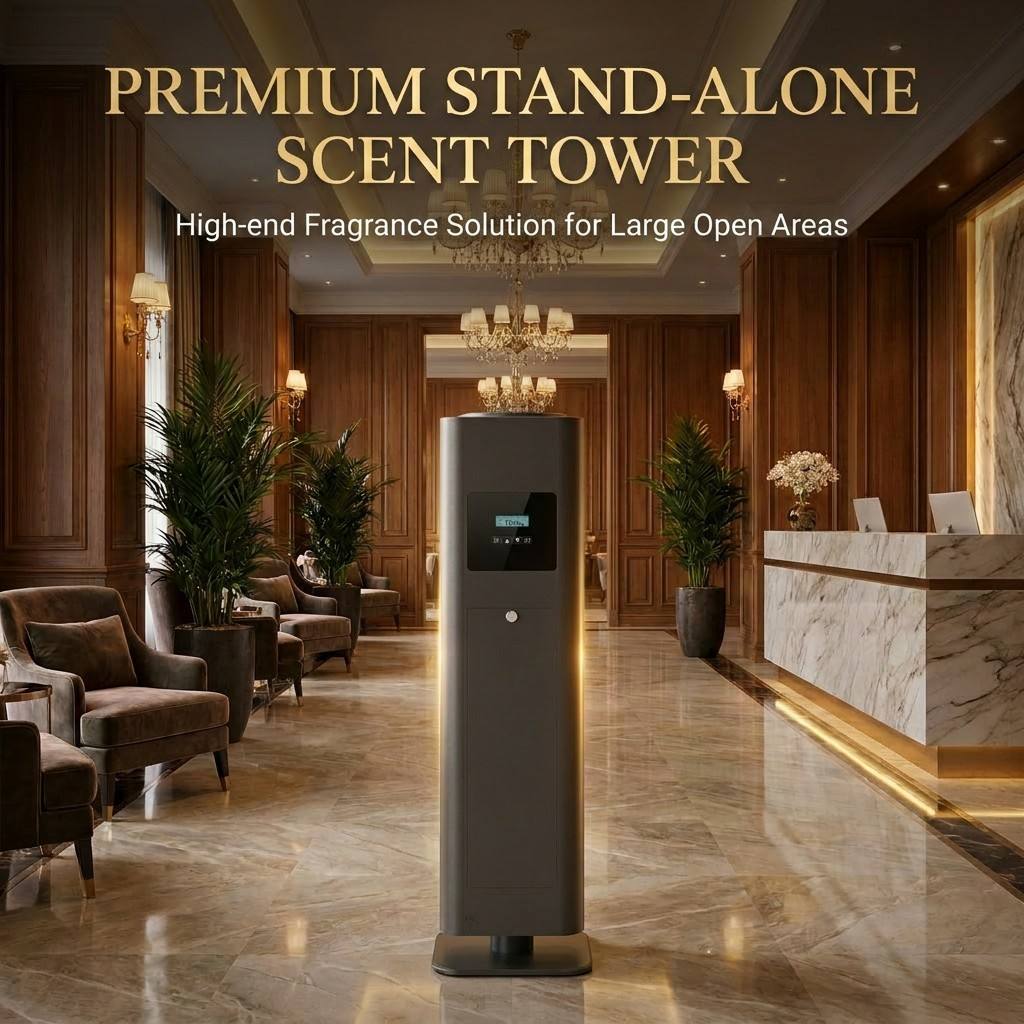
The H5000 is a floor-standing commercial scent diffuser with a 1,000 ml fragrance oil capacity, a coverage rating of 800-1,300 m2 (2,500-4,000 m3 or 8,600-14,000 ft2), and a 20 W plug-in power supply at DC 12 V. It measures L180 x W180 x H610 mm at a net weight of 6.4 kg and a gross weight of 7.1 kg, packed at L190 x W190 x H700 mm. Consumption is rated at 5.4 plus or minus 10 percent ml per hour, and operating noise is below 45 dB.
The dimensional detail that matters most to a property manager is the 610 mm height combined with the compact 180 x 180 mm footprint. The unit diffuses from floor level inside the room rather than from a ceiling duct, so it does not require wall installation and can be positioned after the fit-out programme is largely complete. Its aluminium housing and gunmetal finish are specified for hotel lobbies, shopping malls, showrooms, reception halls and large public areas.
Because the machine holds a full litre of oil, the refill interval is long relative to smaller units, and the hourly output is set for a large open volume. Working schedules and fragrance intensity are managed through smart APP control, which allows running hours to be matched to trading hours or check-in peaks rather than running continuously.
The constraint to plan for is simple: this unit needs floor space and a power outlet. It is not a wall-mounted or duct-integrated device, and its coverage rating assumes an open volume. In a heavily partitioned atrium, more than one unit, or a ducted approach, may be the more realistic route.
P01: Battery Operation for Toilets and Elevators
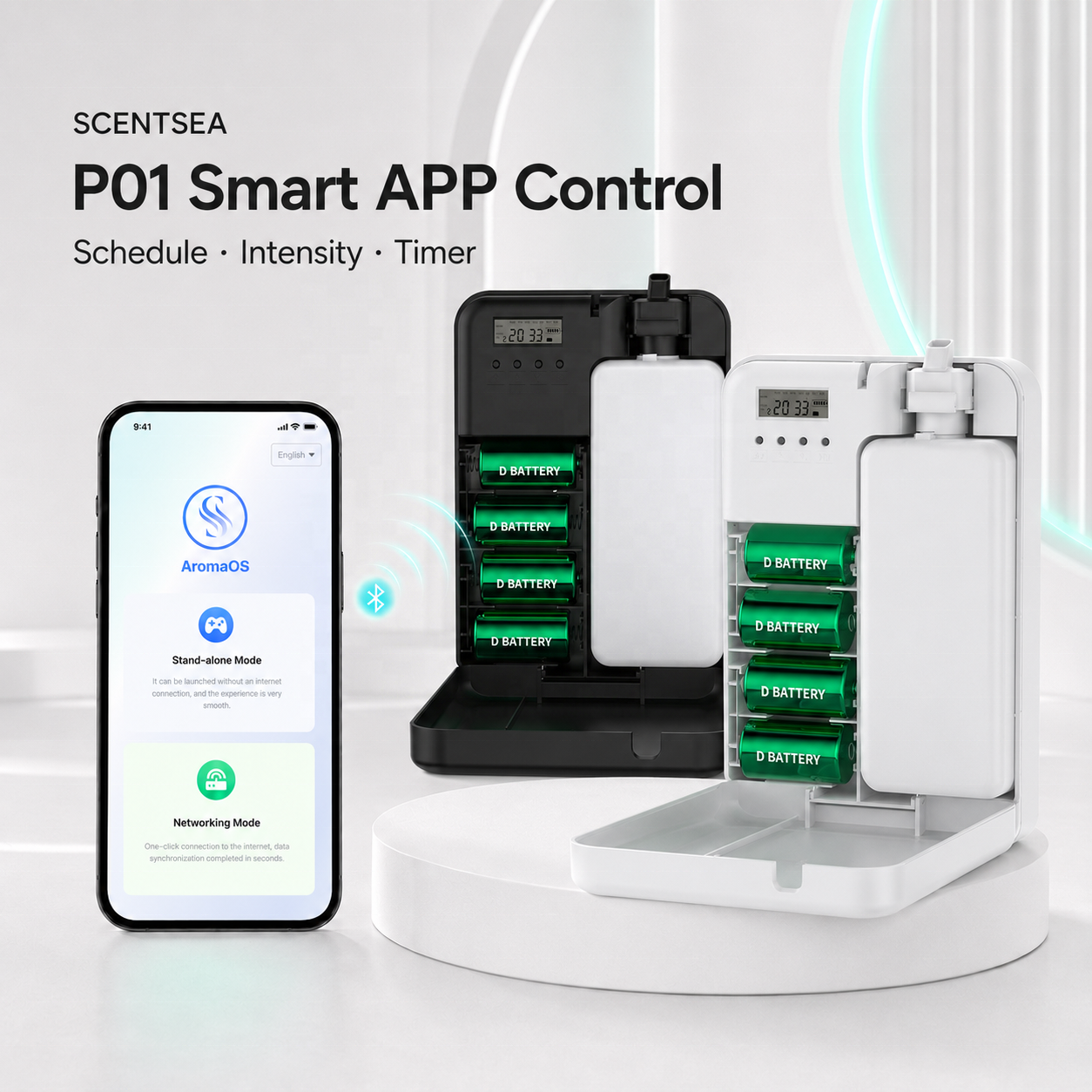
The P01 is a battery-operated scent diffuser with a 500 ml oil capacity and a coverage rating of 100-150 m2 (300-500 m3 or 1,000-1,600 ft2). It runs on 4 pcs D batteries or an optional Type-C supply at 2.5 W, with noise below 35 dB. Net weight is 0.55 kg and gross weight is 0.8 kg, with a product size of H168 x L240 x W50 mm and a packing size of L280 x W83 x H200 mm. It is supplied in white and black.
The design logic here is not coverage but access. Toilets and lift cars are exactly the spaces where power outlets are unavailable or inconvenient, and where running new cabling is disproportionate to the benefit. Cordless installation removes that barrier, and waterless cold-air diffusion means there is no water tank to fill or clean. Fragrance schedules and intensity are set through the AromaOS APP, and the front cover is lockable, which addresses the practical risk of tampering in public washrooms.
Read alongside the other two models, the P01's boundary is clear. At 100-150 m2 it is a small-space device; it is not a lobby solution, and the 500 ml bottle reflects that narrower duty cycle. Buyers should also treat battery replacement as a scheduled maintenance line item, not an afterthought, and confirm expected battery life under their intended daily running hours.
P02: Wall-Mounted Coverage for 150-350 m2 Retail
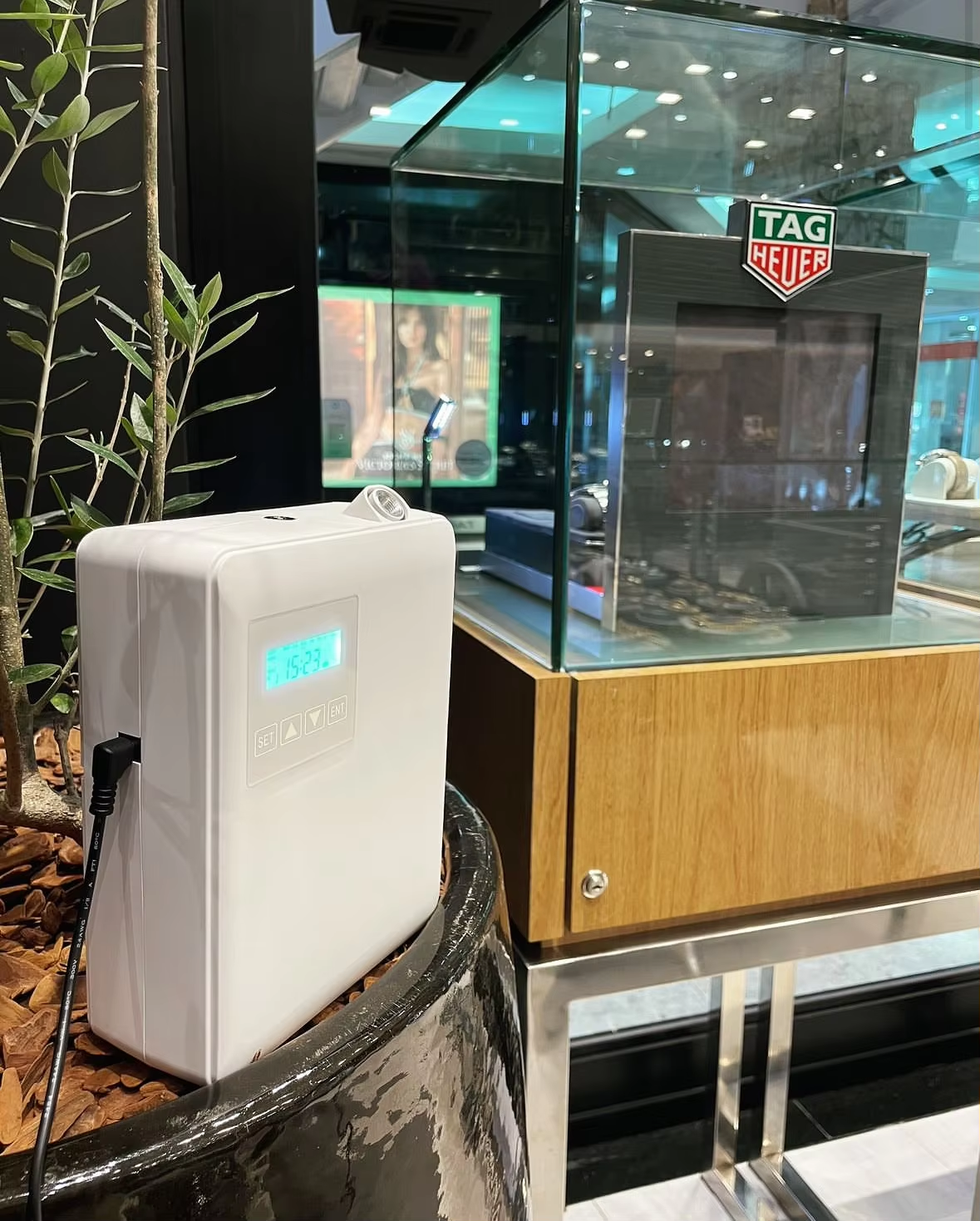
The P02 is a wall-mounted electric scent diffuser rated for 150-350 m2 (500-1,000 m3 or 1,500-3,500 ft2), with a 300 ml oil capacity, DC 12 V plug-in power at 6.5 W, and oil consumption of 2.5 plus or minus 10 percent ml per hour. Noise is below 30 dB. Net weight is 0.8 kg and gross weight is 1 kg, with a product size of L148 x W68 x H203.5 mm and a packing size of L276 x W176 x H98 mm. It is available in white and black, with colour customization available.
Two features align this model with mid-sized retail. The first is the sub-30 dB noise rating, the quietest of the three units discussed here, which matters in shops where fitting rooms, counters and quiet corners sit close to the wall position. The second is the built-in fan, which improves fragrance distribution across a shallow sales floor rather than relying purely on passive drift.
Control is through Bluetooth APP with schedules and intensity adjustment, and an optional Wi-Fi plus Bluetooth version supports remote management. The unit reconnects automatically after a power or network interruption, which reduces the frequency of on-site resets. For shops with existing ductwork, an optional connector and tube allow HVAC integration, so the same unit can operate either as a standalone wall diffuser or as a feed into the duct system.
That HVAC option is a configuration decision rather than a default. Buyers should confirm duct access and the required connector before specifying the unit, and should note that the 300 ml capacity will require more frequent refills than the 1,000 ml floor-standing unit in high-duty retail cycles. The housing is plastic, which suits a wall-mounted indoor application but is not the aluminium construction used on the H5000.
How Cold-Air Atomization Interacts with Form Factor
Cold-air nebulizing diffusion atomizes fragrance oil into sub-micron particles below 2.5 micrometres without heat or water, according to published technical guidance from SCENTA. Because the oil is neither diluted in water nor heated, the machine's job is to move oil and air only, and the fragrance particles then travel with the room's existing air movement.
That is why placement and form matter as much as output. A floor-standing unit dispersing from 610 mm has a different distribution path from a wall unit mounted at counter height, and both depend on the room's ventilation pattern to carry the scent into corners. The practical implication for buyers is that two identical units placed in two different rooms will not produce identical results, and that a sample test in the actual space is more informative than a coverage figure on a specification sheet.
The specified consumption rates reflect that scale difference: the H5000 is rated at 5.4 plus or minus 10 percent ml per hour against the P02's 2.5 plus or minus 10 percent ml per hour, consistent with a coverage rating several times larger. Noise follows a similar logic across the range, from below 30 dB on the P02 to below 35 dB on the P01 and below 45 dB on the H5000, which maps onto venue sensitivity: washrooms, lift cars and retail floors tolerate very little mechanical noise, while a large lobby has more ambient sound to mask it.
Constraints to Verify Before Ordering
For a procurement-stage decision, the following items should be confirmed in writing rather than assumed from a product page.
Certification and compliance documentation
The SCENTSEA diffuser range is certified to CE, RoHS and FCC. Documented evidence in the portfolio includes RoHS certification under RoHS Directive (EU) 2015/863 with certificate number ATL20240416327 for the EU market, EMC certification under EN IEC 55014-1:2021 with certificate number ATL20240416325, and FCC certification under FCC Part 15 Subpart B:2023 with certificate number ATL20240416326 for the US market. All three were issued by Shenzhen ATL Testing Technology Co., Ltd. Because certification requirements depend on destination market, model and wireless configuration, buyers should confirm that certificates and test reports correspond to the exact production model and configuration being purchased, and check whether Bluetooth or Wi-Fi versions trigger additional radio requirements such as RED in the European Union.
Electrical and installation configuration
The H5000 and P02 are DC 12 V plug-in units; the P01 is a 5 V device powered by 4 pcs D batteries or Type-C. Plug type is offered as an OEM/ODM customization item alongside logo, colour, packaging, user manual, APP interface and selected PCB functions, so the electrical configuration can be aligned with the destination market at the ordering stage.
Landed cost and trade classification
Commercial scent diffusers are classified under HS Code 8509.80 (electromechanical domestic appliances), which carries a 4.2 percent US import duty. For projects delivered into the United States, that rate is a landed-cost input worth confirming with the freight forwarder before pricing a multi-unit rollout.
Production capacity, lead time and quality control
SCENTSEA operates a 3,000 m2 manufacturing facility with approximately 30 staff and an annual production capacity of 100,000 units, a monthly capacity of 8,000 units, and a typical lead time of 25-35 days. Minimum order quantity starts from 1 unit for diffusers. Every diffuser is checked before shipment through functional testing, atomization testing, leakage inspection, noise testing, APP and control testing, a 48-hour aging test, and final appearance inspection. After-sales support includes a 1-year free warranty on spare parts.
Where These Three Models Do Not Fit
A venue-matched recommendation is only useful if its limits are stated as clearly as its fits.
- None of the three is a building-scale HVAC scenting system. For centralised scenting distributed through existing ductwork across 2,500-3,500 m2, the appropriate unit is a dedicated HVAC diffuser such as the 5 L, split-type AC-MAX, which separates machine and oil tank and connects directly to central HVAC ducts.
- The H5000 is not wall-mountable or duct-integrated. It requires floor area and a plug point, and its 800-1,300 m2 rating assumes an open, unobstructed volume. Partitioned or multi-level spaces may require additional units or a different approach.
- The P01 trades coverage for installation freedom. Its 100-150 m2 rating and 500 ml capacity are sized for washrooms, elevators and corridors; with 4 pcs D batteries it introduces a replacement routine that should be scheduled.
- The P02 depends on a power source and, for duct use, an optional accessory. HVAC integration requires the optional connector and tube, and the 300 ml bottle implies shorter refill intervals than the 1,000 ml floor unit under continuous retail operation.
- Coverage ratings are ratings, not guarantees. Ceiling height, ventilation, airflow and partitions change real-world results, which is why sample testing and staged rollout are recommended before committing to a full installation.
Application Evidence: What a Venue-Matched Deployment Looks Like
One documented deployment involved a scent marketing company and scenting service provider in the United States that installed 30 units for commercial scenting in shopping malls to create a pleasant fragrance environment and enhance customer experience. The project has been running for five years, with reported results including stable and consistent scent coverage, reduced manual maintenance, improved fragrance management efficiency and an enhanced customer experience. The client highlighted strong atomization, stable operation, smart APP control, adjustable scent intensity, low maintenance requirements and ease of installation. These are client-reported outcomes from a single programme, and the scale of that project, 30 units across mall environments, also illustrates why form matching matters at portfolio level: a mall combines large lobbies, mid-sized tenant floors and washrooms, and a single diffuser type rarely serves all three well.
Market Trend: Scenting Hardware Is Being Specified by Venue
The commercial context supports venue-specific specification rather than one-size deployments. The global scent marketing market is valued at approximately USD 4.1 billion in 2026 according to Cognitive Market Research, and is projected to reach USD 7.28 billion by 2035 at a compound annual growth rate of 6.6 percent. A second source estimates growth at 10.16 percent under a narrower definition of scenting rather than scent marketing, which illustrates how sensitive such figures are to scope and methodology, and why buyers should treat market estimates as directional rather than as procurement inputs.
On the demand side, one secondary industry compilation reports that scenting in retail environments can increase customer dwell time by an average of about 15 minutes, a figure that should be read as indicative rather than as a guaranteed outcome for any single store. What is more useful for equipment planning is the operational pattern the market data reflects: as scenting moves from a single flagship installation to multi-venue rollout, procurement teams increasingly need units that fit the installation, not units that fit the brochure.
Compared with Traditional Scenting Approaches
The most common alternative to waterless cold-air diffusion is the ultrasonic water-based aroma diffuser. Waterless cold-air diffusers atomize fragrance oil without water, delivering stronger and more consistent diffusion, larger coverage, no water dilution and lower daily maintenance, which suits hotels, shopping malls, retail stores, offices, showrooms and spas. Ultrasonic water-based diffusers are more suited to small residential spaces and light personal fragrance use, with smaller coverage and more frequent water refilling and tank cleaning.
On cost, waterless cold-air diffusers typically carry a higher initial equipment cost but require no water refilling, less frequent cleaning and lower daily maintenance, whereas ultrasonic units have a lower purchase price with recurring refill and cleaning duties. Passive formats such as reed diffusers and manual sprays occupy the opposite end of the spectrum: negligible installation requirements but no scheduling, no intensity control and constant manual intervention, which is difficult to sustain across a portfolio of venues.
The honest boundary for the waterless approach is that it depends on compatible fragrance oil viscosity and formulation, and on stable power or, in the case of the P01, on a maintained battery supply. Buyers should test third-party oils before committing to volume, since viscosity and formulation affect atomization stability.
Future Outlook
Three directions are already visible in the hardware itself. First, control is moving from manual buttons to app-based scheduling, with Wi-Fi and Bluetooth remote management available on selected models and automatic reconnection after power or network interruptions. Second, wall-mounted units are becoming duct-aware: the P02's optional connector and tube means a small retail diffuser can feed existing ductwork without upgrading to a plant-scale HVAC scenting system. Third, documentation is becoming a procurement gate rather than an afterthought, with certification scope, model-level test reports and quality control procedures such as 48-hour aging testing increasingly requested before orders are placed.
For property and facilities managers, the practical consequence is that diffuser selection is becoming a zoning exercise. Large open lobbies, compact public facilities such as washrooms and elevators, and mid-sized retail floors each have a natural hardware form, and the portfolio conversation is about how those forms are combined and controlled together rather than about finding a single universal unit.
FAQ
How do I choose the right commercial scent diffuser for different space sizes?
Selection should be based on actual space size, ceiling height, airflow, installation conditions and control requirements rather than on maximum rated coverage alone. Compact models suit small rooms, battery-powered models are better where wiring is inconvenient, higher-output standalone machines are recommended for medium and large commercial spaces, and HVAC scenting systems are preferred for large buildings requiring centralised distribution. In the three-model comparison used here, the H5000 covers 800-1,300 m2, the P02 covers 150-350 m2, and the P01 covers 100-150 m2.
Do commercial scent diffusers require water?
Waterless cold-air scent diffusers atomize fragrance oil directly into fine particles and do not require water. The atomization system uses controlled airflow and pressure to convert fragrance oil into fine airborne particles, which are then dispersed into the air or through an HVAC system. This differs from ultrasonic water-based aroma diffusers, which mix oil with water in a tank and require regular refilling and cleaning.
What certifications apply to commercial scent diffusers, and what should buyers verify?
Requirements depend on the destination market, product model and wireless functions. For the European market, buyers should normally check applicable CE and RoHS compliance documents, and Bluetooth or Wi-Fi models may also need to meet RED requirements. For the United States, applicable FCC compliance should be verified. Documented examples in this portfolio include RoHS under Directive (EU) 2015/863 (certificate ATL20240416327), EMC under EN IEC 55014-1:2021 (certificate ATL20240416325) and FCC Part 15 Subpart B:2023 (certificate ATL20240416326), all issued by Shenzhen ATL Testing Technology Co., Ltd. Buyers should always confirm that certificates and test reports apply to the exact production model and configuration being purchased.
Can wall-mounted scent diffusers be connected to an HVAC system?
Some wall-mounted models can. The P02 offers an optional connector and tube for HVAC integration, allowing the unit to operate either as a standalone wall diffuser or as a feed into existing ductwork, which suits retail floors in the 150-350 m2 range. This is a configuration option rather than a default, so duct access and the required connector should be confirmed before ordering. Centralised scenting across a large building, for example 2,500-3,500 m2, is normally handled by a dedicated HVAC scent diffuser such as the split-type AC-MAX rather than by a wall unit.
How much maintenance do these scent diffusers require?
Maintenance frequency depends on usage and fragrance oil, but regular oil-level checks and atomizer cleaning help maintain stable performance. Oil capacity and hourly consumption are the two figures that determine refill intervals: the H5000 holds 1,000 ml and consumes 5.4 plus or minus 10 percent ml per hour, the P02 holds 300 ml and consumes 2.5 plus or minus 10 percent ml per hour, and the P01 holds 500 ml with cordless battery operation that also requires periodic battery replacement. Common troubleshooting issues such as weak atomization or abnormal noise are usually traced to power supply, schedule settings, pump connections, blocked nozzles, tubing condition or fragrance oil viscosity before any component replacement is considered.
How noisy are commercial scent diffusers in guest-facing areas?
Noise levels vary by model and output power. In this comparison, the P02 is rated below 30 dB, the P01 below 35 dB and the H5000 below 45 dB. For hotels, retail floors, offices and other quiet environments, buyers should check model-specific noise data and test samples in the actual space rather than assuming a uniform level across a product family.
What should buyers consider when purchasing commercial scent diffusers in volume?
Beyond the unit specification, bulk purchasing should weigh the supplier's quality control, certifications, production capability, warranty, spare parts support and delivery reliability, with sample testing before mass production. Relevant parameters include coverage area, airflow conditions, atomization performance, oil capacity, noise level, installation method, power supply, APP or Wi-Fi control, certifications, warranty and lead time. SCENTSEA's production data includes a 3,000 m2 facility, approximately 30 staff, an annual capacity of 100,000 units and a monthly capacity of 8,000 units, a typical lead time of 25-35 days, a minimum order quantity from 1 unit, OEM/ODM customization of logo, colour, packaging, user manual, plug type, APP interface and selected product functions, and a 1-year free warranty on spare parts.